
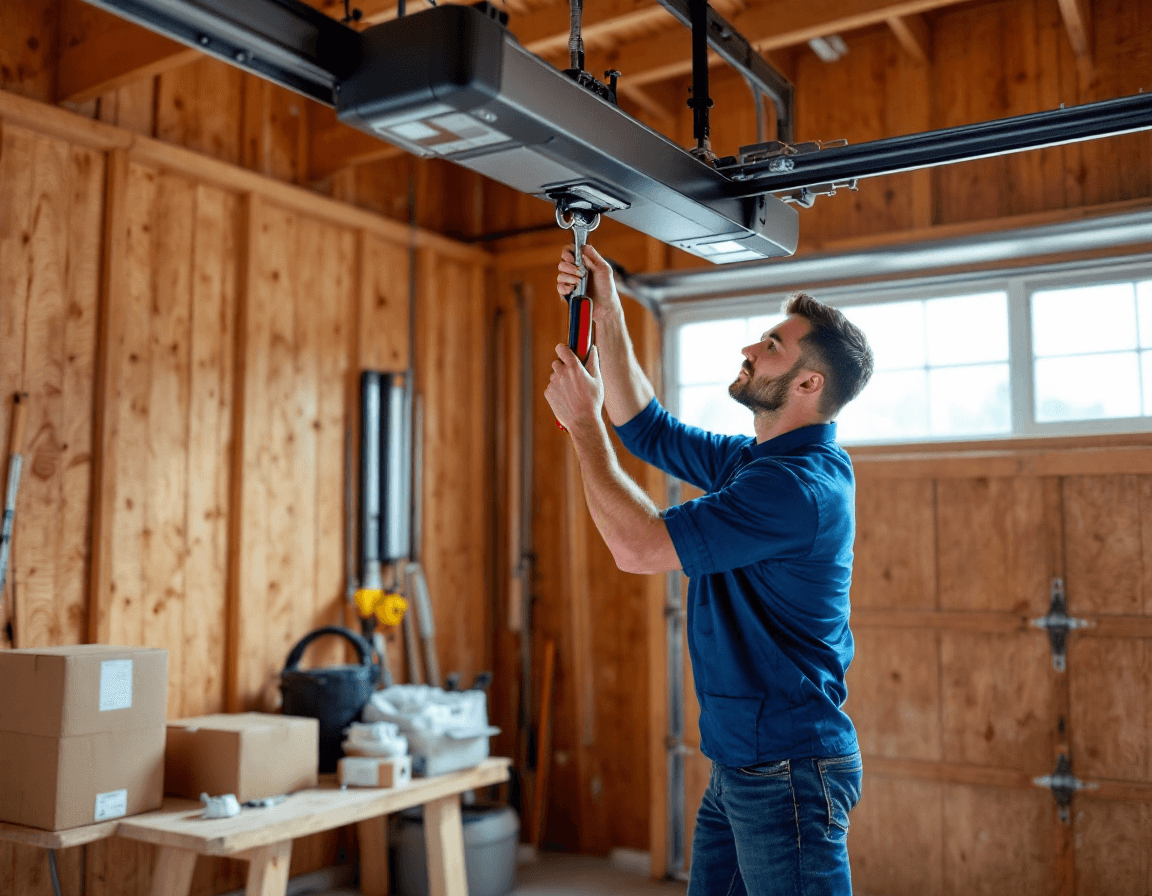
Garage Door Opener Installation & Replacement in Black Diamond, WA is one of the most practical upgrades a homeowner can make, and it's often overlooked until the old unit stops responding on a rainy Tuesday night. Many households here have been running the same opener since the house was built, whether that's an older place near the historic town center or a newer home in one of the developments closer to Lake Sawyer. Over time, motors weaken, gears wear, and safety features fall out of step with what modern homes expect. Our team installs and replaces belt-drive, chain-drive, and wall-mount openers throughout Black Diamond and the surrounding Covington-Maple Valley corridor, and this page explains how to tell when it's time to act and what the process looks like.
Black Diamond sits in the foothills southeast of Seattle, where the air stays cool and damp for much of the year and the ground often holds moisture well into spring. Garage door hardware here faces a steady routine of wet winters, morning fog off the lakes, and the occasional windstorm that knocks out power for hours at a time. Those conditions are hard on electronics, wiring connections, and the metal rails and brackets that an opener relies on every day. A well-chosen replacement can handle that environment, but only if it's sized correctly, mounted solidly, and paired with the right accessories for your particular door and driveway.
Whether you're replacing a unit that has quit or upgrading one that still limps along, the goal is the same: a reliable, safe opener that matches how you actually use your garage. This guide walks through the warning signs, the drive types available, the security and smart-home options, battery backup, pricing, and what happens on installation day. It also covers the safety checks we perform and the parts of a garage door system that should always be handled by a licensed professional. Read it straight through or jump to the section that fits your situation.
Reading the Signs Your Opener Is Wearing Out
Most openers don't fail all at once. They give you a series of hints over weeks or months, and recognizing those hints early can save you from being stuck outside on a cold morning. A unit that starts out quiet and smooth but grows noisy with grinding, clicking, or rattling is often telling you that the gears, trolley, or mounting hardware are loosening. Slow travel is another common symptom, especially when the door seems to hesitate at the top or bottom of its path. If you notice the motor straining, humming without moving the door, or reversing for no clear reason, it's worth having the system looked at before a small problem becomes a dead opener.
Reliability problems tend to show up in the remote and keypad behavior. Remotes that work only when you stand in one spot, or that need several presses before the door responds, usually point to a weakening receiver, a failing antenna wire, or interference from nearby electronics. Some owners find that the light on the opener flickers or the unit resets itself after a storm, which can suggest a power surge or a deteriorating circuit board. Over the years, many older units also lose their ability to tolerate the small shifts in door balance that come with seasonal temperature changes in the foothills. When the opener is working harder to compensate, its lifespan shortens noticeably.
Age matters too, even when a unit still seems to function. Openers from before the mid-1990s were built around simpler security and mechanical standards than what homeowners expect today, and parts for very old models can be difficult to source. If your opener predates your current safety reversal sensors or lacks a modern light and motor design, a replacement will typically cost less than a series of repairs on a unit that is nearing the end of its useful life. A technician can inspect the motor, logic board, rail, and trolley and give you a clear picture of whether repair or replacement makes more sense.
Belt, Chain, or Wall-Mount: Matching a Drive to Your Garage
The drive style is the part of the opener that moves the trolley along the rail, and choosing the right one affects noise, durability, and how much ceiling space you'll need. Belt-drive openers use a reinforced rubber belt instead of a metal chain, which makes them noticeably quieter during operation. That quiet running is a strong reason many Black Diamond homeowners pick belt-drive, particularly when the garage shares a wall with a bedroom, a home office, or a neighbor's yard on a smaller lot. Belts also tend to be easier on the rest of the system because they don't stretch the way chains can over time.
Chain-drive openers remain a sound choice when strength and affordability are the priority. They handle heavier doors, including thicker insulated models and some wood carriage-style doors, with plenty of pulling power. Chain units are louder, so they usually sit best in a detached garage or a space where noise doesn't travel into living areas. Maintenance is simple but important: a chain that is not lubricated and kept at the right tension can rattle, skip, or wear unevenly, so periodic checks matter more than with a belt.
Wall-mount openers attach the motor to the side wall of the garage instead of the ceiling. This design is valuable when the ceiling is low, when there are ceiling joists or storage shelves in the way, or when the garage has a sloped roof that makes ceiling mounting awkward. Wall-mount units also keep the motor away from heat and moisture that can collect near the roofline, which is a practical advantage in a climate where condensation is common in the colder months. Our technicians measure the space, check the door's track configuration, and recommend the drive type that fits your garage rather than defaulting to the same option for every job.
Why Rolling-Code Security Matters on an Older Unit
Rolling-code technology changes the signal your remote sends every time you press the button, so a thief who records one transmission can't simply replay it to open your door. Older openers often use fixed-code receivers, where the same signal works again and again. That design made early openers convenient, but it also made them vulnerable to simple signal-capture devices that can be purchased online. For a home where the garage door is often the main entrance for family members, deliveries, and yard equipment, that vulnerability is worth taking seriously.
Replacing an older fixed-code unit with a rolling-code opener closes that gap without changing how you use the door day to day. The new system pairs with your remotes, wall keypad, and any smartphone access you choose to enable, and it generates a fresh code for each use. We typically recommend clearing old remotes during installation so that any device you no longer control can't continue to open the door. It's a small step, but it's one many people forget when they upgrade.
Security isn't only about the remote. A complete installation also involves checking the manual release cord, the keypad location, and the reversal sensors that stop the door if something passes beneath it. Many older systems have sensors that were never aligned properly, or they were removed during a previous repair. Our technicians confirm the sensors are working and mounted at the correct height, which is typically about six inches above the floor, so the door reverses reliably when an obstacle is detected.
Wi-Fi and myQ Control Without Surprises
Smart openers add the ability to open, close, and monitor your garage from a phone, and many Black Diamond households find that feature useful for everything from letting a contractor in during a workday to confirming the door closed after leaving for a weekend trip. Most modern units communicate through a Wi-Fi connection and work with a companion app or with platforms such as myQ. The convenience is real, but it depends on a stable network and sensible setup, so it helps to think through a few details before committing to a smart model.
Wi-Fi signal strength is the first consideration. Garages are often farther from the router than the main living space, and in larger properties or homes with thick framing, the signal may be weak at the door. Before installation we check the connection from the planned opener location, and if the signal is marginal, we can recommend a range extender or a mesh node placed closer to the garage. Waiting until after installation to discover a dropped connection is a frustrating way to learn about your network.
Smart features also require careful account management. Each person who uses the app should have their own login, and the homeowner should understand how to revoke access when a family member moves out or a service provider no longer needs it. We walk through the notification settings during setup so you can decide whether you want alerts when the door opens at unusual hours or when it's left open for a set period. Smart control is most useful when you know exactly what it does and how to manage it.
Battery Backup and Those Winter Outages Up the Valley
Power outages are part of life in the foothills. Winter windstorms can bring down lines and leave neighborhoods without electricity for a few hours or, occasionally, longer. When that happens, a standard opener won't run, and a garage door that is closed can become a barrier to getting a vehicle out. Battery backup accessories are designed to bridge that gap by providing enough power for the opener to operate the door a limited number of times during an outage. They are a practical addition for households that rely on the garage for daily access.
Backup systems vary in capacity, charge time, and how many cycles they can support before recharging. Some are sized for occasional use, while others are better suited to homes with frequent evening or early-morning trips. Batteries also need periodic attention, since they lose capacity over time and may need replacement every several years depending on use and temperature. In a climate where garages can get cold and damp, we recommend mounting the battery in a location that stays as dry and stable as possible, and we confirm that the charging circuit is working during installation.
It's important to set expectations clearly. A battery backup is not a generator, and it won't keep the entire house running. Its job is to let you open or close the garage door when the grid is down so you can get in or out. If you already have a whole-home or portable generator, the opener's backup and the generator can work together, but that depends on your specific setup. We're happy to discuss how a backup unit fits with what you already have.
Installation Day: What Happens Between Arrival and Test Run
A well-run installation is straightforward when everything is planned, and most homeowners are surprised by how orderly the process feels. The technician arrives, introduces themselves, and reviews the work with you before touching any equipment. That conversation covers the opener you chose, the drive type, any smart features, the location of your remotes and keypad, and whether you want battery backup. It's also a good time to point out any quirks you've noticed about the door, such as a spot where it sticks or a sound you don't like.
Once the plan is confirmed, the technician removes the old opener, inspects the mounting points, and checks the door's condition. The new unit is then assembled, mounted, and connected to power, followed by the rail, trolley, and arm adjustments that allow the door to move smoothly. Sensors are aligned, the travel limits are set, and the force settings are tested so the door reverses correctly if it meets resistance. Smart features are configured, remotes are programmed, and old remotes are cleared if you want them removed from the system.
The final stage is testing and walkthrough. The technician runs the door through multiple full cycles, checks the reversal behavior, and confirms that the manual release works. You'll be shown how to use the app, how to change remote codes, and how to operate the emergency release safely. Before leaving, the technician should answer any questions and explain what to watch for in the coming weeks. A good installation ends with a door you trust and an opener you understand.
- Confirm the opener model, drive type, and any smart or backup accessories before work begins.
- Inspect the door, springs, cables, and mounting points for signs of wear that need attention from a licensed professional.
- Install the unit, adjust travel limits and force settings, and align the safety reversal sensors.
- Program remotes and keypads, clear any outdated codes, and set up app access for approved users.
- Run multiple test cycles, verify the manual release, and review the owner walkthrough before closing the job.
Pricing Between $275 and $650: What Moves the Number
Our installed price for opener replacement generally falls between $275 and $650, and the final figure depends largely on the model you choose. Entry-level chain-drive units cost less than premium belt-drive or wall-mount models with advanced smart features, and battery backup adds to the total when selected. The condition of your existing hardware can also affect the price, since a worn rail, bracket, or mounting point may need to be addressed as part of a sound installation. We give you a clear quote after reviewing your garage, so you know what is included before work begins.
Several factors influence where a job lands within that range. Door type and weight matter, because heavier insulated doors may call for a stronger motor. The distance from the ceiling to the top of the door, the presence of low headroom, and whether the opener needs a wall-mount bracket instead of ceiling hardware can all change the scope. If your garage requires new wiring for an outlet or a dedicated circuit, that is a separate electrical task that should be handled by a licensed electrician, and we'll tell you if it's needed.
We aim to avoid surprises. Before you agree to any upgrade, we explain what it adds and whether it is necessary for your situation. A basic reliable opener may be the right choice for a homeowner who uses the garage occasionally, while a family that relies on the door every day may benefit from belt-drive quiet and backup power. The best value is the option that matches how you use the garage, not necessarily the most expensive model on the shelf.
Repair or Replace? A Practical Look at Cost Thresholds
Deciding whether to repair an opener or replace it is one of the most common questions we hear. A repair can be the smart move when the unit is relatively new, the motor runs well, and the problem is isolated, such as a worn remote battery, a misaligned sensor, or a loose connection. Replacement often makes more sense when the problem involves multiple components, when parts are hard to find, or when the opener is old enough that another expensive failure is likely soon. A technician who explains both options honestly will help you avoid throwing money at a unit that is nearing the end of its life.
Several signs point toward replacement rather than repair. If the motor overheats, produces a burning smell, or fails repeatedly after repairs, the cost of continued fixes can quickly exceed the price of a new unit. An opener that lacks rolling-code security, cannot be paired with modern safety sensors, or offers no path to smart control may also be worth replacing for peace of mind. Units that have been damaged by moisture or repeated power surges often show intermittent failures that are difficult and costly to diagnose.
- Repair may be reasonable if the opener is newer, the motor runs smoothly, and the issue is limited to a remote, sensor, or simple connection.
- Replacement is often the better choice if the logic board or motor has failed more than once, or if parts are no longer available.
- Replacement is usually worth considering if the unit lacks rolling-code security or modern safety reversal features.
- Replacement may also make sense if you want quieter operation, smart access, or battery backup that the current opener cannot support.
Safety Checks We Never Skip, and Why Springs Stay With Pros
Garage doors are heavy, and the springs and cables that counterbalance them store a great deal of energy. That is why spring and cable work should always be left to a licensed, trained professional. A torsion spring or extension spring under tension can cause serious injury if it is handled improperly, and cable repairs require specific tools and knowledge of how the drum, cable, and spring interact. Homeowners should never attempt to adjust, remove, or replace these components, no matter how simple a video makes the job look.
Opener installation does involve safety checks that we perform on every job. The reversal sensors must be aligned and functioning, the force settings must be adjusted so the door reverses when it meets resistance, and the travel limits must be set so the door stops at the correct positions. The emergency release should be tested and labeled so everyone in the household knows how to use it. If the door is out of balance or the springs show visible wear, we stop and recommend corrective work by a licensed technician before the opener is installed.
We also encourage homeowners to keep children and pets clear of the door during operation and to avoid using the manual release while the door is closed and under load unless they understand the risk. The release is meant for power outages and emergencies, and it should be used carefully. Our technicians walk through these practices at the end of each installation so you can operate your new opener with confidence.
Caring for Your New Opener in a Damp Foothills Climate
A new opener will last longer when it's maintained with the local climate in mind. Black Diamond's damp winters and cool, humid springs can lead to rust on exposed brackets, moisture in outdoor-facing wiring, and sticky tracks when dirt and debris collect. A simple seasonal routine helps keep everything moving smoothly. Wiping down the rail, checking that bolts are snug, and watching for shifts in the door's movement can prevent small problems from becoming expensive ones.
Lubrication is an important part of that routine, but it should be done correctly. Use the type of lubricant recommended for the hinges, rollers, and track, and avoid spraying the motor or electrical components unless the manufacturer specifically calls for it. Chain-drive units need periodic checks for proper tension and lubrication, while belt-drive units benefit from occasional inspection of the belt for fraying or looseness. If you notice unusual noise, a change in travel speed, or a door that drifts, schedule a service visit instead of pushing the system harder.
Remote batteries and backup batteries also need attention. Replace remote batteries when the range begins to shrink, and check the backup battery on the schedule recommended for your model. In winter, when the garage may be colder, performance can change, so it's a good idea to test the backup and the remotes before a storm season arrives. A little preventive attention goes a long way toward keeping your opener dependable through wet Pacific Northwest seasons.
Scheduling Your Installation in Black Diamond and Nearby Neighborhoods
We serve Black Diamond and the surrounding communities across King County, including homes in the Ten Trails area and the neighborhoods that stretch toward Lake Sawyer. Whether your garage is attached to a newer home or sits as a detached building on a larger lot, we plan the visit around the details of your property. Access to the garage, the location of the electrical supply, and the condition of the door all shape how we prepare, so it helps to have a rough sense of what you want before we arrive. Tell us about any problems you've noticed, any features you're interested in, and any questions about pricing or timing.
Scheduling is simple. Call (888) 799-3819 to describe your opener, your door, and what you're hoping to accomplish. We'll confirm the drive type that fits your garage, discuss smart and battery backup options, and give you a clear estimate within the range that applies to your model. If you want a quieter belt-drive opener, a wall-mount unit for limited ceiling space, or a rolling-code system for better security, we can help you choose the right fit and schedule the installation at a time that works for your household.