
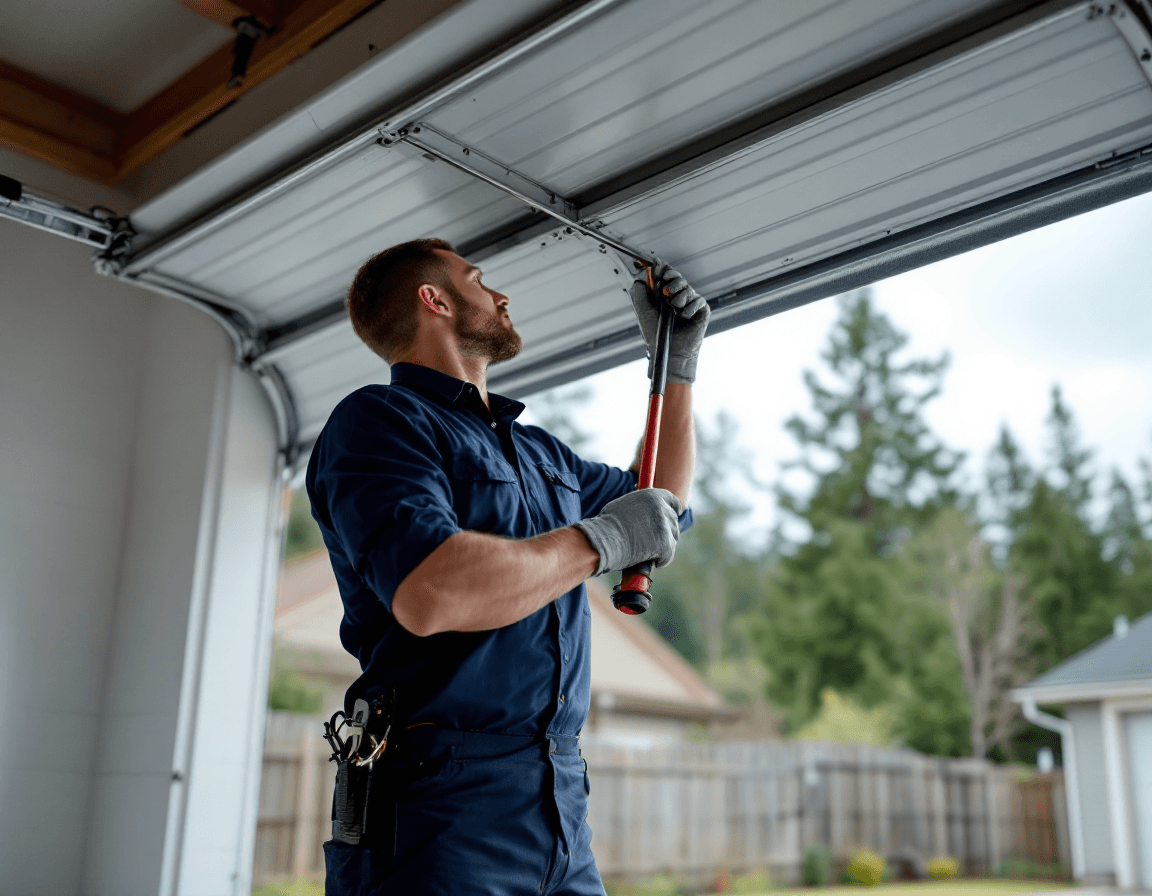
Garage Door Spring Replacement in Covington, WA is one of the most common repairs we handle for homeowners across the Covington Town Center area and the neighborhoods around Jenkins Creek. Springs carry the full weight of a heavy steel door, so when one fails, the door usually stops working altogether. Because springs store tension under very high load, a failed spring can make a loud noise, leave the door stuck halfway, or make the opener labor without lifting anything.
Covington homeowners tend to notice spring trouble at the worst possible moment, such as early on a school-day morning when the car needs to get out, or after a long weekend of heavy rain when the door suddenly refuses to rise. Most of these failures are not random. Springs age through thousands of open-and-close cycles, and the damp, temperature-swinging weather of the Pacific Northwest speeds up that wear. Understanding what is happening inside the door helps you decide whether to call for help today or schedule a planned repair.
This page explains the symptoms we see most often, why local conditions matter, how torsion and extension systems differ, what a typical spring replacement costs, and what safety steps you should follow before anyone touches the hardware. If you have a door that is stuck, misaligned, or making a sound you have never heard before, the information below will help you describe the problem clearly when you call (888) 799-3819.
Hearing the Bang: What a Snapped Spring Sounds Like
A broken garage door spring is hard to miss. Many homeowners describe a sharp, metallic crack, similar to a rifle shot or a heavy piece of steel dropping onto concrete, and it often seems to come from the inside of the garage even if the failure happened in the overhead track area. The sound is loud because the tension stored in the coil releases instantly, and the energy travels through the door panels and the frame. In some homes the noise is strong enough to rattle windows or wake people in bedrooms above the garage.
After the bang, you may see the door sitting lower than usual, or you may notice that it no longer responds when you press the remote. Some doors drop slightly when the spring lets go, while others remain in place but feel completely dead when lifted by hand. The door can also look crooked, with one side higher than the other, because the spring on that side released its tension while the opposite spring kept some of its load. These differences can make it tempting to try a quick fix, but a broken spring should be treated as a safety event rather than a minor inconvenience.
If you hear a bang and the door is still operating, do not assume the problem is solved. A snapped spring often leaves the door in an unbalanced state, and continued use can strain the opener, cables, and drum assembly. Keep people and pets away from the door, avoid standing under it, and do not attempt to lift it manually. Our technicians can inspect the broken pieces, identify which spring failed, and confirm whether the cables, drums, and bearings also need attention.
Why Covington Garages Wear Springs Faster Than You Might Expect
Springs are rated for a specific number of cycles, and every time the door goes up and down, the coil flexes and the metal fatigues slightly. In Covington, several local factors can shorten that lifespan. Long stretches of wet weather bring moisture into garages that may not be fully sealed from the outside, and that dampness encourages surface rust on the coils and the bearing plates they wind around. Rust does not always show up as visible flaking. It often works its way into the grooves of the coil, reducing the metal's ability to flex cleanly and making failure more sudden.
Temperature swings also matter. A cold snap that drops nighttime temperatures well below what most homeowners experience in July can stiffen the lubricant on the spring and make the door feel heavier in the morning. Warmer afternoons then thin that lubricant out again, and the constant expansion and contraction stresses the metal over time. Many Covington homes also have attached garages that share walls with heated living space, which can create condensation patterns that are easy to overlook until a spring starts to show rust spots.
Households near natural drainage corridors, including homes in the broader Jenkins Creek area, sometimes sit on shaded or lower-lying lots where moisture lingers longer after rain. We cannot diagnose a specific property from the street, but when we inspect a garage in damp, shaded conditions, we typically look more closely at the spring coils, the lubrication condition, and the door seals. Wherever you live in Covington, the practical takeaway is the same: a spring that has been exposed to a decade of Pacific Northwest weather deserves a careful inspection before it fails.
Torsion Versus Extension: Knowing Which System Hangs Over Your Car
Before discussing repair options, it helps to know which spring system your door uses. Torsion springs are mounted on a steel shaft directly above the door opening. They wind and unwind to lift the door, and they are generally the most common setup on modern residential doors. A visible gap in the coil, a broken winding cone, or a shaft that has begun to slip are all signs that a torsion spring has failed or is close to failing.
Extension springs run along the horizontal tracks on either side of the door, usually closer to the ceiling. They stretch and contract as the door moves, and they are often found on older garage doors or on smaller doors that were built with simpler hardware. Extension springs typically have safety cables running through their centers, which are designed to keep the spring contained if it breaks. Even so, a broken extension spring can still release energy, and the cables themselves can become a hazard if they are damaged or misrouted.
Identifying the correct system matters because the replacement procedure is different for each. A torsion spring job requires careful handling of high tension and precise balancing, while an extension spring job focuses on the length, wire gauge, and cable configuration. Some Covington homes have been retrofitted over the years, so a door may use a combination of hardware that does not match the original installation. An accurate inspection will confirm the exact configuration before any parts are ordered, which helps avoid mismatched springs that wear unevenly or fail again within a short period.
Reading the Warning Signs Before the Spring Lets Go
Most spring failures give some warning. The most useful early sign is a visible gap in the torsion spring coil, where one section of the wire has pulled apart and left open space between adjacent windings. This is a strong indication that the spring has lost much of its load-bearing capacity and is likely to fail soon. Another common sign is rust or flaking metal along the coil, especially at the points where the spring meets the center bracket.
Other symptoms are less obvious but equally important. Many homeowners notice that their door opens a few inches and then stops, often with the opener still running. This usually means the springs are no longer providing enough lift to carry the door's weight through its full travel. A door that feels extremely heavy when lifted by hand, or one that closes too fast and slams onto the floor, can point to uneven spring tension or a spring that has partially failed. Listen for groaning or popping as the door moves, since these sounds sometimes signal stress in the hardware before a complete break occurs.
Here are the warning signs we recommend taking seriously:
- A visible gap or separation in a torsion spring coil
- The door stopping a few inches above the ground while the opener continues to run
- A door that is extremely heavy to lift by hand or noticeably harder to open than it was last season
- Rust, flaking, or dark staining along the spring coils or their mounting hardware
- A door that closes too quickly, hits the floor hard, or sits crooked in its track
If you notice any of these signs, schedule an inspection promptly. A small problem caught early can often be handled with a planned replacement rather than an emergency call after the spring has already broken.
When the Opener Hums but the Door Barely Moves
A familiar frustration for many Covington homeowners is an opener that hums, strains, or clicks while the door hardly lifts at all. It is natural to assume the opener itself has failed, and sometimes that is true. However, in many cases the opener is working exactly as designed and is simply trying to lift a door that has lost its spring support. Modern openers are built to handle a certain amount of extra load, but they are not designed to replace the springs. When the springs are no longer doing their share, the opener draws excessive current, overheats, and may eventually trip its safety features.
Repeatedly forcing a door with a failed spring can damage the opener's drive system, strip gears, and wear out the trolley. It can also stress the door's panels, hinges, and track brackets. For that reason, we advise homeowners to stop running the opener when the door is struggling and to call for service rather than repeatedly pressing the wall button. A single attempt to see whether the door will move is one thing, but continued cycling under a broken spring can turn an affordable spring replacement into a larger repair.
Our technicians typically test the opener's current draw, check the travel limits, and inspect the spring condition before recommending any changes to the opener. This sequence helps determine whether the opener needs adjustment, whether a new spring is required, or whether both should be addressed in one visit. Covering the full picture up front prevents unnecessary parts from being installed and keeps the job focused on what the door actually needs.
Loose Cables and Crooked Travel: The Hidden Damage After a Break
When a spring breaks, the cables that run from the drums to the bottom bracket can be affected in several ways. The sudden release of tension may cause a cable to jump off its drum, become tangled, or fray where it contacts the drum groove. Once a cable has come loose, the door may hang unevenly, with one side higher than the other. Some doors also show a slight tilt in the track, a rubbing sound along one side, or a gap at the top of the door where the panels no longer line up.
Cable damage is one of the reasons we never recommend simply replacing a broken spring and calling the job finished. The cables, drums, and their attachment points must be inspected and, if necessary, reseated or replaced so the door lifts evenly. A cable that is frayed or stretched will eventually fail, and when it does, it can allow the door to drop suddenly. Drum set screws can loosen over time as well, especially after a spring has broken and released its load unevenly.
Crooked travel also affects the door's rollers and track. When one side lifts faster or carries more load, the rollers on that side can wear unevenly, and the track may pull slightly out of alignment. A thorough repair includes checking the track, tightening mounting bolts, and confirming that both sides of the door move at the same pace. This level of attention protects the rest of the system and helps the new spring work the way it was intended.
Price Expectations: What a $180–$450 Spring Job Typically Covers
Most garage door spring replacements fall in the range of $180 to $450, depending on the spring type, the door's weight, the number of springs involved, and the amount of related work needed. A basic single-spring replacement on a standard residential door usually sits toward the lower end of that range, while a double-spring setup on a heavier or insulated door may move toward the higher end. Doors with additional damage, such as frayed cables or worn drums, may require extra parts and time, which can raise the final cost.
What the price usually covers is the replacement of the spring or springs, the proper balancing of the door, and a safety check of the surrounding hardware. A solid service visit also includes inspecting the cables, drums, bearings, and track, along with verifying that the opener's travel limits and force settings are correct. If additional components are needed, such as a new drum, bearing plate, or set of rollers, we discuss those options before proceeding so that you understand what is being replaced and why.
Homeowners often ask whether cheaper online spring kits can save money. A kit may look appealing, but the total cost of a DIY attempt can exceed the professional price once you add the tools, the risk of injury, and the chance of installing the wrong spring for your door's weight. Matching the correct wire size, inside diameter, length, and cycle rating is essential, and small mistakes can lead to a door that is either too heavy or too light to operate safely. Professional installation gives you a tested result and a clear accounting of the work performed.
High-Cycle Springs and Why Balance Matters More Than Brand
Many spring options are marketed as high-cycle, which generally means they are engineered to last through a greater number of open-and-close movements than a standard spring. For busy Covington households with frequent morning and evening trips, a high-cycle spring can be a worthwhile choice because it is designed to endure more repetition before fatigue sets in. These springs are often made from higher-grade steel and may include a protective coating that resists moisture better than basic finishes.
Still, a high-cycle spring will not perform well if the door is not properly balanced. Balance refers to how evenly the springs share the door's weight, and it has a direct effect on how the opener performs and how long the hardware lasts. A door that is out of balance may feel heavy on one side, rise unevenly, or slam closed when released. Balancing involves adjusting the spring tension so the door stays in place when partly open and moves smoothly through its full range. This is a precise task that requires knowledge of the door's weight and hardware geometry.
We recommend choosing a spring based on the door's actual weight, the frequency of use, and the environmental conditions in the garage, rather than focusing on brand names alone. A correctly sized, correctly balanced spring from a reputable source will usually outperform a mismatched spring of any brand. When our technicians recommend an upgrade, the reasoning will be tied to your door's specific needs, not a generic sales pitch.
Safety Rules Every Covington Homeowner Should Follow
Garage door springs store enormous energy, and that is why safety must come first. Torsion springs and extension springs can cause serious injury if they are mishandled, whether during removal, adjustment, or installation. Winding bars can slip, cables can snap, and a spring under tension can release with force. For this reason, spring replacement should be performed by a licensed, bonded, and insured professional who has the training and tools to do the job safely.
Homeowners can take several simple steps to reduce risk while waiting for service. The following guidelines are worth keeping in mind:
- Keep children, pets, and visitors clear of the garage door area until the repair is complete.
- Do not stand beneath a door that is partly open or hanging unevenly.
- Never attempt to wind, unwind, or adjust a spring with household tools or improvised bars.
- Avoid using the opener repeatedly when the door is stuck, since continued force can damage other parts.
- Disconnect the opener by pulling the emergency release cord only if the door is closed, and only if you understand how the release works.
These precautions help protect your household while you arrange a professional visit. They do not replace the need for expert repair, but they can prevent a frightening situation from becoming a serious injury.
Booking a Covington Visit: What Happens When We Arrive
When you contact us about a spring problem in Covington, the first step is a clear description of what you are seeing and hearing. Let us know whether you heard a bang, whether the door is stuck, whether the opener is straining, and whether you have noticed any gaps, rust, or crooked travel. This information helps our team prepare the right parts and allocate enough time for the visit, which keeps the appointment focused and efficient.
On arrival, our technician will inspect the door, springs, cables, drums, rollers, and track before discussing any repair recommendations. We will confirm the spring type, measure the door's weight where possible, and check whether the opener is operating within safe limits. If a spring replacement is needed, we will explain the options, including standard and high-cycle choices, and provide a clear price range based on the work involved. You will know what is being replaced before any work begins.
Once the repair is complete, the technician will test the door through multiple cycles to verify smooth operation, balanced lift, and proper closing. We will also review basic maintenance steps you can take, such as keeping the springs lubricated with the right product and checking the door monthly for signs of wear. For immediate help with a broken spring, a stuck door, or a loud bang in your garage, call Seattle Garage Door Fix at (888) 799-3819. Our team serves Covington and surrounding King County communities, and we are ready to restore your garage door safely and reliably.