
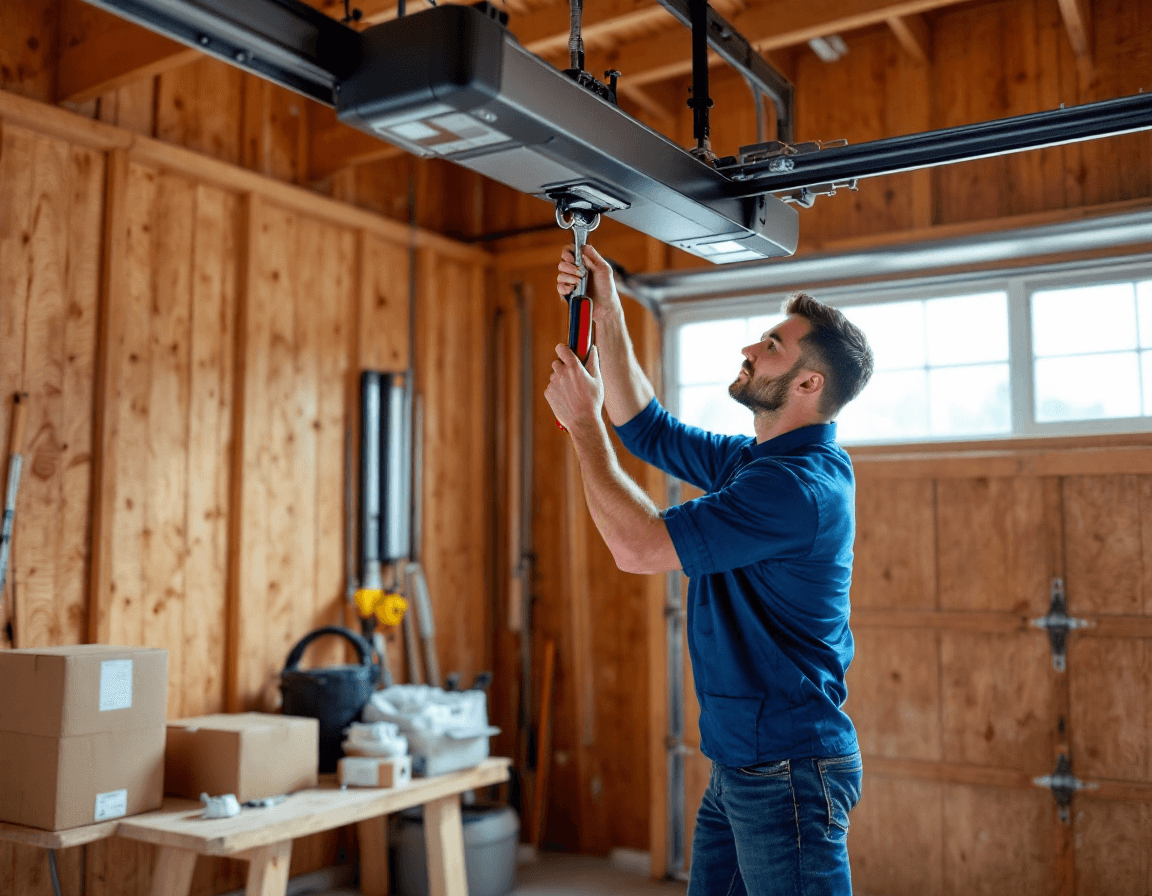
Garage Door Opener Installation & Replacement in Tukwila, WA is one of the most practical upgrades a homeowner can make, because the opener does far more work than most people realize. Every time you pull into the driveway, it lifts a heavy door, reverses it when something gets in the way, and locks the house behind you. When it starts to hesitate, grind, or quit, the garage becomes an inconvenience and a security gap at the same time. Our crews install and replace openers across Tukwila and the surrounding South King County communities, and this page explains how to tell when replacement makes sense, which type fits your space, and what to expect on installation day.
Tukwila homes come in a wide range of styles, from older single-story houses with single-car garages to newer townhomes and detached units with two-car doors. Many of these garages were not designed with modern electric operators in mind, so the mounting space, ceiling clearance, and electrical supply can all shape which opener makes sense. A careful look at your existing setup before buying anything prevents the common mistake of purchasing a unit that looks good on a shelf but does not fit your door. We walk through those details with you so the replacement works the first time.
Whether you are dealing with a noisy old motor, want a Wi-Fi-enabled system you can control from your phone, or simply need a unit that keeps working through a winter power outage, the sections below cover the decisions that matter most. We keep the explanations straightforward, and we point out where a licensed professional needs to take over. If you would like a quote or want to schedule an inspection, you can call (888) 799-3819 at any time.
Reading the Signs That Your Opener Has Reached Its Limit
Most openers do not fail overnight. They give warnings for months, and homeowners often learn to live with those warnings until one morning the door stops halfway up and stays there. The earliest signs are usually sound-related: a rattling carriage, a whine that rises as the door travels, or a clunk at the beginning and end of each cycle. Slow movement is another clue, especially if the door once closed in a few seconds and now takes noticeably longer. Hesitation at the top or bottom of the travel can point to a worn motor, a failing limit adjustment, or a control board that is struggling to keep up with the load.
Reliability problems are more serious than noise. If the opener only responds to the remote after several presses, if the light on the unit flickers without reason, or if the door reverses for no apparent cause, the internal components may be wearing out faster than they should. Intermittent failures are especially frustrating because they come and go, and they often return just as you think the problem has been fixed. A technician can test the safety sensors, the logic board, and the drive mechanism to separate a simple adjustment from a unit that needs replacing.
The decision to replace rather than repair usually comes down to age, parts availability, and cost. When a repair estimate approaches the price of a new installed opener, a replacement typically delivers better value, because you also gain updated safety features, quieter operation, and a warranty on new hardware. Here are the warning signs we hear about most often in the Tukwila area:
- The motor runs but the door barely moves, or it moves only with a loud strain.
- The opener cannot be reset after a power interruption and needs repeated programming.
- Remote controls work only at close range, even after new batteries are installed.
- The unit is more than a decade old and replacement parts are hard to source.
- The safety reversal triggers on an otherwise clear path, suggesting a failing sensor or board.
If any of these sound familiar, schedule an inspection before the problem becomes an emergency. A door that stops in the open position is both a security concern and a safety risk, so it should never be ignored.
Choosing Between Chain Drive, Belt Drive, and Wall-Mount Designs
Choosing the right drive style is the first real decision in any replacement. Chain-drive openers use a metal chain to pull the trolley along the rail, and they remain the most budget-friendly option. They are sturdy and handle heavy doors well, but they are louder than the alternatives because metal links make noise as they move. Chain drives are a sensible choice for detached garages where noise carries less of a concern, or for homeowners who want reliable operation without paying for extra refinements.
Belt-drive openers use a reinforced rubber belt instead of a chain, and that difference makes them noticeably quieter. The smoother movement is a welcome change if the garage shares a wall with a bedroom, a home office, or a neighbor's living space. Belt drives also tend to feel gentler during startup and stopping, which many homeowners appreciate on a daily basis. They typically cost more than chain drives, but for attached garages in dense neighborhoods, the difference in sound is often worth it.
Wall-mount openers attach the motor to the side wall rather than the ceiling, which solves a problem many older Tukwila garages face: limited headroom. If the door's high-lift or low-headroom track configuration leaves little room above the door, a ceiling-mounted unit may not fit at all. A wall-mount design frees up that overhead space, and it can also make the installation cleaner in garages that double as workshops or storage areas. Because the mounting surface must be solid and properly braced, a technician should confirm the wall can carry the load before the unit goes up.
Why Rolling-Code Security Matters for Your Driveway
Older openers often used fixed-code remotes, meaning the same signal was sent every time the button was pressed. A determined person with inexpensive equipment could record that signal and replay it later to open the door. Modern openers use rolling-code technology, which changes the transmitted code with every use so a captured signal cannot be reused. For a house that sits near busy commercial corridors and multi-family buildings, that protection is a meaningful upgrade rather than a luxury feature.
If your current opener still relies on a fixed-code system, the easiest way to check is to look at the model's age and the remote's manufacturer documentation. Many units made before the rolling-code standard became common can be identified by their remote design and the way they are programmed. Replacing the opener and its remotes at the same time ensures that every device in the household uses the same modern protocol. Keypads, wall switches, and vehicle transmitters should be updated too, since an old accessory can undermine the security of the new system.
Security also depends on the rest of the setup. A new opener is only as protective as the habits and hardware around it, so we recommend reviewing the door's manual release, the position of the wall control, and whether the door is set to close automatically after a timed interval. Those details are simple to adjust during installation, and they make a noticeable difference in day-to-day peace of mind. We also review whether an exterior keypad would be useful for family members or for a home that receives frequent deliveries.
Smart Wi-Fi Control and myQ Setup Without the Guesswork
Smart control has become one of the most requested features in our Tukwila installations. A Wi-Fi-enabled opener can send an alert when the door has been left open, let you close it from the car when you realize you forgot, and allow a trusted person to enter a delivery window without handing over a remote. Systems that work with myQ-style apps give you a clear status view and history of recent activity, which helps when you are trying to remember whether the door was closed before leaving for the airport.
Getting a smart system to work reliably depends on the strength of your home network where the opener is mounted. Many garages sit at the far end of the house, and a router placed in a distant room may not reach the opener with a steady signal. Before installation, we check the signal strength in the garage and recommend a mesh node or extender if needed. A weak connection can cause delayed commands, dropped notifications, and frustration that makes the feature seem less useful than it really is.
Setup should be straightforward, but it works best when someone walks through the steps with you. We help connect the opener to your network, create the app account, add authorized users, and test the commands before we leave the house. We also explain how to revoke access if a family member moves out or a contractor no longer needs entry. Taking those few extra minutes at the start means you are not left guessing about how the system behaves when you need it most.
Battery Backup for Winter Storms and Power Interruptions
Western Washington winters bring wind, heavy rain, and occasional outages that can last longer than a homeowner expects. When the power goes out, a standard opener cannot lift the door, so a garage that was closed becomes difficult to open without the manual release. A battery backup unit keeps the opener running for a limited number of cycles during an outage, which can make a significant difference when you need to leave for work, move a car, or reach emergency supplies stored inside the garage.
Battery backup options vary by manufacturer and model. Some units provide only a few lifts before the battery needs to recharge, while others offer more capacity for households that rely on the garage regularly. The backup battery also needs periodic attention, because it can weaken over time. We recommend checking the battery during your annual safety review and replacing it according to the manufacturer's schedule, since a dead battery offers no protection when the lights go out.
Backup power is not a substitute for a safe manual release. Every opener should have a clearly labeled emergency release cord, and every household member should know how to use it. We show owners how to disconnect the trolley safely and how to reconnect it once power returns. Keep in mind that a door left in manual mode should be handled carefully, particularly if the springs or cables show wear, because a heavy door moving unexpectedly can cause injury.
How Moisture and Mild Winters Affect Openers in Western Washington
The Pacific Northwest is known for mild temperatures and steady rainfall, and those conditions shape how openers age. Humidity can accelerate corrosion on exposed brackets, mounting hardware, and electrical connectors, especially in garages that receive little ventilation. Condensation may collect on metal surfaces overnight and then evaporate during the day, a cycle that slowly weakens fasteners and invites rust. A garage with a damp concrete floor or a door that leaks at the bottom can also draw moisture into the opener's housing over time.
Mild winters do not mean the opener is spared from cold-related wear. Temperature swings between daytime warmth and cool nights can affect lubricants and make sluggish parts feel stiffer on certain mornings. Sensor alignment can also shift as the door and frame move slightly with seasonal changes. Many homeowners notice these changes in the fall and early winter, when a door that worked smoothly all summer begins to reverse unexpectedly or stop short of full closure.
Ventilation and simple maintenance help reduce these problems. Keep the garage as dry as possible, check weatherstripping at the bottom of the door, and make sure gutters direct water away from the garage foundation. During installation, we choose hardware suited to damp conditions and tighten connections so they hold up over time. If you already have an opener showing corrosion, the replacement is an opportunity to correct the moisture source rather than simply swapping one unit for another.
Understanding What the $275 to $650 Installed Price Covers
Installed pricing for a new opener in our service area typically ranges from $275 to $650, depending on the model you select and the features you want. The lower end of that range generally reflects a basic chain-drive unit with standard remotes and no smart features, while higher pricing often reflects belt-drive or wall-mount models, Wi-Fi integration, and battery backup. Your final number also depends on the condition of your existing hardware, the type of door, and any additional parts that need replacement during the job.
A quality installation includes more than the opener itself. The price should account for removing the old unit, mounting the new one securely, connecting the door tracks and trolley correctly, programming travel limits, and testing the safety reversal system. It should also include checking the photo-eye sensors, confirming the manual release functions properly, and verifying that the remotes and wall control work as expected. We believe homeowners should understand what they are paying for, so we review the breakdown before any work begins.
Because every garage is different, the most accurate way to get your exact price is to have a technician look at the door and opener in person. Factors such as ceiling height, wiring location, and the presence of an older electrical outlet can change the scope of the job. We would rather give you a clear, honest number after an inspection than promise a figure that does not match your situation. If you are comparing quotes, ask each company to explain what is included so you can make a fair comparison.
What Happens on a Typical Installation Day in a Tukwila Garage
A replacement usually begins with a conversation about how you use the garage, how often the door cycles, and which features matter most to your household. From there, the technician inspects the door, springs, tracks, and existing opener to confirm that the new unit will match the hardware. We look at the mounting surface, the power supply, and the location of the wall control so the installation is planned rather than improvised. This step prevents surprises later and keeps the project on schedule.
Once the plan is set, the old opener is disconnected and removed. The new unit is assembled, mounted, and attached to the door using the correct brackets and hardware for your configuration. Wiring is completed according to local electrical requirements, and the safety sensors are aligned and tested. Travel limits are set so the door opens and closes fully without straining the motor, and the auto-reverse feature is checked with a test object placed in the door's path.
Before we finish, we program the remotes, wall control, and any keypad or smart features you requested. We walk you through the manual release, explain how the battery backup works, and show you how to use the app if your model includes one. Finally, we run several complete cycles to confirm everything works together smoothly. You will leave with a clear understanding of how your new opener operates and a direct number to call if anything seems off.
Safety Checks We Perform and the Work You Should Leave to a Pro
Safety is central to every opener installation. We test the photo-eye sensors to confirm that the door reverses when the beam is interrupted, and we verify the force settings so the door reverses when it contacts an obstacle. We also check that the manual release disengages the trolley cleanly and that the door can be operated by hand when necessary. These checks are required to make sure the door responds properly to the people and objects around it, especially children and pets.
Some parts of a garage door system should never be handled by homeowners. Torsion springs and extension springs store enormous amounts of energy, and they can cause severe injury if they are adjusted, removed, or replaced without the right tools and training. Cables, drums, and bottom brackets under tension also carry serious risks. If your inspection reveals worn springs or frayed cables, call a licensed professional rather than attempting the repair yourself. Our technicians handle spring and cable work safely, and they will explain exactly what needs attention before proceeding.
Even simple maintenance deserves caution. You can wipe the door tracks, check the auto-reverse test each month, and keep the area around the opener clear, but you should not loosen mounting bolts on the spring system or try to rebalance the door. If the door feels heavy, drags, or makes a sudden popping noise, stop using it and schedule a service visit. A well-maintained opener protects your home, and a professional-led installation keeps the entire system working as designed.
Neighborhood Notes for Allentown, Tukwila Village, and the Southcenter Corridor
Tukwila's neighborhoods are as varied as its commercial core, and our installations reflect that variety. Homes in the Allentown area and surrounding blocks often feature garages that were built alongside older single-family construction, where space for modern hardware can be limited. Our technicians plan around low ceilings, shared driveways, and tight side clearances, and they often recommend wall-mount or belt-drive units when a standard ceiling installation would be cramped or noisy. Knowing the typical layouts in these areas helps us bring the right parts on the first visit.
Near Tukwila Village and the Southcenter corridor, many households have busy schedules, frequent deliveries, and garages that serve as main entrances. In these situations, a smart opener with reliable app control and a dependable battery backup can save real time. We often discuss delivery access, guest entry, and after-hours arrivals with customers in these areas, because the way a family uses the garage affects which features make the most sense. A quick conversation about your daily routine helps us recommend a setup that fits your life rather than a generic package.
Our service coverage includes the 98168, 98178, and 98188 ZIP codes, and we regularly travel between Tukwila, nearby Seattle neighborhoods, and the broader South King County area. Scheduling for each job depends on availability and the complexity of the work, so we encourage you to call ahead with your address and the details of your door. Whether your garage is in a quiet residential block or close to the busy shopping district, we aim to give you a clear estimate, a careful installation, and a reliable point of contact after the work is finished.
If your opener is loud, slow, unreliable, or simply past the point of economical repair, now is a good time to plan a replacement. Our team can review your door, recommend the right drive style, and explain the options for security, smart control, and battery backup in plain language. To request an estimate or schedule an inspection for your Tukwila garage, call Seattle Garage Door Fix at (888) 799-3819.