
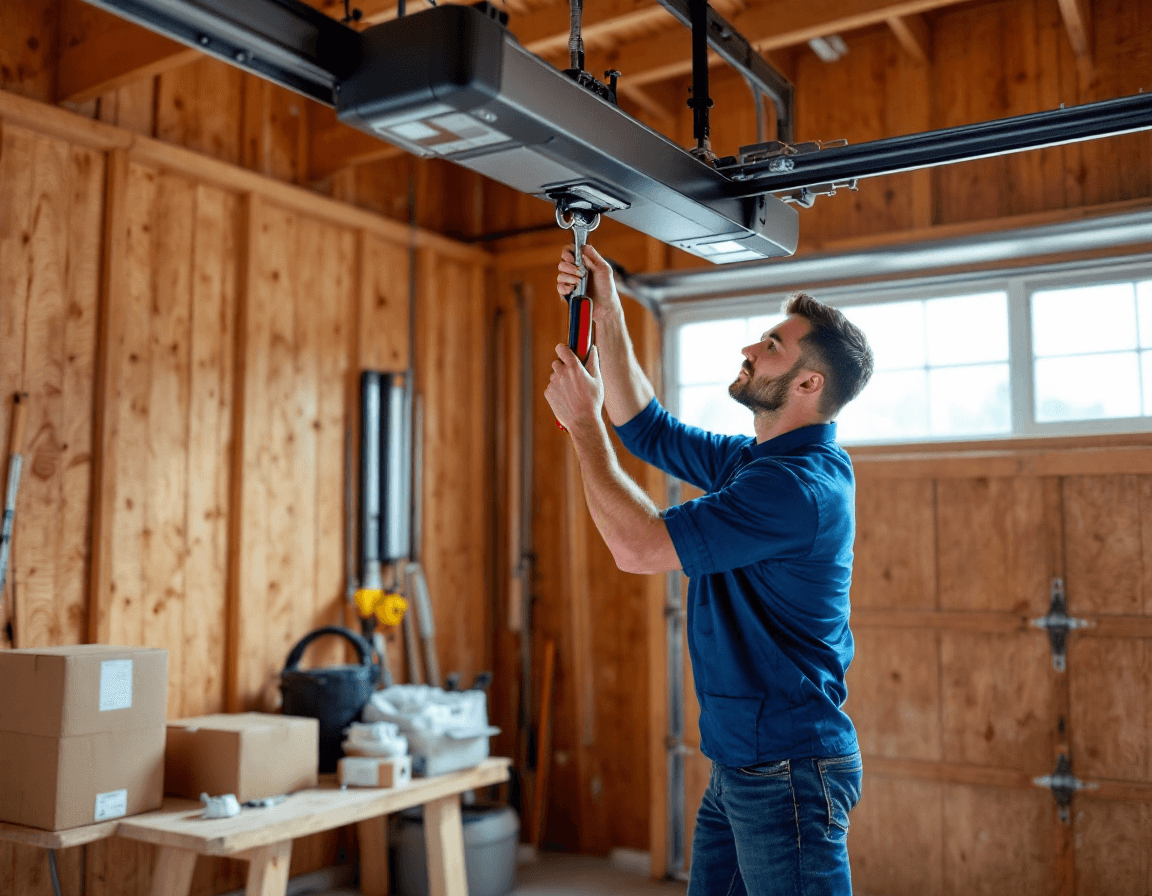
Garage Door Opener Installation & Replacement in SeaTac, WA is one of the most practical upgrades a homeowner can make, and it often delivers more daily comfort than people expect. If your opener groans on every cycle, stops halfway through its travel, or leaves you wondering whether the door actually closed, the problem is usually the motor, the drive, or the control electronics rather than the door itself. Our technicians work across SeaTac, from the residential blocks near Angle Lake to the older streets around Bow Lake and the hillside homes of McMicken Heights, and we see the same pattern repeatedly: an opener that has quietly outlived its useful life.
SeaTac sits in the middle of a mixed housing landscape. You will find modest mid-century ranch homes with single-car garages, newer townhome clusters with tight shared driveways, and larger two-car garages that were built with a little more room for shelving and a workbench. Each setup asks something different from an opener, whether that is quiet operation for a living space directly above the garage, a motor that fits a low ceiling, or a unit that can handle frequent cycles in a busy household. A good replacement starts with understanding how your garage is used, not just which box is on sale.
This page explains what goes into a professional opener installation, how the main drive types compare, what security and smart features really offer, and how we think about the price range. We also explain where repair ends and replacement begins, and where a licensed technician needs to take over for safety reasons. If you are weighing a change, read through the sections below and then call us at (888) 799-3819 for a clear recommendation.
Why Older Openers in SeaTac Homes Start Sounding Like Trouble
Most homeowners do not replace an opener because it suddenly dies. They replace it because it has been getting worse for a long time, and the changes were slow enough to seem normal. A motor that once ran quietly begins to rattle, the door takes a noticeable pause before it starts moving, or the unit stops reversing cleanly when it touches something. These symptoms are your opener telling you that gears are wearing, the trolley is loose, or the logic board is struggling to read its limits.
Pacific Northwest weather accelerates some of this wear. Our winters bring long stretches of damp air, and garages in SeaTac often experience condensation on metal components, especially on nights when temperatures drop near freezing and then rise again. Moisture encourages corrosion on exposed hardware and can make lubricated parts gum up or seize. Over a decade or more, that combination of dampness and daily use takes a real toll on older mechanisms.
When an opener is more than about ten years old, we generally recommend a full evaluation before any repair money goes in. Many older units use components that are no longer easy to source, and fixing one failing part often exposes two more. A candid assessment will tell you whether the unit still has life left or whether replacing it is the more reliable investment.
Belt, Chain, or Wall-Mount: Matching the Drive to Your Garage
The drive style is the first decision that shapes how your new opener will feel every day. A belt-drive opener uses a reinforced rubber belt rather than a metal chain to move the trolley along the rail. Because the belt does not clank across metal teeth, belt-drive units run noticeably quieter, which matters a great deal if your bedroom or home office sits directly above or beside the garage. Belts also tend to need less lubrication and produce less vibration through the ceiling framing.
A chain-drive opener is the traditional, budget-friendly choice and remains a dependable option for detached garages, workshops, or any space where noise is not a major concern. Chain units are straightforward to service and handle heavy doors well, which is why many people with older, solid-core doors still prefer them. They are louder during operation, though, and the chain should be kept properly tensioned to avoid premature wear. For homes in SeaTac with an attached garage and living space nearby, chain drive is often the less comfortable choice.
Wall-mount openers take a different approach by bracketing the motor to the wall instead of the ceiling. This frees up overhead space, which is helpful in garages with low ceilings, storage racks mounted near the top, or a car lift. Wall-mount installation also suits garages where the ceiling joists are not positioned well for a standard ceiling bracket. We evaluate the wall structure carefully before committing to this layout, because the mounting surface must be solid enough to carry the motor and absorb operating vibration.
Rolling-Code Security and Why an Older Unit Leaves You Exposed
Security is one of the most important reasons to upgrade an older opener, and it is one that many homeowners underestimate. Older openers often used fixed codes, meaning the remote sent the same signal every time. Anyone with a basic code-capture device could record that signal and reuse it later to open the door. Modern openers use rolling-code technology, which changes the transmitted code after every use so a recorded signal cannot be replayed to gain entry.
If your opener is more than about fifteen years old, or if you cannot identify the security type printed on its label or in the manual, it is worth assuming the unit does not have rolling-code protection. This is especially relevant in neighborhoods with a mix of rental units, frequent deliveries, and cars parked along shared driveways, which describes many areas around SeaTac. Rolling-code security is not a complete home security plan on its own, but it closes a well-known gap that older equipment leaves open.
Upgrading to a current model also means replacing the remotes and keypads that work with it. We program each new remote during installation and clear out outdated access codes so that old devices no longer function. We will walk you through deleting any lost remote from memory, which is a step many homeowners do not realize they need. Keeping your access list current is one of the simplest ways to maintain the security benefit over time.
Smart Control, myQ, and Living With Phone Alerts
Smart features have become a common reason homeowners choose a new opener. Many current models work with Wi-Fi-enabled control systems such as myQ, which lets you open or close the door from a smartphone, check whether it is open, and receive alerts when it moves. For households with teenagers coming home at unpredictable hours, contractors arriving during the day, or a family member who needs a way to let in a visitor, remote access can be genuinely convenient. Some people also find the open-status check reassuring after they have left the house.
Smart control works best when the opener sits within reliable range of your home's Wi-Fi network. Garages are often located at the far edge of a house, and wall construction, metal framing, or a distant router can weaken the signal. During installation, we confirm connectivity and, where needed, recommend a placement or network adjustment so the feature works consistently rather than dropping out at the moment you need it. We also set up the app with you so you understand notifications, user permissions, and how to share access safely.
Smart features should be set up thoughtfully rather than left at default settings. Give each person their own account where the system allows it, and remove access for anyone who no longer needs it. Consider which alerts are useful for your household, because constant notifications quickly become something people ignore. A well-configured system adds convenience without adding confusion, and we are happy to explain the options before you decide which features to enable.
Battery Backup When the Lights Go Out Along the Airport Corridor
Power interruptions are a real consideration in the Seattle area, particularly during winter windstorms that bring down branches and lines across residential streets. When the power goes out, a standard opener cannot move the door, which can leave you stuck inside or unable to secure the garage. Battery backup options solve this by providing a stored power source that lets the opener operate during an outage, typically for a limited number of cycles depending on the battery and the unit.
Battery backup is especially useful for households that rely on the garage as their primary entry point, or for families who want to close the door securely even when the rest of the neighborhood is dark. It is also helpful for anyone with medical equipment or mobility needs who must be able to get a vehicle in and out without delay. Because backup capacity varies by model and battery, we will explain how many cycles to expect so you have realistic expectations rather than assumptions.
Batteries do age, and they should be checked and replaced on a regular schedule. We recommend testing the backup function during your annual maintenance visit and replacing the battery when its performance declines. It is also important to know how the emergency release cord works, since that manual disconnect lets you operate the door by hand when the opener is not powered. We show every homeowner how to use the release safely and how to re-engage the opener afterward.
What a Typical Installation Visit Covers Step by Step
A professional opener installation is more involved than swapping one motor for another. Our technicians begin by inspecting the existing door, tracks, springs, cables, and hinges to make sure the door is balanced and in good condition before a new opener is connected to it. An opener is only as reliable as the door it moves, so a worn track or a sticking roller can shorten the life of even a premium motor. If we find a problem with the door hardware, we explain it clearly before any work begins.
Next, we confirm the space and mounting requirements. We measure the ceiling clearance, check the framing for a secure bracket location, and determine whether a standard rail, a wall-mount system, or a different configuration fits your garage. We then assemble the rail and motor, install the header bracket and door arm, and connect the safety sensors at the correct height near the floor. Proper sensor alignment is essential, because it is the feature that reverses the door if something passes beneath it.
Finally, we program the limits, test the force settings, and verify that the door reverses when it contacts an obstruction. We also program remotes, keypads, and any smart control features, then walk you through the operating instructions. Before we leave, we confirm that the emergency release works, that the battery backup (if installed) is charged, and that you know how to maintain the system. Depending on your city and the scope of the project, a permit may be needed, and we will let you know what applies before scheduling.
Reading the Price Range: From $275 to $650 Installed
Our installed pricing for opener replacement generally falls between $275 and $650, and the spread reflects real differences in equipment rather than arbitrary markups. The most important variable is the opener model itself, since a basic chain-drive unit costs far less than a belt-drive motor with smart features and battery backup. The drive style, horsepower rating, and included accessories all shift the final number within that range.
Several other factors can affect the total. Wall-mount installations may require additional bracketing or a reinforced mounting surface. Battery backup kits add cost, and so do extra remotes or keypads if you want more than the standard set. Garage doors that are heavier or larger, such as double-wide doors, may call for a unit with more lifting capacity, which influences price. We provide an itemized explanation before you commit so there are no surprises.
Here is what a typical quote may include, depending on the project:
- The opener unit matched to your door's weight and size
- Rail, mounting brackets, and hardware for your chosen drive style
- Safety sensors and wiring connections
- Remote controls and keypad programming
- Optional battery backup, if selected
- Optional Wi-Fi smart control setup and app configuration
- Testing of force settings, reversing function, and the emergency release
Ask us to explain any line item you do not understand. A transparent quote lets you compare options based on what actually matters for your home.
Repair Versus Replacement: When the Math Points to a New Opener
Deciding between repair and replacement is rarely a single calculation, but a few signs make the answer clearer. If the motor is struggling to lift the door, if the logic board fails repeatedly, or if the opener needs frequent expensive parts, the cumulative repair cost can quickly approach the price of a new installation. When you add the benefits of rolling-code security, quieter operation, and modern safety features, replacement often becomes the more sensible choice.
Repair still makes sense in some situations. A worn remote, a misaligned sensor, a single failed bracket, or a dead backup battery can often be fixed without replacing the entire system. If your opener is relatively recent and the problem is isolated, a targeted repair may be all you need. The key is to avoid throwing money at an aging unit that will need the same attention again in a few months.
We aim to give you an honest recommendation rather than pushing the most expensive option. If repair is the better path, we will tell you so. If replacement will save you from recurring headaches and improve security, we will explain why and show you the options at different price points, from the $275 range up to the $650 range for advanced models.
Moisture, Mild Winters, and Protecting Your Opener Investment
Living in the Pacific Northwest means your garage often holds moisture for long periods, even when it does not feel especially cold. Humidity can cause rust on hinges, rollers, and the metal rail, and it can degrade electrical connections over time if they are not protected. Dampness also affects the sensitive electronics inside the opener, so keeping the garage reasonably ventilated and free of standing water makes a real difference in how long your equipment lasts.
Simple maintenance goes a long way. Clean the door tracks, lubricate the rollers and hinges with a silicone-based or manufacturer-recommended product, and avoid heavy petroleum greases that attract dirt. Check that weatherstripping at the bottom of the door is intact, since gaps let in rain, leaves, and cold drafts. Keep the area around the opener free of clutter so that vents and moving parts are never blocked.
A professional tune-up once a year helps catch small problems before they become failures. During a visit, we check the force settings, verify the auto-reverse feature, test the safety sensors, examine the trolley and belt or chain tension, and confirm battery health if you have backup power. Preventive attention keeps a new opener running quietly and reliably through many years of SeaTac rain.
Keeping Your Door Balanced: Where We Stop and a Pro Must Start
Safety is the most important part of any garage door service, and it defines the line between what a homeowner can reasonably check and what must be handled by a licensed professional. Torsion springs and extension springs store enormous amounts of energy, and a sudden release can cause serious injury. Cables, drums, and spring tension are not appropriate for do-it-yourself adjustment, and attempting them without proper training and tools is dangerous.
Homeowners can safely observe the door, listen for unusual sounds, keep tracks clean, and test the auto-reverse by placing an object beneath the closing door. They can also replace remote batteries, clear the sensor lenses, and use the emergency release as described in the manual. If the door is uneven, hangs crooked, sits partly open, or the cables look frayed or loose, stop using it and call a professional right away.
When an opener installation touches the door's balance, springs, or cables, we always recommend a licensed technician complete that work. Our team is licensed, bonded, and insured, and we treat spring and cable service as the high-risk work it is. We will tell you plainly when a repair falls outside what should be attempted at home, so you can make an informed and safe decision about your garage.
Whether your current opener is noisy, unreliable, lacking modern security, or simply past its useful life, a well-planned replacement can make your SeaTac garage safer and more comfortable for years. Call Seattle Garage Door Fix at (888) 799-3819 to schedule an inspection, ask about belt-drive and wall-mount options, and get a clear installed price tailored to your door and your household.