
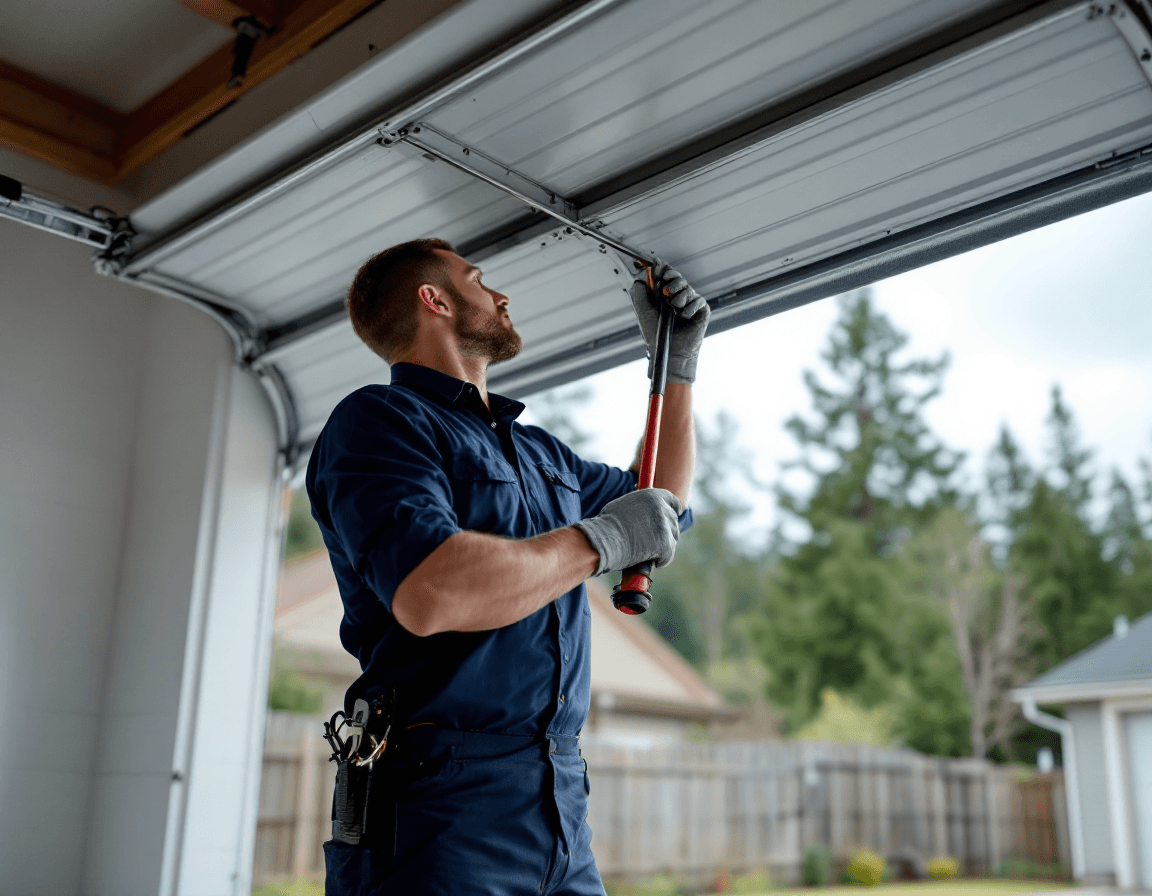
Garage Door Spring Replacement in Issaquah, WA is one of the most common repairs we handle across the city and the surrounding foothills, and it is also one of the most misunderstood. Many homeowners assume a door that suddenly refuses to rise has failed as a whole, when the real culprit is usually a spring that has reached the end of its working life. The springs carry most of the weight of a garage door, and a typical residential door can be heavy enough that the opener alone was never designed to lift it unassisted. When a spring lets go, the change is immediate, and it often sounds much worse than the damage itself.
This page explains how spring failures show up in Issaquah homes, why local weather and housing styles influence wear, and what a responsible repair involves for properties in ZIP codes 98027 and 98029. We will cover the difference between torsion and extension systems, the problems that hide behind a broken spring, what high-cycle upgrades actually offer, and how balancing affects the way a door closes. We will also be direct about the safety boundaries that separate a sensible homeowner check from work that should only be done by a licensed technician.
Whether your garage went quiet overnight or the door has been slowly getting harder to lift for a few months, the steps below will help you describe the problem accurately and understand what a proper repair looks like. Knowing the symptoms in advance makes it easier to decide when to stop using the door and when to call for service.
Reading the Bang: What a Snapped Spring Sounds Like
A broken torsion spring usually announces itself with a sharp crack or a loud bang that many people compare to a gunshot or a heavy tool dropping inside the garage. Households in Issaquah often hear it early in the morning, when the house is quiet and the overnight temperature has dropped, and the first instinct is to check for an intruder or a vehicle collision. The noise is the spring releasing its stored tension all at once. It tends to happen while the door is closed or resting, because that is when the spring holds the most energy.
Not every loud sound in the garage points to a spring, so it helps to look for supporting evidence. Several symptoms commonly appear alongside a broken spring, and noticing more than one makes the diagnosis clearer. Watch for these signs:
- A bang with no obvious cause, especially on a cold or damp morning
- A visible gap or separation in the coil of a torsion spring above the door
- A door that will not lift, or lifts a short distance and then stops
- Lift cables hanging slack on one side, or sitting loose in their channel
- An opener that runs, hums, or strains while the door barely moves
If you notice any of these, treat the situation as a stop sign rather than a puzzle to solve. Do not attempt to lift the door by hand to test it, and keep children, pets, and visitors clear of the door path until a technician has confirmed its condition. A door that has lost spring support can drop suddenly if the opener or a cable fails, and that risk is serious enough to justify a short wait for professional service.
Why Issaquah Garages Wear Springs Faster Than Expected
Garage door springs are rated by cycles, meaning one full open and close counts as a single cycle. Standard residential springs are commonly rated around 10,000 cycles, which sounds like a lot until you consider a household that uses the door several times a day for errands, school runs, and trips to the trailhead. At that pace, a standard spring can reach its rated life in roughly a decade, and sometimes sooner if the door is heavier than the spring was matched to carry. Age alone is not the only factor, but it is the one most homeowners can track.
Pacific Northwest weather adds a layer of wear that many people in drier regions never think about. Damp winters, sudden cold snaps, and the frequent swings between wet and dry conditions cause metal parts to contract and expand throughout the year. Lubrication on springs, rollers, and hinges can thin out or wash away, and moisture settles into the small gaps where rust begins. Surface corrosion weakens steel over time, and a spring that has begun to rust may fail earlier than its cycle count suggests. Homes near the wooded slopes of Squak Mountain often also collect fallen needles, leaf litter, and grit in door tracks, which accelerates friction and wear on the rollers that support the spring load.
Housing style matters too. Many newer homes, including a number of properties in Issaquah Highlands, feature larger or more heavily insulated doors with additional hardware, and that extra weight increases the load on the spring system. Older homes around Gilman Village and other established parts of town may have original or previously repaired doors that were never rebalanced after upgrades. In both situations, the springs are working harder than the original design intended, and a routine inspection can catch the early signs of fatigue before a break happens in the middle of a busy week.
Torsion or Extension: Knowing Which Spring Your Door Carries
Before any repair begins, a technician needs to identify which type of spring system the door uses. Torsion springs mount on a steel shaft that runs horizontally above the door opening, and they wind and unwind to provide lift. Extension springs run along the horizontal tracks on each side of the door, stretching as the door closes and pulling it back toward the ceiling as it opens. Both systems work, but they fail in different ways and require different repair procedures.
Torsion systems are common on many modern residential doors because they are generally smoother, more balanced, and less likely to sag when the door is partway open. The spring sits in a single central location, and its tension is distributed across the entire door width. When a torsion spring breaks, the door often stops dead or drops unevenly, and the spring coil may show a visible gap. Repairing a torsion system requires precise measurement, correct winding procedures, and the right tools, which is why this work belongs with a licensed professional rather than a weekend project.
Extension systems appear more often on older doors and on some lighter-duty installations. They include safety cables that run through the center of each spring and are meant to hold the spring in place if it breaks. When an extension spring fails, the door may still move partially, and the broken spring may hang loosely along the track. Identifying the system type is the first step toward a safe and correct repair, and a good technician will confirm the configuration before quoting the job.
The Door That Stops a Few Inches Off the Ground
One of the most frustrating symptoms is a door that rises a few inches, then stops and refuses to go any farther. Homeowners often assume the opener has malfunctioned or that a sensor is blocking the path, and sometimes that is true. However, a door that stalls at a consistent height after lifting slightly is a classic sign that the spring has lost its ability to support the load, or that the lift cables have come off their drums. The opener is trying to lift a door that has suddenly become much heavier than it should be.
Before calling for service, it is reasonable to look for simple causes that do not involve the springs. Check that nothing is blocking the photo-eye sensors near the floor, since misaligned or obstructed sensors can cause the door to reverse. Confirm that the opener is not in a force setting or travel limit configuration that was recently changed. If the door continues to stop regardless of those checks, the problem is likely mechanical, and continued attempts to force the opener can damage the gear train or motor. Stop pressing the button repeatedly, because each attempt adds strain to a system that is already compromised.
A stalled door is also a safety concern because it may be partially supported by the opener and partially by cables that are no longer under correct tension. Keep people and vehicles out of the doorway until a technician has inspected it. In many cases, a short service visit can confirm whether the spring, the cables, or the track is responsible, and it prevents a small mechanical problem from turning into a larger repair.
Cables, Drums, and the Damage Hiding After a Break
When a torsion or extension spring breaks, the lift cables do not always stay where they belong. Each cable wraps around a drum at the bottom corner of the door, and the spring tension keeps the cable snug as the door moves. Once that tension disappears, the cable can slacken, slip off the drum groove, or tangle in the track. A cable that has been pulled under sudden load may also fray, kink, or develop weak points that are not visible from the floor.
Drums themselves can crack or strip when a spring fails violently, especially on older aluminum or steel drums that have seen years of use. A technician will inspect the drum surfaces, the cable ends, and the connections where the cable attaches to the bottom bracket. In many cases, replacing the spring alone is not enough, and the cables should be replaced at the same time to avoid another failure within weeks. This is one reason a spring repair is often more involved than a single part swap.
Other hardware deserves attention too. The center bearing that supports the torsion shaft, the end bearing plates, and the shaft itself can all show wear or damage after a break. Hinges, rollers, and track sections may have been bent or pulled out of alignment when the door dropped unevenly. A thorough inspection checks these components so the repaired system works as a unit rather than a single replaced part, and so the next failure does not come from a hidden problem that was overlooked during the first visit.
Heavy Lifts and Strained Openers: Don't Blame the Motor First
A garage door opener that hums, grinds, or strains while the door barely moves can look like a motor failure, but spring trouble is a common cause. When the spring no longer provides its share of lift, the opener must do far more work than it was designed to handle. The motor draws heavy current, the gear train absorbs unusual force, and the door moves slowly or not at all. Continuing to run the opener in this state can strip gears, overheat the motor, and turn a modest spring repair into an expensive opener replacement.
Homeowners sometimes try to test the door by disconnecting the opener and lifting the door manually. This is not a safe diagnostic. A door with a broken spring can slam down or lift unpredictably, and a torsion spring may still hold stored energy even after appearing damaged. A proper diagnosis involves checking the spring condition, cable routing, drum position, and balance under controlled conditions, and that work should be left to a technician who can perform it safely.
If the opener seems to be the issue, a technician will still evaluate the springs first. Many opener complaints disappear once the spring system is restored to correct tension. In situations where the opener itself has been damaged by prolonged strain, it can be repaired or replaced after the door is brought back into balance. Addressing the mechanical load first protects the opener investment and avoids replacing parts that were only responding to an underlying spring problem.
High-Cycle Springs and What the Upgrade Really Offers
High-cycle springs are designed to last longer than standard springs under the same use, and they are often considered by households that open and close the garage frequently. They are typically rated for a higher number of cycles, and the manufacturer's specification for each product should be checked directly, since ratings vary by brand, wire size, and design. The upgrade is not automatically the right choice for every door, and it should be matched to the door's weight, height, and usage pattern rather than installed as a generic improvement.
The benefit of a high-cycle spring depends on proper installation. A spring that is too light for the door will fail to lift it correctly, while one that is too heavy can cause the door to lift too quickly and stress the opener. Balance is the key factor, and a technician will measure the door before selecting a spring. Homeowners who choose high-cycle springs should expect a higher material cost than standard springs, and that cost should be discussed as part of the quote rather than discovered after the work begins.
High-cycle options can make sense for busy households with multiple drivers, home businesses that rely on frequent garage access, or doors that have already experienced repeated spring failures. They are not a substitute for regular maintenance, however. Lubrication, cable checks, roller inspection, and hardware tightening still matter, and an upgraded spring installed on a poorly maintained door will not deliver its full service life.
What a Spring Swap Usually Costs Around Issaquah
Most spring replacements fall between $180 and $450, depending on the type of spring, the size and weight of the door, and whether related components such as cables, drums, or bearings also need attention. A standard torsion spring replacement on a typical single or double door sits near the lower end of that range when no extra parts are involved. Extension spring repairs, high-cycle upgrades, and doors with additional damage may land toward the higher end of the range, and the final figure should always come from an inspection rather than a guess.
Several factors shape the price of a spring job. A technician will consider the list below when preparing a quote:
- The spring type, whether torsion or extension, and whether one or both springs need replacement
- The door's size, weight, and insulation level, which affect the spring rating required
- Whether lift cables, drums, or end bearings also show wear or damage
- The choice between standard and high-cycle springs
- Access conditions at the property, including steep driveways or tight garage layouts
Prices can change when hidden damage is discovered during the job, so a reputable company explains the scope before work begins. Ask for a written estimate that lists the parts and labor included, and confirm whether any additional components are required. A clear quote protects both the homeowner and the technician, and it keeps the repair focused on restoring safe, balanced operation.
Balancing the Door So It Closes Straight and Under Control
A door that closes too fast, slams, or drifts to one side is often suffering from uneven spring tension rather than a faulty opener. Torsion systems are designed to share the load evenly between the two ends of the door, and when one side car