
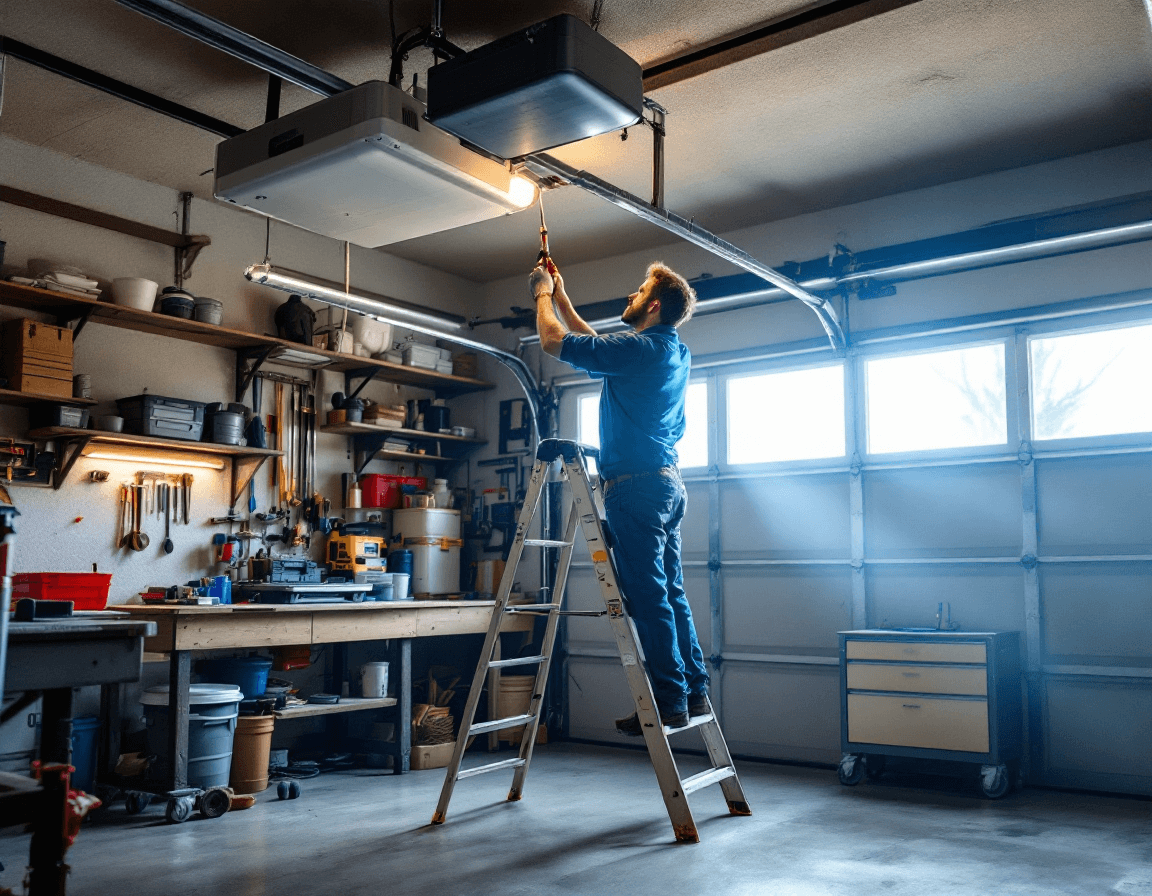
Garage door opener repair in Normandy Park, WA is often a matter of diagnosing a small fault before it becomes a larger one. Homes here sit among tall evergreens, a few minutes from the shoreline at Normandy Park Cove, and the damp, salty air that drifts in off Puget Sound works its way into electrical contacts, track fasteners, and wall-mounted controls. A door that hesitates or refuses to move is usually signaling something specific, whether that is a worn limit switch, a dead remote battery, or a gear that has begun to chew itself apart. Our technicians serve Normandy Park and the surrounding King County neighborhoods, and we work on nearly every major opener brand, so the goal of this page is to help you understand what your opener is telling you before you pick up the phone.
Most opener repairs we handle in this area fall within a range of $95 to $375, depending on the part involved and how much diagnosis the problem requires. A simple logic board replacement or a limit adjustment costs far less than a complete drive assembly, and a good technician should explain the cause and the options before any part is ordered. Some faults, such as a worn trolley or a cracked sprocket, are quick to fix once found, while others hide behind a symptom that looks unrelated, like a remote that seems dead when the real problem is a fried receiver. The sections below walk through the most common complaints we hear from Normandy Park homeowners, what each one usually means, and what you can safely check yourself. Anything involving torsion springs or cables belongs in the hands of a licensed professional, and we will point that out wherever it matters.
Why Garage Doors in Normandy Park Age Differently
The Pacific Northwest climate is gentle on the thermometer but hard on mechanical and electrical parts. Winters bring long stretches of drizzle and fog, and humidity rarely drops far enough for metal surfaces to dry completely between storms. Along the coast and near the water, that moisture carries a faint salt film that accelerates corrosion on hinges, rollers, bearing plates, and the exposed terminals inside an opener housing. Homeowners often notice this first as a stiff or noisy door in November, long before any part has actually failed.
Older ramblers and split-level homes common in the older blocks of the city may have openers mounted on a ceiling joist that flexes slightly with seasonal moisture changes. That movement can shift the rail alignment just enough to load the drive unit unevenly, which shows up as a motor that strains or a belt that rides off its pulley. Newer construction tends to use sealed, higher-spec components, but the garage is still an unconditioned space in many homes, and condensation can form on cold ceilings overnight. Understanding these local pressures helps explain why a repair that might be routine in a dry climate sometimes turns out to be a moisture-related fault that needs cleaning, lubrication, or a relocated sensor.
Because the damp season is long, we recommend paying attention to subtle changes rather than waiting for a dramatic failure. A door that takes an extra second to start, a faint squeal on the first run of the morning, or a remote that needs to be pressed twice are all early signals. Catching those early often keeps a repair in the lower end of our price range and avoids an emergency call on a rainy weeknight.
When the Motor Hums but the Door Stays Still
One of the most frustrating symptoms is hearing the opener motor run, feeling the carriage try to pull, and yet having the door barely move or not move at all. This usually points to a disconnect somewhere between the motor and the door, or to a mechanical load problem. The most frequent culprits are a broken or disengaged trolley release, a damaged drive chain or belt that is slipping on its sprocket, or a door that has become hard to lift because of a bind in the track or a failed roller.
Start by looking at the emergency release cord that hangs from the trolley. If the door is closed and that cord has been pulled, the trolley may be disconnected from the door arm, and the motor will spin without lifting anything. Re-engaging the trolley with the door closed is usually safe, but if the door feels unusually heavy when you disconnect it, stop there and call a technician, because the problem may be the springs rather than the opener. Do not attempt to adjust tension or work on the spring system yourself, since stored spring energy can cause serious injury.
If the trolley is engaged and the motor still hums, a technician will check the drive sprocket, the gear reduction assembly, and the motor coupling. A motor that runs without moving the chain is a classic sign of stripped internal gearing or a sheared coupling pin. Those repairs are often more involved, but they are a clear case where a precise diagnosis saves money, since replacing the wrong part wastes time and does not solve the underlying problem.
Remote Silence and Wall Button Trouble
When the door will not respond to the remote but the wall button works, the fault almost always lies in the transmitter or the receiver, not the motor. Start with the simplest check: replace the battery in the remote and confirm the button indicator lights when pressed. Many remotes lose range gradually, so a unit that worked from the driveway may now only work when you are standing right beside the garage. Interference from nearby electronics, a neighbor's transmitter on the same frequency, or a metal vehicle body can also reduce range in tight suburban lots.
If the battery is fine and the wall button also fails, the problem is more likely in the wall control wiring, a tripped safety circuit, or the logic board. Wall controls are exposed to humidity and temperature swings, and their low-voltage wiring can corrode or loosen over time. A technician will test continuity, check for a shorted button, and confirm the opener is receiving power. We also check whether the opener is in a locked-out state, which some models enter after a series of rapid commands or a fault condition.
Homeowners sometimes replace the remote, only to discover the receiver has lost its memory. Some openers erase programmed codes after a power surge, a storm-related outage, or a firmware fault. Reprogramming is typically straightforward using the learn button on the motor housing, but the exact sequence varies by brand. If you are unsure, bring the remote's model number to your appointment so the technician can confirm compatibility before attempting a fix.
The Grinding Sound Coming from the Opener Head
A grinding, clicking, or metallic scraping noise from the opener head is one of the more urgent symptoms, because it often means a gear has stripped or a nylon gear has cracked. Some openers use a plastic or composite worm gear, and over years of cycling, the teeth can wear or fracture. When that happens, the motor may still spin, but the output shaft does not turn reliably, and the door may stop partway through its travel.
It is worth listening carefully to where the sound comes from and when it happens. A grind that occurs only at the start of travel can indicate a worn bearing or a dry drive shaft that needs proper lubrication with the right grease. A grind that happens mid-travel or only when the door is under load may suggest the gear is slipping or the door balance is off, which forces the opener to work harder than it should. Continuing to run an opener with a grinding gear can damage the motor, so we recommend shutting off power at the breaker and calling for service rather than repeatedly testing the door.
Gear replacement is among the more labor-intensive opener repairs, and results vary depending on the model and how far the wear has progressed. In many cases, a technician can replace the gear assembly without replacing the entire opener, which keeps the cost within our typical range. Before committing, ask whether the door balance has been checked, since a door that is heavier than it should be will wear out a gear much faster than normal.
Doors That Stop Short or Reverse Without Warning
A door that closes partway and then immediately reverses is one of the most common complaints in our area, and it is often caused by the safety system working as designed. Modern openers use photo-eye sensors mounted near the bottom of the door tracks, typically a few inches off the floor, to detect obstructions. If the beam is interrupted, or the sensors are misaligned, the opener assumes something is in the path and reverses. Dust, cobwebs, spider activity, and morning condensation on the lenses are frequent causes, especially in damp garages.
Clean both sensor lenses with a soft cloth and check that the indicator lights on each sensor are steady rather than blinking. If one light is off or flickers, the wires may have been damaged by a shifting door or a stray hand truck, or the sensors may have drifted out of alignment. Gently adjust the bracket so the two sensors face each other directly. Do not bypass or tape over the sensors, since they are a critical safety feature that protects children, pets, and vehicles.
A door that reverses at the very end of its travel usually points to a force setting that is too sensitive or a travel limit that has shifted. When a door is out of balance or the tracks have a slight bend, the opener may read the extra resistance as an obstruction. A technician can adjust the force settings, verify the close limit, and inspect the track alignment. Those adjustments are generally within the scope of a service call and are often quick once the cause is identified.
Decoding the Blinking Lights on Your Opener
Many openers flash a light pattern to communicate fault codes, and the pattern is one of the most useful clues you can give a technician. A slow repeating blink may indicate normal operation or a standby state, while rapid or irregular blinks often point to a sensor fault, a safety circuit interruption, or a logic board problem. The exact meaning of each pattern is specific to the manufacturer, so check the label on the motor housing or the owner's manual before assuming anything.
Count the flashes carefully and note whether the pattern repeats after a pause. Write down the sequence and the brand and model of your opener, then mention it when you call. This information helps a technician narrow the diagnosis before arriving, and it often shortens the appointment. If the lights flash while the door is standing still, the problem is usually electrical or related to a sensor. If the lights flash only during travel, the cause may be a mechanical load issue or a limit switch that is being triggered too early.
Some fault codes indicate a condition that clears itself once the opener is reset, such as a momentary power dip. Others persist and require professional attention. Unplugging the opener for thirty seconds and plugging it back in can clear a temporary lockout, but if the same code returns within a few cycles, the underlying fault still needs to be addressed.
A Chain or Belt That Has Slipped Off Its Track
A loose chain that sags, rattles, or jumps its sprocket is a problem that tends to worsen quickly if left alone. Chain-drive openers rely on proper tension to move the trolley smoothly, and a chain that has stretched or drifted off its guide can bind the carriage or damage the sprocket teeth. Belt-drive openers, which are popular for quieter operation in attached homes, have their own issues, including belts that stretch in humid conditions or ride off a pulley when the rail alignment shifts.
Never try to force a slipped chain back onto a sprocket while the opener is connected to power. Disconnect the opener at the breaker, then look at whether the chain is sitting cleanly in its track and whether the sprocket teeth appear bent or worn. If the chain has jumped off due to a stretched or broken link, the repair typically involves replacing the chain and inspecting the rail for damage. Belt tension is a more precise adjustment, and an over-tightened belt can strain the motor bearings just as much as a loose one.
Note any pattern to the failure. A chain that slips only in the wet months may indicate that the rail is absorbing moisture and flexing, or that the lubricant has washed away. A belt that comes off near the end of travel may be catching on a bracket or a bolt that has loosened over time. A technician can correct the root cause, not just the symptom, which is what keeps the repair from recurring after the next storm.
Intermittent Operation That Seems to Come and Go
Some of the most puzzling calls involve an opener that works perfectly for days and then fails for no obvious reason. Intermittent faults are often caused by loose wiring, a failing capacitor, a marginal power supply, or a contact that corrodes just enough to make a connection unreliable. In a coastal-influenced climate, those problems can worsen during the damp months and improve when the air dries out, which can make them seem random.
Keep a simple log for a week or two. Record the date, time, weather conditions, and what the door did, such as failing to respond to the remote, stopping mid-travel, or reversing unexpectedly. Patterns often emerge quickly. A fault that appears only after heavy rain may point to moisture getting into a wall control or an outdoor-facing junction. A fault that happens only in the morning may relate to temperature-driven condensation inside the garage. This information is valuable to a technician and often cuts diagnostic time significantly.
When an intermittent problem is reported, we check the power supply, test the wiring harness, inspect the control board for signs of heat or moisture damage, and verify that the ground connections are solid. Because these faults can be subtle, the repair sometimes involves replacing a component that looked fine at first glance. We would rather spend an extra few minutes confirming the cause than send you home with a door that works until the next rainstorm.
Travel Limits, Force Settings, and Brand Differences
Every opener needs its travel limits set correctly so the door stops fully open and fully closed without straining the drive or the springs. Limits are adjusted differently across brands. Some use a dial, others use buttons on the logic board, and many newer models store limits electronically and require a specific learning sequence. Incorrect limits are a common reason for a door that closes short, opens too far, or stops mid-travel after a part has been replaced.
Force settings work alongside limits to determine how much resistance the opener will tolerate before it reverses. Setting force too low can make a door reverse on a light breeze or a slight track flex. Setting it too high can defeat the safety intent of the system and may increase wear on the drive. The correct setting depends on the door's weight, the track condition, and local safety standards, and it should be verified after any repair that affects the door balance or the drive.
Our technicians work across major brands, and we pay attention to the specific procedures each manufacturer uses. The key is not to rely on a general method when a model-specific one exists. If you have the owner's manual, keep it with the opener or photograph the relevant pages so the information is available during your service call. If you no longer have the manual, the model number on the motor housing is usually enough for a technician to find the correct procedure.
What a Technician Checks During a Normandy Park Service Call
A thorough opener repair starts with a conversation about the symptoms and a check of the door's overall condition. Technicians typically look at the following items in a logical order, which helps avoid replacing parts that were never the cause of the problem.
- Confirm power at the outlet and the breaker, and inspect the cord and plug for heat or corrosion.
- Test the remote, wall control, and safety sensors, checking both function and wiring continuity.
- Inspect the drive chain or belt for tension, wear, alignment, and proper seating on the sprocket or pulley.
- Check the trolley release mechanism and confirm the door engages and disengages cleanly.
- Verify travel limits and force settings against the manufacturer's specifications for the specific model.
- Examine the door tracks, rollers, and hinges for bends, loose fasteners, and moisture-related corrosion.
- Listen to the motor and gear assembly under load, noting any grinding, clicking, or strain.
Keep in mind that spring tension and cable condition are part of the door system and must be handled only by a licensed professional. If the door is noticeably heavy, uneven, or the cables look frayed, we will recommend a separate evaluation rather than attempting any adjustment during an opener repair.
Simple Habits That Protect Your Opener Between Visits
Routine care will not replace professional service, but it can extend the life of your opener and reduce the frequency of emergency calls. Start by testing the auto-reverse feature monthly. Place a flat object, such as a piece of wood, in the door's path on the floor and close the door. The door should reverse on contact. If it does not, stop using the opener and contact a technician immediately.
Keep the sensor lenses clean and make sure nothing blocks their view. A quick wipe every few months during the damp season helps prevent false reversals. Check that the track bolts and bracket fasteners are snug, but do not overtighten them, since stripped threads create new problems. Avoid spraying lubricant directly onto the chain or belt unless the manufacturer specifies it, and use only the product recommended in the owner's manual.
- Replace remote batteries annually and keep spares in the vehicle.
- Clean sensor lenses and check their indicator lights after heavy rain or fog.
- Inspect the chain or belt for slack, cracks, or debris during spring and fall.
- Keep the door balanced and call a professional if it feels heavy or uneven.
- Note any new noises, lights, or delays so you can describe them accurately on the phone.
These habits take only a few minutes and give you early warning before a minor issue becomes a stranded car in the driveway. When the door is working well, you are in a better position to notice when something has changed.
If your Normandy Park garage door opener is stalling, reversing, grinding, or ignoring your remote, do not wait for the problem to spread. Call Seattle Garage Door Fix at (888) 799-3819 to schedule a licensed technician who can diagnose the fault, explain your repair options clearly, and get your door moving again.