
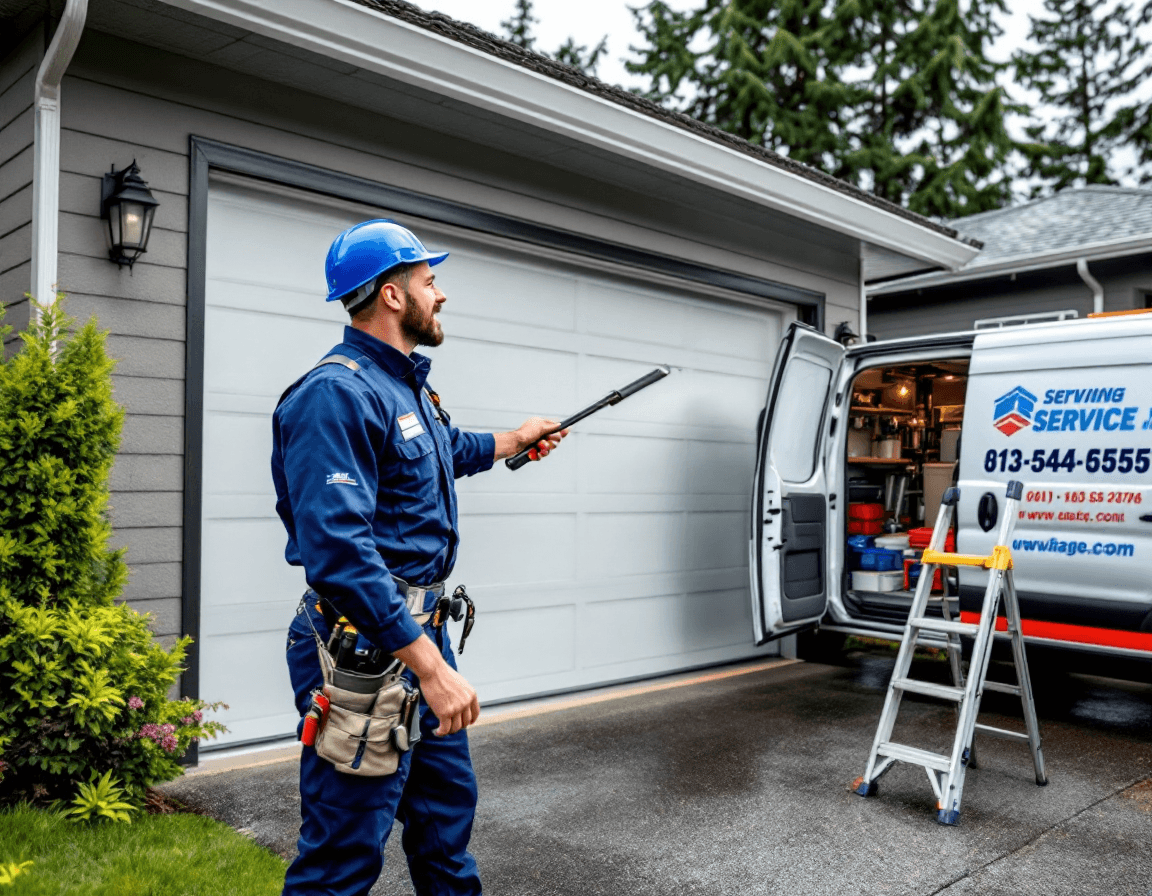
Garage door repair in Normandy Park, WA is rarely an emergency you can ignore for long. A door that stalls, reverses, or refuses to budge leaves your car exposed and your household stuck on the wrong side of a heavy panel. Our technicians serve homes across this small coastal city in southwest King County, from the blocks near Normandy Park Cove to the quieter streets tucked up from Marine View Drive. Most residential repairs in this area fall between $95 and $450, depending on which part has failed and how much labor the job requires.
Normandy Park sits close enough to Puget Sound that salt air, morning fog, and long stretches of drizzle are part of everyday life. Those conditions are generally kind to lawns and hard on steel, wood, and electronics, which is exactly what a garage door is made of. Hardware that looked fine during a dry summer can start to bind or corrode after a wet winter, and the symptoms often show up gradually. Knowing what your door is trying to tell you makes it far easier to catch a small problem before it becomes a service call that strands you at the curb.
This page walks through the common ways doors fail in our area, what each symptom usually means, and what a typical repair looks like from start to finish. It also explains where homeowners should stop and call a professional, because spring and cable work carries real risk. If your door is misbehaving right now, read the sections that match what you are seeing, then call us at (888) 799-3819 so a licensed technician can take a look.
Why Normandy Park Doors Show Wear Sooner Than Expected
Garage doors in this part of King County face a combination of stresses that inland neighborhoods often avoid. Moist air settles on the metal in the early mornings, and sea spray can carry a fine salt residue that finds its way into hinges, rollers, and the bottom weatherstripping. Over several seasons, that residue speeds up corrosion on steel tracks and roller shafts, which makes the door work harder every time it moves. The result is often a door that still opens but sounds rougher and travels less smoothly than it did a few years earlier.
Wood and composite doors add another layer of complexity. Many homes in and around Normandy Park have older wood panels or insulated steel doors whose panels expand slightly in damp weather and shrink again when the air dries out. That movement can rub against weatherstripping, shift the panels slightly out of line in their frames, and throw off the balance the opener depends on. A door that feels heavy on a humid afternoon but normal after a dry spell is often reacting to moisture rather than failing outright.
Lot conditions matter too. Driveways on sloped lots and homes that sit lower than the street can channel runoff toward the door threshold during heavy rain. Water pooling against the bottom seal or sitting in a track channel can freeze in rare cold snaps, and it can wash grit into rollers that were already sluggish. Paying attention to where water goes when it rains, not just how the door looks, is one of the most practical habits a homeowner here can build.
Reading the Early Warning Signs Before a Door Quits
Garage doors rarely fail without warning. Most stop-and-start breakdowns begin with small changes that homeowners notice but dismiss, such as a slightly slower opening speed, a faint squeak on the way up, or a bit of extra shaking at the top of the travel. Catching those early signals often means a shorter, cheaper visit and fewer surprises on a rainy weekday morning. A quick walk-around once a month is enough to spot most of them.
Here are the signs our technicians see most often in Normandy Park homes:
- The door hesitates for a second before it begins to move in either direction.
- The opener motor runs longer than usual or seems to strain under a door that used to lift easily.
- Rollers wobble in their tracks, or you can see a visible gap where a track meets the wall.
- Weatherstripping along the bottom has torn, flattened, or pulled away from the panel.
- The remote needs several presses before it responds, especially from the driveway.
Any one of these alone may be minor. Two or three together usually point to a system that needs attention before it strands you. Write down what you noticed and when it happened, because that detail helps a technician narrow down the cause quickly. If your door has started to show more than one sign at a time, schedule a repair visit rather than waiting for a complete failure.
When the Door Reverses Before It Reaches the Concrete
A door that starts closing and then springs back up before it touches the floor is doing exactly what it was designed to do, which is protect people and objects from being crushed. The safety reversal system is usually one of two types: an infrared sensor pair mounted near the floor on either side of the opening, or a pressure sensor built into the bottom edge of the door. Either one can trigger a reversal when it detects something, even if nothing is actually there.
In our experience, the most common cause in Normandy Park is a sensor that has been knocked out of alignment or has collected grime. Spiderwebs, dust, and salt film can dim the infrared beam, and a sensor bracket bumped by a trash bin or a stray shovel can tilt just enough to stop communicating with its partner. Start by checking that both sensor lenses are clean and that their small indicator lights are steady rather than blinking. Gently realign the brackets so each lens faces the other directly, then test the door again.
If the sensors look right but the door still reverses, the problem may lie in the closing force settings on the opener. An opener that has drifted out of calibration or a door that has become heavier from worn rollers can trigger a reversal even with clean sensors. Adjusting those settings incorrectly can create a genuine hazard, so this is a point where a licensed technician should take over. A door that reverses on a bright, dry day with nothing in its path deserves a professional look instead of repeated resets.
Noises That Tell a Story: Grinding, Squealing, and Banging
Garage doors are noisy by nature, but certain sounds are clear signals that something needs attention. A high-pitched squeal usually means dry or corroded metal rubbing against metal, often at the hinges or roller stems. A grinding noise points to worn rollers, a failing bearing, or grit caught in the track, and it tends to get louder over time. A sharp bang at the top or bottom of the travel often indicates a loose bracket, a worn cable drum, or a track that has shifted slightly out of position.
Seasonal humidity can make these sounds seem to come and go. Metal parts that were lubricated in summer can stiffen after a few weeks of wet weather, and rollers that ran quietly in the dry months may begin to complain once the moisture sets in. Wiping down the tracks with a clean cloth and applying a light lubricant designed for garage door hardware can silence many squeals. Avoid using heavy grease or household oils, which attract dust and grit and can make the problem worse.
A banging noise deserves more caution. Loose hardware can shift under load, and a door that slams against a stop can damage the opener or crack a panel. If the banging is accompanied by visible movement, a sagging edge, or a door that sits crooked, stop using it and call a technician. Repeated impacts stress components that were never meant to absorb them, and a small loose bolt can turn into a costly panel or track repair.
A Door That Looks Crooked, Sags, or Has Jumped Its Tracks
Few garage door problems look as alarming as a door that has come partly out of its tracks or hangs visibly lower on one side. A crooked door places uneven strain on the opener, rollers, and springs, and it can continue to worsen with every cycle. Homeowners sometimes assume the door is simply settling, but a sagging edge almost always signals a mechanical issue that will not correct itself.
Common causes include a roller that has popped out of its track, a bent section of track that was knocked during a delivery or a backing-up mishap, and a broken spring or cable on one side of the door. Each cause has a different level of danger. Rollers and bent track sections can sometimes be reseated or replaced by a trained technician, but spring and cable work involves tension that can release with enough force to cause serious injury. Under no circumstances should a homeowner attempt to adjust, wind, or replace a torsion spring or a lift cable.
Our standard advice for a crooked or off-track door is simple. Keep the door closed, keep people and vehicles clear of the opening, and disconnect the opener if you can do so safely from the outside using the emergency release cord. Do not try to force the door back into its track by hand. Once the door is secured, schedule a visit so a licensed technician can inspect the springs, cables, drums, and tracks before anything is moved.
Stuck Halfway: What Jams a Door Mid-Travel
A door that stops partway up or down is one of the more frustrating situations homeowners face, particularly on a cold morning when the car is already running. The most frequent cause is a safety stop triggered by the opener's force sensing, which can happen when the door meets resistance from debris, a frozen track, or a rough patch in the track channel. The opener interprets that resistance as an obstruction and halts the door to prevent damage.
Before calling for help, look at the tracks. Leaves, moss, wet debris, and gravel from a driveway can collect in the lower track and wedge rollers out of their path. Our coastal location makes this more common in autumn and winter, when fallen needles and leaves gather near the door. Clear the track carefully, avoiding any moving parts, and try the opener once more. If the door moves freely by hand when disconnected but binds when the opener is connected, the problem likely lies in the opener's travel settings or force calibration.
A door that will not move at all, even when the opener runs, may have a more serious mechanical issue such as a broken spring, a stripped gear, or a failed drive chain or belt. Those components carry significant load, and attempting to force the door can cause additional damage. A technician can diagnose the failure, confirm whether the door is safe to operate, and recommend the right repair. Keep the emergency release handle accessible so you can reach the door manually when needed.
Remotes, Wall Buttons, and the Electronics That Run the Door
When a remote or wall button does nothing, homeowners often assume the entire opener has failed. In reality, the cause is frequently much simpler. Remote batteries lose strength over time, and a fob kept in a damp car or a hot dashboard can drain faster than expected. Wall button wiring can become loose or corroded, especially where a wall switch sits on an exterior-facing wall or near a garage vent that lets moisture in during wet weather.
Begin with the simplest checks. Replace the remote battery, and test it at the opener itself to see whether the door responds. If the opener responds to its own control but not the remote, the remote may need to be reprogrammed or the receiver may have lost its memory after a power interruption. If the wall button fails but the remote works, inspect the wall plate for moisture, look for cracked insulation on the low-voltage wires, and confirm that the button is firmly seated in its housing.
Opener electronics can also be affected by power surges, which occur from time to time during Pacific Northwest storms and outages. A surge may reset the opener's logic board or damage a receiver module. If the opener shows a flashing light pattern, consult the manufacturer's diagram or call a technician, because those codes often pinpoint the exact fault. Attempting to open the logic board or rewire the motor without training can create a shock hazard and void warranties.
Slamming Shut or Closing Too Fast on a Sloped Driveway
A door that drops quickly and hits the floor with a thud is more than an annoyance. Rapid closing stresses the rollers, the track, the cables or chain, and the floor itself, and it can make the door feel unsafe to operate. Many homes in our service area sit on gently sloped lots, and the way the door meets the slab, along with how the opener's force and speed settings are tuned, can influence how the door behaves on the way down.
The most common causes of a fast-closing door include worn or misadjusted close limits, a balance problem that makes the door heavier on one side, and a damaged or stiff track. A door that closes faster than the opener is set to allow can also indicate a control board issue. Start by observing how the door behaves when you operate it slowly by hand from a neutral position. If it feels as if it wants to drop on its own, the balance is likely off, which is a job for a technician rather than a homeowner.
Adjusting the opener's speed settings is often part of the fix, but it should be done with care. Making the door close too slowly can cause the safety reverse to misfire, and making it too fast can damage the floor seal and the door bottom. Our technicians set speed and force together, testing the reversal function afterward to make sure the door stops and reverses reliably when it encounters an object.
Typical Repair Visits and What Affects the Price
Homeowners often ask what a repair will cost before they agree to a visit, so it helps to understand the factors that shape the final bill. For most residential repairs in Normandy Park, our pricing falls between $95 and $450. Simple jobs such as realigning a sensor, replacing a remote, or clearing a track typically sit near the lower end of that range. Repairs involving rollers, hinges, bottom seals, or opener components usually land in the middle, while more involved work on panels, drums, or drive systems may move toward the upper range.
Several variables drive the final figure. The make and model of the door and opener affects how easily parts can be sourced. Access matters too, since a door in a tight garage or one that requires extra disassembly takes more time. Whether the job is a one-time fix or part of a broader tune-up will also change the scope, and your technician should explain the options clearly before any work begins. A good visit ends with you knowing what failed, what was done, and what, if anything, should be monitored in the months ahead.
Spring and cable work is priced differently because it requires specialized tools, careful tension handling, and a higher level of safety precautions. Those repairs must be performed by a licensed professional, and they are often the most significant expense a homeowner faces. If a technician recommends spring replacement, ask them to walk you through the reason and the parts involved so you understand what you are paying for and why it matters.
Keeping Repairs Small With Seasonal Care for Coastal Weather
The best repair is often the one that never becomes urgent. A simple maintenance routine built around Western Washington's weather can prevent many of the problems described above. In late summer, before the rainy season settles in, clean the tracks, wipe down the rollers and hinges, and apply a light lubricant designed for garage door parts. Check the weatherstripping along the bottom edge and replace it if it is cracked or compressed. These steps take less than an hour and can extend the life of the entire system.
Coastal air calls for extra attention to corrosion. Rinse exterior hardware occasionally with fresh water, especially after storms that carry spray or wind-blown salt, and dry the surfaces with a cloth. Look for orange or brown spots on tracks and brackets, which signal early rust, and address them before they spread. Keep the garage floor free of standing water and make sure any drainage near the door sends runoff away from the threshold.
Testing the safety features once a month is one of the most valuable habits a homeowner can build. Place a sturdy object on the floor in the door's path and run the door through its closing cycle. It should reverse immediately when it contacts the object. Test the auto-reverse sensors by briefly interrupting the beam. If either system fails to respond, stop using the door and call a technician. Routine checks like these catch problems early and keep your household safer.
Safety Lines You Should Never Cross on Your Own
Some garage door work is well within the reach of a careful homeowner, such as cleaning sensors, lubricating moving parts, or replacing a remote battery. Other work is dangerous and should never be attempted without training and proper tools. Torsion springs and extension springs store enormous amounts of energy, and a spring that releases unexpectedly can cause severe injury or worse. Lift cables can snap under tension, and drums can unwind rapidly when released. Every spring and cable repair must be handled by a licensed professional.
If you suspect a spring or cable has failed, there are a few signs to watch for. A loud bang from the garage that sounds like a gunshot, a door that suddenly sags or refuses to lift, or cables that hang loosely on one side all point to a failure that needs immediate professional attention. Do not attempt to re-tension the spring, wrap cables, or pry the door into place. Keep people and pets away from the area, and avoid standing beneath the door until it has been secured.
Our commitment to safety means we will always recommend licensed professional service for spring and cable work, and we will explain our findings in plain language so you can make an informed decision. Being licensed, bonded, and insured gives you added assurance when a repair involves tension, heavy components, or access to the overhead track system. When in doubt, call before you touch anything.
Getting Your Normandy Park Door Back on Track
Garage doors carry a lot of weight in daily life, and a malfunction can disrupt everything from morning commutes to grocery runs. Whether your door is reversing too early, grinding through its track, sitting crooked, or refusing to respond to the remote, the right next step starts with understanding what the symptom means and acting before a small issue grows. Normandy Park's coastal climate and wet seasons put real demands on hardware, so a little attention to moisture, corrosion, and track cleanliness goes a long way.
If your door is showing any of the signs described on this page, we are ready to help with a prompt, thorough inspection and a clear explanation of what it needs. Most residential repairs in the area fall between $95 and $450, and we will walk you through the options before any work begins. For spring, cable, or any repair involving high tension, you can count on licensed technicians who put safety first.
Call Seattle Garage Door Fix at (888) 799-3819 to schedule your Normandy Park garage door repair today.