
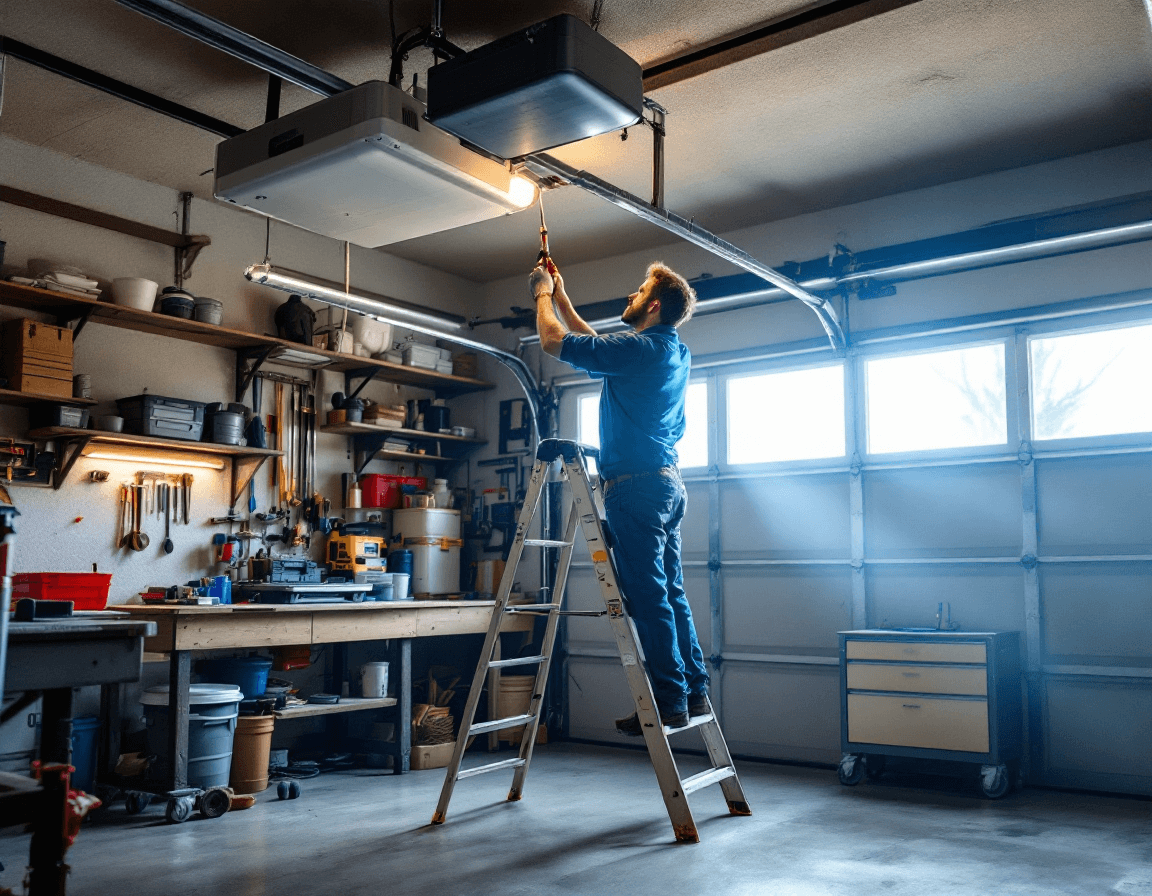
Garage door opener repair in North Bend, WA is one of the most common calls we handle in the Snoqualmie Valley, and it is rarely a mystery once someone looks at the right part of the system. A North Bend homeowner might notice the door sitting halfway down after a rainy commute up from Interstate 90, or hear a sudden clatter from the ceiling on a frosty November morning. The opener is a small motor, a logic board, a drive mechanism, and a set of sensors all working together, and any one of them can cause the same frustrating result: a door that won't behave. This page explains how those parts fail, what the warning signs look like, and what a careful technician checks before recommending a repair.
Our work covers motor, gear, circuit board, and travel-limit troubleshooting on every major opener brand, and most opener repairs fall within a range of $95 to $375 depending on the part involved and the labor it takes to reach it. Final pricing always depends on what the inspection finds, and we will explain the options before any work begins. Whether your home sits near the Downtown North Bend core, out along the rural roads toward Tanner, or in a neighborhood with a view of Mount Si, the underlying mechanics are the same, though the local climate and property conditions can shape which failures show up first. The sections below walk through those patterns in plain language so you can describe the problem accurately when you call.
Why Foothill Weather Shapes Opener Problems in North Bend
North Bend sits at the edge of the foothills, where cool, damp air from the Cascades and the Snoqualmie Valley meets the moisture that rolls in off Puget Sound. Winters bring long stretches of drizzle and fog, and the valley floor can hold a chill well into the morning even when the afternoon warms up. That daily temperature swing matters more to a garage door opener than most homeowners realize. Metal contracts and expands, lubricants thicken, and humidity condenses on surfaces that were never designed to stay wet for weeks at a time. Over a few seasons, those conditions wear on the same connections, sensors, and rail hardware that keep your door moving smoothly.
Many North Bend garages are attached or detached structures that were not built with climate control in mind. Some have unsealed slab floors, gaps around the weatherstripping, or a utility sink that drips into a corner. Humidity can creep into the opener housing, especially in older installations where the ceiling mount sits close to the roof framing and sees little airflow. Moisture on the circuit board can cause intermittent contact faults, and it can corrode the terminals on the wall console and the safety sensors near the floor. Because these problems develop gradually, they often show up as odd behavior first, such as a door that works fine on dry days and stalls after a week of rain.
Dust and debris also travel differently here. Fir needles, fine grit from gravel driveways, and leaf litter get tracked in on tires and shoes, and they settle into the track channel and onto the drive gear. Mount Si's forested slopes and the wooded lots around Tanner add pollen in spring and falling needles in autumn. None of this is unusual, but it means a North Bend opener benefits from a periodic inspection that goes beyond a quick glance at the remote. When a technician knows what the local environment does to equipment, the diagnosis tends to be faster and more accurate.
When the Motor Hums but the Door Stays Put
One of the most puzzling symptoms we hear about is an opener that makes a clear motor sound, perhaps a steady hum or a short buzz, while the door refuses to lift or lower. Homeowners often assume the motor has died, but a humming motor usually means power is reaching the unit and the control board is sending a signal. The problem tends to sit somewhere between the motor and the door, such as a disconnected drive coupling, a stripped gear inside the head unit, or a door that has become mechanically stuck on the track. Each of those causes produces a similar sound and a similar result, so careful listening and a few simple checks help narrow the field.
A technician will typically start by disengaging the trolley and moving the door by hand to see whether it travels freely. If the door feels heavy or binds at one point, the cause may be a bent track, a worn roller, or a spring that has lost tension, and any spring work belongs to a licensed professional. If the door moves freely by hand but the opener still hums without lifting it, the drive system is the likely suspect. Worn drive gears, a broken chain link, or a slipping belt can all allow the motor to spin without transferring force to the door. Our diagnosis at this stage focuses on confirming where the power stops.
Some openers also hum briefly when they detect an obstruction or when the force setting is too aggressive for the door's current load. In a North Bend garage, a door that has absorbed moisture or swollen slightly after a wet spell can feel heavier than usual, and a mismatched force setting may cause the opener to strain without success. Adjusting these settings is a reasonable first step for many homeowners, but repeated humming with no movement should be checked before the motor is stressed further. Continuing to run a strained opener can heat the windings and shorten the life of the unit.
Remote and Wall Button Silence: Sorting Batteries From Boards
When the door doesn't respond to the remote or the wall button, the cause can be as simple as a weak battery or as involved as a failed logic board. Start by checking the remote battery and confirming that the wall console has power and is not stuck or swollen. Many North Bend homeowners keep remotes in a car visor or a jacket pocket, where they experience temperature swings and moisture that accelerate battery drain. A replacement battery costs very little, and it is worth trying before assuming a larger failure. If the wall button also fails, the problem is less likely to be the remote itself.
The next step is looking at the opener's learn button and the receiver. Some units have lost their programmed codes after a power outage, a firmware issue, or a storm that caused a brief surge. Reprogramming is usually straightforward, but a technician will also check the antenna wire, which can become disconnected or damaged where it hangs from the power unit. If the antenna is intact and the codes are present, the receiver board may have failed. Moisture and condensation are common contributors to receiver faults in damp garages, so a board that works in July and fails in January often points to an environmental cause.
Wall consoles deserve attention as well. Their wiring runs through the wall and can loosen or corrode over time, especially where the wire passes near a cold exterior wall. A console that only works intermittently may have a poor connection rather than a dead switch. Testing the wiring at both ends usually reveals the fault. If the console and receiver both test fine, the logic board is the next place to look, and board-level diagnosis is where a trained technician earns their keep.
The Grinding Head: Stripped Gears and What They Mean
A grinding or whining noise from the opener head is one of the clearest signals that something inside the drive system needs attention. In most residential units, the motor turns a small gear that engages a larger gear or a screw-style drive shaft, and that interface takes a lot of repeated stress. Over years of cycles, teeth can wear down, shear off, or strip completely. A stripped gear often produces a rough grinding sound, a clicking noise on each cycle, or a jerky start and stop as the teeth slip past one another. Ignoring it can damage the motor shaft or the surrounding housing.
Gear problems are more common in openers that have been used heavily, installed with a poorly balanced door, or left without lubrication for long periods. A door that is slightly out of balance forces the opener to work harder, and that extra load wears the gear faster. Dust and grit from the garage floor can also work into the gearbox, and moisture can thin or emulsify the grease that is supposed to protect the teeth. In North Bend's damp climate, we sometimes find gearboxes with grease that has turned into a gummy residue, which accelerates wear even when the gears look intact.
Repairing a stripped gear usually means opening the head unit, removing the damaged component, and installing a matched replacement. Some brands make it simple to source parts, while others require more searching. A technician will also check the motor, the drive shaft, and the mounting bracket for secondary damage, because a stripped gear can stress those parts as well. We recommend addressing grinding noise promptly rather than waiting for the opener to fail completely, since a partial failure can leave the door stuck in a half-open position.
Doors That Stop Short or Snap Back: Travel Limits and Force Settings
Travel-limit problems are common in every climate, but they can be especially confusing in North Bend because seasonal changes affect how the door tracks. A door that closes almost all the way and then reverses, or that stops a few inches above the floor and won't go lower, usually points to a limit setting that has drifted. Limits tell the opener where the fully open and fully closed positions are. When the door's weight changes, when the rollers wear, or when a cable or chain stretches, the limits may no longer match the door's real travel. Setting them correctly restores smooth, complete movement.
Force settings are the companion to limits. These control how much pressure the opener applies before it decides something is in the way. If the force is set too low, a door that is slightly sticky in damp weather may reverse unexpectedly. If it is set too high, the opener may push against an obstruction rather than stopping, which can cause damage to the door or injury. Many modern openers have automatic force learning, but they still need a clean baseline. Our technicians test both the limit and force settings under real operating conditions, not just on paper, because a door can behave differently when it is cold or the tracks are damp.
Safety reversal is a related feature that deserves special attention. Photo-eye sensors near the floor should align and clear, and the wiring should be intact. A sensor that is dirty, misaligned, or wet can cause the door to reverse immediately, even when nothing is blocking the path. Cleaning the lenses and checking the bracket angle solves many of these cases. If the door still reverses without cause, the issue may lie in the control board or the sensor wiring, and both should be inspected before any other adjustments are made.
Blinking Lights as a Diagnostic Language
Many openers communicate their problems through a pattern of blinking lights on the motor head or the logic board. A repeating sequence, such as a light that flashes several times and pauses, is meant to indicate a specific fault category. The exact codes differ by brand and even by model year, so the owner's manual or the label inside the cover is the best place to begin. For a homeowner, the important thing is to notice the pattern, count the flashes, and write down whether the light blinks steadily or in bursts. That detail helps a technician narrow the cause quickly.
Common categories include sensor faults, obstructions, travel-limit errors, and communication problems between the wall console and the head unit. A sensor code may point to misalignment or a wiring break, while an obstruction code can mean something physically blocks the door or the force settings need review. Communication faults sometimes trace back to a loose connector or to moisture inside the head housing. In a damp garage, a faint blink pattern that appears only on rainy days may signal a connection that is losing contact as humidity rises.
Reading the lights is useful, but it is not a substitute for a full inspection. Some codes can be triggered by more than one cause, and clearing the code without addressing the root problem usually leads to a repeat call. We recommend recording the pattern, noting when it occurs, and sharing those details when you schedule service. That information often shortens the diagnosis and avoids unnecessary parts replacement. If the lights are accompanied by smoke, a burning smell, or a hot housing, shut off power at the breaker and call for service before running the opener again.
Chains, Belts, and the Rail Problem
Chain-drive and belt-drive openers both rely on a continuous loop that pulls the trolley along the rail. A chain can stretch, slip off its sprocket, or develop a broken link, and a belt can loosen, fray, or jump off its pulley. When this happens, the motor may run normally while the door stays still or moves unevenly. Homeowners sometimes notice a loose chain hanging low over the rail, a slapping sound during operation, or a gap at the front of the track where the trolley no longer connects. Any of these signs calls for prompt attention, because a loose drive loop can jam the door or cause sudden movement.
Tension adjustment is a routine part of opener service, and it is one of the areas where a careful technician makes a noticeable difference. A chain that is too tight strains the motor and the bearings, while one that is too loose can skip under load. Belts require a different tension approach, and the wrong setting can shorten belt life. We also inspect the rail for bends, loose mounting brackets, and debris that could catch the trolley. In North Bend homes where the rail is anchored to older framing, a bracket that has shifted slightly can create enough misalignment to slow the entire system.
It is worth clarifying the boundary here. Opener drive loops, rails, and trolleys are within the scope of opener repair, but the torsion or extension springs that counterbalance the door are a different matter. Those springs carry significant stored energy, and mishandling them can cause serious injury. If a drive problem leads you to suspect a spring issue, stop operating the door and call a licensed professional. We discuss that boundary further in the safety section below.
Intermittent Operation in Damp Garages
Intermittent operation is one of the most frustrating symptoms because it defies easy testing. The door may work perfectly for a week and then fail on a Tuesday morning, or the wall button may respond only when tapped a certain way. These problems often come from loose connections, aging capacitors, or moisture that comes and goes with the weather. In North Bend, a garage that feels dry in the afternoon can hold enough humidity overnight to affect sensitive electronics, and that cycle can produce failures that seem random to the homeowner.
A systematic approach helps. We begin by checking every visible connection in the head unit, the wall console wiring, and the safety sensors. Terminal screws that have loosened from vibration can create intermittent contact, and corroded wire ends can add resistance that causes erratic behavior. We also examine the logic board for signs of moisture, discoloration, or swelling in components. Improving garage ventilation, sealing gaps around the door, and keeping the floor clear of standing water can reduce the chance that a repaired opener fails again for the same environmental reason.
Some intermittent faults are caused by power supply issues. A brief voltage dip, a shared circuit with a heavy appliance, or a failing outlet can make an opener reset or behave strangely. If the problem seems tied to other household events, such as the refrigerator cycling or the furnace starting, it may be worth having the circuit checked. We are careful to explain when a fault may fall outside opener repair, because that honesty helps you decide whether to involve an electrician as well.
What a North Bend Opener Repair Visit Typically Covers
Every visit begins with a conversation about the symptoms you are seeing, when they started, and whether anything changed before they appeared. We then inspect the door by hand, observe the opener through a complete travel cycle, and test the remote, wall console, and safety sensors. This sequence helps separate mechanical problems from electrical ones and prevents unnecessary parts from being installed. Once the cause is identified, we explain the repair options, the expected cost range, and whether the repair is likely to be durable given the age and condition of the unit.
A typical visit may include some or all of the following steps, depending on what the inspection reveals:
- Confirming power supply, outlet condition, and the opener's dedicated circuit
- Testing the remote, receiver, and wall console wiring
- Checking the logic board, motor, and drive gear for wear or damage
- Inspecting chain or belt tension, rail alignment, and trolley engagement
- Adjusting travel limits and force settings under real operating conditions
- Cleaning and aligning photo-eye safety sensors and verifying wiring
- Lubricating moving parts with products appropriate for the opener's design
Most opener repairs we perform fall in a range of $95 to $375, though complex board or motor work may vary. We will not proceed with any repair without your approval, and we will explain why a particular part is needed. If your opener is nearing the end of its service life, we will say so and discuss whether replacement makes more financial sense than continued repair. Our goal is to give you a clear, honest picture so you can decide with confidence.
Brand Coverage and Choosing Between Repair and Replacement
Homeowners in North Bend have a wide range of opener brands in their garages, from long-established names such as Chamberlain, LiftMaster, and Genie to Ryobi and other models sold through home improvement retailers. We service major opener brands and their common models, and we work with the diagnostic tools and parts sourcing needed for each. Brand matters because control systems, code patterns, and gearbox designs differ, and a technician who knows the platform can usually find the fault faster. If you are unsure which brand you have, the label on the motor housing or the owner's manual will show the model number.
The repair-versus-replace decision depends on several factors. The age of the opener, the availability of parts, the extent of the damage, and the condition of the door all play a role. A relatively new unit with a single failed component is often worth repairing, while an older unit with a damaged housing, multiple failing systems, or a discontinued control board may be better replaced. We also consider whether the existing opener meets current safety expectations, such as working photo-eye sensors and an auto-reverse feature that functions correctly. Replacement is sometimes the more sensible choice, and we will tell you when that is the case.
When replacement is recommended, we discuss features that matter in this region, such as sealed motor housings, battery backup for power outages, and smart controls that can report faults. Quality openers are an investment, and choosing one that fits the garage, the door weight, and the household's habits can prevent repeat calls. We aim to recommend equipment based on what your home needs rather than on what carries the highest margin.
Safety Boundaries: What Stays With a Licensed Professional
Garage door safety is not something to improvise. Springs, cables, and drums hold substantial tension, and a door that falls or a spring that releases can cause serious injury or property damage. For that reason, any work involving torsion springs, extension springs, lift cables, or drum assemblies should be handled by a licensed and insured professional. We are licensed, bonded, and insured, and we treat spring and cable work as a specialized task that requires proper tools, training, and caution. Homeowners should never attempt to wind springs or remove tension on their own.
Homeowners can take some safe steps while they wait for service. Keep the remote out of children's reach, avoid standing under a door in motion, and do not hang objects from the door or opener. If the door is stuck, do not force it or pull on the emergency release repeatedly, because that can cause the door to drop unexpectedly. If you suspect a broken spring or cable, keep everyone clear of the door and call for help. Regular visual checks, such as looking for frayed cables, loose hardware, or visible gaps in the door panels, can also help you spot problems early.
Our goal in opener repair is to restore reliable operation while respecting these boundaries. We will tell you plainly when a problem extends beyond the opener, and we will help you understand what needs attention next. Clear communication and careful work are the foundation of our service in North Bend and across the greater Seattle area.
If your North Bend garage door opener is humming without moving, grinding, blinking an unfamiliar pattern, or simply refusing to cooperate, we are ready to help. Call Seattle Garage Door Fix at (888) 799-3819 to describe what you are seeing, schedule a diagnostic visit, and get a clear explanation of your options before any work begins.