
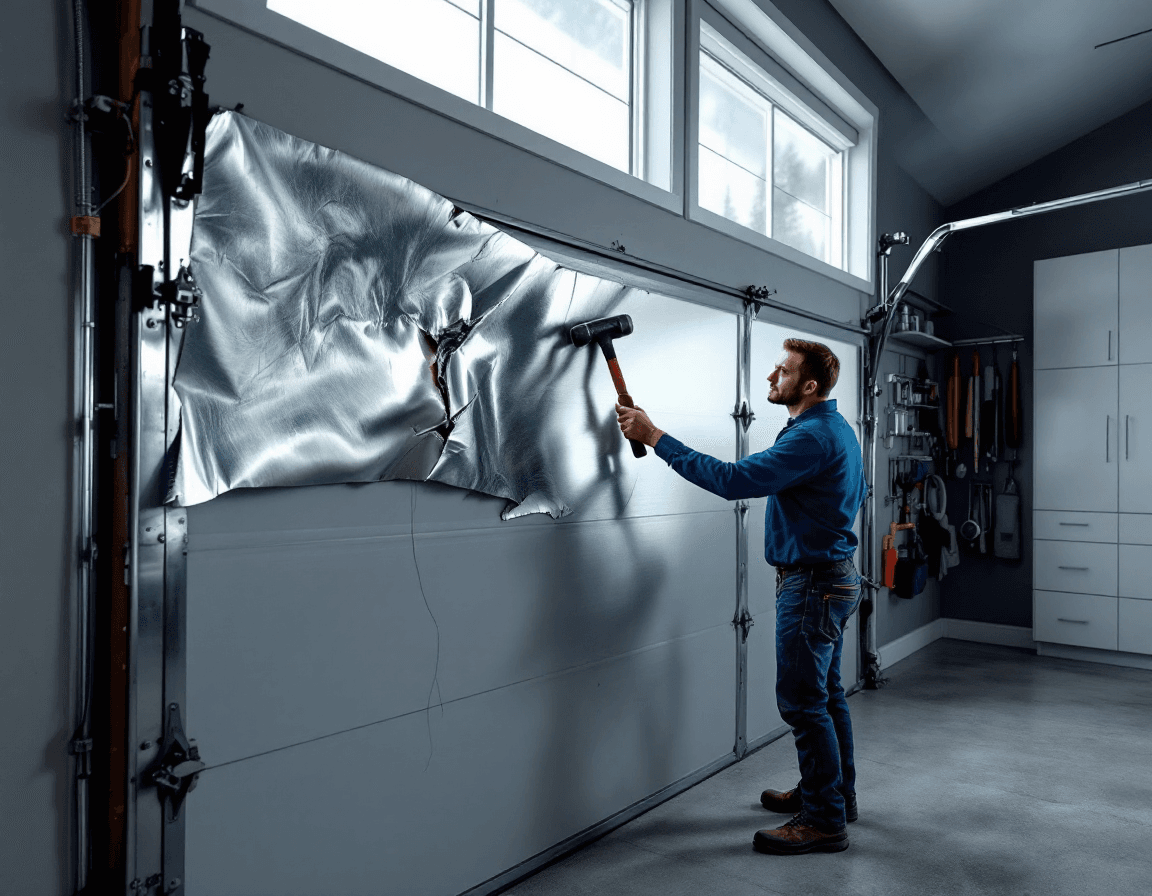
Garage Door Panel Replacement in North Bend, WA is one of the most common repairs we handle across the Snoqualmie Valley, and it often starts with a single ugly dent after a backing-up mishap or a bottom section that looks waterlogged after a wet February. Many homeowners assume that one damaged panel means buying an entirely new door. In most cases that isn't necessary. Sectional garage doors are built from individual panels that bolt together, so a damaged section can usually be swapped out while the rest of the door, including the springs, tracks, and opener, stays in place.
North Bend sits at the foot of Mount Si in the upper Snoqualmie Valley, where the air stays cool and damp for much of the year and the Snoqualmie River keeps the ground soft in the low spots. Those conditions show up on garage doors in predictable ways: moisture wicks into the bottom rows, mildew creeps along seams, and steel sections that have seen a few decades of rain begin to rust at the edges. Homes near Downtown North Bend, along the routes toward Tanner, and in the neighborhoods across ZIP 98045 all see their own version of this wear, shaped by how much afternoon sun the door receives and how close it sits to the driveway.
This page walks through the situations we see most often, explains how to tell a panel problem from a larger door problem, and gives a realistic sense of what section replacement costs. Pricing typically falls between $250 and $800 per section, depending on the door's make, the panel style, insulation, and how difficult the existing panel is to match. Read on to decide whether a panel swap is the right fix for your door, or whether it makes more sense to step back and look at the full picture.
The Dent That Started It All: Reading Impact Damage Honestly
A dent is often the first thing a homeowner notices and the last thing they want to think about, but not every dent means the same thing. A shallow crease across the middle of a steel panel may be purely cosmetic, while a sharp fold near a hinge or roller can weaken the panel's ability to stay flat as it travels along the track. When a panel is bent, the stress doesn't always stop at the damaged area. It can pull on the hinges, shift the alignment of neighboring sections, and cause the door to rub or bind as it opens and closes.
Pay attention to where the damage sits. A dent in the upper panel that never touches the track is usually a straightforward swap. A dent in a lower panel that has pushed the edge out of its groove, or one that has cracked the vinyl or foam core, deserves a closer look because it can allow cold air and moisture into the door. If the door has a window section, check whether the impact has cracked the glass or loosened the frame, since that often requires replacing the entire section rather than repairing it.
- Look for creases that run across the full width of a panel, which usually indicate a bent structural rib.
- Check whether the dented panel's edges still sit squarely in the tongue-and-groove joints with the panels above and below.
- Note any cracked paint, exposed bare metal, or hairline splits in composite and wood-look panels.
- Watch the door through one full open and close cycle and listen for scraping, popping, or a sudden jump in the track.
If the door moves cleanly after a dent and nothing scrapes, a replacement section often restores the look without changing how the door operates. If the door hesitates, leans, or makes new sounds, the impact may have affected more than the surface.
Water Lines and Bottom Panels After a Wet Valley Winter
The bottom section of a garage door takes the worst of the weather. Rain runs down the driveway, splashes up from the concrete, and collects in the gap beneath the door when the threshold seal has worn thin. In the Snoqualmie Valley, where the wet season lingers well into spring, that bottom panel can stay damp for weeks at a time. Over the years, the constant moisture softens insulation in insulated doors, lifts paint, and encourages corrosion along the inside of the panel where you rarely look.
Water damage often shows up as a dark band that won't wipe away, a panel that feels spongy when pressed, or a faint musty smell when the door has been closed for a while. Sometimes the bottom section looks fine from the outside, but the foam core has absorbed water and no longer provides insulation. In steel doors, the lowest rows can develop rust at the seams where water pools. A bottom panel that has been compromised by water is worth replacing sooner rather than later, because the moisture will spread upward through the joints if it is left alone.
Water damage also raises a practical question about the threshold and weatherstripping. Replacing a bottom panel without addressing the seal at the floor usually means the new panel will face the same conditions within a season or two. When we replace a bottom section, we typically check the bottom weatherstrip, the threshold, and the drainage path from the driveway so the new panel isn't set up to fail the same way. That small extra step tends to protect the investment far better than the panel alone.
Rot, Rust, and the Damp Air Coming Off the Foothills
Wood garage doors and wood-look composite doors face a different set of challenges in North Bend. Cedar and fir can hold moisture for long stretches, especially on the north or shaded side of a house where the sun rarely dries the surface. Once water gets under the finish, the wood begins to swell, the edges separate from the rails, and soft spots appear near the bottom edge or around the hardware. Left unchecked, that softened wood can crack and split along the grain. Rot in a wood panel is rarely confined to the visible surface, so it is important to probe any suspicious area with a screwdriver before deciding on a repair.
Steel doors have their own vulnerabilities. Scratches that expose bare metal allow rust to start, and once it starts it spreads under the paint, pushing the coating outward in small blisters. Rust is especially common where two panels meet, where hinges and rollers rub, and along the bottom edge. Surface rust caught early can sometimes be cleaned, primed, and painted, but deep rust that has thinned the steel or perforated the panel calls for replacement. A panel that crumbles when tapped or leaves an orange residue on your hands has passed the point of simple touch-up work.
Rot and rust both tend to hide behind a clean-looking exterior. When we inspect a suspect panel, we look at the back side, the edges, and the joints, because that is where the damage usually begins. If you notice soft wood, flaking steel, or swollen edges, it is worth having the panel examined before the problem reaches the hinges, the track, or the rails. Catching it early typically keeps the repair to a single section rather than a larger rebuild.
Matching a Panel That Has Been Sitting in the Sun
One of the most common frustrations we hear from homeowners is that a new panel doesn't match the old ones. Paint and finish fade over time, especially on the south- and west-facing sides of a house that catch afternoon light. A panel that was installed fifteen years ago may have weathered to a noticeably different shade than its neighbors, even if the door itself was in good shape. When a single section needs replacing, the new panel arrives fresh from the factory, and the contrast can be jarring.
Matching involves more than color. Panel profile, groove spacing, embossing pattern, thickness, and whether the panel is insulated all affect how well a replacement fits. Some manufacturers have discontinued older door lines, which can make an exact match difficult. In those cases, we start by identifying the door's make and model from the label or hardware, measure the panel height and width, and check the spacing of the rib pattern. If an exact match is unavailable, we discuss options such as a close color match with a clear explanation of the difference, or in some cases repainting the full door so the sections blend together.
Homeowners sometimes ask whether they can simply paint the new panel to match. That is possible for many steel doors, but it requires proper prep, a suitable primer, and paint designed for exterior metal. Painting a panel that has weathered unevenly may still show a difference in sheen. We are candid about what paint can and cannot do so you can decide whether a patch will look acceptable or whether a more complete refinish makes sense.
Repair or Replace: Making the Call on a Damaged Door
Deciding between repairing a panel and replacing a section is the core question on most service calls. Section replacement is usually the right move when the damage is limited to one or two panels, the door's springs and track are in good condition, and the remaining panels are still straight and sound. Replacing a section restores the door's appearance and weather resistance without the expense of an entire new door, and in most cases the work can be completed in a single visit.
There are times when replacing one panel doesn't make sense. If the door is old and several panels show rust or rot, replacing one section simply moves the problem to the next one. If the door's frame or track is bent, a new panel will be placed on a structure that continues to misalign it. And if the door lacks the insulation or weatherstripping you want for comfort, a full door replacement may deliver far better value. Sometimes the honest answer is that a panel swap buys you a few years, and a new door is the better long-term investment.
- Replacing one or two panels is typically reasonable when the rest of the door is square, quiet, and free of rust.
- Consider a full door if three or more panels are damaged, or if the damage is spread across the bottom and top sections.
- Factor in the age of the springs and opener, since a new panel will not extend the life of worn hardware.
- Think about your goals, whether that is curb appeal, energy performance, noise reduction, or simply stopping water from getting in.
We are happy to lay out both options with honest figures so you can choose what fits your home and budget.
What a Panel Replacement Typically Costs in North Bend
Panel replacement pricing generally falls between $250 and $800 per section. The wide range reflects real differences in the work. A basic steel panel on a common residential door sits at the lower end, while an insulated composite, wood-look, or custom panel that requires special ordering sits higher. The number of sections involved matters too, since each additional panel adds materials and labor. Access and condition also play a role, because a panel that is tightly bound by hardware or stuck in a rusted track takes longer to remove safely.
Several factors can push the cost toward the upper end of that range. Discontinued panel styles may require sourcing from a specialty supplier. Insulated panels cost more than single-layer steel, and matching a panel that carries a specific finish or texture adds time. Repairs that also involve replacing weatherstripping, brackets, or roller hardware will change the total. We discuss these items before any work begins so the estimate reflects what your door actually needs rather than a generic guess.
It is also worth remembering what the price does not include. Spring and cable work is a separate category, and the tension on a garage door's springs can be dangerous to handle without proper tools and training. If your inspection reveals worn springs or frayed cables, we will explain that work and its cost separately, and we will recommend a licensed professional for any spring or cable service. Keeping those items distinct helps you understand exactly what you're paying for.
When the Door Runs Smoothly but Still Looks Wrong
Some of the calls we take come from homeowners whose doors open and close without any trouble but simply look damaged. A dented panel near the top of the door, a faded section next to a newer one, or a cracked edge along a seam can make the whole house look neglected even when the mechanics are perfectly sound. In a neighborhood where many homes share similar architecture, a poorly maintained door stands out, and it can affect how a property presents when it comes time to sell.
A cosmetic problem still deserves attention, however. Small cracks in a panel can expand during cold snaps, when the material contracts and the crack widens. A dent that has broken the paint can become a starting point for rust. Because the door is working correctly, it is easy to postpone the repair, but a panel replacement at this stage is usually simpler and less expensive than waiting until the damage has spread to the hinges or the adjacent sections.
If the door works but looks worn, a panel swap is often the most efficient upgrade. It refreshes the appearance without disturbing the springs, tracks, or opener, and it lets you address one problem area without committing to a larger project. We are glad to walk through the door with you and point out exactly which panels are affecting the look and which ones are simply showing normal age.
After a Backing Accident: A Safety-First Checklist
A backing accident is one of the most common reasons a single panel gets damaged. A car bumper, a trash bin, or a basketball hoop can strike the lower section and bend it inward or pop it out of its track. The first priority after any impact is safety. Do not attempt to force a damaged door open or closed, and keep children and pets clear of the opening. If the door is off its track or hanging unevenly, disconnect the opener by pulling the emergency release cord and keep the door closed until it can be assessed.
Once the door is secure, take a few minutes to look over the damage. Check whether the panel is still seated in the tracks, whether the rollers are intact, and whether any brackets have bent or torn free. Look at the springs and cables without touching them. If you see a gap in a spring, a cable that has come loose from the drum, or any sign that the door's tension has shifted, leave those components alone and call a licensed professional. Spring and cable work carries serious risk, and it should only be handled by trained technicians with the proper equipment.
Many backing accidents can be resolved with a single panel replacement and a realignment of the track. If the impact was strong enough to bend the track or damage the header bracket, the repair may involve more hardware. Document the damage with photos before the work begins, which can be useful if you need to file an insurance claim. We can coordinate that documentation and give you a clear written description of what was affected.
How a Panel Swap Usually Unfolds on a North Bend Home
A panel replacement follows a predictable sequence, though every door has its own quirks. We begin by identifying the door's make, model, and panel profile, usually from a label on the inside of a panel or from the manufacturer's hardware. We then measure the damaged section and confirm whether the replacement needs to match an existing finish, color, and texture. Once the correct panel is sourced, we plan the removal so the surrounding sections stay supported and the door remains balanced throughout the work.
During installation, the damaged panel is removed by carefully disengaging the hinges and rollers that connect it to its neighbors. The new panel is then fitted into the same position, and the hardware is reattached with attention to alignment. We check that the edges sit flush in the tongue-and-groove joints, that the door travels smoothly along the track, and that the panel does not rub the frame or the floor. Before we leave, we run the door through several full cycles and confirm that the opener responds correctly.
Because garage doors in the valley see heavy seasonal moisture, we also look at the surrounding weatherstripping and the bottom seal as part of the visit. A new panel will serve you best when the rest of the door keeps water and drafts out. If we notice worn seals or cracked brackets, we explain what we found and what it would take to address it, so you can decide how far to take the repair.
Keeping a Replacement Panel Looking Its Best Through Wet Seasons
Once a new panel is in place, a few simple habits can extend its life and keep it blending with the rest of the door. Wash the exterior with a mild soap and water every few months, paying attention to the bottom rows where road grime and moisture collect. Rinse thoroughly, since residue left on the surface can attract dirt. For steel doors, a light inspection for chips or scratches once or twice a year makes it easier to catch rust before it spreads under the finish.
Moisture control matters just as much as cleaning. Check the bottom weatherstrip each season and replace it when it flattens, cracks, or pulls away from the door. Keep the area in front of the door clear of standing water, and direct gutter runoff away from the driveway if possible. In a home where the garage stays cool and damp, a small dehumidifier or regular ventilation can reduce the condensation that encourages mildew and corrosion on the inside of the panels.
Finally, pay attention to how the door behaves over time. A panel that starts to rub, a track that begins to shift, or a seam that opens unevenly are all early signals that something needs attention. Addressing those signs quickly keeps a single panel repair from turning into a bigger project. If you ever feel unsure about what you're seeing, a short inspection can clarify whether the issue is cosmetic, moisture-related, or a sign of a deeper problem.
If a dented, cracked, water-damaged, or mismatched panel is affecting your North Bend garage door, call Seattle Garage Door Fix at (888) 799-3819. We will look at the door with you, explain whether a panel replacement or a larger repair makes the most sense, and give you a clear price before any work begins. For any spring or cable concerns, we will recommend a licensed professional and walk you through what that involves.