
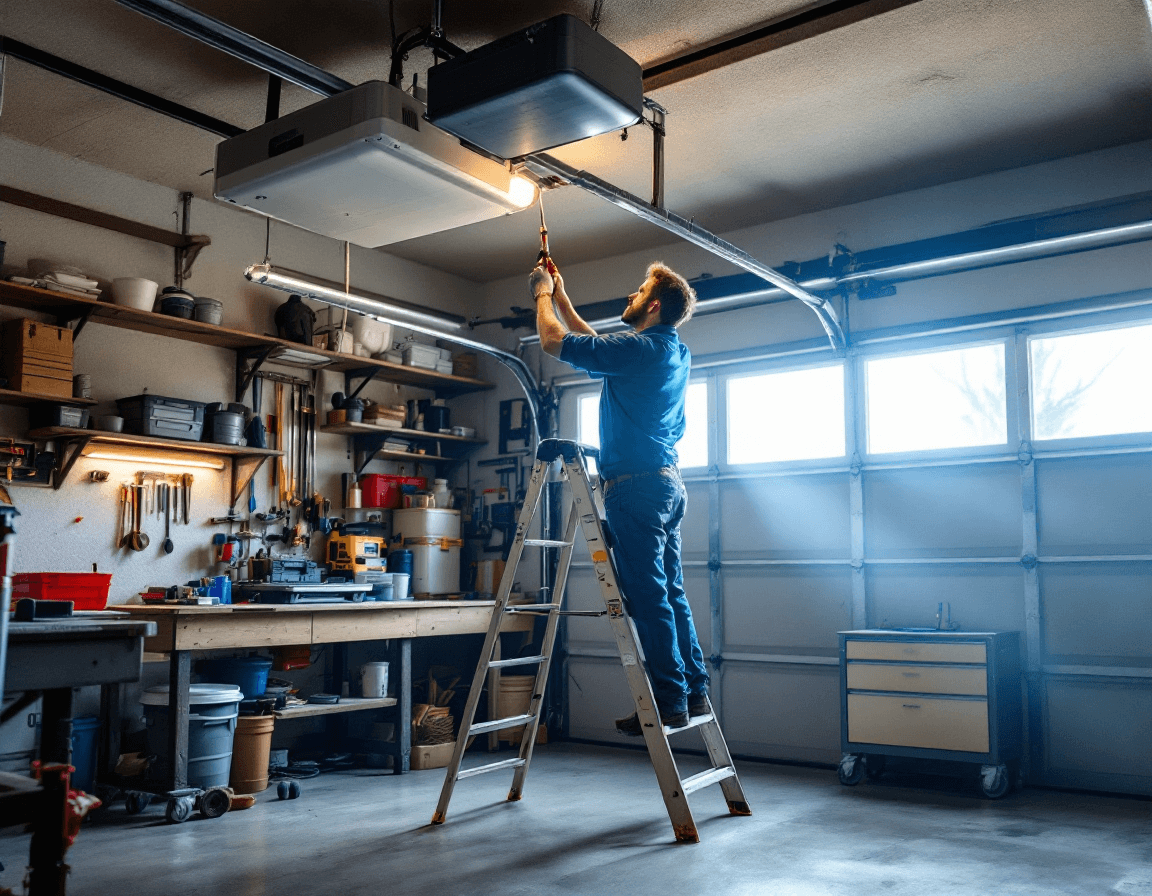
Garage door opener repair in Woodway, WA is often a straightforward fix, but the causes can be hard to pin down from the driveway. Woodway sits on a wooded bluff in Snohomish County, where tall conifers, damp air off Puget Sound, and long, gray winters all put stress on the equipment that moves your door. A failing opener might show up as a motor that hums without lifting anything, a remote that stops working after a rainy week, or a door that stalls halfway down. This page explains what those symptoms usually mean and what a technician checks before recommending a repair.
Most homeowners in the 98020 ZIP code do not need a new opener when something goes wrong. Motors, gears, logic boards, travel-limit settings, and safety sensors can usually be repaired or adjusted for a fraction of replacement cost. Our technicians work on every major opener brand, and most opener repairs fall in a typical range of $95 to $375, depending on the parts involved and how much diagnostic time the problem requires. The final figure always depends on what we find, and we will explain the options before any work begins.
Opener problems rarely happen in isolation. A humid garage can corrode a wall button's wiring, a branch can knock a photo-eye out of alignment, and a motor that has been straining against an unbalanced door can wear out its gears faster than expected. Reading the symptoms in the right order saves time and money. The sections below walk through the most common complaints we hear from Woodway homeowners, along with what usually causes each one and what a licensed technician can do about it.
Reading the Signals Your Opener Is Sending
Your opener is constantly reporting on its own condition, even if you never look closely. Some signals are obvious, such as a loud grinding noise or a door that refuses to close. Others are subtle, like a slightly longer run time, a faint buzz at the start of each cycle, or a light that blinks once when you press the remote. Paying attention to these changes gives a technician a head start, because a problem that is caught early often requires a smaller repair.
Start by noting what happens, when it happens, and whether the door is opening, closing, or stopping. Try to recall whether the problem began after a storm, a power outage, or a stretch of heavy rain. In Woodway, many service calls trace back to a weather event that the homeowner did not connect to the garage at the time. A short written log, even a note on your phone, can help the technician narrow the cause quickly.
Avoid repeatedly cycling a door that is making a harsh noise or moving unevenly. Continued operation can turn a worn gear into a stripped one, or a loose chain into a damaged sprocket. If the door is stuck, use the manual release only when the door is fully closed, and keep children and pets clear of the track. Anything involving the springs, cables, or drums should be left to a licensed professional.
When the Motor Hums but the Door Stays Put
A motor that runs without moving the door is one of the most frustrating symptoms, and it almost always points to a disconnection somewhere between the motor and the door. The most common culprit is the drive mechanism itself. If the chain, belt, or screw drive has slipped off its sprocket or pulley, the motor spins freely while the carriage stays still. In other cases the trolley has been disengaged, either by a manual release pulled during a power outage or by a cord that was tugged by accident.
Less obvious causes include a failed centrifugal clutch in some older belt-drive units, a stripped drive gear inside the head, or a motor capacitor that no longer provides enough torque to start the door. Because a hum with no movement can result from several different failures, a technician checks each link in the chain before replacing anything. We look at the drive path, confirm that the trolley engages the rail, test the motor's start behavior, and verify that the door is not binding in the track.
Woodway homes frequently have long driveways, sloped approaches, and garages set into hillsides, all of which can increase the load on the opener. Uneven tension from a sagging door or a track that has shifted slightly can force the motor to work harder than it was designed to. Correcting the underlying imbalance usually restores normal operation. A technician should inspect the springs before any hands-on work near them, since spring tension is dangerous and must be handled by trained professionals only.
Remote and Wall Button Silence in Damp Weather
When a remote stops working, many homeowners assume the battery has died. Batteries do matter, but the Pacific Northwest weather causes its own set of problems. Repeated dampness can corrode the contacts inside a remote, and a wall button mounted on an exterior-facing wall can develop moisture behind the faceplate. Over time, condensation can reach the low-voltage wiring that runs from the wall station back to the opener. Once the connection becomes unreliable, the door may respond only when the button is pressed at a particular angle or in a particular temperature.
Start with the simple checks. Replace the remote battery, confirm that the opener's learn button and remote programming are intact, and make sure the wall button is not stuck or pressed partway. Then look at the wall station itself. A faceplate that has cracked, a gasket that has dried out, or a wire that has shifted behind the plate can all create intermittent contact. Many of these issues are fixed by replacing the button or resealing the connection, which is a modest repair in most cases.
If the remote works in the driveway but not inside the garage, or the opposite, the antenna or receiver may be the source of the problem. Nearby metal structures, dense foliage, and interference from other electronics can weaken the signal. Woodway's tall trees and sloped lots can change how radio signals travel from the driveway to the head unit. A technician can test the receiver's sensitivity and reposition the antenna wire if necessary, which often resolves what looked like a faulty remote.
Stripped Gears and the Grinding Head
A grinding, clicking, or ratcheting sound from the opener head is usually a warning that gear teeth have worn, chipped, or stripped. The drive gear inside the head transfers the motor's rotation to the chain or screw, and it takes considerable stress each time the door starts and stops. Once a few teeth fail, the remaining teeth can slip under load, which produces the loud grinding noise many homeowners describe. Continuing to run the opener in this condition can damage the motor shaft and the drive sprocket, which makes the repair more expensive.
Stripped gears often appear after years of daily cycles, but they can also result from a heavy or unbalanced door that forces the opener to work beyond its design. A door that has been left partly open, a warped panel that catches on the track, or a spring that has lost tension can all increase the load. In Woodway, where many garages house a second vehicle or a workshop and the door is used several times a day, gear wear can accumulate faster than in lighter-use settings.
Replacing a gear assembly is a common repair for most major opener brands, and it is typically one of the more involved fixes on the list. The technician must confirm that the motor is still healthy, that the chain or screw drive is not damaged, and that the door is balanced before installing new gears. Skipping these checks can cause the replacement gear to fail quickly. If you hear grinding, stop using the door until it has been inspected.
Doors That Stop Short or Snap Back
A door that won't close fully, or that reverses as soon as it touches the floor, is almost always a sign that the safety system is doing its job. Garage door openers are required to reverse when they detect an obstruction, and modern units use photo-eye sensors near the floor along with force-sensing circuits in the logic board. When either system reports a problem, the opener stops the door and reverses it. That behavior is protective, but it can be frustrating when there is no visible obstruction.
Photo-eye problems are very common in the Pacific Northwest. Heavy rain can splash mud or debris onto the sensor lenses, spider webs appear quickly in damp garages, and a bumped sensor bracket can point the beam away from its partner. Woodway's wooded surroundings add leaves, pine needles, and dust to the mix. Cleaning the lenses and checking the alignment often solves the issue. The indicator lights on each sensor usually tell you whether the beam is being received, so take note of their status before calling for service.
Force settings can also cause a door to reverse early. If the travel path has become stiff because of cold weather, a dry track, or a slightly bent section, the opener may interpret normal resistance as an obstruction. A technician can measure the force the door requires to travel, adjust the limits within safe ranges, and inspect the rollers and hinges for wear. Increasing force settings beyond manufacturer guidance to make a door close is not a fix, because it can create an unsafe condition for people and property.
Blinking Lights as a Diagnostic Code
Many modern openers use a blinking light on the motor housing or control panel to communicate a fault. The pattern might be a single flash, a rapid series of flashes, or a pause followed by a sequence. Each brand uses its own code, and the meaning is usually listed in the owner's manual or on a label inside the cover. Learning to read the pattern is one of the quickest ways to narrow down a problem, especially if the door is behaving strangely but no obvious damage is visible.
Repeating blink patterns often point to a sensor fault, a travel-limit problem, a stuck button, or an error in the logic board. For example, a series of rapid flashes may indicate that the opener has detected an obstruction or a photo-eye misalignment, while a longer pause followed by a few blinks may relate to the travel limits or the force settings. The light can also flash to show that the remote has been programmed incorrectly or that the wall button is stuck closed. Writing down the exact sequence and how many times it repeats is very helpful.
Do not ignore a blinking light that continues after you have cleaned the sensors and reset the power. A persistent code can mean the logic board is failing or the wiring has been compromised by moisture. A licensed technician can read the code, confirm the cause, and perform the correct repair. In many cases the issue is simple, but guessing at the source can lead to unnecessary parts replacement. Keep the manual handy so you can share the exact pattern during your call.
Chains, Belts, and Slack Caused by Woodland Humidity
Chain and belt drives are the workhorses of most residential openers, and they are sensitive to the environment. A chain that has slipped off the sprocket, or a belt that has stretched and begun to ride off its pulley, will stop the door from moving or cause a loud clacking as it runs. In Woodway's humid climate, metal chains can develop surface rust over time, especially in garages with poor ventilation, and that corrosion can lead to stiffness or sudden binding. Belts can soften or stretch when exposed to moisture and temperature swings.
Slack is often the first sign of trouble. If the chain sags noticeably between the opener and the door, or if the belt looks loose when the door is closed, the tension needs correction. Over-tightening can damage the bearings and the motor shaft, so adjustment should be done carefully and only to the manufacturer's specification. A technician checks the sprocket alignment, examines the chain links for stretch or damage, and verifies that the trolley and rail are not bent or misaligned.
Lubrication matters too, but it should be done with the right product. Silicone-based or manufacturer-recommended lubricants are typically preferred for chains, while belts should not be sprayed with oil that could break down the material. Heavy grease can attract dust and tree debris in a wooded lot, which turns into a gritty paste. We recommend asking the technician what type of lubricant suits your specific opener, rather than applying a general-purpose product from the hardware store.
Travel Limits, Force Settings, and Circuit Boards
Travel limits tell the opener where the door should stop when it opens and closes. If they are set incorrectly, the door may stop too high, close too far, or reverse before reaching the floor. Travel limits can drift over time, especially after a repair, a power outage, or a change in door balance. Some openers store these settings in the logic board, while others use mechanical limit switches. Either way, the adjustment should be made with the door in good working order and the springs properly tensioned.
Force settings work alongside the travel limits. The opener measures how hard the motor must push to move the door, and it reverses if that force exceeds a set threshold. A door that binds in one spot, or one that has become heavier due to a worn hinge or a bent panel, can trigger reversal in the middle of travel. Adjusting force is a precise task because it affects safety. A licensed technician balances the door first, then tunes the limits and force within the range the manufacturer allows.
Circuit boards can fail after lightning strikes, surges, or long-term moisture exposure. Symptoms include erratic behavior, lights that come on and off randomly, or a motor that starts and stops unpredictably. Before assuming the board is bad, a technician checks the power supply, the wiring, and the connections at the terminal block. Surge protection at the outlet can help reduce future damage, particularly in areas where storms and outages are common.
- Common travel-limit symptoms include a door that stops too high, closes past the floor, or refuses to reach the top.
- Force-related symptoms include reversal in the middle of travel, a door that reverses when it encounters light resistance, or a door that moves slowly.
- Logic board warning signs include random behavior, lights that flicker without cause, and remote commands that work only some of the time.
- Mechanical issues that mimic electronic faults include loose hinges, worn rollers, and a track that has shifted out of alignment.
Intermittent Faults That Come and Go with the Weather
Intermittent problems are the most challenging to diagnose because they may not appear during a service visit. An opener might work perfectly on a dry afternoon, then fail to respond on a foggy morning or after a night of heavy rain. These patterns usually point to moisture, temperature changes, or loose connections that expand and contract with the weather. Woodway's frequent drizzle and cool nights can make these faults appear and disappear, which is why many homeowners describe the opener as "acting up" without a clear trigger.
Connections are a common suspect. Wire terminals inside the wall station, the head unit, and the sensor brackets can loosen over time, especially if they were installed quickly or without proper strain relief. Moisture can also create a film of conductive residue on contacts, which causes the signal to drop. A technician checks the continuity of the wiring, inspects the terminals for corrosion, and reseats the connections. In some cases a protective cover or drip loop can prevent water from reaching sensitive areas.
Environmental changes can also influence the opener's sensitivity. Cold air can stiffen the door's springs and rollers, and warm, humid days may cause the track or panels to expand slightly. These changes can push a marginal setting over the edge, which makes the door behave differently from one day to the next. Keeping a record of when the problem occurs can help the technician replicate the conditions, and sometimes a small adjustment to the force or limits solves the issue for good.
What a Woodway Repair Visit Typically Involves
A typical repair visit begins with a conversation about the symptoms and a visual inspection of the door, the opener, and the surrounding hardware. The technician will ask when the problem started, whether it happens every time, and whether any recent changes were made to the garage or door. We then test the remote, the wall station, the sensors, and the travel limits. If the door needs to be moved manually, the technician will confirm that it is balanced and that the springs and cables are in safe condition before proceeding.
Once the cause is identified, the technician explains the repair options and provides a clear price before any work begins. For most opener repairs the cost falls between $95 and $375, depending on the parts required and how much labor is involved. Simple adjustments such as sensor realignment or travel-limit tuning are typically at the lower end of that range, while gear replacement, motor work, or logic board repairs may fall toward the upper end. Some situations, such as a severely damaged door or a spring system that needs replacement, may require a separate estimate.
After the repair, the technician tests the opener through several full cycles, checks the safety reversal, and confirms that the remote and wall station respond consistently. We also review basic care steps with the homeowner, such as keeping the sensors clean and watching for early signs of wear. If the door or the springs show concerns outside the scope of the opener repair, we will describe what we observed so you can decide how to proceed. Spring and cable work must be performed by a licensed professional, and we recommend that homeowners never attempt those repairs themselves.
Keeping Your Opener Running Between Service Calls
Routine care can extend the life of your opener and reduce the number of emergency calls. Start by testing the auto-reverse feature once a month. Place a flat object, such as a piece of wood, in the door's path and run the door through a close cycle. If the door does not reverse when it contacts the object, stop using it and call for service. Also check that the photo-eyes are clean and aligned, and wipe the lenses gently with a soft cloth whenever you notice dust or spray from the driveway.
Pay attention to the tracks, rollers, and hinges as well. Keep the tracks free of debris, and remove leaves and pine needles that collect near the bottom of the door. Lubricate the rollers and hinges with a product recommended for garage doors, but avoid getting lubricant on the photo-eyes or the belt. Tighten visible hardware carefully, and do not adjust the springs or cables yourself. If you notice a new noise, a change in run time, or a door that seems to labor, schedule an inspection before the problem grows.
In a wooded community like Woodway, it also helps to keep vegetation trimmed back from the garage and driveway, since branches and sap can reach the door and sensors. Consider adding a simple weather cover or drip guard over an exterior wall button, and make sure the garage has adequate ventilation to limit condensation. These small steps reduce moisture and debris, which are two of the most common causes of opener trouble in this part of Snohomish County. A few minutes of attention each season can prevent many of the symptoms described on this page.
If your opener is grinding, stalling, blinking a warning pattern, or ignoring the remote, call Seattle Garage Door Fix at (888) 799-3819 to schedule a licensed technician for your Woodway home. We will diagnose the cause, explain your repair options clearly, and give you a price before any work begins. Our team handles every major opener brand, and we are happy to help with the spring and cable concerns that require professional attention.