
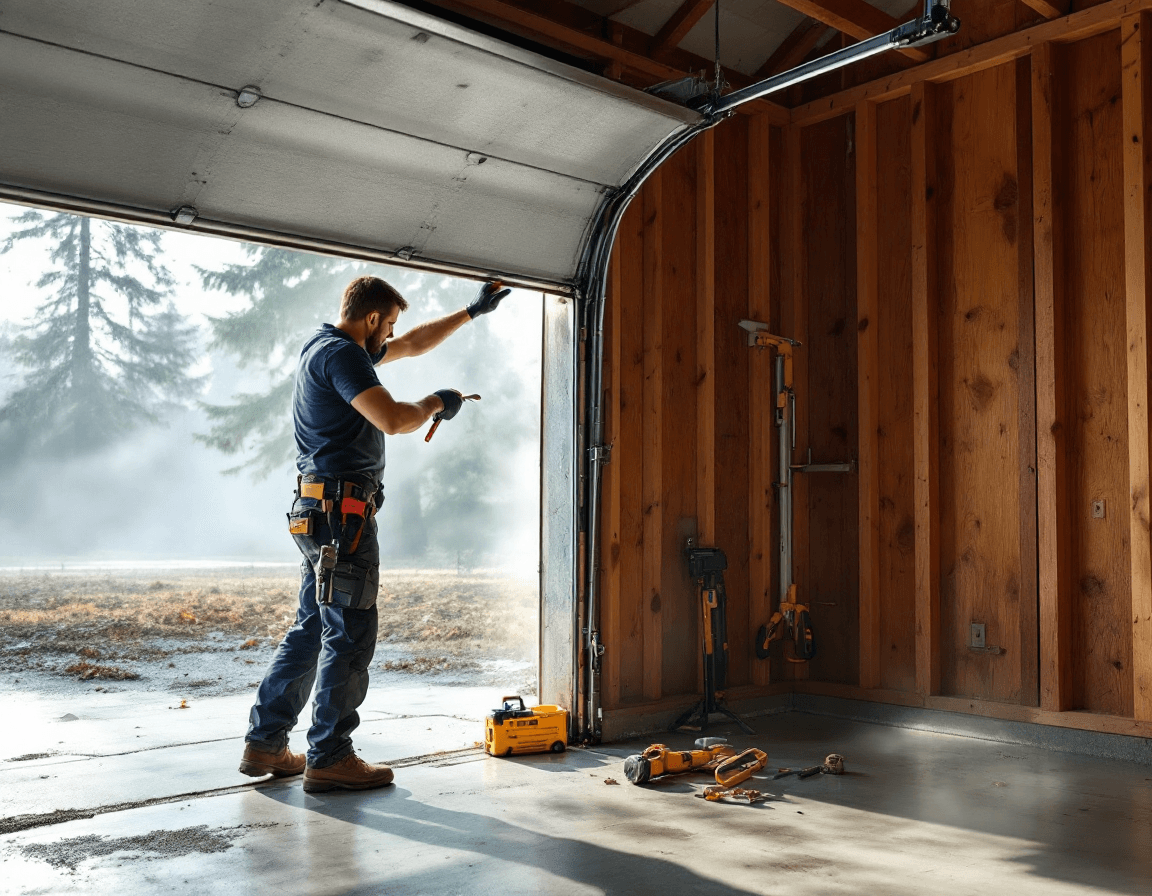
Off-track garage door repair in Woodway, WA is one of the more common calls we handle on the north end of Snohomish County, and it rarely comes from one single cause. A door that jumps off its tracks may have been struck by a car backing out, may have a roller that has worked loose over years of use, or may have a track that shifted slightly after a wet winter. Whatever the reason, a door sitting crooked in its opening or stuck halfway up is a real problem, and it should not be forced. Homeowners in town often notice the problem when the door stops closing evenly or when a gap opens along one side.
This page explains what usually goes wrong when a door comes off track, what a technician checks, and what you can reasonably expect to pay. Most off-track repairs we perform fall between $125 and $400, though the final figure depends on how many rollers, track sections, or brackets need attention. We also explain which parts of the job belong to a licensed professional, because torsion springs and cable tension can cause serious injury when they are mishandled. The goal is to help you make a clear decision about your door, not to push you toward a larger repair than you need.
If your door is off track right now, stay out of the opening, keep children and pets clear, and avoid pulling on the door by hand. Call (888) 799-3819 and describe what you see, including whether the door is leaning, whether one side is higher than the other, and whether any track looks bent. That information helps us plan the visit and bring the right parts. The sections below walk through each step in plain language.
Why Doors in Woodway Tend to Leave the Track
Homes in Woodway often sit on wooded, sloped lots where the ground moves with the seasons. Heavy winter rain soaks into clay-rich soil, and the slab or driveway apron can settle unevenly over time. When the garage floor shifts even a fraction of an inch, the vertical track can drift out of plumb, and the door begins to ride against one side. Over several rainy seasons, that small misalignment can grow until the rollers no longer sit squarely in the track channel.
The Pacific Northwest climate adds its own pressure. Moisture gets into the track hardware, the bolts loosen, and the steel can develop surface rust at contact points. Trees around the property also drop sap, needles, and debris that collect in the track channel and act like grit under the rollers. A door that has been running with a little extra friction for months may suddenly jump the track on a cold morning when the lubricant has thickened and the wheels stop turning smoothly.
Many Woodway garages are also built with tall or wide door openings to accommodate trucks, boats, and lumber. Larger doors carry more weight on each side, and they put more stress on the track brackets, the bearing plates, and the lift cables. Without regular inspection, those components can lose their alignment long before a homeowner notices any visible change in the door.
Reading the Early Signs Before a Full Derailment
Most doors do not fall off the track without warning. The first sign is usually a sound change: a grinding, scraping, or popping noise as the door rises or lowers. If you hear a metallic squeal that wasn't there last season, one of the rollers may be rubbing against the track lip or a bracket may be starting to flex under load. Catching that early often means the repair is a simple roller swap rather than a full track realignment.
Visual clues are just as useful. Look at the gap between the door panels and the vertical track on both sides, using a flashlight if needed. If the gap is wider on one side than the other, the door is probably tilting or the track has moved. Check the top corners of the door as well, since a crooked door often shows uneven spacing where the top section meets the header. Another common warning is a door that closes but does not seal at the bottom along one edge, which can mean the door is no longer tracking evenly.
Some owners notice the door stopping midway, reversing on its own, or lifting slightly off the floor before it finishes closing. These behaviors can result from a roller that has partially exited the track, and they can get worse quickly. If you see any of these signs, stop using the door until it has been inspected.
Here are signs that warrant a service call sooner rather than later:
- A roller visibly sitting outside the track channel or hanging at an angle
- One side of the door sitting noticeably lower than the other
- The door making a grinding or popping noise when it moves
- A gap that appears or grows between the door edge and the vertical track
- The opener strains, reverses, or shuts off partway through its travel
What a Technician Checks on an Off-Track Door
When we arrive at an off-track call, the first step is always a safety check. The technician confirms that the opener is disconnected or locked out, that the door is supported so it cannot drop, and that no spring or cable is damaged in a way that would create a hazard during the repair. We do not assume a door is stable just because it looks still. A door that has been pulled partway off track can carry hidden tension, and it needs to be secured before anyone works underneath it.
Next we measure. A properly installed track runs plumb along the vertical sections and level along the horizontal sections, with consistent clearance between the track and the rollers. We check the track at multiple points, including the bottom bend, the curve where the track transitions to horizontal, and the top mounting brackets. Small variances can be corrected by loosening bolts and resetting the track, but larger deviations usually mean a bracket has pulled away from the wall or header, or the track has been bent.
We also inspect the rollers, hinges, and bearing plates, since these parts are what actually guide the door. Worn or cracked rollers can slip out of the track even when the track itself is in good shape. A roller with a flat spot will bump along the track, causing the door to jerk and eventually pop free. Once the entire system has been checked, we explain what we found in plain terms and give you a clear recommendation before any repair begins.
Rollers, Hinges, and the Parts That Pop Out
Rollers are the small wheels that ride inside the track, and they are among the most frequently replaced parts in a garage door system. Nylon rollers are common on residential doors because they run quietly, but they can crack or flatten after years of use, especially in the temperature swings that come with a Puget Sound winter. Steel rollers last longer under heavy use, though they can be noisier. When a roller fails, the door loses its guidance at that point, and the adjacent roller is forced to carry extra load.
Hinges and bearing plates work alongside the rollers. A hinge that has pulled loose from the panel edge will let the door flex, which allows a roller to drift out of its channel. Bearing plates, which hold the roller stems, can wear oval over time. When that happens, the roller wobbles and eventually escapes the track. Replacing a single worn roller without addressing a loose hinge or worn plate often leads to a repeat call within a few months.
Regular maintenance is the best defense. Clean the track channels with a dry cloth to remove debris, then apply a silicone-based lubricant to the roller bearings and hinge pivots. Avoid heavy grease or oil on the track itself, because it attracts dirt and grit. Check the roller stems and hinge bolts every few months, and tighten anything that has backed out. If you are unsure whether a part needs replacement, a technician can inspect it during a service visit.
Bent, Dented, or Separated Track Sections
Track sections are made from thin galvanized steel, which holds its shape well under normal use but can bend easily under impact. A dented track may still hold the rollers, but the distortion can cause binding, especially near the curve where the track changes direction. A separated section, where one piece has pulled away from the splice joint, is more serious because the roller can catch on the gap and send the door off the track entirely.
Straightening is often possible if the damage is modest and the metal has not cracked. A technician can use a track straightening tool to gently bring the profile back into line, then recheck clearances and tighten the brackets. When the track is creased, torn at a joint, or deformed in multiple places, replacement of the affected section is usually the safer and more durable choice. Patching a badly damaged track tends to create new pinch points that wear the rollers unevenly.
Our general pricing guidance for off-track work in Woodway is that most jobs land between $125 and $400, depending on how many components are involved. A simple realignment with a single roller replacement typically falls near the lower end of that range, while a job that involves straightening multiple track sections or replacing a bracket will generally move toward the higher end. We provide an estimate on site before work begins, so you know the cost before we proceed.
Vehicle Strikes in Tight Driveways
Woodway driveways often include tight turns, sloped approaches, and limited turnaround space, which makes it easy to clip the garage door frame while backing out. A vehicle strike can bend the track, crack a bracket, or knock a roller out of its channel without leaving a dramatic dent in the door panel. Homeowners sometimes assume that because the door looks fine on the outside, nothing is wrong inside the track. In practice, the track and brackets absorb most of the energy from an impact, so the hardware is usually the first thing to fail.
After any collision, avoid operating the door until it has been inspected. Running the opener on a damaged track can drive a bent section further out of alignment and can damage the opener's trolley or rail. If the door is still closed and stable, you can usually leave it that way until a technician arrives. If the door is partly open and hanging unevenly, keep people and vehicles clear of the opening and call for help promptly.
Insurance questions often come up after a strike, and documentation helps. Take photos of the track, brackets, and any damaged panels from several angles, and note the date and time of the incident. Our technicians can describe the repair in writing if you need it for a claim, though the decision about coverage belongs to your insurer.
Wind, Wet Weather, and Hillside Lots
Western Washington's wind events and heavy rain have a noticeable effect on overhead doors, particularly on properties with exposure to open sky or tall trees. Wind can push against a large door panel, flexing the section and loading the rollers unevenly. If the door is already close to the edge of its track tolerance, a strong gust can be enough to pop a roller free. Homeowners on higher or more exposed lots often notice more movement in their doors during storm season than their neighbors do lower down.
Wet weather is another factor. Water seeping along the track can rust the steel where the rollers ride, creating a rough surface that increases friction and wears the roller tires faster. Moisture can also work into the bearing plates and cause corrosion that makes the roller stem seize. Keeping the bottom of the track free of standing water and checking for surface rust each fall can prevent many off-track problems before they start.
Hillside and wooded lots also tend to collect leaf litter, pine needles, and moss near the garage threshold. Debris that builds up in the track channel acts like sandpaper and can gradually push the rollers out of position. Sweeping the threshold and rinsing the track gently with water after storms helps keep the channel clear. Avoid high-pressure washers near the door hardware, since the spray can force water into bearings and bracket bolts.
Safety Rules Before Anyone Touches a Spring
Off-track repairs can look straightforward, but they often involve parts that store a lot of energy. Torsion springs above the door hold most of the door's weight, and they can release that energy suddenly if they are unwound incorrectly or if a cable snaps. Lift cables are under high tension, and a cable that fails can whip violently. For these reasons, homeowners should never attempt to wind springs, adjust spring tension, or remove a spring assembly themselves. Those tasks should be handled only by a licensed, trained professional with the proper equipment.
There are still safe steps you can take while you wait for service. Keep everyone out of the garage and away from the door's path of travel. Do not stand under a door that is partly raised or hanging crooked. If the door is stuck, do not pull on it or push it hard to force it back into the track. Disconnect the opener by pulling the emergency release cord only if you are sure the door is closed, and be aware that a door released while off track may move unpredictably.
Our technicians follow these rules on every call. We secure the door, check the springs and cables before moving any components, and only proceed with realignment when the system is safe to work on. We are licensed, bonded, and insured, which means you are covered if anything unexpected happens during the work. If your door has any sign of cable damage, a broken spring, or a deformed drum, we will tell you clearly that it needs professional attention before any further operation.
What Off-Track Repair Usually Costs in Woodway
Pricing for off-track garage door repair depends on what has actually failed, how accessible the door is, and whether the track needs straightening or replacement. For most off-track repairs in Woodway, the cost falls between $125 and $400. A straightforward realignment with a single roller replacement sits at the lower end of that range, while jobs involving multiple damaged track sections, bent brackets, or a hinge and bearing plate replacement fall toward the upper end. Each call starts with an inspection, and we give you a written estimate before any parts are installed.
The cost of waiting can be higher than the cost of prompt repair. A door that is merely crooked can become an off-track door, and a door that is off track can strain the opener, damage the rails, or create a hazard if it falls. Repairs done early usually involve fewer parts and less labor. If you are weighing whether to repair or replace a damaged track or door component, ask the technician to explain the options and the expected lifespan of each.
Keep in mind that your opener and the door's springs may also need evaluation during an off-track visit, particularly if the door has been under stress for some time. A technician who sees a worn spring or frayed cable will tell you what needs attention and what can wait. We would rather recommend a smaller, focused repair than sell you a larger job that your door does not need.
Keeping Tracks Aligned Through Each Pacific Northwest Season
Preventive care is the most effective way to avoid off-track problems in Woodway. Start each spring by inspecting the track for loose bolts, bent sections, and surface rust. Tighten the bracket fasteners, check that the track remains plumb and level, and wipe the channels clean. In late summer, when dust and pollen have built up, give the rollers and hinges a light lubricant coat and confirm that the door still runs smoothly in both directions.
Fall is the season to prepare for heavy rain and wind. Clear debris from the threshold, check the bottom seal, and make sure water is not pooling near the track. A quick test of the door's balance can also reveal problems early. Disconnect the opener, lift the door manually about halfway, and see whether it stays in place. If it drifts up or down, the springs may need adjustment, which is a job for a licensed technician.
Winter is when most homeowners notice problems, because cold temperatures stiffen lubricants and make the door harder to move. Avoid forcing a stuck door during cold weather, since that is when rollers and tracks are most likely to crack or bend. If you hear new noises or see movement that concerns you, schedule an inspection rather than waiting for spring. A well-maintained door in Woodway can run reliably for many years, and a small investment in attention each season keeps the track aligned and the door secure.
If your garage door has come off track, is leaning, or will not move in either direction, do not wait to see if it corrects itself. Call Seattle Garage Door Fix at (888) 799-3819 and a licensed technician can inspect the door, explain what needs attention, and give you a clear estimate before any work begins. We serve Woodway and surrounding Snohomish County communities, and we are ready to help you get your door back on track safely.