
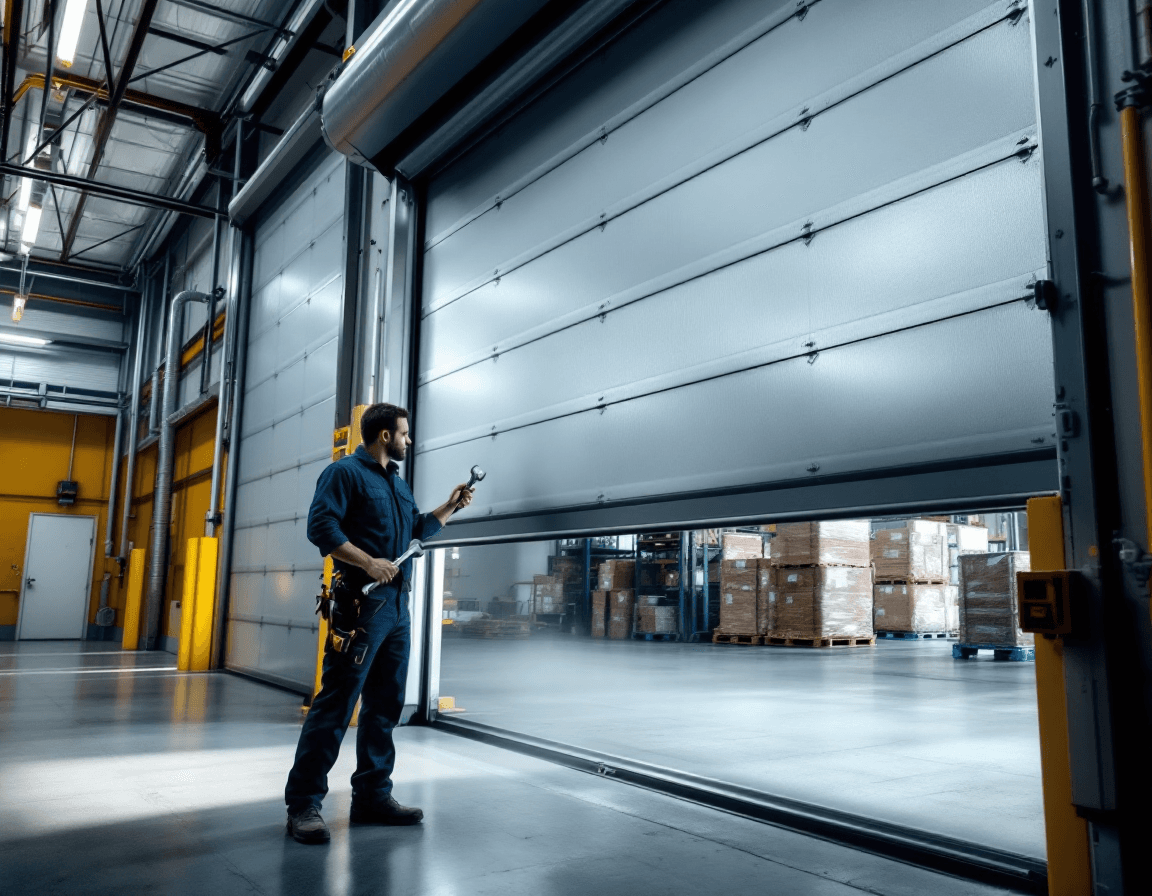
Commercial Overhead Door Repair in Snoqualmie, WA is a service that matters more than most business owners expect until a bay sits closed during a delivery window. A warehouse, dock, or light industrial building in the Snoqualmie Valley depends on its overhead doors to move freight, staff, and vehicles every day, so a stuck or failing door quickly becomes a scheduling problem, a safety problem, and a revenue problem. Seattle Garage Door Fix provides licensed, bonded, and insured commercial door service for businesses across King County, and our technicians are trained to work on sectional doors, rolling steel doors, and commercial operators in the same way they would work on any other critical piece of building equipment.
The Snoqualmie area has its own set of conditions that shape how commercial doors perform. Properties near the foothills see long stretches of damp, cool weather from fall through spring, and moisture gets into hinges, bearings, and track joints in ways that a dry-climate facility never experiences. Traffic patterns also vary across the valley, with some sites handling steady daily truck movement and others receiving only occasional deliveries but still needing reliable access when those deliveries arrive. Our approach starts by understanding how your building actually uses its doors, then matching the repair or maintenance plan to that real pattern.
Whether you are dealing with an emergency lockout, a door that has slowly lost speed over the past year, or a loading dock that needs a planned upgrade before peak season, the right first step is a clear conversation about what the door is doing and what your operation requires. Call (888) 799-3819 to describe the problem, and we will help you decide how quickly a technician needs to be on site and what information to have ready.
Why Snoqualmie Valley Facilities See Different Wear Patterns
Commercial doors in the Snoqualmie Valley face a combination of moisture, temperature swings, and heavy daily use that can accelerate wear on components that might last much longer in a drier, milder location. Water running off roofs during long winter storms can splash against the base of a door, and mud or grit tracked in on vehicle tires can work its way into the bottom seal and the track channel. Over time, those contaminants cause rollers to bind, weatherseals to crack, and steel panels to develop surface corrosion at fastener points. Facilities near the river corridor or in low-lying parking areas often notice this sooner than sites on higher ground.
Temperature changes add another layer of stress. Morning frost and afternoon warmth can cause metal panels to expand and contract, which shifts the alignment of track sections and stresses the connections between door sections. Springs, whether torsion or extension types, lose tension gradually, and cold mornings make a worn spring feel the strain more sharply. A door that opens smoothly in July may hesitate or make a grinding sound in January, and that seasonal change is often the first clue that a component is nearing the end of its service life.
Because these conditions are persistent rather than occasional, we recommend that commercial owners treat seasonal inspections as routine rather than optional. A technician who checks track alignment, lubrication points, seal condition, and panel fasteners before the wettest months can identify small problems while they are still inexpensive to correct. That kind of attention protects the door, protects the people who use it, and keeps your bays running through the weather patterns that define the valley's working year.
Diagnosing a Dock Door That Stops Halfway
When a sectional or rolling door stops partway through its travel, the cause is usually one of a few mechanical or electrical conditions, and identifying the right one requires a methodical approach. Stopping mid-travel often points to a safety reversal triggered by an obstruction, a photo-eye that has lost alignment, a tripped circuit, or a binding roller that prevents smooth movement. Doors that bounce back slightly before stopping sometimes indicate a sensor problem rather than a true mechanical fault, which is why a proper diagnosis looks at the sequence of events rather than only the final symptom.
Before calling for service, your staff can help by noting what they observed. Knowing whether the door made a sound, whether the motor hummed without moving, or whether the door reversed after touching a pallet or cart gives our technicians valuable starting information. Please keep people and equipment clear of the opening and do not attempt to force a stuck door open or closed, since that can damage the door, the operator, or the tracks. We also recommend checking that the disconnect or breaker feeding the operator has not been switched off during cleaning or maintenance.
Once on site, a technician will typically inspect the sensors and their wiring, test the operator's limit settings, check the track for debris or deformation, and examine rollers, hinges, and springs for wear or damage. Many dock door stoppages in our experience trace back to a combination of small issues, such as a dirty photo-eye lens paired with a roller that has started to flatten. Addressing every contributing factor at once prevents a repeat call a few weeks later and gives you a clearer picture of the door's overall condition.
- Note whether the door stopped, reversed, or made no movement at all.
- Record any sounds, such as grinding, popping, or a single loud clunk.
- Check whether photo-eyes, bottom edges, or nearby racking appear obstructed or misaligned.
- Confirm that the operator's disconnect or circuit breaker is on and not tripped.
- Keep the door area clear and avoid forcing it manually.
Rolling Steel Doors That Have Left the Track
Rolling steel doors are common in warehouses, auto shops, and industrial bays across the valley because they save overhead space and stand up well to daily abuse. Their design, however, depends on interlocking slats riding smoothly inside guide tracks on each side, and when a slat is bent or a guide is knocked out of position, the door can jam, bind, or slip off track entirely. A rolling door that has come out of its guides is not something to fix with brute force, because the curtain is heavy, the tension components are dangerous, and a sudden release can cause serious injury.
Off-track conditions often result from a vehicle clipping the lower edge, a pallet jack catching the curtain during a shift change, or repeated slight misalignment that eventually pushes a slat out of its channel. Once a door is off track, the first priority is to secure the area, keep everyone away from the curtain, and call for professional service. Our technicians will assess whether the curtain can be carefully realigned, whether specific slats or guide sections need replacement, and whether the tension system has been affected. In some cases the door can be restored to service the same day, and in others a replacement component must be ordered before the repair can be finished.
Preventing future derailments usually comes down to protective hardware and alignment checks. Guide reinforcements, bumper stops, and properly adjusted guide clearances can reduce the chance that a bumped door stays damaged. We also recommend a periodic review of slat condition, since a slat with a small kink can cause the curtain to track unevenly and eventually fail. Keeping guides free of paint overspray, dirt, and debris is another simple step that many facilities overlook.
Commercial Operators: When the Motor Quits or Crawls
Commercial operators are the drive units that lift and lower heavy doors, and they are built for far more cycles than residential openers. Common failures include burned-out motors, worn drive chains or belts, failed control boards, damaged limit switches, and gearbox wear that causes the door to run slowly or unevenly. An operator that hums but does not move the door, or one that starts strong and then labors near the top of its travel, is telling you something specific about the drive, the load, or the balance system.
Speed matters for operations as well as for safety. If a dock door takes noticeably longer to cycle than it did a year ago, drivers and crews lose time at every single movement, and those minutes add up across a busy shift. Slow operation can also be a sign that the door's counterbalance has weakened, forcing the operator to work harder than it was designed to. Replacing or tuning an operator without checking the balance can shorten the life of the new unit, so a complete evaluation is worth the time.
When an operator needs replacement, sizing matters. A unit must match the door's weight, width, height, and expected cycle frequency, and it should integrate with your existing control stations, safety edges, and any building automation or access systems. Our custom quotes take these details into account so you are not paying for capacity you do not need or stuck with a unit that cannot keep pace with your traffic. Commercial operators also require correct wiring and grounding, and that work belongs with a qualified technician who understands the load requirements.
Forklift Impact Damage and Section Replacement
Forklift impact is one of the most frequent causes of damage to sectional commercial doors, and it rarely looks minor from the inside. A tine strike can crack a panel, bend a hinge, distort a track section, or knock a roller out of its race. Even when the visible dent seems small, the stress often travels through the joints and can throw the entire door out of balance. That is why we inspect the adjacent sections, hinges, and track alignment whenever we replace a damaged panel, rather than simply swapping the one piece that looks broken.
Sectional doors are designed so that individual sections can often be replaced without replacing the full door, which saves significant cost and downtime when the rest of the door remains in good condition. The process requires matching the section's thickness, insulation type if applicable, window options, and hardware compatibility, and we confirm those details before ordering parts. Once the new section is installed, the door must be rebalanced and the track must be checked for square and level alignment. Skipping that step is one of the most common reasons a repaired door starts making noise or wearing out prematurely.
Facilities that experience frequent impacts often benefit from protective measures such as dock bumpers, guard posts, high-visibility marking, and staff training on approach speeds. These are not replacements for good equipment handling, but they reduce the frequency and severity of strikes. We can discuss which protections make sense for your layout and traffic flow during a site visit, along with suggestions for replacing sections in a way that minimizes the risk of recurring damage.
Keeping Throughput High Without Sacrificing Safety
A door can technically be working and still be costing your business money. Throughput problems show up as longer dwell times at the dock, staff waiting at the door, trucks idling in the yard, or crews working around a door that opens only partway or cycles inconsistently. These issues are easy to accept as normal wear, but they often point to adjustments, worn components, or outdated controls that can be improved without a full replacement.
Our technicians look at throughput from the perspective of your daily operation. We examine cycle time, the consistency of the opening and closing motion, the responsiveness of controls and entrapment sensors, and whether a door's speed settings are appropriate for the traffic it handles. In some cases, a higher-speed operator or a faster-acting high-speed door may make sense for an area with constant movement, while in others a careful tune-up and a few replacement parts restore the performance you expected. We will be direct about which option delivers real value for your site.
Any adjustment to speed or travel must preserve the safety features that protect people and vehicles. Entrapment sensors, safety edges, and reversal functions are not optional, and we will never recommend bypassing them to gain a few seconds. Faster doors demand more precise sensors and more attentive maintenance, so we factor that into every throughput recommendation.
How Custom Commercial Quotes Are Built
Commercial door pricing is not a single flat rate, because every building, opening, and operating schedule is different. A custom quote reflects the door type, opening dimensions, material, insulation, operator requirements, lift height, track condition, access for lifts or staging equipment, and whether the work must happen during off-hours to avoid disrupting operations. We do not publish one-size-fits-all numbers for commercial work because those numbers would not reflect the real conditions on your site.
To help us build an accurate estimate, it is useful to have a few details ready before the technician arrives. Measurements of the opening width and height, the door model or manufacturer if you know it, photos of any damage, the age of the operator, and a description of how often the door cycles per day all make the estimate faster and more reliable. If the door is part of a larger facility upgrade, sharing the planned timeline and any inspection requirements helps us plan around your schedule.
Our quotes are designed to be clear about what is included. A good estimate separates the immediate repair from recommended follow-up work, so you can decide what must be done now, what can be scheduled later, and what preventive items will extend the life of the door. We aim to give business owners enough information to make a confident decision without pressure, and we are happy to walk through options with property managers, facility leads, and owners.
Fast Response Plans That Protect Your Schedule
Downtime is the real cost driver for most commercial door failures, so our service approach emphasizes quick assessment and clear communication. When you call (888) 799-3819, we gather the basic details about the door, the symptoms, and your operational needs, then prioritize accordingly. A door that blocks a loading dock during a delivery window is handled differently from a door that works intermittently but still allows access, and we try to respond in a way that matches the urgency of your situation.
On site, the goal is to restore safe, reliable operation as fast as the parts and conditions allow. Where a temporary solution is safe and appropriate, we will explain what it does and does not fix, and we will outline the permanent repair so you can plan around it. When parts must be ordered, we communicate expected timing honestly rather than promising a same-day finish we cannot guarantee. Keeping you informed is part of minimizing disruption.
Finally, we recommend documenting every service visit in your facility records. Recording the date, the work performed, the parts replaced, and any recommendations creates a useful history for property managers, insurers, and future technicians. That record also helps identify patterns, such as a door that repeatedly struggles after heavy rain or a section that keeps taking impact damage from the same loading route.
Preventive Maintenance Agreements for Valley Businesses
A preventive maintenance agreement is one of the most effective ways to protect a commercial door from unexpected failure. Under a planned program, a technician visits on a set schedule to inspect the door, lubricate moving parts, check balance and alignment, test safety devices, tighten fasteners, and identify wear before it becomes a breakdown. For businesses in the Snoqualmie area, where moisture and seasonal temperature changes are constant factors, scheduled visits timed before the wet season can be especially valuable.
A maintenance plan typically covers the items that wear gradually and quietly. These include roller condition, hinge health, track cleanliness and alignment, weatherseal integrity, spring tension, operator settings, and the condition of photo-eyes and safety edges. Each visit produces a written summary that notes what was checked, what was adjusted, and what should be watched or replaced in the coming months. This gives your facility team a practical roadmap rather than a surprise invoice.
We tailor agreements to your building. A small warehouse with two doors and light use will have a different schedule and scope than a distribution site with multiple high-cycle dock doors. We can discuss visit frequency, response priorities, and how the agreement interacts with emergency service so you know exactly what to expect. Preventive care costs far less than an unplanned closure, and it gives your operation more predictable access to the doors you depend on.
Safety Rules for Spring and Cable Work on Commercial Doors
Torsion springs, extension springs, and cables store enormous amounts of energy, and mishandling them can cause severe injury or death. Commercial doors are often heavier and use larger springs than residential units, which makes this risk even greater. Spring and cable work should never be attempted by building staff, property maintenance crews without specialized training, or do-it-yourself owners. Only a licensed, trained professional with the correct tools and safety procedures should adjust, replace, or repair these components.
Because the stored energy in a spring is significant, technicians follow strict procedures for securing the door, relieving tension, and verifying that the door is stable before any component is removed. Broken springs, frayed cables, or a door that drops suddenly should be treated as a hazard. Keep people and vehicles away from the opening, do not attempt to lift the door by hand to test it, and disconnect power to the operator if it is safe to do so. Then call a qualified technician to handle the repair.
We include spring and cable inspection in our preventive maintenance visits because early detection prevents dangerous failures. A spring that shows fatigue, a cable that is fraying, or a drum that is loose can be identified and corrected on a planned schedule rather than during an emergency. Our insistence on licensed professionals for this work is not a sales tactic; it is the standard that keeps your staff, customers, and property protected.
Serving Snoqualmie, Snoqualmie Ridge, and ZIP Code 98065
Seattle Garage Door Fix provides commercial overhead door service throughout the Snoqualmie area, including businesses in and around the Snoqualmie Ridge development, the historic town core, and the commercial corridors that serve the wider valley. Snoqualmie Falls, which drops roughly 268 feet and draws visitors year-round, is a reminder of how much water moves through this region, and the moisture that feeds that landscape also affects the metal, seals, and tracks of nearby commercial buildings. Our technicians are familiar with the access patterns, delivery routes, and weather exposure that come with working in this part of King County.
Businesses in ZIP code 98065 range from light industrial and contractor yards to retail spaces, service shops, and storage facilities. Each type of site presents different door requirements, and we adapt our approach accordingly. A contractor yard may need a rugged rolling steel door that can handle trucks and equipment, while a retail back-of-house area may need a quieter sectional door with precise controls. We bring that practical understanding to every job, whether you are located near the ridge, in the valley floor, or along the corridors that connect Snoqualmie to neighboring communities.
If your business is in Snoqualmie or the surrounding area and a commercial overhead door needs attention, we are ready to help. Call (888) 799-3819 to describe your door, your schedule, and your concerns, and our team will work with you to schedule an assessment, provide a custom quote, and get your bays moving again.