
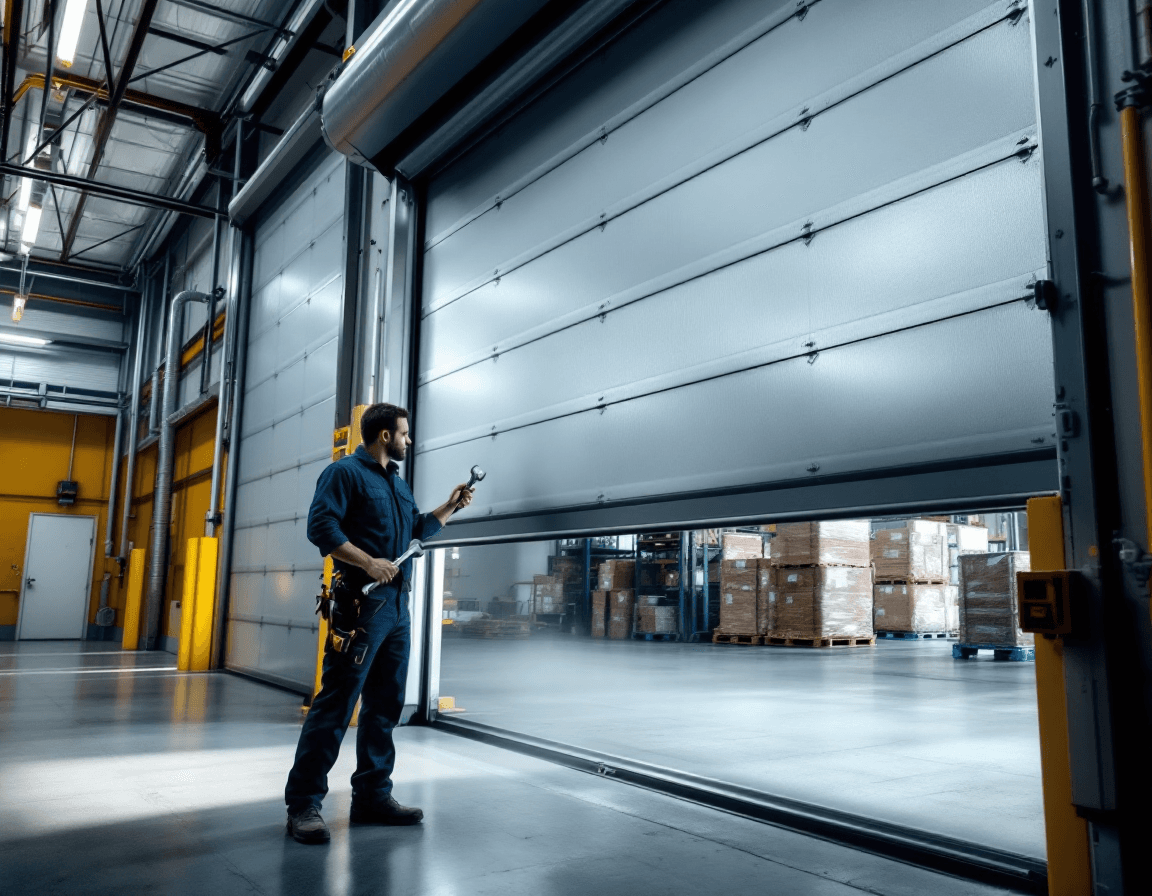
Commercial Overhead Door Repair in North Bend, WA keeps a business moving, and when a loading door stops working, the whole operation feels it. North Bend sits at the eastern edge of King County, where the Snoqualmie Valley opens up under Mount Si and the I-90 corridor carries freight, contractors, and visitors through town. Many of the warehouses, light-industrial shops, and dock-equipped buildings in ZIP 98045 depend on a handful of large doors that run hard every day. When one of them goes down, the cost is measured in delayed trucks, idle crews, and product sitting on the wrong side of a closed door.
We work with property managers, owners, and facility teams throughout North Bend and the surrounding valley to get commercial doors back in service quickly and safely. Our technicians are licensed, bonded, and insured, and we handle sectional overhead doors, rolling steel doors, commercial operators, and the preventive maintenance programs that keep those systems predictable. Every job starts with a clear explanation of what failed, what it will take to fix it properly, and what the options are for getting you back to full throughput. We would rather give you a plain answer and a custom quote than a vague estimate that changes once the crew is on site.
This page explains the most common commercial door problems we see in North Bend, how the Pacific Northwest climate affects them, what to expect during a service visit, and how a maintenance agreement can reduce emergency calls. If your door is down right now, call (888) 799-3819 and describe what you are seeing. The details you share over the phone often help us plan the right truck, parts, and crew before we arrive.
Why Valley Loading Docks Fail on Their Own Schedule
Commercial doors in the Snoqualmie Valley rarely fail in a vacuum. Heavy daily cycles, forklift traffic, temperature swings between cold mornings and warm afternoons, and the wet months from October through April all add stress to rollers, hinges, cables, and drive components. A door that cycles fifty or a hundred times a day will wear out its hardware far faster than a residential garage door that opens twice a day, and the wear tends to show up as small noises long before it becomes a shutdown. Most of the emergency calls we get in North Bend begin with a symptom that a facility team noticed a few weeks earlier and deferred.
Location matters as well. Buildings near the river bottoms and those tucked against the foothills can hold moisture longer, especially on the shaded sides where morning dew lingers into the afternoon. Rust creeps into track joints and bottom brackets in those spots, and grit from road traffic gets pulled into the bottom seal every time the door closes. Doors that serve a busy dock on a main route often see more vehicle impact than doors in a quieter industrial court, so a single bump can misalign a section that was perfectly square the week before.
Understanding these patterns helps you plan. We recommend walking each dock door once a month with a simple checklist, looking for gaps at the sides, uneven movement, scraped paint, and any sound that did not used to be there. Writing down what you observe gives the technician a timeline, which usually shortens diagnosis time and reduces the number of return visits. A short log kept by the dock supervisor is often more useful than any single repair invoice.
Sectional Overhead Doors Along the I-90 Corridor
Sectional overhead doors are the workhorse of most North Bend warehouses and service bays. Each panel rides on rollers inside vertical and horizontal track, and the whole assembly is counterbalanced by torsion springs mounted on a shaft above the opening. When the system is healthy, a commercial sectional door should lift smoothly with little effort from the operator. When it is not, the symptoms usually appear in the track, the rollers, the hinges, or the springs, and each one points to a different repair path.
Common sectional problems we see include rollers that have flattened or cracked, hinge brackets that have pulled loose, track that has been knocked out of plumb, and bottom seals that have torn away from the bottom panel. Any of these can make the door hesitate, bind partway up, or come down unevenly. Track alignment is especially important on wide openings, because even a small variance can cause one side to lag and put extra load on the operator and the opposite spring.
Spring work is the part of sectional service that requires the most caution. Commercial torsion springs store a large amount of energy, and they should only be adjusted, replaced, or wound by a licensed, trained technician with the correct tools and procedures. Homeowners and facility staff should never attempt spring work themselves, and we always recommend a licensed professional for any cable or spring repair. When we quote a sectional repair, we list spring and cable work as a separate line item so you can see exactly what is involved and why it is being done.
Rolling Steel Doors That Jam, Bind, or Jump Track
Rolling steel doors are common in North Bend retail fronts, storage buildings, and industrial bays where space above the opening is limited and the door needs to stay compact. Instead of panels that stack along a horizontal track, a rolling steel door winds into a coil above the opening, and interlocking steel slats slide through vertical guides on each side. That design is efficient, but it is sensitive to anything that interrupts the guides, whether that is a bent slat, debris in the channel, or a guide that has been pushed out of square.
When a rolling steel door jams, the first thing we check is the guide channel on both sides. A small dent, a pebble wedged in the track, or accumulated grit can cause the curtain to skip or stall, and forcing the door can bend slats and damage the coil. Jumping off track is often a sign that one side has shifted, the bottom bar has been struck, or the tension on the coil has changed. Those problems are typically fixable without replacing the entire curtain, but the repair must be done carefully so the slats remain aligned.
Rolling doors also have a larger footprint of moving parts than most people expect, including the barrel, brackets, and locking hardware. We inspect each of these during a service call, and we explain which components are worn and which are simply dirty. Keeping the guides clean and free of debris is one of the simplest maintenance steps a facility can take, and it prevents many of the jams we are called out to fix.
Commercial Operators: When the Motor Quits Mid-Shift
A commercial operator is the motor and control system that raises and lowers the door, and it is the component most likely to fail when a dock is busiest. Heavy-duty operators are built for high cycle counts, but they still depend on limit settings, safety sensors, gear reduction, drive chains or belts, and reliable power. A door that stops halfway, reverses for no clear reason, or refuses to respond to the wall control is often pointing to one of those systems rather than the door itself.
We approach operator failures by separating the electrical side from the mechanical side. On the electrical side, we check power supply, control boards, relays, wall stations, and the safety edge or photo-eye sensors that stop the door when something is in the path. On the mechanical side, we inspect the drive chain or belt, the gearbox, the sprockets, and the brake or limit mechanism. Many failures turn out to be a sensor that is misaligned or dirty, which is a quick fix, but some need a motor or control board replacement, and those are worth planning around rather than discovering during a rush.
Commercial operators also benefit from periodic programming checks. Limit settings drift over time as cables stretch and components settle, and a door that once stopped perfectly at the top can begin overshooting or underestimating its travel. Re-checking those settings during scheduled service often prevents the sudden failure that stops a dock in the middle of a shift.
Throughput Problems: When the Door Is Technically Working but Too Slow
Not every commercial door problem is a breakdown. Sometimes the door works, but it moves so slowly that trucks and forklifts queue at the opening, and the dock loses efficiency every time it cycles. Slow travel usually traces back to an operator that is underpowered for the door's weight, worn drive components, tracks that are binding, or a door that has been upgraded or resized without changing the drive. Each of those causes can be measured and corrected.
Our technicians start by timing a full open and close cycle and comparing it with the door's specifications and the operating conditions described by the facility. We look for friction points in the track, check roller condition, confirm the counterbalance is set correctly, and evaluate whether the operator is still delivering the speed it was designed for. If the door is slow only at certain points, that often indicates a localized binding issue or a worn guide. If it is slow throughout, the drive system or balance is more likely the cause.
For facilities that need faster cycles, we can discuss upgrades such as higher-speed operators, improved controls, or updated track components. Those changes are not always the right answer, and we will say so if a repair to existing equipment will meet your needs. The goal is to match the door's performance to how your dock actually runs, rather than selling a bigger system than you need.
Forklift Strikes and Damaged Door Sections
Forklift impact is one of the most frequent causes of commercial door damage in busy North Bend industrial and warehouse settings. A pallet jack or forklift tine that clips the bottom panel can bend a section, crack a glass lite, pull a hinge loose, or knock the track out of plumb. Damage like this rarely stops the door immediately, which is why many facilities keep running with a bent panel until the next failure forces a shutdown.
After an impact, we recommend an immediate visual check and a simple test: open and close the door slowly, watch for uneven movement, listen for rubbing or popping, and look for gaps where panels meet. If any of those signs appear, the door should be inspected before it cycles again under full load. Continuing to operate a door with a misaligned section can damage rollers, track, and the operator, which turns a single-panel repair into a multi-part job.
Replacing a damaged section is often more economical than repairing it, but the right answer depends on the door's age, the panel style, and whether matching sections are still available. We can often source replacement panels in the correct profile and insulation rating, and we will tell you if a full door replacement makes more financial sense. Either way, we document the damage with photos so your records reflect what happened and when it was repaired.
Moisture, Mildew, and Valley Weather on Metal Doors
The Pacific Northwest's wet season is hard on steel doors, and the Snoqualmie Valley is no exception. Fog settles in the valley on cool mornings, rain runs for long stretches from late fall through spring, and humidity stays high enough that moisture rarely fully dries from the lower parts of the door. Over time, that moisture encourages surface rust at bottom brackets, track fasteners, and the lower edges of panels, and it can work its way into hinge pins and roller bearings.
Winter brings its own challenges. When temperatures drop near freezing, the bottom seal can stiffen and stick to the threshold, and ice can form in the track on exposed docks. A door that has been frozen to the floor should never be forced, because the stress can damage the operator, the bottom bar, or the panels. Instead, call for service and let the technician assess whether the ice can be safely cleared and what caused the bond in the first place.
Good weather protection is a practical investment. Keeping the threshold clear of gravel and debris, making sure drainage around the dock directs water away from the opening, and checking weatherstripping each fall all reduce corrosion and drafts. We can recommend seal replacements and coatings that suit the environment, and we can help you set a seasonal inspection schedule so the wettest months do not catch your doors unprepared.
Preventive Maintenance Agreements That Actually Pay Off
A preventive maintenance agreement is one of the most effective ways to reduce unplanned downtime for commercial doors. Instead of waiting for a failure, the agreement schedules regular inspections, lubrication, adjustments, and safety testing, and it gives the facility a documented record of the equipment's condition. For operations where a stopped dock means lost revenue or missed shipments, that predictability is often worth more than the cost of the service itself.
A typical program covers sectional and rolling doors, operators, safety sensors, and the hardware that connects them. During each visit, the technician checks balance, track alignment, roller condition, bottom seals, cable and spring condition, operator limits, and safety reversal function. Findings are logged with notes and photos, so you can see trends over time, such as a bracket that is loosening or a guide that is slowly shifting. Many of these issues are minor when caught early and expensive when they are discovered during a shutdown.
We structure our agreements around your operation rather than a one-size-fits-all package. Some facilities need quarterly visits for heavily used docks, while others are well served by semiannual service on lighter-duty doors. We will also outline which repairs are included, which require a separate approval, and how emergency calls are prioritized, so there are no surprises when something breaks at an inconvenient hour.
- Scheduled inspections of sectional and rolling doors, including track, rollers, hinges, and guides
- Operator checks covering limits, safety sensors, controls, and drive components
- Spring and cable inspection, with any adjustment or replacement performed by licensed technicians
- Lubrication and seal checks suited to wet-season and freeze conditions
- Written service logs with photos, so trends are visible and budgets are easier to plan
- Priority response terms for covered customers, outlined clearly in the agreement
What Happens During a Commercial Service Visit
A commercial service visit begins with a conversation about what is happening at the dock. We ask when the problem started, whether it is intermittent or constant, what changed recently, and how the door is used during a normal shift. That information shapes the diagnostic plan and helps us bring the right parts and tools on the first trip, which is one of the most effective ways to reduce downtime.
Next, the technician walks the full door assembly. We check the opening, the track, the rollers or guides, the springs and drums or the barrel, the operator, and all safety devices, then test the door through a complete cycle under observation. We document what we find, separate urgent safety items from routine wear, and explain the options in plain language. You will know what is failing, what it will take to correct it, and whether the door can safely run while parts are ordered.
For larger repairs, we provide a custom written quote with line items for labor, parts, and any specialty work. Commercial jobs can involve special lead times, so we will tell you what is in stock, what needs to be fabricated, and what the realistic completion window looks like. Once the work is complete, we run the door through several cycles, confirm the safety reversal functions, and leave a summary of the repair for your records.
Safety Rules We Hold Ourselves To
Commercial doors are heavy, and they carry stored energy that can cause serious injury when handled incorrectly. Our technicians follow established safety practices on every job, including lockout and tagout procedures when power is involved, supported and controlled door movement during inspection, and proper handling of torsion springs and cables. We do not rush spring work, and we do not allow a door to be left in a partly disassembled state when people are working around the opening.
We also believe facility staff should know the basics of safe operation. Employees should never walk under a door that is moving or stuck, should never try to force a door that is jammed or frozen, and should never attempt to adjust springs, cables, or track brackets themselves. If a door behaves unexpectedly, the safest response is to stop using it, keep people clear of the opening, and call a qualified technician to inspect it.
Our standard is simple: any spring, cable, or high-tension work is performed by a licensed professional, and that professional takes the time to do it correctly. We are glad to walk your safety lead through the procedures we use, and we encourage facility managers to ask any contractor, including us, how they manage stored energy and lockout requirements before work begins.
Getting a Custom Quote Without Waiting Days
Commercial downtime is expensive, so speed matters, but a fast quote still has to be accurate. To help us price your job quickly, have the following information ready when you call: the door type and approximate size, the building address in ZIP 98045 or elsewhere in the area, the operator brand if you know it, photos of the damage or the affected components, and a description of when the problem started. Those details let us determine whether the job calls for a same-day stabilization visit, a parts order, or a planned replacement.
Once we have the details, we prepare a custom quote that separates immediate repairs from recommended upgrades, so you can approve what keeps the dock running now and plan the rest on your own schedule. We will also note any safety concerns, such as a door that should remain closed until repairs are complete. If a repair will be temporary, we will say so and explain what to watch for until the permanent fix is installed.
For facilities that are not yet in crisis but are seeing warning signs, a quote and inspection now can prevent a much larger bill later. Whether your need is a single broken panel, a stubborn operator, or a full preventive maintenance agreement for your North Bend properties, we will tailor the plan to your schedule and budget. Call (888) 799-3819 to speak with our team about your dock, and we will help you get your doors moving again.