
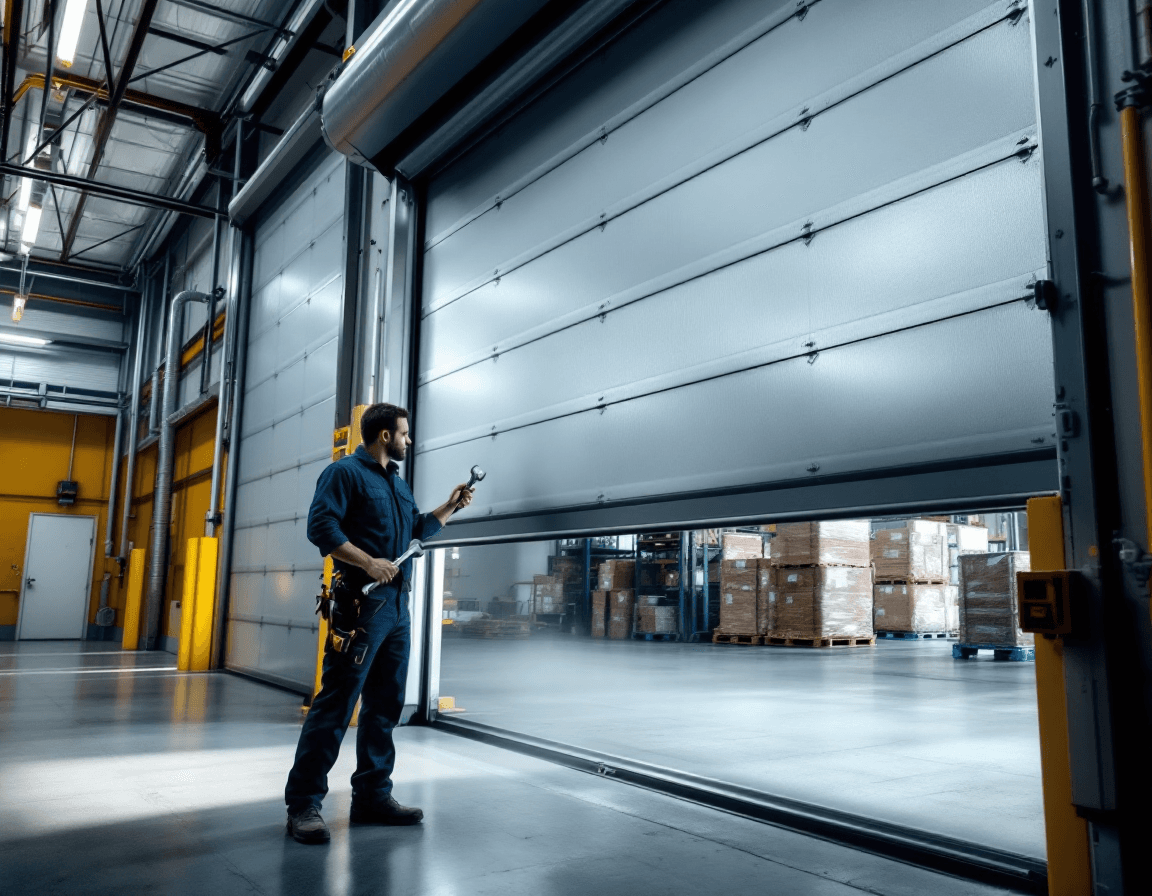
Commercial Overhead Door Repair in Issaquah, WA is a different job from fixing a garage door at home, and it demands faster response, larger hardware, and a clear plan for keeping your business open. Warehouses, light-industrial suites, contractor yards, and retail loading docks around Issaquah depend on their overhead doors to move inventory and staff every day. When one of those doors stops working, the cost shows up in missed deliveries, idle crews, and trucks waiting at the curb. Our team at Seattle Garage Door Fix handles sectional doors, rolling steel doors, commercial operators, and preventive maintenance for businesses across Issaquah and the surrounding King County communities.
Issaquah sits in the foothills where the Cascades meet Lake Sammamish, and that position shapes how commercial doors age here. Winters bring long stretches of rain, cold mornings that dip near freezing, and humidity that lingers well into spring. Those conditions slowly work on steel, galvanizing, weatherseals, and the lubricants inside rollers and hinges. A door that performed well during a dry summer can start to bind or groan after a wet December, and owners often notice the change only when the cycle count starts to climb.
This page explains the most common commercial door problems we see in Issaquah, how to recognize them early, what a professional repair involves, and how preventive maintenance can keep your operation running through the busiest seasons. Every commercial job is different, so the details below are meant to help you understand the process and ask better questions, not to replace an on-site evaluation. If your door is down right now, the fastest path to a working opening is a phone call to (888) 799-3819.
Why Issaquah Loading Docks Wear Doors Differently
Commercial doors in Issaquah rarely sit idle for long. A door on a distribution suite near the I-90 corridor may cycle dozens of times during a single delivery window, while a smaller shop may open only a handful of times but face heavy forklift traffic every time it does. Each cycle loads the springs, cables, rollers, and operator with force that a residential door never experiences. Over several years, that cumulative stress is what usually leads to failure, not a single dramatic event.
The Pacific Northwest adds its own pressures. Wet weather trims moisture into bottom seals, track joints, and the mounting hardware along the header, and it encourages surface corrosion on exposed steel that rarely dries out completely in winter. Temperature swings between cold nights and warmer afternoons cause panels and tracks to expand and contract slightly, which can shift alignment over time. In the foothill neighborhoods near Squak Mountain, where tree cover and damp conditions persist, debris such as moss, fir needles, and grit collects in track channels and can wedge rollers out of their path.
Our technicians account for these local factors when we inspect a door. We look at the condition of the bottom weatherseal, the drainage at the threshold, the tension of the counterbalance, and whether the track has shifted from its original position. Understanding how a door was loaded and how it wears in this climate lets us recommend repairs that last rather than simply getting the door moving again for another week.
Reading the Warning Signs Before a Door Goes Dark
Most commercial door failures announce themselves well before the door stops completely. Operators and dock staff often notice small changes in sound, speed, or behavior that signal a component is approaching the end of its service life. Catching those signs early usually means a shorter repair, fewer parts, and less disruption to your schedule. Waiting until the door is stuck halfway can turn a planned visit into an emergency call.
Look for these common warning signs at your facility:
- Grinding, squealing, or popping sounds during the opening or closing cycle
- The door pausing, stuttering, or reversing without a clear obstruction
- Visible gaps at the bottom or sides that let in water, drafts, or pests
- Sections or curtain slats that appear bent, bowed, or pulled out of alignment
- Uneven lifting, where one side of the door rises faster or lower than the other
- Operator motor running hot, tripping a breaker, or producing a burning smell
- The door taking noticeably longer to reach full height than it did last season
If you notice any of these, log the date, the time of day, and the weather. That information helps a technician identify patterns, such as a door that binds only after heavy rain or a motor that struggles during the first cold morning of the week. Keeping a simple maintenance log is one of the easiest ways to make your service calls faster and more accurate.
Sectional Door Repair for Business Suites and Dock Openings
Sectional doors are the most common overhead style on Issaquah commercial buildings, and they are built from insulated or non-insulated panels connected by hinges and guided by tracks on each side. Repairs usually involve replacing a damaged panel, reattaching a loose hinge or roller, realigning the track, or correcting uneven spring tension. When a single panel is damaged, we can often replace it without replacing the entire door, provided the panel profile and hardware still match the existing system.
Springs deserve special attention. Commercial sectional doors typically use torsion springs mounted on a shaft above the opening, and those springs store enormous energy when they are wound. Adjusting, replacing, or rewinding a torsion spring is dangerous work that must be done by trained professionals with the proper tools and procedures. Spring and cable repairs are never a do-it-yourself project, and any business owner or property manager should insist on licensed technicians for that work.
Because sectional doors often serve as the primary entrance for trucks and staff, we also evaluate the surrounding hardware during a repair visit. That includes the bottom seal, the side seals, the weather stripping at the header, and the wheel and roller condition on each section. Addressing those smaller items at the same visit prevents a second service call a few weeks later and keeps the opening secure against wind-driven rain.
Rolling Steel Doors That Jam, Derail, or Bind
Rolling steel doors are common in Issaquah's light-industrial buildings, workshops, and storage facilities because they coil into a compact hood above the opening and protect against intrusion. Their design is simpler in some ways than a sectional door, but a jammed or derailed rolling door can be just as disruptive. The curtain is made of interlocking slats that ride in guides on each side, and the coil is wound around a barrel that is tensioned by a spring assembly or driven by an operator.
When a rolling steel door jams, the most frequent causes are debris in the guide channels, a bent slat that catches the guide, or a curtain that has slipped out of its track. Trying to force the door open can deform slats further and damage the guides, which turns a manageable adjustment into a larger rebuild. If a door has come partly off its guides, stop operating it, keep people clear of the opening, and call for service before attempting to pull the curtain back by hand.
Our technicians inspect the guide alignment, the condition of the bottom bar, the coil and barrel assembly, and any lock or latch hardware that could interfere with travel. We clean the channels, straighten or replace damaged slats, and restore the curtain to a smooth, even run. In many cases, a simple adjustment to the barrel tension or the guide spacing restores full operation without replacing major components.
Commercial Operators: When the Motor Quits Mid-Shift
A commercial door operator is the motor and control system that opens and closes the door on command. In Issaquah's business districts, operators are often tied to keypads, card readers, wall stations, or building automation systems, and they must respond consistently throughout the day. When an operator fails, the door may stop completely, move only partway, reverse unexpectedly, or refuse to respond to a signal from the control station.
Diagnosing an operator starts with the basics: power supply, control wiring, limit settings, and safety devices. Photo eyes, safety edges, and entrapment protection are required features on commercial doors because they stop or reverse the door when something blocks the opening. A misaligned photo eye or a damaged safety edge can cause a door to reverse repeatedly even when nothing is in the way, and those components are often the first thing we check when a door behaves erratically. Operators built to current safety standards are designed with those protections in mind, and any repair should preserve them rather than bypass them.
Some operator problems are straightforward, such as a worn drive chain, a failed limit switch, or a control board with a burned component. Others call for a full replacement, particularly when the operator is an older model that no longer has available parts or when it cannot meet current requirements for your building. We provide a clear explanation of what is failing, what repair options exist, and what each option costs before work begins, so you can plan around your operating hours.
Solving Throughput Problems Before They Cost You Shifts
A door can be technically working and still be the bottleneck in your operation. If trucks wait at the threshold while the door crawls upward, or if dock crews start propping the door open by hand because the operator is too slow to keep up, you are losing productivity even though nothing has failed outright. Throughput complaints are common in busy warehouses and service yards, and they often trace back to worn bearings, unbalanced springs, aging motors, or control settings that no longer match how the building is used.
We begin with a timed review of the door cycle. Measuring how long it takes to fully open and close, noting any pauses or hesitations, and watching how the door behaves under load gives us a baseline. From there we can adjust the operator speed within safe limits, rebalance the spring system, replace worn rollers or bearings, or recommend a faster operator if the existing one is undersized for the duty cycle your business requires.
Speed is not the only goal. A faster door that slams or stresses components will shorten the life of the system and may create a safety hazard. That is why we balance throughput with durability and safety, and we explain the tradeoffs before making changes. For many Issaquah operations, the right answer is a combination of tuning, lubrication, and a targeted component upgrade rather than a full door replacement.
Forklift Impact Damage and Hidden Structural Stress
Forklift strikes are among the most common causes of commercial door damage, and they are rarely limited to the visible dent. A pallet or forks that clip a section can bend the panel, pull the hinge out of its mounting, shift the roller off its track, or stress the spring assembly in ways that are not obvious at first glance. Even a glancing impact can knock a track out of plumb, and a door that continues to operate after a hit may be hiding progressive damage.
After an impact, we recommend that the door be taken out of service until it has been inspected. Operating a damaged door can cause a section to drop, a track to separate, or a spring to fail under additional load. Our inspection covers each panel, the hinges between sections, the tracks and brackets, the spring tension, and the operator's response to the altered geometry. We document the damage so you have a clear record for insurance or internal reporting.
Repairs after forklift damage may range from replacing a single section to realigning a track, reinforcing a bracket, or rebalancing the entire door. We match replacement panels to the existing profile and hardware whenever possible, since mismatched sections can create gaps and uneven motion. Where the door has been repeatedly struck at the same location, we also discuss protective measures such as bollards, guard rails, or revised traffic patterns that reduce the chance of a repeat incident.
Custom Commercial Quotes Built Around Your Downtime
Every commercial door project is scoped individually, and no two quotes look exactly alike. The door size, material, operator type, safety components, access conditions, and business hours all influence the final price and timeline. Because our commercial work is quoted rather than priced from a fixed menu, we take the time to understand what your facility needs before recommending a plan. That approach also lets us respond quickly when a door is down and the clock is running.
A typical commercial quote includes an on-site assessment, a list of required repairs or replacements, the parts and labor involved, any safety upgrades needed to meet current requirements, and a suggested schedule. Where possible, we propose work windows that minimize disruption, such as early morning visits before a shift begins or evening appointments after the dock closes. If a temporary solution will keep the building operating while a part is ordered, we will explain that option and its limitations.
Our goal is a quote you can act on without guesswork. We ask about your operating hours, the volume of door cycles you expect, and whether other doors in the building are due for service. If you have a history of recurring problems, we will say so and recommend a path that addresses the root cause. Call (888) 799-3819 to discuss your facility, and we will walk you through what a custom assessment involves.
Preventive Maintenance Agreements for Issaquah Facilities
Preventive maintenance is the most reliable way to avoid emergency downtime. A scheduled maintenance agreement gives your facility regular inspections, lubrication, adjustments, and early identification of wear before it becomes a failure. For businesses that cannot afford an unplanned closure, that predictability is worth far more than the cost of a single emergency call. Agreements can be tailored to the number of doors, the duty cycle, and the level of inspection your operation requires.
A typical preventive maintenance visit may include the following items, adjusted to your specific equipment:
- Full inspection of springs, cables, drums, and mounting hardware, performed by licensed technicians
- Lubrication of rollers, hinges, bearings, and track surfaces using products suited to the Pacific Northwest climate
- Testing of safety edges, photo eyes, and entrapment protection devices
- Checking track alignment, panel condition, and weatherseal integrity
- Adjustment of operator limits, speed settings, and control functions
- A written summary of findings, including recommended repairs and their priority
Regular service is especially valuable in Issaquah's wet months, when moisture and debris can accelerate wear on hardware that is otherwise in good shape. We can schedule visits before the rainy season begins and again after the coldest weeks pass, giving you a clear picture of how the doors are holding up. Over time, the maintenance history also helps you plan capital budgets, since you can see which doors are approaching replacement and which have years of service left.
Safety Practices Your Crew Should Follow Until We Arrive
When a commercial door malfunctions, the first priority is keeping people safe. Staff should never attempt to repair springs, cables, or drums, and they should never stand under a door that is partially open or unsupported. Until a licensed technician arrives, a few simple precautions can prevent injuries and additional damage to the equipment. Clear communication with your team matters just as much as the repair itself.
Consider the following steps while you wait for service:
- Close the door fully if it is safe to do so, and keep the area clear of people, vehicles, and equipment
- Disconnect power at the operator only if a qualified staff member can do so without touching the door
- Post a clear notice or cone off the opening so no one walks beneath a hanging or misaligned section
- Avoid forcing a jammed door, since that can bend slats, tear cables, or damage guides
- Use alternate receiving doors or entrances when available, and notify drivers and vendors of the change
- Document what happened, including the time, weather, and any sounds or impacts beforehand
Never assume a door that seems to be working is safe. Hidden damage, such as a loose cable or a cracked spring, can fail without warning. Treat every malfunction as a potential hazard, and let a licensed professional confirm that the door is ready for normal use before returning it to service.
Serving Issaquah's Commercial Corridors Across 98027 and 98029
Our commercial service area covers the business and industrial neighborhoods across ZIP codes 98027 and 98029, including the mixed-use blocks of Issaquah Highlands, the older storefronts and workshops near Gilman Village, and the light-industrial properties that serve the broader Plateau and surrounding foothill communities. Each area has its own mix of building ages, door styles, access routes, and delivery schedules. Knowing those differences helps us arrive prepared with the right parts and tools for your building.
Newer developments often feature modern sectional doors with advanced operators and integrated safety systems, which means technicians need current diagnostic knowledge and access to compatible components. Older buildings may still rely on rolling steel doors, legacy operators, or custom-fabricated openings that require careful measurement and fitting. We work with both, and we are happy to discuss the age, make, and condition of your doors when you call so we can plan accordingly.
Access and scheduling also vary across the area. Some commercial sites have limited parking, shared loading zones, or restricted hours, and we coordinate with property managers and tenants to keep the work efficient. If your facility is near Squak Mountain or in one of the older commercial pockets with tighter approaches, let us know during scheduling so our team can plan the route and equipment needed for a smooth visit.
Get Your Issaquah Commercial Door Back in Service
When your loading dock or warehouse door stops working, every hour of downtime matters. Our licensed, bonded, and insured technicians provide commercial overhead door repair, rolling steel door service, operator diagnosis, throughput tuning, and preventive maintenance agreements for businesses throughout Issaquah and the surrounding King County communities. We provide custom quotes, fast turnaround, and clear communication so you can plan around your operation. For immediate help or to schedule an assessment, call Seattle Garage Door Fix at (888) 799-3819 today.