
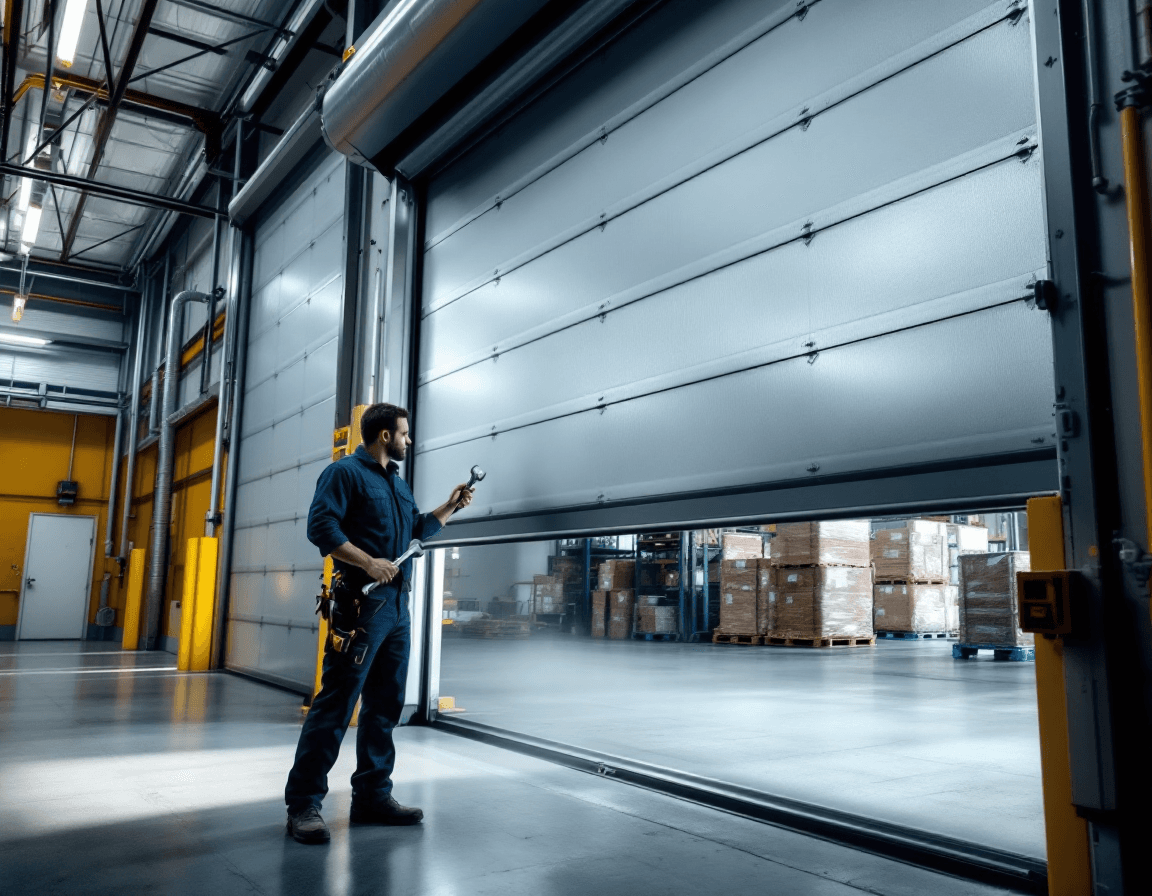
Commercial overhead door repair in Bellevue, WA is a different job from fixing a garage door at a single-family home. A warehouse, loading dock, or retail back entrance carries heavier daily traffic, larger door panels, and a business that loses money every hour the opening stays shut. Our technicians work on sectional overhead doors, rolling steel doors, and commercial operators across the Eastside, from the office towers near Downtown Bellevue to the light-industrial buildings tucked along the back roads of Factoria and Lake Hills. Most calls start with a simple question from a facility manager or property owner: "Can you get this door moving again today?"
Bellevue businesses face a mix of conditions that shape how commercial doors perform. The Pacific Northwest brings long stretches of damp weather, frequent drizzle, and cool nights that carry moisture into steel and mechanical parts. Combine that with heavy delivery schedules, tight parking areas, and forklifts that operate close to the door frame, and you get a set of problems that repeat across the region. We have designed this page to explain what typically goes wrong, how we approach each repair, and how a preventive maintenance plan can keep a dock running through the busy seasons.
Whether your door is at a small contractor's yard near Somerset or a multi-bay loading area close to the Crossroads shopping district, the goal is the same: a safe, reliable opening that matches the pace of your operation. Read on for a practical walkthrough of the common failures, the repair options we typically recommend, and the details that matter when you are comparing service providers.
Why Bellevue Loading Docks Wear Doors Differently
Commercial doors in Bellevue live in a demanding environment. Many of them open and close dozens or even hundreds of times in a single shift, which is far more cycling than a residential door will ever see. The moisture that rolls in from Puget Sound and settles over the Eastside during fall and winter works its way into hinges, roller bearings, and the lower edges of steel panels. Over several seasons, that moisture encourages surface rust on exposed hardware and can loosen fasteners that were never meant to flex this often.
Temperature swings add another layer of stress. A dock door might sit in cool morning air, warm up in the afternoon sun on a clear spring day, and then face a damp chill again by evening. Steel expands and contracts with those changes, and tracks can shift slightly out of alignment over time. A door that closed cleanly in July might start to drag or stick in November, even though nothing obvious has broken.
Traffic patterns matter just as much as weather. Loading docks near busy arterials and industrial pockets in the 98004 through 98008 ZIP codes often see trucks backing in at odd angles, pallet jacks clipping the bottom bar, and forklifts cutting corners during peak hours. Each small impact transfers force into the door panels, the guide tracks, and the operator mounting brackets. When we inspect a commercial door, we look at the whole system together, because a problem in one area often shows up as a symptom somewhere else.
Reading the Warning Signs Before a Dock Goes Dark
Most commercial door failures announce themselves well before the door stops completely. Catching these early signals is the single best way to avoid an emergency call and the lost production that comes with it. Operators and facility staff are usually the first to notice a change, especially when they use the same door every shift. If you notice any of the following, it is worth scheduling an inspection before the problem grows:
- The door pauses, shudders, or stalls partway through its travel, especially when cold or damp.
- Grinding, popping, or scraping sounds appear from the track or the operator housing.
- The door closes noticeably slower than it did a few months ago, which can signal a worn motor, a failing drive component, or a binding track.
- Panels have visible gaps, bent edges, or seals that no longer make contact with the ground or the frame.
- The door reverses or reopens for no clear reason, which may indicate a sensor misalignment or an obstruction in the safety circuit.
Facility managers sometimes ask whether a slow door can wait until the next scheduled shutdown. Our answer is that a slow door usually means something is already under strain. Replacing a worn roller or realigning a track costs far less than repairing a bent section after the door has jammed under load. A short inspection can often identify whether the issue is a simple adjustment or something that requires parts on order.
Sectional Overhead Doors: Panels, Tracks, and Hidden Stress
Sectional overhead doors are the workhorses of many Bellevue warehouses, distribution spaces, and service garages. Each door is made of horizontal panels hinged together and guided up and back along tracks on both sides of the opening. The design is efficient, but it depends on every roller, hinge, and track segment staying true. A single worn roller can force the entire panel stack to bind, and the stress often shows up at the joints between panels first.
When we service a sectional door, we typically start by checking track alignment at the top radius, the horizontal runs, and the vertical sections. We look for loose track brackets, bent track sections, and signs that the door has been hitting the frame. Rollers get inspected for flat spots, cracked nylon, or worn bearings, and hinges get checked for elongated holes or stripped fasteners. The counterbalance system, which uses torsion springs or extension springs, gets evaluated as part of the same assessment, although spring work itself is always handled by trained technicians under safe conditions.
Panel damage is a common reason for commercial sectional door calls. A single cracked or bowed panel can affect how the door tracks, so it is often better to replace the affected section than to patch it. Replacement panels are commonly available in matching insulation values and colors, which helps maintain a consistent look on a building facade. We discuss the options with you so that the repair fits the building's needs and budget.
Rolling Steel Doors That Jam or Jump Their Tracks
Rolling steel doors are common at storefronts, mechanical rooms, parking structures, and secure bays where space above the opening is limited. Instead of hinged panels, these doors use interlocking steel slats that coil around a barrel above the opening. Because the curtain is held in tracks along each side, a small misalignment can cause the slats to catch, jam, or pop out of the guide channel. This kind of failure can happen suddenly, especially after a vehicle bumps the lower edge.
Our first step with a jammed rolling steel door is to make the area safe and prevent further damage. We check whether the curtain has come partly out of the guides, whether any slats are bent, and whether the barrel and brackets are still seated correctly. Dirt, grit, and winter debris often build up in the tracks, and cleaning them out can restore smooth movement. In other cases, a bent bottom bar or damaged guide needs to be straightened or replaced before the door can run freely again.
Rolling doors also depend on a balanced spring tension system, and this is one area where safety requires a licensed professional. A sudden release of spring energy can cause serious injury, so we never recommend that property staff attempt to adjust or remove the spring assembly themselves. If a rolling door has dropped, stopped mid-travel, or shows a broken spring, the right move is to stop using the door and call for service.
Commercial Operators, Sensors, and Entrapment Protection
Commercial operators are the motors and control systems that lift and lower large doors on a schedule that matches your business. They include heavy-duty drives, control panels, push buttons, key switches, access control interfaces, and safety devices. When an operator fails, the door may not respond at all, or it may open partway and then stop. Diagnosing the cause means checking power supply, limit settings, control wiring, and every safety input that feeds into the control board.
Safety sensors deserve special attention. Commercial doors are expected to reverse when they detect an obstruction, and in many installations the photo eyes and edge sensors must be aligned and functioning before the door will close. Dirt on the sensor lenses, a bumped bracket, or a damaged cable can make the door behave erratically. We test each sensor, clean the lenses, realign brackets, and verify the reversing response so the door stops and reverses safely if someone or something is in the path.
Entrapment protection is more than a convenience feature. Commercial door and gate systems are typically designed with reference to industry safety standards such as UL 325, which addresses how automated doors should detect obstructions and respond to them. We encourage facility owners to ask whether their existing system meets current requirements, especially after a control board or sensor replacement. Our technicians will explain what is installed, what is missing, and what an upgrade would involve, without pressuring you into work you do not need.
Forklift Damage: Replacing Sections Without Losing a Day
Forklift impact is one of the most frequent causes of commercial door damage in busy Bellevue facilities. A forklift tine catching the bottom panel, a pallet load swinging into the frame, or a misjudged turn can bend tracks, crack panels, and knock operators out of alignment in seconds. Because these incidents often happen during peak hours, the pressure to restore the opening quickly is intense. A good repair plan balances speed with the need to get the door right the first time.
When we respond to a forklift-damaged door, we begin by documenting the damage and determining whether the door can be operated safely. If there is any risk of the door falling, the area is cordoned off and the door is secured. From there, we assess which panels, tracks, and brackets need replacement and whether any structural components have been compromised. In many cases, a temporary solution keeps your dock partially functional while parts are ordered and installed.
Planning ahead helps reduce downtime. We recommend keeping a record of your door's make, model, and panel dimensions, along with photos of the existing hardware. That information speeds up part identification and reduces the back-and-forth that can add days to a repair. The following items are especially helpful to have ready when you call:
- Door manufacturer, approximate installation date, and any model or serial information on the operator or panel labels
- Overall opening width and height, plus the number of panels in a sectional door
- Photos of the damaged area, including tracks, brackets, and the operator housing
- A description of how the door behaved before the impact, such as noises, delays, or misalignment
- Your preferred operating hours, so we can plan repairs around your business schedule
Speed Matters: Keeping Throughput Up During Repairs
For a commercial property, the real cost of a broken door is often measured in delayed shipments, idle staff, and frustrated customers. That is why we treat turnaround time as part of the service, not an afterthought. Our approach begins with a clear assessment of what must happen first to restore safe operation, and we avoid turning a small adjustment into a long project. When parts are needed, we discuss availability and timing up front so you can plan around them.
Throughput also depends on how the door is operated while repairs are underway. In some cases, a door can be run in a limited mode, with a single-speed operation or manual override, until the full repair is complete. We explain any restrictions clearly so your team knows what is safe and what should be avoided. If a door must stay out of service for a longer period, we can help you think through temporary access options that keep deliveries moving.
Every commercial job is priced as a custom quote, so the scope and cost are matched to the actual work required. We do not guess at the price over the phone without seeing the door, because a loose track and a broken torsion system have very different requirements. Once we have inspected the equipment, we provide a written estimate that outlines the work, the parts, and the expected timeline.
Preventive Maintenance Contracts Worth Considering
A preventive maintenance agreement can be one of the most cost-effective decisions a Bellevue business makes about its doors. Instead of waiting for a breakdown, a scheduled service visit checks the components that wear over time and catches small issues before they cause downtime. Typical maintenance visits include lubrication, track inspection, roller and hinge checks, operator testing, sensor alignment, and a review of safety devices. The schedule and scope are customized to your facility, since a busy distribution dock has different needs than a quieter service bay.
The value of a maintenance plan shows up most clearly during the wet months. Moisture can cause hardware to stiffen and fasteners to loosen, and a scheduled inspection gives us the chance to address those changes before they affect operation. A maintenance visit also creates a documented history of your doors, which helps when you are deciding whether to repair an older unit or invest in a replacement. Over time, that record becomes a practical tool for budgeting and planning.
If you are considering a contract, ask what is included, how emergency calls are handled, and how often inspections occur. A good agreement should clearly describe which parts are covered, which services are billed separately, and how the team will communicate about findings. We are happy to walk through these details so you understand exactly what you are getting before you commit.
Service Areas Across 98004 Through 98008
Our commercial crews serve businesses throughout Bellevue and the surrounding Eastside communities, with coverage that includes the 98004, 98005, 98006, 98007, and 98008 ZIP codes. Downtown Bellevue is home to office buildings, mixed-use developments, and service entrances that often require careful coordination with building management and limited loading windows. Our technicians are accustomed to working around tight access, scheduled deliveries, and building rules that govern when and how work can be performed.
In the Crossroads area, retail back-of-house doors, restaurant service bays, and small distribution spaces tend to see heavy daily use. The doors in these locations often run long hours and benefit from regular preventive attention. Factoria has a mix of commercial and light-industrial buildings where forklift traffic and truck deliveries are common, so impact damage and operator issues come up frequently. Somerset and Lake Hills include residential-adjacent commercial properties and business parks where discreet, timely service matters just as much as speed.
Wherever your facility sits in Bellevue, we plan each visit with the surrounding traffic, parking, and building operations in mind. We will tell you when we expect to arrive, what we need from your team, and how long the work is likely to take. That kind of straightforward communication helps keep the day running smoothly, even when a door has to come off line for repairs.
Safety First: Why Spring and Cable Work Belongs to a Professional
Every commercial door involves stored mechanical energy, and that energy is what makes repairs hazardous. Torsion springs and extension springs carry enough tension to cause serious injury if they are released improperly, and cable systems can snap under load and whip through the surrounding area. These components are not do-it-yourself items, regardless of how simple the surrounding hardware may look. Facility staff should never attempt to wind, unwind, or remove springs, and they should keep clear of any door that is hanging, uneven, or making unusual noises.
When a spring or cable problem is suspected, the right response is to secure the door, keep people away from the opening, and contact a licensed professional. Our technicians are trained to relieve tension safely, replace components correctly, and verify that the door is balanced before returning it to service. We also check the surrounding hardware, since a failed spring often indicates wear elsewhere in the system that deserves attention.
Safety also extends to everyday operation. Staff should be trained to recognize when a door is behaving abnormally and to stop using it until it is inspected. Clear markings, reliable sensors, and regular maintenance all contribute to a safer work environment. If your team has questions about what is safe to handle and what requires a professional, we are glad to explain.
Get Your Bellevue Commercial Door Back in Service
When your loading dock, warehouse, or rolling steel door stops working, you need a team that understands both the mechanics and the business pressure behind the call. Our crews provide custom commercial quotes, prioritize fast turnaround to reduce downtime, and approach every job with a focus on safety and reliability. Whether you need an emergency repair, a sectional panel replacement, an operator diagnosis, or a preventive maintenance agreement, we can help you choose the right next step. Call (888) 799-3819 to speak with a Seattle Garage Door Fix team member about your Bellevue commercial door and schedule an inspection.