
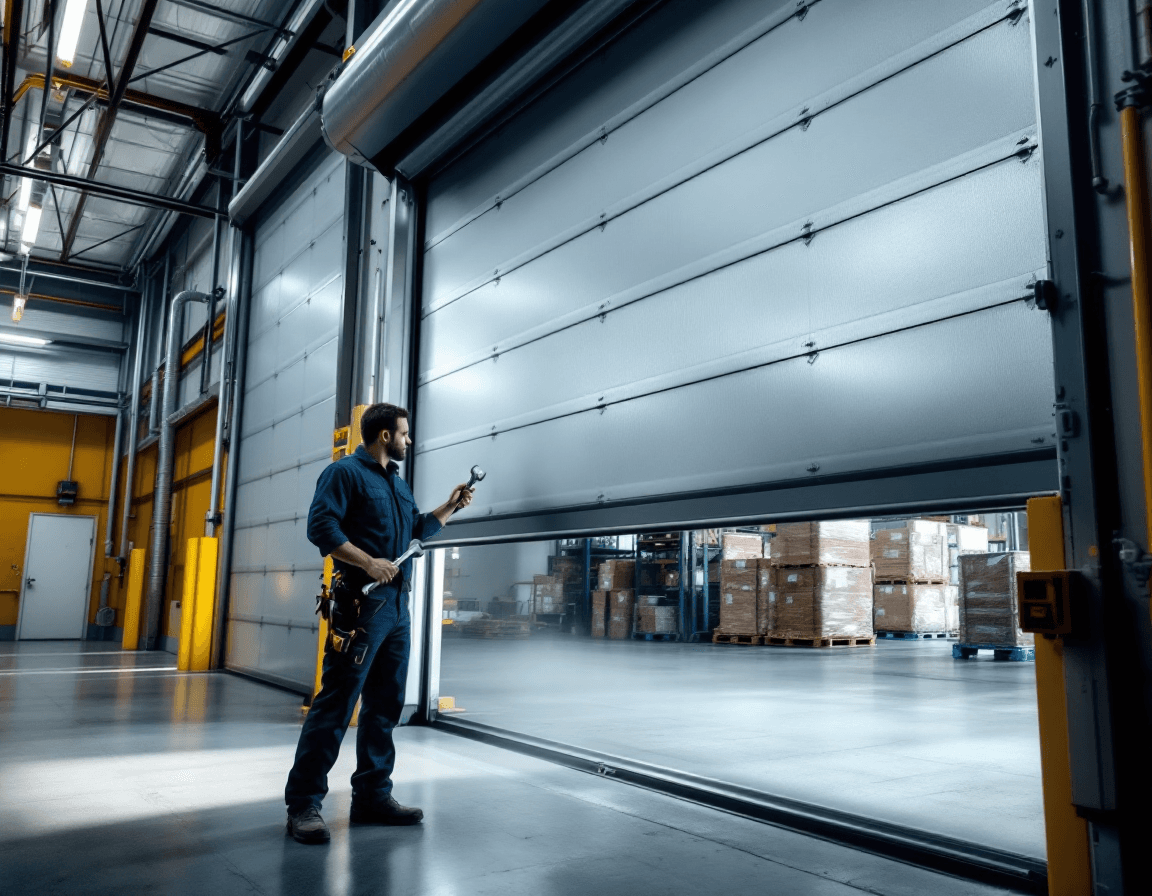
Commercial overhead door repair in Redmond, WA is a different job from residential service, and it usually has a tighter clock. A warehouse, dealership, or light-industrial bay with a stuck dock door is losing money every hour it stays down, whether that means trucks idling at the apron or crews standing around waiting for a pallet to move. Seattle Garage Door Fix handles sectional overhead doors, rolling steel doors, commercial operators, and preventive maintenance for businesses across Redmond and the surrounding Eastside. We are licensed, bonded, and insured, and we build our scope around getting your opening working again quickly and safely.
Redmond's business landscape is a mix of technology campuses around Overlake, retail and restaurant frontage in Downtown Redmond, flex warehouses and service yards tucked along the industrial edges, and small contractors operating out of older buildings near Education Hill and the Marymoor area. Each of those settings puts a different kind of stress on a door. A high-traffic loading dock sees hundreds of cycles a week, while a seldom-used rolling steel shutter on a storage bay may sit closed for months and then fail on the first cold morning. This page explains how we think about those differences, what symptoms usually point to which repair, and how a custom quote and maintenance plan can keep your openings running.
Whether you are dealing with an emergency or planning ahead, the goal is the same: identify the actual failure, explain the options in plain terms, and get your facility moving with as little disruption as possible. If you call (888) 799-3819, a technician can talk through what you are seeing and what information will help us prepare an accurate quote.
How Pacific Northwest Weather Shapes Redmond Door Problems
Redmond sits in a climate that is mild by national standards but hard on steel and moving parts. Long stretches of drizzle, frequent morning fog off the Sammamish River corridor, and humidity that lingers well into spring all keep metal damp for much of the year. Moisture gets into hinge pins, track joints, and the bottom weather seals of commercial doors, and it slowly promotes surface rust and binding. Those are the quiet problems that turn into a jammed door on a busy Tuesday.
Winter brings its own issues. Road salt and grit get tracked onto loading aprons and carried up into the lower track, where they grind against rollers and drag on the bottom panel. When temperatures drop near freezing, condensation can freeze inside a track or around a seal, and an operator that worked fine the day before suddenly labors or trips its overload protection. We see more of these calls after the first hard cold snap than at any other point in the year.
Because of this, we recommend that facility managers treat seasonal transitions as a maintenance checkpoint rather than a random event. A walk-through in late fall to check weatherstripping, lubrication, and track alignment often prevents a midwinter outage. The same inspection in spring can catch corrosion or sagging before summer operating loads push a door past its tolerance.
Matching Sectional and Rolling Steel Doors to Your Dock
One of the first decisions in any commercial project is whether the opening calls for a sectional overhead door or a rolling steel door. Sectional doors are made of horizontal panels that hinge together and run on tracks that curve from the vertical opening into a horizontal overhead run. They are the standard choice for loading docks, large bays, and any opening that needs to be used frequently and wide enough for a truck or trailer. Their insulated panels can also help keep a conditioned space stable, which matters for food storage, light manufacturing, and climate-sensitive inventory.
Rolling steel doors work differently. They consist of interlocking slats wound around a barrel above the opening, so they take up very little overhead or side space. That makes them a natural fit for storefronts, fire-rated separations, storage rooms, and tight Redmond retail corridors where a sectional door's track would collide with ceiling joists or mechanical lines. Rolling steel is typically sturdier against break-ins and impact, though it is generally less insulating and can be louder during operation.
When we evaluate an existing opening, we look at more than just the door itself. We check the header height, the depth of the room behind the opening, the wall condition on either side, and whether the surrounding structure can support the door's loads. Sometimes the right answer is a like-for-like replacement, and sometimes a change in door type makes more sense for how the building is used today than it did when the opening was first built.
Triage When a Dock Door Goes Down
When a commercial door stops working, the fastest route back to service begins with a clear diagnosis rather than guesswork. A door that will not move at all can have a very different cause than one that starts, stalls, and reverses. Our technicians typically start by confirming power, checking the operator's status indicators, and determining whether the problem is electrical, mechanical, or related to a safety device that is intentionally preventing motion. Taking those few minutes first often saves hours of unnecessary disassembly.
Some situations need immediate attention for both safety and operations. Use the following checklist to describe what you are seeing when you call:
- The door will not open or close, and the operator gives no response at all
- The door starts moving, then stops or reverses without an obvious obstruction
- The door makes a grinding, popping, or snapping sound during travel
- One side of the door is higher or lower than the other when it moves
- The door is partially open and cannot be fully secured for the night
Any sound of a snapping spring, a cable that has jumped its drum, or a door that drops suddenly should be treated as a hazard. Keep people clear of the opening, do not attempt to force the door, and do not try to adjust springs or cables yourself. Securing the area and calling a licensed technician is always the correct first step.
Recovering Jammed Rolling Steel Curtains and Off-Track Slats
Rolling steel doors fail in ways that are often visible to the naked eye. A slat can bend after a bump from a cart or a forklift tine, causing the curtain to catch in a guide. Dirt and debris pooling in the bottom guides can slow the curtain until it binds, and corrosion along the guide channels can increase friction until the operator simply gives up. When a curtain jumps its guides, it can wedge hard and require careful, controlled recovery.
Recovery work must be done with attention to tension. Rolling steel doors are counterbalanced by springs stored inside the barrel, and those springs carry significant stored energy even when the door looks ordinary. We do not release tension on a jammed curtain until the door is properly supported and the procedure is planned. Once the curtain is seated back into its guides, we inspect the slats for kinks, check the bottom bar, and confirm the lock mechanism engages cleanly.
After a recovery, the most useful thing a facility can do is schedule a follow-up inspection to address the root cause. Common findings include misaligned guides after a vehicle strike, worn bottom rollers, and lubrication that has either dried out or been applied in the wrong places. Fixing the underlying issue prevents the same jam from returning during the next busy shift.
Commercial Operators, Controls, and Safety Reversal
The operator is the heart of a commercial door, and it works hard. Commercial operators typically run in duty cycles that are far more demanding than residential units, and they must integrate with controls like wall stations, key switches, card readers, and building management interfaces. When an operator fails, the cause may be a worn motor, a failed contactor, a tripped thermal overload, a damaged limit switch, or a control board that has taken a power surge.
Safety devices deserve special attention. Commercial doors are required to include entrapment protection, and sensors such as photo-eyes and monitored edges are designed to stop or reverse the door if something is in the path. These sensors can be knocked out of alignment by forklifts, blocked by dust or cobwebs, or damaged by moisture cycling in a Redmond winter. Testing and realigning them is a routine part of any professional service visit, and a door should never be operated with safety devices bypassed.
Where a door is connected to a broader facility system, we coordinate with the building's controls to make sure the operator behaves as expected. Our team can review wiring diagrams, verify the controller's configuration, and recommend upgrades when the existing hardware is no longer reliable or supported. Every operator repair is performed with the door's safety features restored and verified before we return the system to service.
When Your Door Is Too Slow for Business Throughput
Not every commercial door problem is an outright failure. Sometimes the door works but cannot keep pace with the business it serves. A dock door that takes twenty seconds to open may be fine for a small shop, but for a distribution yard running a continuous stream of deliveries, that delay adds up to a noticeable bottleneck. Drivers wait, idling trucks waste fuel, and staff begin propping doors open out of frustration, which creates security and climate problems of its own.
Speed issues usually come from a few sources. Operators may be undersized for the door's weight, especially after a door has been upgraded with heavier insulated panels. Tracks may be out of level or worn, creating friction that the motor has to fight on every cycle. Counterbalance springs may have lost tension over years of use, forcing the operator to carry more of the load. Each of these conditions can be measured and corrected, and we can recommend speed or soft-start adjustments within the safe limits of the equipment.
A useful step is to tell us how the door is used. How many cycles per hour does it see during peak times? Does it open fully for every truck, or only partially? Is it controlled by a single button or by an integrated system? That information lets us propose options that match your throughput needs, from tuning the existing operator to recommending a higher-speed door for a high-volume opening.
Forklift Strikes and Targeted Panel Replacement
Forklift impact is one of the most common causes of commercial door damage, and it is almost always preventable with better traffic planning and clear bollards or guards. When a forklift catches a lower section or a rolling curtain slat, the result can range from a cosmetic dent to a bent track or a cracked panel. The good news is that many of these incidents do not require replacing the entire door.
Sectional doors are built from modular panels, and when one panel is damaged, we can often replace only that section. The job requires matching the panel's profile, insulation thickness, and hardware, which is why we ask for the door's manufacturer, approximate age, and the size of the affected section before quoting. Track sections, hinges, and rollers can usually be replaced individually as well, and that approach can save significant cost when the door's overall condition is still good.
Rolling steel doors can be repaired by replacing bent slats, straightening guides, and swapping damaged bottom bars. Severe damage to the barrel, drive shaft, or spring assembly may call for a larger rebuild, and we will explain those options clearly. If a strike caused a misalignment that stresses the operator or safety devices, we recheck those systems as well, because a door that looks fine can still be operating outside its safe range.
Preventive Maintenance Agreements for Busy Facilities
Reactive repairs keep a facility moving in the short term, but a planned maintenance agreement is usually more affordable over a year of operation. For businesses in Redmond that depend on their doors to run shifts, deliveries, and client visits, a scheduled program reduces the chance of unplanned downtime and gives management a clear record of what has been inspected and when.
A typical commercial maintenance visit includes checking the springs, cables, and drums for wear and proper tension, inspecting tracks and hinges for alignment and damage, lubricating moving parts with products appropriate for the environment, and testing the operator and safety sensors. Seals and weatherstripping are reviewed for moisture intrusion, which matters a great deal in the Pacific Northwest. Findings are documented so that trends, such as gradual sagging or rising motor current, can be addressed before they become failures.
Agreements can be tailored to the number of doors, the duty cycle of each opening, and the operating hours of the facility. We discuss visit frequency, response priorities, and what is covered before anything is signed. Because every site is different, the best way to understand the right plan is to schedule a site review, which we can arrange by calling (888) 799-3819.
Serving Overlake, Downtown Redmond, Education Hill, and the Marymoor Corridor
Our service coverage across the Redmond area includes the business districts around Overlake, the mixed-use blocks of Downtown Redmond, commercial and light-industrial properties on the Education Hill side, and the service and storage facilities that serve the Marymoor corridor. Commercial addresses in ZIP codes 98052 and 98053 are part of our regular service area, and our technicians are familiar with the traffic patterns, loading access, and building types common in these parts of town.
Access matters. Some Redmond sites have tight truck courts shared among several tenants, limited on-street parking, or delivery windows that restrict when work can happen. We plan visits around those constraints wherever possible, and for sites with active operations we can coordinate with property managers or dock supervisors to schedule repairs during slower periods. When a repair must happen during business hours, we set up clear work zones and keep the affected opening's status updated throughout the job.
If your property is in another part of King County or the wider Eastside, we may still be able to serve you. Call (888) 799-3819 to confirm coverage for your address and to talk through timing for your site.
Understanding a Custom Commercial Quote
Commercial door pricing is not a flat rate, because no two openings are identical. A custom quote reflects the door type, size, age, condition, operator, controls, and access constraints, along with the scope of work and the urgency of the request. Emergency calls may carry different considerations than scheduled replacements, and we aim to be transparent about what drives the number on the page.
To help us prepare a fast and accurate estimate, it is useful to have a few details ready. Knowing the door's width and height, the manufacturer or any visible nameplate information, the operator brand and model if you can read it, and photos of the damaged area all speed up the process. Describing when the problem started and how the door is used day to day also helps us select the right repair or replacement path.
Our goal is to turn around quotes quickly so your operations can get back on track. Once we have a clear scope, we present the work in plain language, outline options where they exist, and let you decide how to proceed. Nothing is started without your approval, and we are glad to answer questions before work begins.
Safety Standards and Why Spring and Cable Work Belongs to Licensed Crews
Commercial doors store tremendous energy in their springs and cables, and that energy can cause serious injury if handled incorrectly. Torsion springs on large sectional doors and the counterbalance springs in rolling steel barrels are under high tension, and a spring or cable failure can move quickly enough to cause harm. For this reason, any work involving spring replacement, cable repair, drum adjustment, or tension changes should be performed only by licensed and trained professionals with the right tools and procedures.
Our crews follow established safety practices, including securing the door before work begins, using appropriate winding and support equipment, verifying balance after adjustments, and testing the operator and safety devices before handing the door back. We also document the work so you know what was replaced, what was adjusted, and what should be monitored going forward. Facility managers should never attempt these repairs with household tools or improvised methods, even if they seem simple from the outside.
If you are unsure whether a problem needs immediate attention, err on the side of caution. Keep people away from the door, avoid running it manually, and call a licensed technician. A short conversation with our team can help you decide whether the situation can wait for a scheduled visit or needs same-day response.
Commercial doors are central to how Redmond businesses move goods, welcome customers, and protect what is inside. Whether your opening needs a sectional panel replaced after a forklift strike, a rolling steel curtain recovered from a jam, an operator brought back to full speed, or a maintenance agreement that keeps seasonal problems from catching you off guard, Seattle Garage Door Fix is ready to help. Call (888) 799-3819 to describe your situation, request a custom commercial quote, and get a clear plan for getting your doors moving again.