
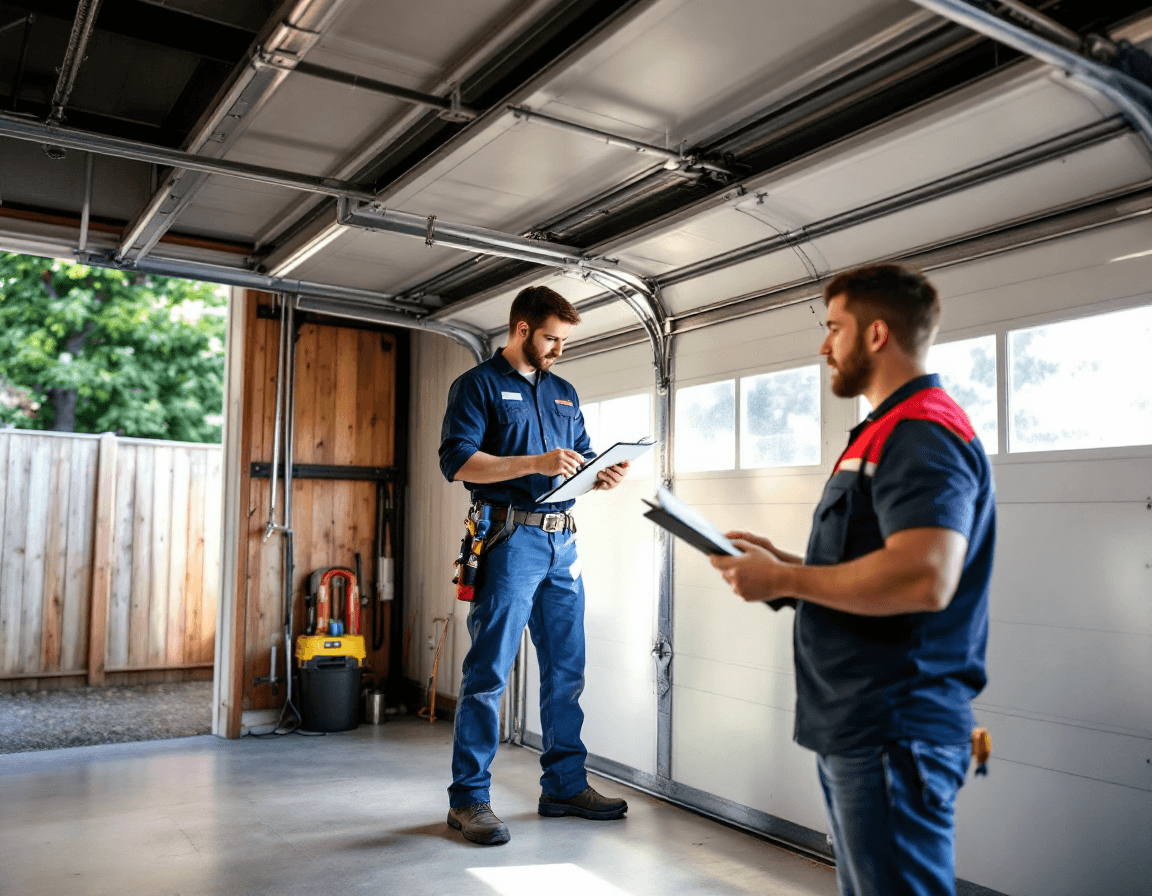
Garage Door Maintenance & Tune-Ups in Bremerton, WA are about catching wear while it is still small, before a worn cable or a tired spring turns into a door that won't close or, worse, a sudden failure on a cold morning. Homes across Bremerton see a steady mix of weather, salt air, and daily use that quietly works on every moving part of a garage door. A door can look fine from the driveway while its rollers have flattened, its hinges have started to bind, and its opener has begun to strain under a load it was never meant to carry for long.
This page explains what a professional tune-up involves, why Kitsap County homes benefit from it more than many homeowners expect, and how to tell when your door is asking for attention. We cover the safety checks that matter most, the difference between lubrication and guesswork, and what to expect from a visit priced between $89 and $149 for a full multi-point service. Whether you have lived in your home on Sinclair Inlet for decades or just closed on a place in Manette last month, the information here should help you make a confident decision about your door.
Nothing here replaces a licensed technician. Springs and cables store a large amount of energy, and adjusting them without the right tools and training is one of the most common ways homeowners get hurt. Use this guide to understand what is happening above your head, then let a professional handle the parts that carry real risk.
Why Bremerton Garage Doors Age Faster Than the Calendar Suggests
Bremerton sits on the Kitsap Peninsula, with Sinclair Inlet and the broader Puget Sound shaping much of the local weather. The region's mild, wet winters mean garage doors spend long stretches in damp air, and summers are generally cool enough that doors rarely dry out completely between rain events. Moisture is patient. It finds its way into hinge barrels, roller bearings, and the steel track sections, where it slowly encourages surface corrosion and stiffens the moving parts that are supposed to glide.
Many homes here also have older garages built before modern door hardware became standard. A door installed fifteen or twenty years ago may have been set up with lighter-duty rollers or hinges that were never designed for the amount of cycling a busy household puts on them. Families who leave for work early and return late, or who use the garage as a second entry point, can open and close the door several times a day. Every cycle is a small stress test on the springs, cables, and opener.
Because the change happens gradually, owners often adapt without noticing. The door takes a little longer to rise, it rattles a bit more than it used to, and the opener sounds slightly different. A scheduled tune-up is the moment to compare what the door does now with what it should do, rather than waiting for a dramatic failure to tell you something is wrong.
How Salt Air and Damp Winters Work on Hardware
Kitsap County's proximity to salt water means the air carries fine mineral particles that settle on exposed metal. Even on days when the ocean feels far away, those particles can coat a garage door's steel panels and hardware. Once moisture is present, the salt accelerates corrosion on hinge pins, roller stems, bottom brackets, and the bolts that hold track sections in place. A small amount of rust can seize a hinge that would otherwise pivot smoothly.
Damp winters create a different problem. Water trapped inside roller bearings can wash out factory lubricant, and cold mornings can thicken whatever grease remains. The result is a door that opens unevenly, makes a grinding or chirping noise at the same point in every cycle, or hesitates before it starts moving. Technicians often find that the lubricant on a neglected door has turned into a dark, gritty paste that attracts dirt instead of reducing friction.
Weatherstripping at the bottom of the door deserves attention too. Cracked or compressed seals let damp air and debris into the garage, and they can also trap water against the threshold. Over time that water can rot wooden trim, corrode the bottom bracket, and encourage the kind of surface rust that makes a door look older than it is. A tune-up gives your technician a chance to check these details before they become costly.
What Happens During a Multi-Point Safety Inspection
A multi-point inspection is a structured walkthrough of every system that keeps your door moving safely. It starts with the outside: the panels, the bottom seal, the weatherstripping along the sides and top, and the condition of the header and jamb hardware. The technician then examines the track, looking for dents, loose mounting bolts, misalignment, and any section that has pulled away from the wall or ceiling.
Next comes the mechanical side. The springs, cables, drums, and rollers are inspected for wear, fraying, or signs of stress, and the hinges and bottom brackets are checked for cracks or play. The opener is tested under load, and the safety systems are evaluated in detail. Technicians typically cover the following areas during a full visit:
- Spring condition, including visible gaps, rust, or signs of metal fatigue
- Cable inspection for fraying, kinks, or cables that are no longer seated on the drum
- Roller condition, including worn nylon tires, bent stems, and loose brackets
- Track alignment, bolt tightness, and any section that is out of square
- Hinge and bottom bracket integrity
- Weatherstripping and bottom seal condition
- Opener mounting, rail alignment, and drive belt or chain tension
- Photo eye alignment and sensor wiring
- Auto-reverse function and manual release operation
Every item on that list matters, but the reason for the inspection is to connect the dots. A slightly frayed cable paired with a noisy roller and a strained opener tells a very different story than any one of those problems alone. Good technicians look at the whole system and explain what they see in plain language.
Balance Testing: Does Your Door Carry Its Own Weight?
A well-balanced garage door should feel almost weightless when you lift it by hand from the middle. Once you disconnect the opener and raise the door partway, it should stay where you leave it, neither sinking nor shooting upward. That behavior is what balance testing measures, and it is one of the most useful indicators of how hard your opener is working. A door that is out of balance forces the opener to do work the springs should be doing.
Balance problems often develop slowly. A spring loses tension over years of cycles, or one side of the door begins to sag because its spring has weakened faster than the other. Owners may describe the door as feeling heavy, or they may notice it jerks or tilts as it rises. Ignoring that behavior can shorten the life of the opener motor and place extra strain on the cables and drums.
Balance testing is also where the danger is most real. Torsion and extension springs carry high tension even when they look relaxed, and adjusting them requires specialized winding bars, safe handling, and a clear understanding of how the system stores energy. For that reason, a balance test should be performed by a licensed technician who can measure the response, document the results, and make any needed corrections with the correct equipment. Please do not attempt to wind, unwind, or reposition a spring yourself.
Opener Safety Testing and Auto-Reverse Checks
Your garage door opener is responsible for more than lifting the door. Modern openers are required to include safety features designed to prevent injury, and those features need periodic verification. The auto-reverse function should stop and reverse the door when it contacts an object, and the photo eyes should prevent the door from closing when their beam is interrupted. Both systems should be tested during every tune-up, not assumed to work because the door has operated without complaint.
A common test uses a solid object about one and a half inches high placed on the floor in the door's path. When the door descends and meets it, the door should reverse automatically. Technicians also check that the photo eyes are aligned, clean, and wired correctly, because a misaligned sensor may appear to work while failing to detect a child or pet standing in the opening. Many homeowners are surprised to learn how easily a sensor can be knocked out of alignment by a bicycle, a stray ladder, or a vacuum cleaner.
Opener safety testing should also include the manual release. Homeowners need to know it works in an emergency, but they should never pull it while the door is under tension or while a vehicle is in the path. A technician can demonstrate safe operation and make sure the release handle is not frayed or sticking. If anything about the opener seems unusual, such as a delayed reversal or a door that closes on its own, stop using it and contact a professional right away.
Lubrication That Helps Rather Than Harms
Lubrication is one of the simplest maintenance tasks, and also one of the easiest to get wrong. Garage door parts need a lubricant designed for metal-to-metal and metal-to-nylon contact, typically a silicone-based or lithium-based product applied in measured amounts. Heavy grease or household oils can attract dust, collect grit, and create a sticky film that slows the door down over time. Spraying lubricant directly into the opener motor or onto belts and chains is also a common mistake.
A thoughtful lubrication service targets the points that actually move. Hinges, roller stems, bearing races, the lock mechanism, the bottom brackets, and the torsion shaft bearings are the usual candidates. Technicians wipe away old residue before applying fresh product, because new lubricant placed on top of dirty grease simply traps the grit. Rollers that are cracked, flat-spotted, or noisy often benefit more from replacement than from any amount of lubricant.
Lubrication also has limits. Rust that has eaten into a hinge pin, a worn bearing that has lost its balls, or a track that has been bent out of shape will not be fixed by adding oil. A good tune-up distinguishes between parts that simply need lubrication and parts that have reached the end of their service life. Homeowners should expect honest recommendations rather than a blanket promise that a few squirts will make the door like new.
Here are a few habits that help between professional visits:
- Clean the track and rollers with a dry cloth to remove grit before applying any lubricant
- Apply lubricant sparingly to hinges and roller stems, then wipe off drips
- Keep the weatherstripping free of debris so the bottom seal can do its job
- Test the auto-reverse feature monthly with the safety object method
- Watch for new noises, uneven movement, or a door that stops partway
Warning Signs That Your Door Is Due for a Tune-Up
Some signs of trouble are obvious, such as a door that won't open or a loud bang during operation. Many others are subtle, and they are easy to dismiss as normal wear. A door that is getting noisier over time is one of the most common early indicators. Squeaks, rattles, and grinding often mean rollers are worn, hinges are dry, or a track section has loosened. Listening carefully to your door can save you from a much larger repair bill later.
Opener behavior tells another story. If the motor sounds strained, the door moves slowly, or the opener seems to pause at the top or bottom of its travel, the balance may be off or the track may be binding. Some owners notice that the door reverses unexpectedly or stops halfway, which could point to a sensor problem or an opener that is working harder than its design intends. None of these symptoms should be treated as a minor annoyance.
Other signs are more subtle. A door that feels heavy when lifted by hand, a visible gap at the top of the door, or a bottom seal that no longer touches the floor all suggest the system needs inspection. If your door hasn't been serviced in over a year, it is worth scheduling a tune-up even if nothing seems wrong, since many of the most important wear points are hidden until someone looks closely.
Serving East Bremerton, Manette, and Kitsap Lake Neighborhoods
Garage door needs in Bremerton vary by neighborhood, and a technician familiar with the area can anticipate some of them. Homes in East Bremerton often include a mix of older single-story houses and newer infill construction, which means you may find everything from original steel doors with aging hardware to recent installations with heavier insulated panels. Heavier doors place greater demand on springs and openers, so balance and opener testing become especially valuable.
Manette is known for its closeness to the water and its character, and many homes there sit within easy reach of the marine air that accelerates corrosion. Garages facing the Sinclair Inlet side can accumulate salt residue quickly, and owners in these areas often benefit from more frequent cleaning and an earlier look at hinges and brackets. The same environmental factors affect properties near the Manette Bridge corridor and the nearby shoreline, where dampness can linger.
Kitsap Lake brings its own considerations. Homes in the surrounding area often have driveways that slope or sit beneath tree cover, which can keep the garage door damp for longer stretches after rain. Moss, needles, and fallen debris can collect in the track and at the threshold. A tune-up in these neighborhoods typically includes a close look at drainage around the door opening and any signs that water is reaching the bottom bracket or seal.
Buying a Home in Kitsap County? Start With a Tune-Up
If you recently bought a house in Bremerton, the garage door is one of the first systems you should check. Many buyers focus on the roof, foundation, and appliances, but the garage door is a large moving mechanism that carries real safety responsibility. You inherit whatever maintenance history the previous owner kept, which may have been minimal or nonexistent. A professional tune-up gives you a clear baseline of the door's condition.
A new-homeowner inspection is also a chance to learn how the system works. Your technician can show you where the manual release is, explain the auto-reverse test, point out the photo eyes, and identify whether the opener is due for a particular type of service. You will also learn what kind of springs and hardware your door uses, which is valuable information if you ever need replacement parts or a repair estimate later.
Buyers sometimes discover problems that were not visible during a walkthrough. A spring may be nearing the end of its cycle life, a cable may have started to fray, or an opener may be missing the safety features required for its age. Knowing these details early lets you plan for them on your own schedule rather than during an emergency. A tune-up is a modest investment compared with the cost of an unexpected failure on your first winter in the house.
What the $89–$149 Tune-Up Covers and What It Doesn't
A full multi-point tune-up through Seattle Garage Door Fix is priced between $89 and $149. That range reflects the time required for a thorough inspection, lubrication of moving parts, balance testing, and opener safety verification. The exact amount depends on the size and type of door, the number of components that need attention, and whether the opener is a standard chain drive, belt drive, or another design. Your technician will confirm the scope before beginning work.
It is important to understand what a tune-up is and is not. It is a preventive service designed to evaluate, clean, lubricate, adjust where appropriate, and test. It is not a replacement for worn springs, damaged cables, bent track sections, or failed openers. If the inspection reveals a part that needs replacing, your technician should explain the problem, describe the options, and discuss pricing before any repair work moves forward. You should never feel pressured into a repair you did not ask for.
Think of the tune-up as a clear snapshot of your door's health. Many homeowners find that the visit gives them peace of mind, a list of items to watch, and a realistic timeline for future service. If the door is in good shape, you will know that. If it is not, you will have time to plan rather than scramble.
Building a Maintenance Rhythm That Fits a Kitsap Household
A practical maintenance schedule for Bremerton homes usually begins with an annual professional tune-up. Households that use the garage daily, park vehicles in the bay during storms, or live closer to the water may benefit from checking the door more often. Between professional visits, a few simple habits can extend the life of your system. Keep the tracks clear of leaves and debris, wipe down hardware after heavy rain, and listen for changes in sound or movement.
Seasonal awareness helps too. Late fall, when the rainy season is in full swing, is a good time to confirm that the bottom seal is intact and that water is not pooling at the threshold. Early spring, after the damp months have passed, is a useful time to check for rust, loose bolts, and any hardware that has shifted. Testing the auto-reverse and photo eyes every month takes only a minute and provides an extra layer of confidence between visits.
Consistency matters more than perfection. A door that receives a yearly inspection, sensible cleaning, and honest attention to new noises will usually outperform one that is ignored until it fails. Keep a simple log of service dates and any notes from your technician, so future visits can start from a clear history. Over time, that record becomes one of the most useful tools you have for keeping your garage door safe and dependable.
If your garage door is getting noisier, feels heavy, strains your opener, or hasn't been serviced in over a year, now is a good time to act. Call Seattle Garage Door Fix at (888) 799-3819 to schedule a full multi-point tune-up for your Bremerton home, and let a licensed technician check the safety systems, balance, lubrication, and opener performance before a small problem becomes a surprise breakdown.