
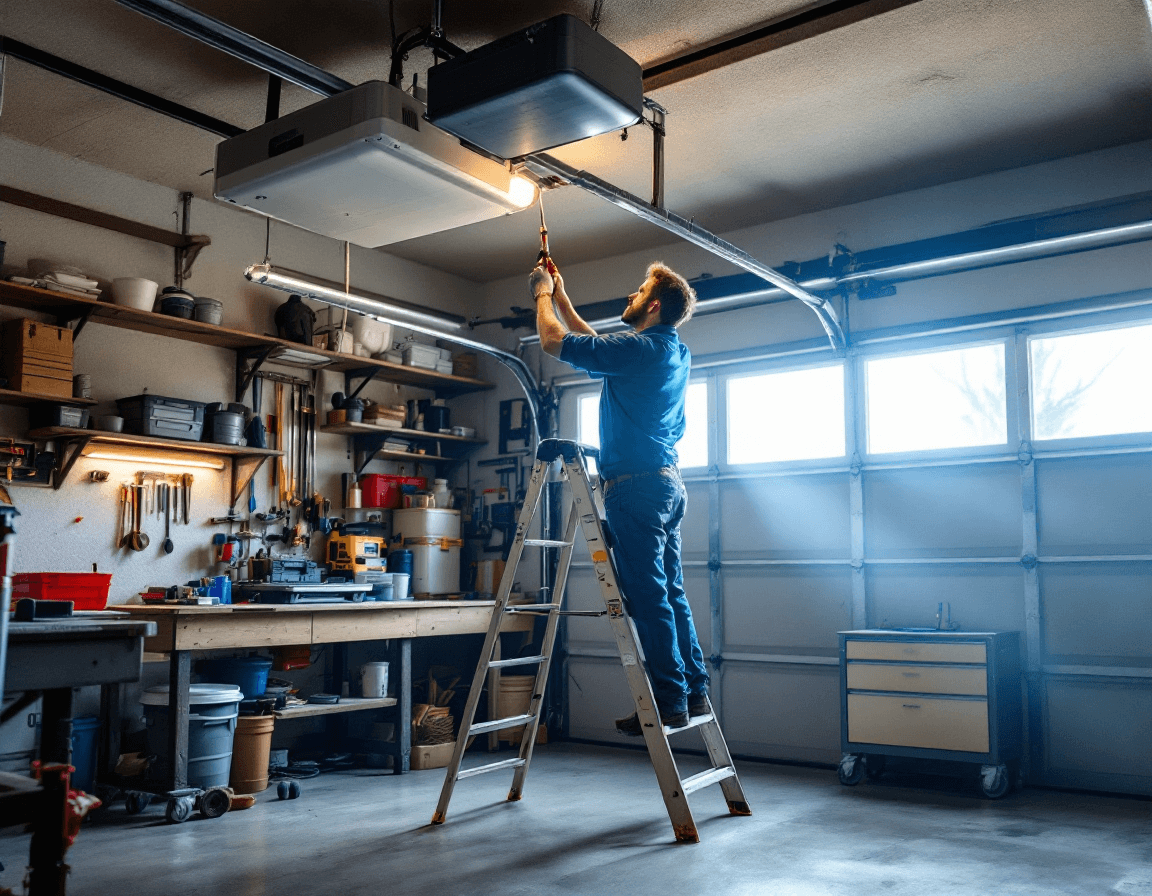
Garage Door Opener Repair in Beaux Arts Village, WA is a service many homeowners on the village's Lake Washington shoreline need sooner than they expect. Beaux Arts is a small, tightly held enclave on the Eastside, and its homes often sit on lots where the garage is the main way in and out, so a balky opener quickly becomes a daily inconvenience. Seattle Garage Door Fix provides troubleshooting and repair for motors, gear sets, circuit boards, and travel limits on every major opener brand, and we work with homeowners in the 98004 and 98005 ZIP codes that cover this area. This page explains what the most common opener problems look like here and what can be done about them.
Many of the openers we see in Beaux Arts have been in place for a decade or more, and that age shapes what goes wrong. The good news is that most opener faults are diagnosable without tearing anything apart, and a surprising number cost less to fix than homeowners fear. Our typical opener repairs fall between $95 and $375, depending on the part involved and how much diagnostic time the problem requires. Read on for the symptoms we hear about most, what they usually mean, and when it is time to call a licensed technician at (888) 799-3819.
How Lake Washington Weather Tests an Opener
Living right on the water means the air around your garage carries more moisture than it does a few miles inland. Lake Washington's cool, damp microclimate sends fog and dew across shoreline properties for much of the year, and the autumn and winter rains that roll in off the Sound and across the Cascades keep humidity high for weeks at a time. That moisture finds its way into door hardware, wiring junctions, and the control board housing on the opener, especially if the unit is mounted near a window or a gap in the ceiling. Over time it encourages corrosion on contacts and slowly degrades the lubricant on moving parts.
Temperature swings matter too. Winters here are mild compared with much of the country, but the occasional cold snap drops temperatures below freezing overnight, and damp cold makes metal parts stiffen and grease thicken. An opener that moved the door smoothly in July may strain in January, which is one reason homeowners often notice problems only after a cold week. Wind gusts off the lake can also push on a tall or lightweight door, adding resistance that the opener has to fight against.
Because of all this, we check more than the opener itself when we visit. We look at the seals around the door, the condition of the rail, the moisture level in the garage, and whether the opener's electrical connections show green or white crust. Addressing those factors alongside the mechanical repair tends to extend how long the fix lasts.
When the Motor Hums but the Door Refuses to Budge
This is one of the most alarming symptoms to hear and see: you press the button, the motor runs, you can feel the rail vibrate, and the door simply sits there. The cause is usually somewhere between the motor and the door rather than in the motor itself. The most common culprit is a disconnected trolley, meaning the release cord has been pulled or the carriage that attaches the arm to the door has slipped free of the rail. Less often, the drive gear has stripped or a coupling between the motor shaft and the drive system has failed, so the motor spins without transferring any force.
Before you call anyone, it is reasonable to check whether the emergency release handle hangs loose or whether the trolley arm is still attached to the top of the door. Do not force the door by hand, and do not attempt to adjust anything under spring tension. If the door is heavy or if the springs look damaged, leave it closed and wait for a technician. Pulling a door open manually while the opener is still engaged can strain the arm and the rail in ways that turn a simple fix into a larger bill.
When we diagnose this symptom in Beaux Arts, we start by confirming that the trolley engages correctly and that the rail is clear of obstructions or debris. From there we check the drive gear and the coupling to see whether power is actually reaching the drive mechanism. A door that moves freely by hand but stays put under power almost always points to the drive side, and that is usually a repair measured in tens of dollars for parts rather than a full replacement.
The Remote That Stopped Talking to the Door
A remote that suddenly stops working is frustrating, but the reasons vary widely, and many of them are simple. Start with the obvious: replace the battery in the transmitter and try the wall button. If the wall button works and the remote does not, the problem lives in the handheld unit or in the receiver's ability to hear it. Antennas that have been bent or damaged, and wall consoles that have had their wiring disturbed, are both common causes.
Other times the opener's logic board has lost its memory of the remote, which can happen after a power surge or a storm knocks out electricity to the house. Lightning activity is not unusual in the Puget Sound region during the fall and winter months, and a surge that is not severe enough to visibly damage anything can still scramble the receiver. Some openers also have safety features that lock out remote commands when a sensor is blocked or a wire is shorted, so a remote that seems dead may be responding to a protective lockout.
Reprogramming a remote is often possible without special tools, but the steps differ by brand, and the manual is the safest guide. If your remote works intermittently, stand next to the opener and then move farther away to see whether range is the issue. Remotes that work only from the driveway but not from the back of the garage may simply need a fresh battery or a receiver check rather than full replacement. Our technicians test the receiver, the wall console, and the transmitter so that the repair targets the real fault instead of replacing parts that are not broken.
A Grinding Sound from the Opener Head
Grinding from the opener head is a sound that usually means something inside the gearbox is no longer meshing cleanly. Many residential openers use a plastic or nylon drive gear that wears down over years of use. Once the teeth begin to strip, the motor keeps turning but the gear skips, producing a rough, gravelly noise and sometimes a jerky door movement. Left alone, a stripped gear can leave the door stuck halfway or damage the motor shaft, which turns a modest repair into a more expensive one.
It helps to know the difference between a grinding noise that comes and goes and one that is steady. A loud, constant grind during every cycle suggests a worn gear set or a failing bearing. A clicking or ticking sound at the start or end of travel may point instead to a limit switch or a loose mounting bracket. Note when the noise happens, whether it is worse in cold weather, and whether the door moves at a normal pace. Those details help a technician narrow the diagnosis quickly.
Gear replacement is one of the more involved opener repairs, and we recommend letting a licensed technician handle it. The opener must be disconnected from power, the motor housing opened, and the gear set removed and matched to the correct model. Installing the wrong part can cause the same grinding to return within weeks. Expect the repair to fall in the mid-range of our pricing, and ask for a written estimate that names the exact replacement part before work begins.
Here is what to watch for between visits:
- A grinding sound that starts suddenly rather than building slowly.
- Jerky or stop-start door motion during an otherwise normal cycle.
- A faint burning smell after the opener has run for a while.
- Visible debris, such as plastic shavings, near the rail or the base of the motor.
If you notice any of these, unplug the opener, keep the door closed, and schedule service rather than continuing to run it.
Doors That Stop Short or Turn Back Mid-Travel
A door that closes most of the way and then reverses immediately is one of the most common complaints we hear in the Eastside area. Openers are designed to reverse when they detect resistance, which protects people and objects in the door's path. When the door reverses unexpectedly, the first suspects are the safety photo-eyes near the floor, the force setting, and the travel limits that tell the opener where fully closed and fully open positions are located.
Photo-eyes are the two small sensors mounted on either side of the door opening, about six inches above the floor. Lake-side homes sometimes have spiderwebs, dust, and lake-fog residue collecting on the lenses, and a sensor knocked slightly out of alignment by a bumped bin or a shifted bracket will report a blockage that is not really there. Check that both lights are steady, that nothing is in the path, and that the sensors face each other squarely. Wiring that has been chewed by pests or pinched during a previous repair can cause the same symptom.
Force and travel settings are the other half of this problem. If the door was once adjusted to close with more force than necessary, or if the closing limit has drifted, the opener may read ordinary friction from a worn roller as an obstruction. Fine-tuning these settings is delicate work, because too much force creates a safety risk, and too little leaves the door unable to close on a bad day. A technician will test the door's balance and roller condition before adjusting the limits, because an unbalanced door will always cause trouble no matter how the opener is configured.
Decoding the Blinking Lights on the Motor Unit
Many openers flash a light in a repeating pattern to signal a fault. The number of blinks, the speed, and whether the light is steady or intermittent each carry meaning, and the code differs by manufacturer and sometimes by model year. A pattern that repeats every few seconds often indicates a safety circuit has detected a problem, while a light that flashes only when you press the button may point to a wall console or wiring issue.
Because the codes are brand-specific, the first step is to find the model number on the motor housing and look up the fault table in the owner's manual. If the manual is missing, the manufacturer's support site usually has a downloadable copy. Writing down the pattern exactly, including how many times it flashes before pausing, makes a phone call or service visit much faster. We can usually identify the fault from a precise description.
Blinking codes that point to a board problem are the ones where homeowners should avoid guesswork. Power cycling the opener by unplugging it for thirty seconds sometimes clears a temporary fault, and that is a reasonable first step. If the pattern returns, the board, a sensor, or a limit switch may be failing, and the repair needs a technician with the right test equipment. Board replacement is one of the costlier opener repairs, so confirm the diagnosis before authorizing the part.
Belts, Chains, and Where Tension Becomes a Hazard
A loose chain or belt can make an opener clatter, lurch, or skip, and occasionally the chain comes completely off the sprocket. Chain drives are common on older units and are sturdy but noisy, while belt drives are quieter and better suited to attached garages. Both need periodic tension checks, and both can work loose after a few seasons of expansion and contraction caused by temperature changes.
It is tempting to tighten a chain or belt yourself, and for minor slack some homeowners do so safely. The line should be drawn at anything involving the door's springs, cables, or drums. Torsion springs and extension springs store a great deal of energy, and a spring that releases under tension can cause serious injury. Adjusting a spring, replacing a cable, or working on a drum should always be left to a licensed professional. Even a seemingly simple chain repair can involve the drive sprocket and the tracks, and a technician can assess the whole system at once.
Our approach is to inspect the belt or chain for wear, check the tension according to the manufacturer's specifications, and verify that the drive sprocket and idler are seated correctly. A chain that has jumped off the track often reveals a stretched chain or an out-of-position rail bracket, and fixing only the chain would leave the underlying cause in place. Where a belt is cracked or glazed, we replace it rather than trying to stretch it back into service.
Intermittent Problems: The Hardest Faults to Chase
Intermittent operation is frustrating precisely because it is unpredictable. The opener works perfectly for a week, then refuses to respond twice in one afternoon, then runs normally again. These faults are often caused by loose wiring, a failing relay, moisture in a connector, or a sensor that is borderline. In a damp garage near the lake, a connector that is slightly corroded may conduct well when dry and fail when humidity rises.
The key to diagnosing an intermittent fault is documentation. Note the date and time of each failure, the weather that day, what the door was doing when it failed, and whether the remote or the wall button was used. Patterns often emerge after a few incidents. A failure that happens only after rain, for example, suggests moisture at a connection point. A failure that happens during a particular door position may point to a limit switch or a worn section of the rail.
Intermittent faults can also be linked to power quality. Older homes may have aging outlets or shared circuits that dip when large appliances start, and an opener that shares that circuit may reset itself. Plugging the opener into a dedicated outlet and checking the connection can rule out this cause. Our technicians look at the power supply, the wiring harness, and the moisture conditions together, because fixing an intermittent problem usually requires finding a single loose or corroded point among many possibilities.
What a Service Visit Typically Covers and What It Costs
Homeowners often ask what they get for their money when a technician arrives. A standard opener service visit includes an inspection of the motor, gear or belt drive, trolley, rail, safety sensors, wall console, and travel limits. The technician tests the door's balance and checks the rollers and hinges, since a door that is difficult to move will put strain on the opener no matter how well it is maintained. We will explain what we find, show you any worn parts, and provide a clear quote before performing repairs.
Our typical opener repairs range from $95 to $375. Lower-end repairs usually involve adjusting limits, replacing a remote or sensor, or reconnecting a disconnected trolley. Mid-range work includes gear replacement, belt or chain replacement, and wiring repairs. Higher costs usually reflect board replacement or motor work, particularly on heavier-duty openers. We recommend asking for an itemized estimate so you understand which components are being replaced and why.
Spring, cable, and drum work is outside the scope of a typical opener repair and should always be handled by a licensed, insured technician with the proper tools. If a visit reveals that the springs are fatigued or a cable is frayed, we will tell you plainly, explain the safety risk of continued use, and provide a separate estimate for that work. Do not attempt those repairs yourself, and do not run the door until a qualified person has inspected it.
Keeping an Opener Dependable Through Wet Seasons
Preventive maintenance is one of the best investments a homeowner near the lake can make. Once or twice a year, inspect the door's rollers and hinges for wear, lubricate the rail with a silicone-based product rather than heavy grease, and check that the photo-eyes are clean and aligned. Wipe down the opener housing and the wall console to remove dust and moisture, and make sure the garage has adequate ventilation so humidity does not build up around the unit.
Test the safety reversal feature every month by placing a flat object, such as a piece of wood, on the floor in the door's path and closing the door. The door should reverse when it contacts the object. Test the auto-reverse by hand as well, and make sure the emergency release still works. These quick checks catch problems early and cost nothing but a few minutes.
Finally, keep records. Note when the opener was installed, when the belt or chain was last tensioned, and any repairs performed. A short log helps a technician understand the history of your system and can speed up diagnosis when something changes. Whether your opener is a few years old or has been running since the house was built, a little attention each season will go a long way in a climate that tests every mechanical part of your garage.
If your opener is acting up in Beaux Arts Village or anywhere else on the Eastside, Seattle Garage Door Fix is ready to help. Our licensed, bonded, and insured technicians will diagnose the problem, explain your options in plain language, and get the door moving safely again. Call us today at (888) 799-3819 to schedule service or to ask questions about your opener.