
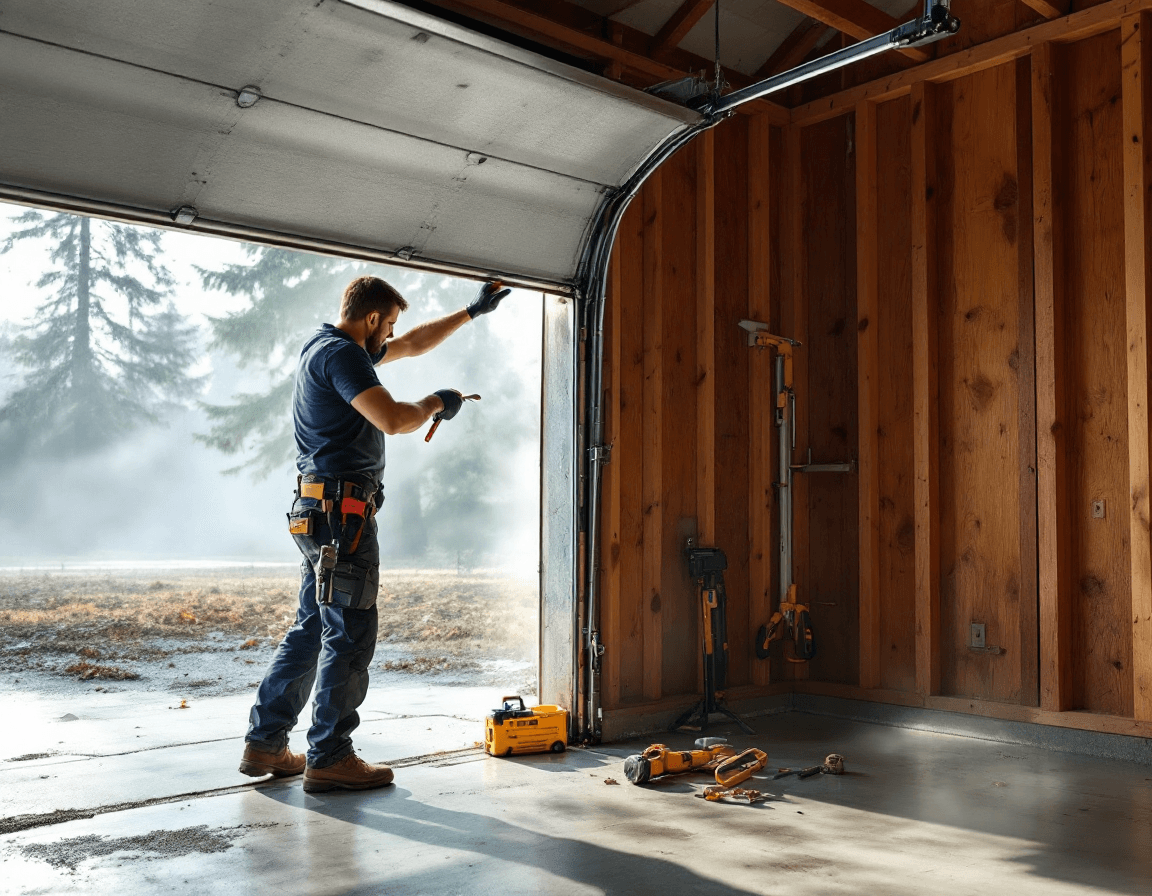
Off-Track Garage Door Repair in Beaux Arts Village, WA is one of the most common calls we take from homeowners along the eastern shore of Lake Washington, and it is also one of the most misunderstood. A door that has jumped its track can look like a major failure, but in many cases the damage is limited to a few rollers, a shifted bracket, or a section of track that has been nudged out of line. Knowing what happened, and what you should and should not do next, can save you from making a bad situation worse.
Beaux Arts Village is a small, close-knit community with a mix of older waterfront homes and newer builds tucked among mature trees. Many garages here are detached or set back from the street, and driveways often slope toward the lake or curve around established landscaping. Those details matter, because the way a door is installed and the way it gets used both affect how it behaves when something goes wrong. This page explains what typically causes a door to come off track, how we approach the repair, and what a realistic cost looks like for homeowners in the 98004 and 98005 ZIP codes.
Whether your door is sitting crooked, binding halfway up, or hanging with a visible gap along one side, the goal of this guide is to help you make a calm, informed decision. If anything involves the springs, the cables, or the drum, stop and call a licensed technician. For everything else, you will find practical details below that reflect how these repairs actually go in our service area.
Why Doors Leave the Track More Often Than You Think
A garage door is essentially a large, heavy panel riding on steel rollers inside two vertical tracks, with a horizontal section that carries the door overhead. Each roller is designed to stay seated in its track channel, but that tolerance is smaller than most people assume. A few inches of misalignment, a worn roller stem, or a loose bolt can allow a roller to ride up and out of the channel. Once one side lets go, the door tilts and the opposite roller often follows.
In the Lake Washington area, a few local factors make this more likely. Frequent wind off the water can push on wide, lightweight panels, especially on single-car doors that are not braced as well as they should be. Homes on sloped lots sometimes experience slow settling in the garage slab or header, which subtly changes the geometry the door was built around. Over years of daily cycles, that movement can gradually shift tracks away from their original position.
Most off-track events are not caused by a single dramatic moment. They build up through small problems: a roller that has been running dry, a track bolt that has backed out a few turns, or a door that has been forced open by hand while the opener was disengaged. When you understand that the door is a system of parts working together, it becomes easier to see why a derailment is usually a symptom rather than the root problem.
Reading the Warning Signs Before a Derailment
Doors rarely jump the track without giving some clues first. The most common early sign is a popping or chattering noise on one side as the door rises or falls. That sound often means a roller is catching on a track seam, a lip, or a bolt head before it runs smoothly again. If you hear it regularly, the roller is likely starting to misalign and the problem will probably worsen.
Another warning sign is a door that closes unevenly. You may notice that the bottom seal touches the threshold on one side but leaves a visible gap on the other, or that the top section of the door sits slightly lower on one end. Some homeowners see a faint line of daylight that appears only when the door is fully closed. Any of these changes deserves attention, even if the door still opens and closes normally.
Pay attention to how the door behaves at the top of its travel as well. A door that slows, stutters, or seems to hesitate near the horizontal section may be fighting a track that is no longer square. Opener motors can also strain in this situation and sometimes trigger reversing or force-limit safety stops. If your opener starts reversing for no clear reason, treat that as a reason to inspect the tracks, not just to reset the opener.
What Happens Inside the Track When a Roller Pops Out
To understand the repair, it helps to picture what actually happens when a roller leaves its channel. The track is a U-shaped steel profile, and each roller rides inside it with a small amount of clearance. When the roller is forced sideways or upward, its outer edge can ride over the track lip, and the wheel may then sit on the outside of the track rather than inside it. The door's weight transfers abruptly, and the panel can slump, tilt, or wedge against the header.
Once a roller is out, the door is no longer supported evenly, and the surrounding hardware takes extra load. Hinges can bend, brackets can loosen, and the track itself may flex or deform where the roller pressed against it. This is why we always check the full length of the track rather than only reseating the roller that fell out. A single derailment can leave a dent, a kink, or a separated joint that is not obvious at first glance.
When we reseat a roller, we look at the stem, the wheel bearing, and the track surface beneath it. A roller with a flattened wheel, a cracked nylon tire, or a worn bearing will likely pop out again no matter how carefully it is positioned. Replacing a damaged roller is typically a small part of the overall job, but it makes a meaningful difference in how long the repair lasts.
Lakeside Humidity, Moisture, and Track Corrosion
The Pacific Northwest climate is easy on lawns and hard on steel. Lake Washington shoreline properties see long stretches of damp air, morning fog that lingers over the water, and winter rain that can keep garage floors and door bottoms wet for days. Steel tracks, hinges, and fasteners are vulnerable to surface rust in this environment, especially where paint has chipped or where the galvanized coating has worn thin from years of door movement.
Corrosion matters for off-track repair because rust changes how parts fit together. A bolt that has rusted in place may not tighten to spec, and a bracket with a corroded base can shift slightly under load. Rough, pitted track surfaces also make rollers catch more often, which increases the chance of another derailment. We typically clean and inspect the track during a realignment and recommend a suitable lubricant that will not attract grit in damp conditions.
Moisture also affects the garage structure. Wood framing around the door opening can swell and soften after prolonged wet weather, which can alter the position of the track brackets. If you notice dark staining, soft spots, or peeling paint around the door frame, mention it to your technician. Those signs may point to a drainage or ventilation issue that is contributing to the movement rather than the door hardware alone.
Vehicle Strikes on Narrow Village Driveways
Driveways in and around Beaux Arts Village are often narrower than newer subdivisions, and many garages sit close to turning areas, landscape borders, or shared access paths. A vehicle that clips a door while backing out, pulling in, or navigating a tight curve can bend a track section or knock a roller clean out of its channel. Even a low-speed impact can be enough to create a visible dent in a track or a crooked section of door panel.
If a vehicle has struck your door, do not assume the damage is limited to what you can see. Impact can pull the track away from its mounting bolts, stress the header bracket, or twist the panel sections just enough to cause binding later. We recommend keeping the door closed and avoiding repeated cycling until someone has checked it, because forcing the opener to run on a damaged track can compound the harm.
Document the situation with a few photos before anything is moved. Note where the impact occurred, whether the door is hanging evenly, and whether any panel sections have separated. This information helps the technician assess the repair and can be useful if you need to discuss the incident with your insurance provider or a property manager.
A Practical Walkthrough of How We Diagnose a Binding or Crooked Door
When a homeowner calls about a crooked or jammed door, the first thing we do is establish a safe working condition. That means disconnecting power to the opener, confirming the door is not under dangerous tension, and checking whether the door can be moved by hand without forcing it. We never recommend that a homeowner attempt to lift a door that is hanging unevenly, because a sudden release of weight can cause serious injury.
Next, we examine the tracks from top to bottom. We look for gaps between the track and the wall, uneven spacing between the two sides, bent sections, loose bolts, and any sign that the track has been struck. We also check the vertical and horizontal runs for alignment using a level and a measuring tool, since a track that looks straight to the eye can still be a few millimeters off in a way that causes binding.
Then we inspect the rollers, hinges, and brackets. Rollers are checked for wobble, flat spots, and bearing wear. Hinges are checked for cracks or elongated holes. Brackets are checked for bent flanges or stripped fasteners. This full-system approach is what allows us to explain the cause of the problem clearly, rather than simply pushing the door back into place and hoping it holds.
What a Typical Off-Track Realignment Involves
Most off-track repairs follow a fairly consistent sequence, though the details vary with the door style and the extent of the damage. Our technicians begin with the safety steps described above, then move through the inspection and correction process in a deliberate order so nothing is overlooked. The goal is a door that tracks smoothly in both directions and sits level when closed.
A typical realignment usually includes the following steps:
- Disconnecting the opener and securing the door safely before any hands-on work
- Checking the track alignment from top to bottom and noting any bends or gaps
- Reseating each roller fully in its track channel and confirming it rides smoothly
- Tightening or replacing track bolts, brackets, and hinges that have loosened
- Straightening minor track deformities where the metal can be corrected without cracking
- Testing the door through several full cycles and listening for popping or scraping
- Reconnecting the opener and confirming that auto-reverse and safety sensors respond correctly
For most homeowners, this process is completed in a single visit when the damage is limited to rollers, brackets, or light track bends. If the inspection reveals worn springs, frayed cables, or a damaged drum, we will explain those findings and recommend the appropriate next step. Those components are under high tension and should only be handled by a licensed, trained professional.
Straightening Track Sections Without Replacing Everything
A common worry after a derailment is that the entire track assembly will need to be replaced. In many cases, that is not necessary. Minor bends in the vertical or horizontal track sections can often be corrected carefully, restoring the channel shape so the rollers can run true again. The key is to avoid overcorrecting, which can crack the galvanized coating or weaken the steel at the bend point.
Replacement becomes the better option when a track section is kinked sharply, split along a seam, or separated from its joint. In those situations, the metal has been stretched beyond the point where it can be trusted to hold a roller reliably. A partially straightened track in that condition may appear fine during a quick test and then fail after a few weeks of daily use. We are upfront about which situation applies to your door so you are not paying for a patch that will not last.
Matching replacement track is important, too. Different track profiles and gauges exist, and mixing parts from different systems can cause misalignment even when each piece looks correct. When we replace a section, we verify the profile and fit before installation so the door continues to operate as the manufacturer intended.
Cost Expectations for Off-Track Repair in 98004 and 98005
Most off-track repairs we perform fall within a range of $125 to $400. Where a job lands in that range depends on the number of rollers involved, whether track sections need straightening or replacement, the condition of the brackets and hinges, and how long the door has been out of alignment. A single roller reseated with a quick track check typically sits at the lower end of the scale. A door with multiple rollers out, a bent track section, and loosened hardware will generally fall toward the upper end.
We provide a clear explanation of the findings before any work begins, so you know what is being repaired and why. If the inspection reveals a problem outside the scope of a realignment, such as a broken spring or a frayed cable, we will explain the situation and give you a sense of what to expect. We do not recommend spring or cable work as a do-it-yourself project, and those repairs are handled separately by licensed professionals.
Homeowners in both 98004 and 98005 should also consider timing. If the door is inoperable and you are relying on the garage for daily access, prompt attention prevents further strain on the opener and reduces the chance of additional damage. A repair that is addressed early is almost always less involved than one left to worsen over several weeks.
Safety Rules Every Homeowner Should Follow
Garage doors store a great deal of energy, and off-track situations are some of the most hazardous. A door that is hanging at an angle can shift unexpectedly, and the springs or cables can be under tension even when the door looks stationary. Following a few simple rules dramatically lowers the risk of injury while you wait for service.
Keep these guidelines in mind until a technician arrives:
- Never place your hands or fingers in the track area or between door sections
- Do not attempt to lift, push, or pry a crooked door into position
- Keep children and pets away from the garage while the door is out of alignment
- Do not disconnect or adjust springs, cables, or the spring tension system yourself
- Use the manual release only when the door is closed and you understand how it works
- Avoid running the opener repeatedly, since it can strain the track and rollers further
If you are unsure whether the door is safe to operate, treat it as unsafe. A few hours without the garage is a far smaller inconvenience than an injury. When in doubt, call a licensed technician and keep the door closed until the inspection is complete.
Keeping Your Lakefront Garage Door Tracking Smoothly
Preventive care makes a noticeable difference for garages in damp, windy locations. A simple seasonal routine can catch small problems before they become derailments. Once or twice a year, wipe down the tracks with a dry cloth to remove grit and debris, and check that the track bolts are snug without being overtightened. Look for surface rust, flaking paint, or any section that appears to have shifted.
Lubrication is part of prevention, but it should be done carefully. Use a lubricant recommended for garage door rollers, hinges, and bearings, and apply it sparingly so it does not collect dust and grime in the track channel. Avoid spraying lubricant directly onto the track surface where rollers ride, since that can create a slick film that encourages slipping. Keep the weather seal and threshold in good condition as well, because moisture entering under the door accelerates corrosion in the lower track brackets.
Finally, pay attention to what changes around the house. Landscaping work near the garage, new driveway grading, or a shift in the foundation can all affect door alignment over time. If you notice a new gap, a new noise, or a door that seems to sit differently than it did before, schedule an inspection rather than waiting for a full derailment. Early attention is the simplest way to keep your door tracking true for years.
Off-track repairs are often straightforward when they are addressed promptly by a qualified technician. If your door has jumped its track, is binding, or shows a visible gap or bent section, call Seattle Garage Door Fix at (888) 799-3819 to arrange an inspection. We will explain what we find, outline the repair options and expected costs, and make sure your door is safe to use before we leave.