
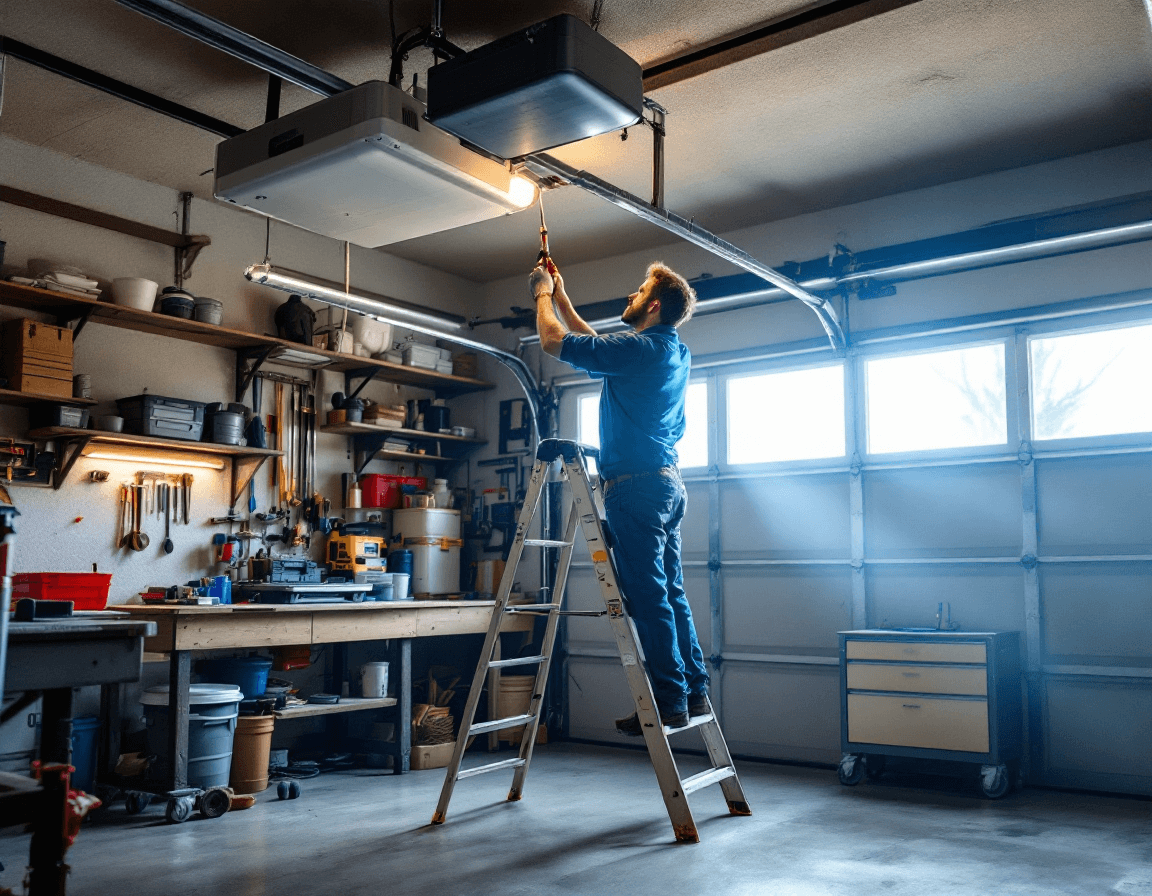
Garage door opener repair in Medina, WA is one of the more common reasons homeowners call us, and it is rarely as mysterious as it first looks. When the door stops responding, grinds, reverses for no clear reason, or simply sits there while the motor hums, the cause is usually a specific, testable component: a power feed, a limit setting, a worn gear, a failed logic board, or a drive chain that has lost its tension. Medina's mix of established residences, long private driveways, and homes close to the lake means openers here work hard in a damp, temperate climate that is kind to lawns but tough on electronics and metal. Seattle Garage Door Fix is a licensed, bonded, and insured company, and we troubleshoot motors, gears, circuit boards, and travel limits on every major opener brand. Most opener repairs we perform fall in the range of $95 to $375, with the final figure depending on what the diagnosis reveals.
The Pacific Northwest climate shapes opener problems more than most homeowners realize. Our winters bring long stretches of cold, wet air, and the sensors near the floor and the wiring that runs along the door track can collect moisture and corrosion over time. Lake-adjacent properties can see a bit more humidity than homes farther inland, and that moisture finds its way into connectors, wall control housings, and the small photo-eye sensors that tell the opener the path is clear. Summers are mild but dry out lubricants and belts, and a door that was adjusted in April may behave differently by November. Understanding these patterns helps explain why a repair that seems straightforward on one visit may need a second look a few months later.
This page walks through the symptoms we see most often, explains what typically causes each one, and describes how we approach diagnosis safely. You will also find guidance on when a problem is best left to a licensed technician, especially anything involving torsion springs, lift cables, or high-tension hardware. If you are reading this with a malfunctioning door in front of you right now, the sections below will help you narrow down the possibilities before you call. If the door is stuck in an unsafe position or you smell burning or see smoke from the opener, switch off power at the breaker and contact a professional immediately.
When the Motor Hums but the Door Refuses to Move
A motor that runs without lifting or lowering the door is one of the most puzzling symptoms, because it suggests power is reaching the opener while something between the motor and the door has failed. Start by listening carefully. A steady hum with no movement often points to a disconnected or slipping drive component, while a clicking or buzzing sound may indicate that the motor is straining against a load. In many Medina garages the door is heavier than homeowners expect, particularly on two-car doors with insulated panels, so a motor that is underpowered for its load will struggle long before it fails outright.
Several causes are worth checking in order of simplicity. The door may have been manually released by the red emergency cord and never re-engaged, which is an easy fix that often surprises people after a power outage. The carriage on a chain or belt drive can slip off the rail or lose its connection to the trolley, leaving the motor turning freely. A worn coupling, a sheared drive gear, or a failed capacitor in some motor designs can also produce this exact symptom. We diagnose by isolating the motor from the door first, then testing the drive path step by step, so we know whether the fault lies in the opener itself or in the mechanical connection to the door.
- Confirm the emergency release cord is fully re-engaged to the trolley and the door is not disconnected.
- Look for a chain, belt, or screw drive that has slipped off its track or lost tension.
- Check that the outlet supplying the opener is live and that the opener breaker has not tripped.
- Note whether the motor runs in only one direction, which can indicate a control or limit problem rather than a mechanical one.
- Watch for a motor that stops abruptly after a brief hum, which often signals an overload or a thermal cutout.
Remote Silence and Wall Buttons That Do Nothing
When the remote fails to respond and the wall button produces no reaction, the first question is whether the fault is in the transmitter, the receiver, or the wiring between them. Remote batteries are an obvious starting point, but in Medina's damp climate we also see transmitters whose contacts have oxidized, particularly in vehicles that sit outside under the trees. A wall control that reads the same way is a stronger clue that the problem lies in the opener's logic board or the low-voltage wiring that connects the wall station. Being systematic here saves time and avoids replacing parts that were never at fault.
Begin by checking whether the opener's indicator light responds when you press the wall button. If the light stays dark, the issue is almost always at the power supply or the wall control wiring. If the light flickers without the motor starting, the logic board may be receiving the signal but failing to confirm it, which can occur after a power surge or a long humid spell has affected the board. Many wall stations use a two-wire run that can be damaged by staples, rodents, or a careless drill bit during a previous home project, and a continuity test will reveal a broken conductor quickly.
Remote interference is worth ruling out as well. Garage door frequencies can be disrupted by newer electronics, certain LED fixtures, or a neighboring transmitter operating on a similar channel. Reprogramming the remote to the receiver, after confirming the opener model supports it, sometimes restores function immediately. If the remote still fails after a fresh battery and a reprogramming attempt, the receiver antenna may be damaged, disconnected, or routed too close to metal framing. A technician can test the receiver directly and determine whether the transmitter or the opener is the source of the failure.
A Grinding Head and the Stripped Gear Problem
A grinding or clattering sound from the opener head is a warning worth taking seriously. In many belt and chain openers, the most common culprit is a stripped or worn gear inside the reduction box, where a plastic or nylon gear has lost teeth from years of load cycles. Once teeth begin to shear, the metal shavings and debris can spread through the gearbox and accelerate wear on the remaining components. Catching the problem early often means replacing a single gear assembly rather than the entire motor unit, which keeps the repair within a reasonable range.
On screw-drive openers, a grinding noise can also indicate a worn drive nut or a dry or contaminated screw. The screw shaft needs periodic lubrication with a lithium-based grease formulated for garage door hardware, and a neglected screw can build up grit that scores the nut. In the Pacific Northwest, where humidity and seasonal temperature swings can cause lubricant to thicken and harden, screws often feel stiff after a cold snap and then grind as the grease softens and redistributes. Cleaning and relubricating the screw is a simple task, but if the nut is cracked or the screw is bent, the component will need replacement.
It is important not to continue running the opener while it grinds. Each cycle can take a bite out of gear teeth, and a stripped gear can eventually allow the door to drop unexpectedly or fail to hold position. If the door begins to sag, creep, or drift when it should be fully closed or open, stop using the opener and contact a professional. We inspect the gear train, check the motor coupling, and determine whether the opener can be repaired or whether replacement makes more sense for its age and condition.
Doors That Close Partway and Then Reverse
A door that begins to close, then immediately springs back up, is frustrating because the opener appears to be working correctly while refusing to finish the job. In most cases the opener is responding to its safety reverse system, which is designed to protect people and objects in the path of a closing door. The safety system typically includes photo-eye sensors mounted near the floor on each side of the door, and a sensor that is misaligned, dirty, or obstructed will cause the door to reverse even when nothing is in the way. Keeping the sensor lenses clean and checking their alignment is the first step in this kind of repair.
Force settings are the second area to examine. Over time, a door that has been adjusted or that has lost balance may demand more force than the opener's limit settings allow, causing an automatic reversal. This is worth distinguishing from a true obstruction, since the two can look identical from the driveway. A door that reverses at the same point on every cycle often has a fixed cause, such as a sensor angle or a travel limit set too close to the floor, while a door that reverses unpredictably may have a balance or track issue. We check the door balance and the opener's force settings together, because adjusting one without the other can create new problems.
Travel limits deserve careful attention because they tell the opener where fully open and fully closed positions occur. If the close limit has drifted or was never set correctly after installation, the door may stop short, reverse early, or attempt to push past the floor. Limit adjustment is generally a precise task on most major brands, and small changes make a noticeable difference. Some openers have a built-in learning routine, while others require manual adjustment of dials or screws. A technician who understands the specific model can set the limits properly and confirm the door reaches and holds each position without overloading the motor.
Reading the Blink Code: Lights That Flash in a Pattern
Many modern openers use the indicator light on the motor housing or wall station to communicate fault conditions, and a repeating blink pattern is often the opener's way of naming the problem. A single slow flash may indicate normal standby, while several rapid flashes followed by a pause can signal a sensor fault, a limit error, or a memory problem. Because the codes vary by manufacturer and sometimes by model year, the owner's manual or the label on the opener cover is the best starting point for interpretation. Writing down the number of flashes and the timing before calling will help a technician narrow the search quickly.
Sensor faults are among the most common causes of repeating light patterns. If the photo-eyes are wired incorrectly, blocked by debris or spiderwebs, or affected by moisture in the wiring harness, the opener will often flash a fault code and refuse to close. Medina garages, particularly those with mature landscaping nearby, can accumulate dust, pollen, and leaf residue on the lenses, and fog or condensation can build up on the inside of the sensor housing during damp mornings. Wiping the lenses and checking that the indicator lights on each sensor match the manual's description resolves many of these cases on the spot.
Logic board issues can also produce blink codes, and these deserve a professional diagnosis. A board may show a fault after a power surge, a lightning-related event, or a long period of moisture exposure. Some codes indicate that the opener has lost its learned travel limits and needs to be reprogrammed, which is a relatively straightforward procedure when done correctly. Others point to a failing component on the board itself, which requires testing and sometimes replacement. Repeated flashing that continues after a basic reset should not be ignored, because it often reflects an underlying issue that will worsen over time.
Loose Chains, Slipping Belts, and Drive Components That Jump Track
A chain or belt that has become loose, shifted off its sprockets, or come completely off the rail is a common and noisy failure. Chain drives can stretch slightly over years of use, and an out-of-tension chain may slap against the rail or the housing, producing a rattle that intensifies during each cycle. Belt drives, which are quieter and common on many newer openers, can develop slack or lose their grip on the pulleys, especially if the rail or trolley has become misaligned. In either case the opener may run, the door may move unevenly, and the components are being stressed in ways that can cause larger damage.
Tension adjustment is a precise job that requires attention to the manufacturer's specifications. Overtightening a chain or belt can strain the motor bearings and the gearbox, while leaving it too loose invites slippage and sudden jolts. When a chain has come off the sprocket, the rail may need to be inspected for bent sections or damaged mounting brackets that allowed the misalignment to occur. We check the rail straightness, the sprocket alignment, and the trolley connection before setting tension, so the adjustment holds rather than failing again after a few weeks.
Homeowners should avoid attempting to re-tension a chain or belt while the opener is connected to power or while the door is in an unsupported position. Even on a relatively light door, the forces involved can cause injury if a component slips unexpectedly. If the door is off track or the trolley has disengaged in a way that affects the door's balance, do not try to force it back into place. Treat the situation as a service call and let a licensed technician handle the alignment and the tension in a controlled manner.
Sporadic Operation That Comes and Goes
Intermittent problems are often the hardest to diagnose because the opener behaves correctly during the visit and then fails the following morning. A door that works fine in the afternoon but refuses to respond on a cold, wet morning may have a connection that expands and contracts with temperature, a sensor affected by condensation, or a remote whose signal fades in damp air. In Western Washington, the combination of cool nights, heavy dew, and fog can create exactly the conditions that expose marginal wiring and corroded terminals. Recognizing this pattern helps guide the search away from simple user error.
The best approach for intermittent faults is to document when they happen. Note the time of day, the outdoor temperature if you know it, whether it has rained recently, and whether the failure involves the remote, the wall button, the sensors, or the motor itself. This information helps a technician test the most likely weak points under similar conditions. Loose screw terminals, frayed low-voltage wires, and corroded spade connectors are common findings, and they are typically inexpensive to repair once located. Replacing a worn power cord or adding a surge protector may also stabilize the system, particularly in areas prone to electrical disturbances during storms.
Do not dismiss intermittent operation as a minor annoyance, because it can signal a developing failure. An opener that stops mid-cycle, reverses at random, or fails to lock the door can create safety concerns, particularly if the door is left partially open overnight. If the behavior is unpredictable, avoid relying on the opener for security until it has been checked. We can run a complete diagnostic that covers power quality, wiring, sensors, and the logic board, so the root cause is identified rather than masked by a temporary fix.
Matching the Repair to Your Opener Brand
Every major opener brand shares the same basic mechanical principles, but the details of motor design, control boards, limit systems, and diagnostic codes differ enough that a generic approach often misses the mark. Chain drives, belt drives, and screw drives each have their own maintenance requirements, and the logic boards from different manufacturers handle sensors, force settings, and wireless communication in distinct ways. Knowing the brand, model, and approximate age of the opener is one of the most useful things a homeowner can provide when scheduling a repair. The label on the motor housing or the back of the opener usually carries this information.
Our technicians work across the common brands found in Medina homes, and we approach each one with the manufacturer's service logic in mind. For older units, we check whether replacement parts remain practical to source and whether the cost of repair approaches the cost of a new opener. For newer units with integrated smartphone connectivity or battery backup systems, we verify firmware compatibility and confirm that the control accessories are working as intended. In every case the goal is a repair that restores reliable operation without introducing unnecessary parts or steps.
It is worth noting that a repair on one brand does not automatically translate to another. A stripped gear on a chain drive requires a different set of parts and procedures than a failed board on a screw drive, and both differ from a belt system with a soft-start motor. Choosing a provider who asks detailed questions about your opener before quoting the job will generally produce a more accurate result. If you are unsure of the model, take a clear photo of the label and note any display codes before calling.
Medina Garages: Lake Breezes, Long Drives, and Mature Trees
Homes in Medina sit in a setting that has its own quirks for garage equipment. Properties near the waterfront and the lake breezes that move across Lake Washington can experience more humidity and occasional wind-driven moisture than inland neighborhoods, which affects sensor lenses, wall stations, and wiring that runs along exposed walls. Many homes also feature long driveways and detached or semi-detached garages, which can mean longer low-voltage runs to the wall control and a greater chance of wiring damage from landscaping work. Mature trees common in the area drop sap, needles, and leaves that can coat sensor lenses and gather in tracks, especially during autumn.
Overlake and the surrounding corridor bring their own considerations. Nearby commercial activity and dense residential development can create occasional electrical noise on the grid, and while this is rarely severe, it can contribute to wear on sensitive control boards over time. Homeowners who live on the edges of Medina may also have garages with additional storage or workshop equipment that adds load to the door, increasing stress on the opener's motor and gearbox. Keeping the door balanced and the opener properly sized for the door's weight is one of the simplest ways to extend its life.
Seasonal planning is useful for Medina homeowners. A check of the sensors, track, and lubrication before the wet season tends to prevent many of the reversing and intermittent faults described above. In late winter, look for signs of corrosion on the rail and the trolley, and in early summer make sure the opener has not been strained by heat-softened weatherstripping that makes the door stick. A brief inspection each year, combined with prompt attention to new noises or behavior, goes a long way toward avoiding a sudden breakdown on a busy morning.
Safety Boundaries: Springs, Cables, and Licensed Professionals
Garage door opener repair involves electrical and mechanical components that can be handled safely by a trained technician, but it also sits close to parts that carry serious danger. Torsion springs store enormous amounts of energy and can cause severe injury if they are adjusted or released improperly. Lift cables and drum assemblies can snap or unwind under tension, and a door that has lost its cable balance can drop with force. For this reason, any work involving springs, cables, or high-tension hardware should be performed only by a licensed professional with the proper tools and training. We recommend that homeowners never attempt these repairs on their own.
Opener work also has safety boundaries. Disconnecting power at the breaker before touching the motor, the logic board, or the wiring is essential, and the emergency release should be used carefully when the door is closed or fully supported. Never place hands or tools in the path of a moving door, and never try to test the safety reverse by standing under the door. If you see scorched wiring, smell burning insulation, or notice that the motor housing is hot to the touch, switch off power immediately and contact a professional. Loose or frayed wiring at the wall station should be left to a qualified technician, since low-voltage systems can still produce unexpected behavior when disturbed.
Our approach is to stop and recommend a licensed professional whenever a repair crosses into spring or cable territory, and we explain clearly why the work is more involved than it appears. Doing so protects both the homeowner and the technician, and it ensures the door is restored to safe, balanced operation rather than simply running again. If a previous repair attempt by someone else left the door out of balance or created a new fault, a full inspection is a wise next step.
Pricing Transparency and What Shapes Your Quote
Most garage door opener repairs we perform fall in the range of $95 to $375, and the final cost depends on the specific fault, the parts required, and the complexity of the diagnosis. A simple adjustment such as resetting travel limits, realigning a sensor, or tightening a chain may land at the lower end of the range, while replacing a gear assembly, a logic board, or a motor typically moves the price higher. We believe homeowners should understand what drives a quote before the work begins, so we explain the diagnosis and the recommended repair in plain language before proceeding.
Several factors influence the total. The brand and model of the opener determine part availability and labor time, and older units may require parts that are harder to source. The condition of the door itself, including balance, track alignment, and the hardware connecting it to the opener, can affect how long a repair takes and whether