
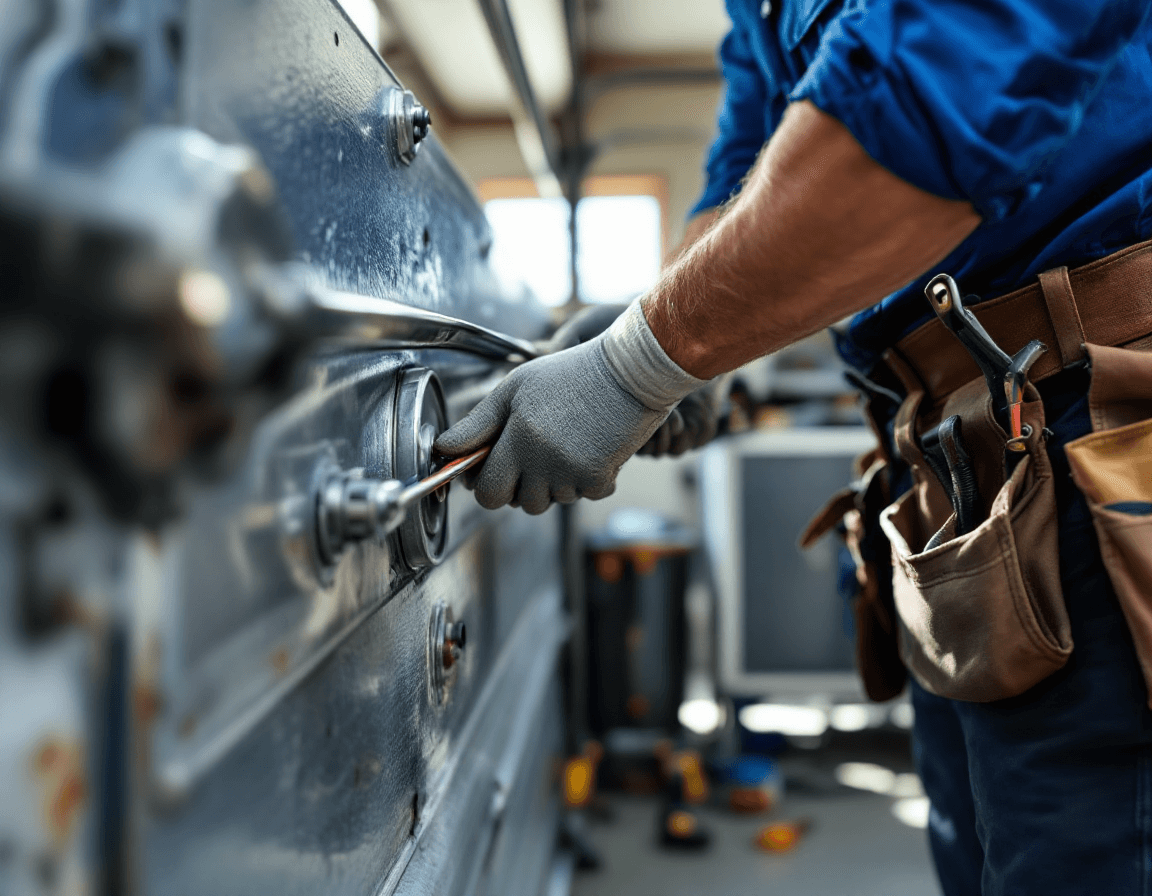
Garage door cable replacement in Medina, WA is one of the more common repairs we handle on the Eastside, and it is also one of the most important to get right. The lift cables on a garage door carry the weight of a heavy panel every time it moves, so when one frays, rusts through, or slips off its drum, the door can become unstable or stop working altogether. Medina homeowners often notice the problem as a door that looks slightly off level or as a sudden, alarming bang from the garage. Either way, the sooner the cable is inspected, the less likely a minor fault becomes a damaged door, bent track, or injured person.
This page explains what lift cables do, the warning signs that tend to show up before a failure, and why the moist, mild climate around Lake Washington affects this hardware more than many homeowners expect. It also walks through what happens during a professional cable replacement, how cable drum service fits into the job, and what influences the typical price range of $110 to $300 for most cable work. Medina is a community of large lots, waterfront properties, and older construction alongside newer builds, and garage setups vary widely from one street to the next, so the guidance here is written to help you recognize what your own door is telling you.
Whether your door is a single-car unit tucked beside a driveway near the water or a double-width door on a property closer to the Overlake corridor, the principles are the same. Cables are under significant tension, and any repair that involves tension, springs, or the drum must be handled by a licensed professional. Read the sections below to understand what you are seeing, then call us at (888) 799-3819 so a technician can confirm the cause and give you a clear plan.
What the Lift Cables Are Quietly Doing Every Time the Door Moves
Most sectional garage doors use a pair of steel lift cables, one on each side, that run from the bottom bracket of the bottom panel up through a pulley and wrap around a drum mounted on the end of the torsion shaft above the door opening. As the door closes, the cables unwind from the drum and the panels travel down the track; as the door opens, the cables wind back onto the drum and lift the panels in a controlled arc. The torsion springs above the opening provide most of the force that offsets the door's weight, while the cables transmit that force to the panels and keep the door moving in a straight, level path.
Because the drum and cable are matched, the two sides have to stay synchronized. If one cable is shorter, frayed, or sitting incorrectly on its drum, that side can carry a different share of the load, and the door will try to rise or drop unevenly. This is why a cable problem often shows up first as a door that looks crooked, or as one bottom corner that lags behind the other when you open it. The cable is not just a rope that lifts the door; it is one half of a balanced system.
Understanding this helps explain why a cable failure can be so disruptive. The steel strands are designed to handle repeated flexing and load, but they are not designed to tolerate kinks, rust pitting, or the abrupt shock of a spring that has suddenly released. When a cable fails, the door usually loses its balance point instantly, which is why the first sign for many homeowners is a sharp crack or snap followed by a door that no longer moves smoothly at all.
Reading the Early Warnings Before a Cable Gives Way
Lift cables rarely fail without warning, although the warnings are easy to dismiss if you use the garage only a few times a day. The most common early sign is a door that looks slightly out of level when it is halfway open, with one edge of the bottom panel sitting higher than the other. Homeowners sometimes assume the track has shifted, but a crooked door is just as often caused by a cable that has stretched, slipped, or lost its even tension across the two sides.
Visual inspection can reveal a good deal, provided you look carefully and only from a safe distance. Check the cable for fraying, flattened spots, bird-caging where strands splay outward, or a dull orange-brown film that signals rust working into the steel. Note whether the cable sits neatly in the groove of the drum or whether it appears to be riding up over the edge. A cable that looks slack when the door is closed and then tightens sharply when you open the door is a sign something is wrong with its seating or length.
Sound and behavior matter as well. A door that binds or hesitates on one side, or that closes unevenly so one corner touches the floor before the other, deserves attention. Some homeowners notice a grinding or ticking noise as the drum turns, which can indicate that the cable is catching on itself or that the drum is worn. None of these signs by themselves means the cable is about to break, but together they point to a system that needs professional eyes before the next cycle.
- The door appears level at the bottom when closed but tilts or lags when opened halfway
- One side of the door closes first or seems to hang lower than the other
- Visible fraying, kinking, or orange-brown rust along any section of the cable
- The cable appears loose on the drum or seems to sit above the drum groove
- A grinding, ticking, or scraping sound when the door moves through its travel
- The door stops partway through its cycle and then resumes after a manual nudge
Why Medina Garages Wear Cables Faster Than Expected
The Pacific Northwest is known for rain, but the more subtle issue for garage hardware is the persistent damp that lingers between storms. Lake Washington and the surrounding waterways keep the air near Medina moist for long stretches, especially in the cooler months, and garages are often the least climate-controlled space on a property. Condensation can form on steel hardware overnight, and when temperatures swing across a single day, moisture cycles in and out of the cable's strands. Over years, that cycle invites rust, which weakens the wire from the inside before any damage is visible from the outside.
Medina's landscape adds another layer. Many homes sit on sloped or wooded lots where leaf litter, moss, and organic debris collect near the garage threshold and in the track channels. Debris that gets kicked into the drum area or caught under the bottom bracket can grind against the cable each time the door cycles. Properties close to the waterfront may also see more humidity drifting inland, which accelerates corrosion on exposed metal, particularly on older doors whose protective coatings have thinned.
Garage use patterns in the area matter too. Many households run multiple vehicles, store bikes and kayaks, and open the door several times a day. Every cycle is a bend and a load, and cables that work hard for years in a damp space will eventually fatigue. This is why we recommend inspecting cables as part of routine maintenance rather than waiting for a failure, especially for doors that are more than a decade old or that show surface rust on other hardware such as hinges and rollers.
The First Ten Minutes After a Snap or a Sudden Drop
A loud crack or bang from the garage is unsettling, and the instinct is often to force the door open or try to lift it by hand. Resist that urge. When a lift cable breaks or comes off the drum, the door may be partially supported only by the remaining cable and springs, and it can shift unpredictably. Your first priority is keeping people and pets away from the door and its tracks, and making sure no one is standing underneath or in the path of the panels.
Next, use the emergency release cord if your opener is connected, and keep the door closed unless you have confirmed it is safe to move. Do not attempt to reattach the cable yourself, do not try to wind the drum by hand, and do not adjust or remove any spring components. The springs are under high tension even when the door appears to be at rest, and mishandling them can cause serious injury. If the door has dropped partway, leave it where it is and treat the garage as a restricted area until a technician arrives.
Once everything is secure, document what you saw and heard. Note the time, the location of the bang, whether the door is level, and whether you can see a cable hanging loose or lying across the floor. These details help a technician diagnose the failure quickly, and they also help you describe the situation accurately when you call. A clear description of the symptoms usually allows us to plan the visit with the right parts and tools on the first trip.
What Happens When a Cable Comes Off the Drum
Cables that slip off the drum are common in doors where the drum groove has worn, where the cable has stretched unevenly, or where the door has been forced after a previous fault. When the cable comes off, it often loops loosely around the drum or the shaft, sometimes creating a tangle that locks the door in place. This is one of the more dangerous scenarios because the cable may still be carrying residual tension in unpredictable ways, and the drum itself can rotate suddenly if the spring is disturbed.
Diagnosing the situation requires understanding how the drum, the cable, and the spring interact. A technician will check whether the cable is seated correctly in the drum groove, whether the drum is damaged or cracked, and whether the spring tension is set appropriately. In many cases, the drum needs to be re-seated or replaced along with the cable, because a worn groove can cause the new cable to slip again within weeks. Skipping this step is one reason some repairs fail to hold.
We always treat a cable off the drum as a priority repair. The door cannot be trusted to lift evenly until the cable is correctly seated and tensioned, and continuing to operate the opener in that condition can damage the door, the track, or the opener itself. A proper repair restores the door's balance, returns the cable to the correct groove, and confirms the door closes and opens smoothly across its full travel.
How a Professional Cable Replacement Visit Usually Unfolds
A cable replacement visit begins with a full inspection rather than an immediate swap. The technician checks the door's overall balance, the condition of the track and rollers, the drum, the bottom bracket, the pulley, and the springs. This inspection matters because a failed cable is often one symptom of a broader issue, such as worn rollers, misaligned track, or a spring that has lost tension. Addressing only the cable in those cases means the replacement may not last.
Once the cause is confirmed, the technician releases the spring tension using proper tools and procedures, removes the damaged cable, and inspects the drum for groove wear, cracks, or looseness. If the drum is compromised, it is serviced or replaced at the same visit. A new cable is then sized to the door, routed through the pulley, seated correctly in the drum, and secured at the bottom bracket. The spring tension is restored and balanced to the door's weight.
The final step is testing. The technician operates the door through a full cycle several times, watching both sides to confirm they lift and lower together. They check that the door stays level, that the cables sit correctly on the drum at both the closed and open positions, and that no binding or unusual noise remains. Homeowners are typically walked through what was done and what to watch for in the coming weeks, so the door's behavior is understood rather than mysterious.
What Shapes the $110 to $300 Cost of Most Cable Work
Most cable replacements fall within a range of $110 to $300, but the exact figure depends on several factors. The type and gauge of cable matter, as does whether a single cable or both cables need replacement. Doors that are older, heavier, or built with less common hardware can require different parts, and that affects the total. Access also plays a role; a door with a clear working space and standard track is generally more straightforward than one with an unusual configuration or tight clearance above the opening.
Scope of work is another driver. A simple cable swap on a door whose drum is in good shape will cost less than a visit that also requires drum replacement, roller replacement, or spring adjustment. When a cable has failed because of a deeper problem, the technician may recommend additional repairs to protect the new cable and prevent a repeat failure. We explain these recommendations before any work begins, so you can decide how to proceed.
- Whether one or both cables need replacement, and their length and gauge
- Whether the cable drum is worn, cracked, or needs replacement at the same visit
- Condition of the track, rollers, and bottom bracket that may affect cable life
- Door size, weight, and access above the opening for safe spring work
- Whether a spring adjustment or balance correction is needed after the swap
Cable Drum Service and Why the Drum Deserves Equal Attention
The drum is the unsung partner of the lift cable. It is a grooved component that guides the cable as it winds and unwinds, and its condition determines how evenly the cable seats and how long it lasts. Over time, the drum's grooves can wear smooth or become misshapen, especially if the cable has repeatedly slipped or been forced. A worn drum can cause a brand-new cable to ride unevenly, rub against its neighbors, or slip off again, which is why drum service is so often part of a proper cable repair.
Drum service may involve cleaning, inspection, re-seating, or replacement. Cleaning removes built-up grit and rust that can cause the cable to bind. Inspection checks for cracks, looseness on the shaft, and groove wear that is beyond what a new cable can tolerate. Replacement is appropriate when the drum is damaged or too worn to hold the new cable securely. In all cases, the drum is inspected alongside the cable so the two work together as intended.
Because drum work involves the same tensioned system as the springs, it should be done only by a licensed technician with the right equipment. Attempting to remove or reposition a drum without releasing spring tension properly is one of the more hazardous home repairs, and it is one we strongly discourage. A professional visit ensures the drum, cable, and spring are matched and that the door will balance correctly once the work is complete.
Keeping New Cables Healthy Through Damp Seasons
Once a new cable is installed, a little attention can extend its life considerably. The most practical habit is to keep the garage floor and track area clear of leaves, grit, and debris, since these can work into the drum and bottom bracket. Periodic visual checks, such as glancing at the cable each month and watching the door's movement, help you notice early changes before they become failures. Any sign of new rust, fraying, or uneven travel is worth a call.
Lubrication is part of the picture, but it needs to be done carefully. Lubricate the moving hardware the manufacturer recommends, such as rollers, hinges, and the track where appropriate, using a product suited to garage doors. Avoid spraying lubricant directly onto the cable in a way that attracts dirt, and do not apply heavy grease to the drum without confirming it is appropriate for that system. A technician can recommend a maintenance routine matched to your specific door.
Humidity control also helps, where it is practical. Improving ventilation in an attached garage, keeping the door closed during long damp spells when it is not in use, and addressing any water intrusion at the threshold can reduce the moisture that drives corrosion. These steps will not eliminate the Pacific Northwest climate, but they make a measurable difference in how quickly steel hardware deteriorates.
Choosing a Technician Who Understands Eastside Homes
Medina homeowners benefit from working with a technician who understands the range of garage setups in the area, from older attached garages to newer detached structures with larger doors. The right provider will inspect the whole system rather than quoting a cable swap in isolation, will explain what they found in plain terms, and will recommend only the work your door actually needs. They will also be clear about safety, including why spring and cable work must be left to professionals.
Our team is licensed, bonded, and insured, and we treat every cable visit as a safety-first job. We will inspect the door, explain the cause of the failure, outline the repair options and their costs, and test the door thoroughly before we leave. Our service area covers Medina and more than sixty other communities across the greater Seattle and Western Washington region, so we are familiar with the climate, construction styles, and common issues that affect garage doors in this part of King County.
If your door is crooked, your cable has frayed or rusted, or a snap has left you with a stuck or unbalanced panel, do not wait for the next cycle to test it. Call Seattle Garage Door Fix at (888) 799-3819 to schedule a visit. We will look at the cable, the drum, and the springs, explain what we find, and get your door moving level and safe again.