
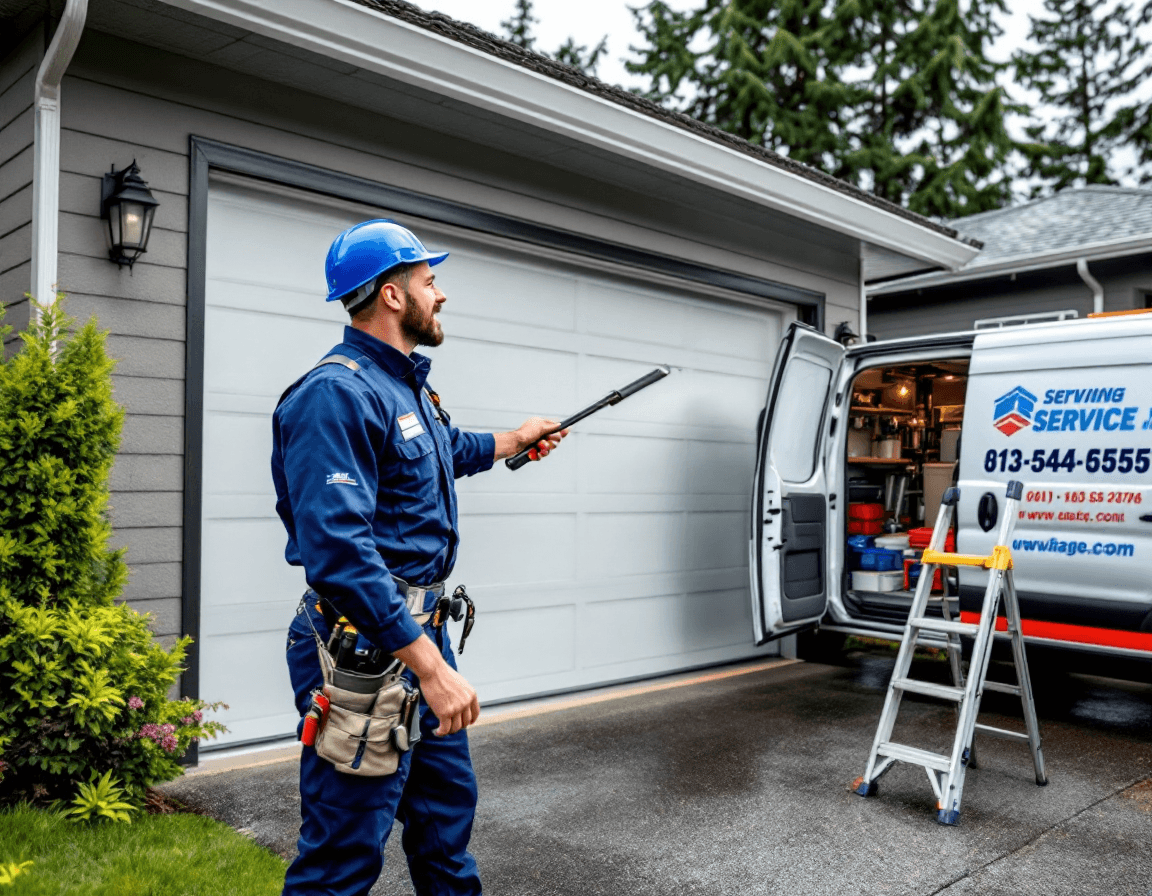
Garage Door Repair in Medina, WA is a service we handle regularly for homeowners on the city's tree-lined streets and lakefront lots, where a garage door that sticks, reverses, or stops halfway can throw off the whole morning. Medina sits on the east shore of Lake Washington, and many of the homes here have wide, heavy doors that carry more weight and see more daily use than the standard builder-grade door found in other neighborhoods. When one of those doors fails, the problem is rarely a mystery, but it is often misdiagnosed by people who try to fix it without the right tools or experience.
This page explains the most common reasons doors malfunction in the 98039 area, what the symptoms usually mean, and how a licensed technician approaches each repair. We cover everything from remotes that stop responding to doors that come off their tracks, and we describe what to expect from a service visit. Whether your home is near the waterfront, tucked into a wooded lot off a long driveway, or closer to the commercial corridors around Overlake, the principles are the same: diagnose carefully, protect the people in the house, and repair the cause rather than just the symptom.
If you are reading this with a door that is currently stuck or behaving strangely, you do not need to finish the article before calling. Keep people and pets clear of the opening, avoid pulling on any spring or cable, and keep reading for the signs that point to a quick fix versus a situation that needs immediate professional attention.
Why Medina Garage Doors Carry a Heavier Load
Many homes in Medina were built with larger garages than average, including multi-car bays, workshop spaces, and oversized carriage-style or insulated steel doors. A double-wide door can weigh well over 200 pounds, and the counterbalance system has to lift that weight smoothly every time someone pulls out of the driveway. When a door is larger, every component works harder, from the torsion springs and cables to the rollers, hinges, and opener motor. Small wear that would go unnoticed on a single-car door can become a noticeable problem on a bigger one.
Medina properties also tend to have longer driveways and more frequent use. Families coming and going for school, sports, and errands, along with household staff, contractors, and visitors, mean the door may cycle many more times in a day than a typical suburban garage door. Each cycle adds a little more stress to the rollers and track joints. Over several years, that cumulative wear shows up as louder operation, uneven travel, or a door that hesitates before starting to move.
Some homes also feature custom wood doors, glass panels, or decorative hardware that adds weight and changes how the door balances. A technician familiar with these setups will check whether the springs are correctly sized for the actual door, not just the one that was installed originally. Mismatched weight is one of the quiet causes of premature failure, and it is worth asking about during any inspection.
Lakeside Humidity and What It Does to Tracks and Rollers
Living near Lake Washington means dealing with the damp, mild climate that defines the Pacific Northwest. Winter brings long stretches of drizzle and low cloud, and the moisture in the air does not always stay outside. Humidity can cause the steel in tracks and hinges to develop surface rust, and it can make nylon or sealed rollers swell or stiffen over time. In a garage that is not well ventilated, the problem compounds because water condenses on cool metal surfaces overnight.
Moisture also affects the wood components found on many older and custom doors. Wood can swell in wet months and shrink in dry spells, which changes the fit between panels and the door frame. When panels rub against the weatherstripping or the track edges, the door may start to drag or make a scraping sound. A technician will often check the seals at the bottom and sides of the door as part of the same visit, since a worn seal can let water in and accelerate the damage to the bottom roller brackets.
Regular cleaning and light lubrication help offset the effects of humidity, but it is important to use the right product. Penetrating oils that are meant for loosening stuck bolts can attract dirt and gum up the rollers. A silicone-based or manufacturer-recommended lubricant applied sparingly to the hinges, rollers, and track is usually the better choice. Avoid spraying lubricant directly onto the springs or cables, because those parts require professional inspection and should be handled only by a licensed technician.
When the Door Will Not Open or Close at All
A door that refuses to move in either direction is the most alarming symptom, and it usually points to one of a few causes. The first is a power or control issue: the opener may not be receiving electricity, a circuit breaker may have tripped, or the opener's safety sensors may be blocked or misaligned. These problems are often simple to resolve, and it is worth checking them before assuming the door itself has failed. Look at the small sensor eyes mounted near the floor on each side of the opening, and make sure nothing is blocking their line of sight.
The second cause is mechanical. A broken torsion spring, a snapped cable, or a disconnected arm between the opener and the door can leave the door completely unable to lift. This is a serious situation because a door without its spring can drop unexpectedly and because the opener may be straining against a load it cannot handle. If the door feels extremely heavy when you try to lift it manually, or if you hear a loud bang when the spring broke, stop attempting to operate it. Keep the area clear and call a licensed technician.
The third cause is a stuck or jammed door that the opener cannot overcome. Debris in the track, a bent section of track, or a roller that has come out of its channel can all prevent movement. The opener's logic may detect the resistance and stop the motor to protect itself. Clear any visible obstructions only if it is safe to do so, and never try to force the door by pushing on it from the bottom while the opener is engaged.
Reversing Before the Floor: Safety Sensors and Auto-Reverse Faults
Modern openers are required to reverse the door if they encounter an obstacle, and this safety feature is one of the most valuable parts of the system. However, when the auto-reverse function activates for no obvious reason, the door may travel down, stop, and rise again before reaching the floor. Homeowners often assume the opener is broken, but in many cases the cause is a sensor problem or a sensor that has been knocked out of alignment.
The photo-eyes on the sides of the garage door opening must be aligned so that each one faces the other and both indicator lights are steady. Direct sunlight through a garage window, a bright reflection off a wet driveway, or a stray leaf or spider web can interrupt the beam and trigger a reversal. Along the Medina waterfront and in wooded areas, low winter sun can shine straight into an opening at certain times of day, which sometimes surprises homeowners who notice the problem only at dusk or dawn.
It is also worth checking the travel limits and the force settings on the opener. If the limits drift or the force setting is too sensitive for a heavier door, the system may reverse early even when nothing is in the way. Adjusting these settings requires care, because the goal is to keep the door safe for people and objects without making it unreliable. A technician can test the reversal response with a standard object and confirm that the system meets safety expectations before handing the door back to you.
Grinding, Squealing, and Banging: Reading the Noises
Every garage door makes some noise, but a change in sound is one of the best early warnings you will get. A high-pitched squeal usually comes from dry metal rubbing against metal, most often at the rollers, hinges, or the bearing on the torsion shaft. A grinding sound often points to a worn gear inside the opener, a loose or misaligned chain, or a roller that has started to wear flat. A sharp bang or clunk may mean a loose bracket, a roller hitting a track seam, or a section of the door moving out of sync with the rest.
Listening carefully helps narrow the cause. If the noise happens only at the start of the door's travel, the issue may be near the bottom bracket or the opener's starting torque. If it occurs at the top of the travel as the door reaches its fully open position, the problem could be a worn roller or a track that is not fully seated. Noises that come and go with temperature changes may be linked to the metal contracting in cold mornings, which is common during Western Washington winters.
Do not ignore a banging or grinding sound that is getting louder. Continued operation can damage the opener, strip gears, or allow a roller to fail completely, which may cause the door to jam. A licensed technician can inspect the full system, tighten hardware, replace worn rollers, and recommend whether the opener itself is nearing the end of its service life.
Crooked Travel, Sagging Sections, and Doors Knocked Off Track
A door that moves unevenly, leans to one side, or looks visibly crooked is telling you that the load is not balanced. This often happens when one side of the door has a roller that has worn down or come out of the track, or when the cable on one drum has slipped. Sagging sections, gaps at the top or bottom, or a door that sits lower on one side than the other can all be signs that the door is no longer tracking properly.
Doors that come off their tracks are one of the most serious problems we see. Usually this is caused by a damaged track, a loose track bracket, or a roller that has jumped out of its channel after repeated stress. Once a door is off its track, it can bind, twist, or fall, so it should never be forced back into place by hand or powered again until a technician has inspected it. The safest action is to disconnect the opener if you are able to do so safely and keep everyone away from the door while you wait for service.
Gaps or sagging can also result from worn hinges or damaged panels. A panel that has been dented or cracked may no longer hold its shape, and the joints can separate under load. Replacing a single panel is sometimes possible, but matching color, style, and insulation can be tricky, particularly on older or custom doors. A technician can advise whether a repair is practical or whether the section should be replaced as part of a larger job.
Remotes and Wall Buttons That Go Silent
When the remote or wall button stops working, the first thing to check is the simplest one: the battery in the remote and whether the opener's light flashes when you press the button. Many remotes use small coin cells that lose charge gradually, and a remote that works only when you stand close to the door is often running low. If the opener does not respond at all, check the wall button wiring and the control panel on the opener unit. A loose wire or a corroded contact can interrupt the signal.
Interference is another common cause. Other electronic devices, a new security system, or a neighbor's remote operating on a similar frequency can sometimes block the signal. Large properties in Medina may have gates, outdoor lighting, and other remote-controlled equipment, so it is worth testing the remote from different locations on the property. Reprogramming the remote to the opener is usually a straightforward process, though the exact steps depend on the brand and model.
If the opener's receiver has failed, the remote and wall button will both stop working. In that case the fix involves replacing the logic board or the entire control unit, which is a more involved repair. A technician can test each component separately and tell you whether the problem lies in the remote, the wall control, the wiring, or the opener itself, so you are not paying to replace parts that were never the issue.
Slamming Shut: Why Speed and Tension Matter
A door that closes too quickly, or drops with a loud thud, can create real danger for people, pets, and vehicles beneath it. Speed problems are often linked to the opener's close-force settings, a worn gear or belt that no longer controls descent smoothly, or a spring that has lost tension. When a torsion spring weakens, the door may feel light on the way down and slam into the floor because the counterbalance is no longer doing its job correctly.
Adjusting the opener's close speed or force can sometimes reduce slamming, but this is only a temporary fix if the underlying spring or cable issue is not addressed. Balance testing is an important step. Disconnect the opener, lift the door partway, and see whether it stays in place. If it drops or rises on its own, the springs are out of balance, and that calls for professional adjustment. Never attempt to adjust spring tension yourself, because the stored energy in these springs is considerable and can cause serious injury.
Doors that slam are also a concern for the vehicles and property around them. A closing door can crack a bumper, damage a bike, or pinch a child's hand if the auto-reverse system is not functioning. A licensed technician will test the close cycle, confirm that the reversal system responds correctly, and check that the door seals properly at the floor when closed.
What a Typical Medina Repair Visit Covers and What It Costs
Most residential garage door repairs in Medina fall within a price range of $95 to $450, depending on what is needed. Simple jobs such as sensor realignment, roller replacement, or a remote and keypad programming issue tend to sit at the lower end. Repairs involving broken springs, damaged cables, opener component replacement, or multi-section panel work usually fall higher in the range, because they require more parts and labor time. Your technician should explain the scope of the work and the cost before beginning any repair, so there are no surprises.
A thorough service visit typically starts with a walk-through of the symptoms you describe and a visual inspection of the door, tracks, rollers, hinges, springs, cables, and opener. The technician will test the door's balance, the auto-reverse system, the travel limits, and the remote and wall controls. Once the cause is identified, the technician should walk you through the repair options and what each one addresses. Some problems are best handled right away, while others may be safe to schedule for a later date.
Medina homeowners sometimes ask whether it is worth repairing an older door or opener. That depends on the condition of the door panels, the availability of parts for the opener, and how often the problem is recurring. A good technician will give you an honest assessment rather than pushing an unnecessary replacement. If a repair is still reasonable, the work will restore reliable operation without unnecessary expense.
Safety is always part of the visit. Spring and cable work must be performed by a licensed, trained professional, and we recommend that homeowners never attempt those repairs themselves. Springs store significant force, and a mistake during removal or adjustment can cause severe injury. If your repair involves these parts, the technician will explain the reason and the steps being taken to keep the work safe.
Simple Habits That Keep Small Problems From Growing
Preventive care does not replace professional service, but a few consistent habits can extend the life of your door and catch small issues early. Walk the door through a full open and close cycle once a month and listen for changes in sound, speed, or smoothness. Look at the tracks, hinges, and rollers for dust, debris, or visible rust, and wipe them clean with a dry cloth when needed.
Several simple checks are worth adding to your routine:
- Keep the photo-eyes clean and confirm both indicator lights are steady after each cleaning.
- Test the auto-reverse by placing a short piece of wood on the floor in the door's path and confirming the door reverses on contact, then have a technician verify this periodically.
- Check weatherstripping along the bottom and sides for cracks or gaps, especially after heavy winter rain.
- Inspect the remote batteries twice a year and replace them before they run low.
- Keep the area around the door clear of stored items that could interfere with sensors or be struck by the door.
- Note any new noise, slow start, or uneven movement and schedule service before it becomes a jam.
Beyond these habits, schedule a professional inspection at least once a year, especially if your door is heavy, older, or used many times a day. A technician can check spring balance, cable condition, roller wear, and opener performance with equipment and experience that go beyond what a homeowner can see. Catching a worn roller early is far less expensive than dealing with a jammed door in the middle of a busy morning.
Garage doors in Medina work hard, and the damp Pacific Northwest climate asks a lot of their hardware. With attentive care and prompt repair when something changes, you can keep your door reliable for many years. If your door is stuck, reversing, noisy, crooked, or simply not responding, call Seattle Garage Door Fix at (888) 799-3819 to schedule a licensed technician who can diagnose the problem and explain your options clearly.