
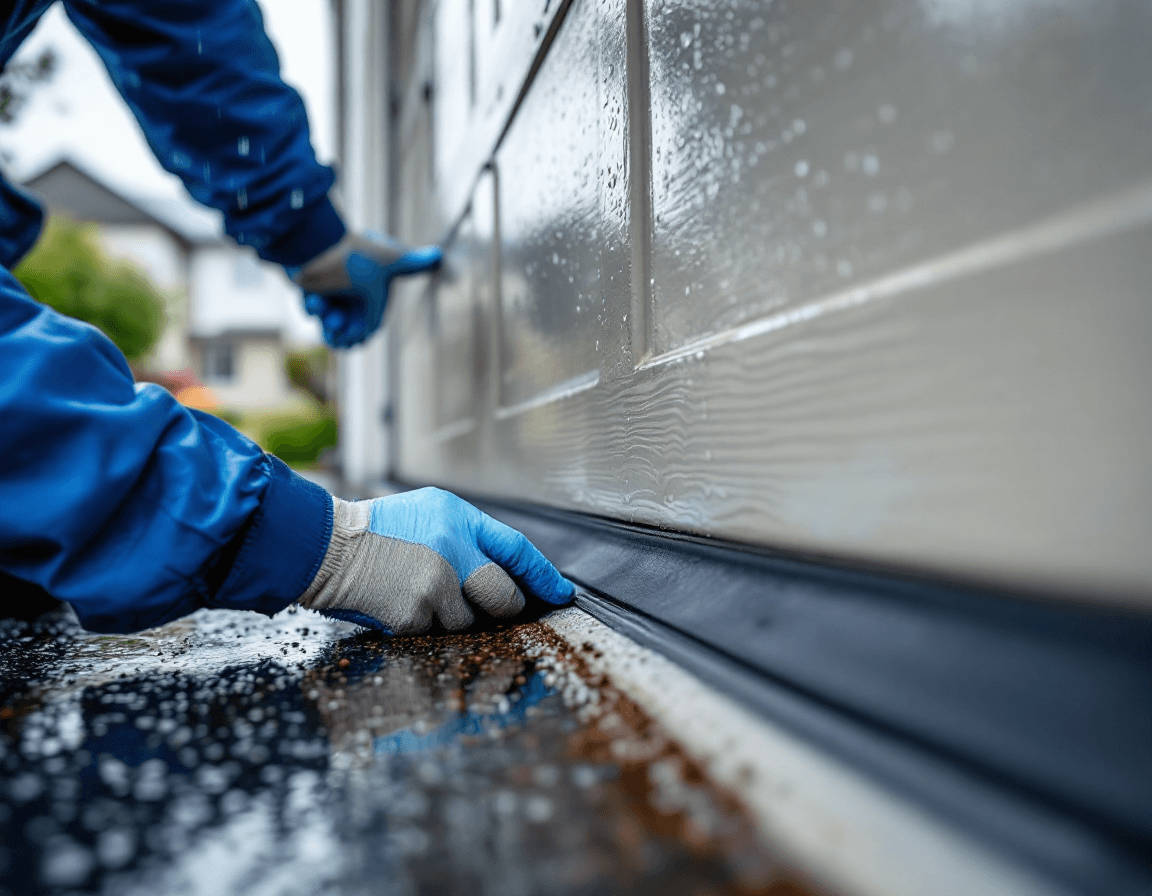
Garage door weather seal replacement in Milton, WA is one of the most affordable fixes that makes a visible difference in how your garage feels, smells, and holds up through the year. Many Milton homeowners don't notice a failing seal until a puddle forms near the back wall after a long February storm, or until they find a line of sawdust-colored debris along the threshold. The seal at the base of the door, the strip running along the sides and top, and the threshold piece on the floor all work together to keep weather out. When one of them wears down, the others have to work harder, and the gap usually grows.
This page explains what those seals do, how to tell when they've failed, and what a replacement visit typically involves for homes in and around Milton. You'll find a practical look at local weather patterns, a few self-checks you can run safely in your driveway, and a clear breakdown of the $95 to $250 price range that depends on seal type and door size. We also cover where sealing ends and where spring tension and cable work begin, because that boundary matters for your safety. Our goal is to give you enough information to make a confident decision, whether you schedule service or simply want to understand what's happening at your door.
If you already suspect your seals are worn, you're probably right to act now rather than waiting for spring. Small gaps tend to stay small only for so long in Pierce County weather. Read through the sections below, run the quick checks, and call (888) 799-3819 when you're ready to talk through options for your specific door.
Why Milton Garages Lose Their Seals Faster Than Expected
Milton sits in the lowland corridor of Pierce County, where the air stays damp for much of the year and the ground holds moisture long after the rain stops. Garages in this area see a steady cycle of wet fall weeks, cold and soggy winters, brief spring dry spells, and summers that are mild by comparison but still bring morning dew and humidity. That cycle is hard on rubber and vinyl. Seals expand when they soak up moisture, contract when temperatures drop, and gradually lose the flexibility that lets them press firmly against the concrete or the door panel.
Sunlight matters too, even on cloudy days. Ultraviolet exposure dries out the surface of rubber and causes it to crack along the edges, especially on the bottom seal where the door meets the slab. Garages that face south or west, or that sit under open sky without much overhang, often show this wear earlier than shadier properties. Many homes in the area also have driveways that slope slightly toward the garage, which means runoff pushes against the threshold every time it rains hard.
Age and installation quality play a role as well. A bottom seal that was fitted incorrectly or cut too short will fail sooner than one installed with proper alignment. Perimeter weatherstripping that was stapled rather than seated in a channel can pull loose over time. None of this means your door is defective. It simply means that a door in a wet, temperate region needs its seals checked on a regular schedule, and that a seal lasting several years in a drier climate may need attention sooner here.
Reading the Gap: A Five-Minute Check From the Inside
The most reliable way to judge a bottom seal is to look at it with the door closed and the lights on. Stand inside the garage at dusk or with a flashlight, and check whether you can see daylight under the door at any point along its width. A gap that is visible from a few feet away usually means the seal has compressed, torn, or pulled away from the bottom panel. You don't need any tools for this, and you can do it without climbing anything.
Next, check the seal itself. Run your fingers along its length while the door is closed. A healthy seal feels soft and springs back when pressed. A failing one feels hard, cracked, or sticky, and it may leave residue on your fingers. Pay attention to the corners, where the seal bends around the end caps and is most likely to tear. If the seal has pulled out of its retainer channel in any section, that's a sign the fasteners or the channel itself need attention.
Common warning signs include:
- Daylight visible under the closed door, especially at the center or near one side
- Cracks, flaking, or chunks missing from the bottom rubber
- Dirt lines, leaf fragments, or small pebbles accumulating just inside the door
- Water stains or dampness on the floor directly in front of the door after rain
- Perimeter strips that are loose, torn, or no longer touching the door panel when it closes
If you find any of these, note where they occur. Patterns help a technician diagnose the problem faster. A gap only at one end often points to an uneven threshold or a bent track, while a gap across the full width usually points to general seal fatigue. Take photos if it helps, and keep them for your records or to share during a service call.
Rain That Finds the Smallest Opening
Water is the most persistent enemy of a garage, and it doesn't need much room to get in. A gap the width of a credit card, under the right conditions, can let enough water through to dampen the floor, soak cardboard boxes, and bring moisture up through the slab. Milton's frequent rain, combined with wind driven from the southwest during storm systems, pushes water sideways against the lower edges of garage doors. Even a door that looks tight from the street can leak at the corners when the wind is strong.
Water intrusion does more than make a mess. Standing moisture at the threshold can encourage mildew on stored items, rust on tools and metal shelving, and swelling in wooden components such as baseboards or the lower edge of a door panel. In older garages, moisture can also find its way into the wall framing near the slab, which is a far more expensive problem than a worn seal. Many homeowners first notice this as a faint musty smell in the spring, long before they see visible damage.
A new bottom seal, sized to the door and pressed firmly into place, is usually the most effective first step. Perimeter weatherstripping along the sides and top helps catch wind-blown rain that might otherwise slip past the bottom edge. If your driveway slopes toward the garage, a threshold seal can add a second line of defense at the floor level. Your technician can look at how water actually behaves on your particular slab and recommend the combination that fits the way your property drains.
Drafts, Heat Loss, and the Cost of an Unsealed Garage
A garage door is a large opening, and every gap around it lets outside air in. In Milton's cool months, that cold air rolls across the garage floor and into any connected living space, particularly if the garage shares a wall with a kitchen, laundry room, or bedroom. Homeowners often notice that rooms above or beside the garage feel colder than the rest of the house, or that the furnace runs longer than it should during a cold snap. A failing seal is one of the simplest explanations, and one of the easiest to correct.
The energy impact depends on how much of the door's perimeter is open and how often the door is used. A garage that is opened several times a day will lose more heat through worn seals than one that rarely sees traffic. Heat loss also affects the garage itself. If you keep a freezer, a workbench, or a vehicle that needs to start easily on cold mornings, a drafty garage can make those tasks harder and more expensive over time. Sealing the perimeter reduces the amount of cold air that reaches the rest of the structure without requiring any change to your daily habits.
Drafts also make a garage less comfortable to use as a workspace. If you spend time there for hobbies, storage organization, or small projects, a cold, wet floor is hard to enjoy. Restoring a tight seal along the bottom and sides turns the garage into a more usable room for much of the year. For many households, the comfort gain alone justifies the modest cost of a replacement.
Pests, Leaves, and Fir Needles: Keeping the Outdoors Outside
Pacific Northwest properties are surrounded by plant life, and Milton is no exception. Leaves, fir needles, moss fragments, and small debris blow across driveways constantly, and they collect in any gap under a garage door. Over time, that debris builds a small ridge on the inside of the door, which can jam the bottom panel slightly and add strain to the opener. The accumulation also gives insects and small animals a sheltered entry point, especially during the cooler, damper months when they seek shelter.
Pests that commonly slip through worn seals include spiders, earwigs, centipedes, mice, and occasionally larger rodents that can squeeze through surprisingly small openings. Slugs and snails are a particular concern during the wet season, since they thrive in damp garage corners and can leave slime trails on stored items. A good bottom seal provides a continuous barrier across the full width of the door, which is far more effective than trying to control pests with traps or sprays alone. Sealing the entry point addresses the cause rather than the symptom.
Keeping the garage clean also helps. Sweep the floor near the door regularly, clear leaves from the threshold after storms, and avoid storing firewood or yard waste directly against the exterior door panel. These habits, combined with a properly fitted seal, will keep most unwanted visitors outside. If you notice droppings, nests, or chewed materials near the door, the seal should be inspected promptly, since rodents tend to find a single gap and use it repeatedly.
Bottom Seals, Perimeter Strips, and Threshold Seals Explained
The term "weather seal" covers several components that work together, and the right replacement depends on which part has failed. The bottom seal is the rubber or vinyl strip attached to the lowest panel of the door. It meets the concrete floor when the door closes and does most of the work of blocking water, drafts, and pests at ground level. Bottom seals come in several profiles, including T-shaped, J-shaped, and flat designs, and each is matched to a specific channel or retainer on the door.
Perimeter weatherstripping runs along the vertical jambs and the header above the door. It typically consists of flexible vinyl, foam, or bulb-shaped rubber that compresses when the door closes. Its job is to block wind-driven rain, air leakage around the sides, and light that might show through at the edges. This strip is often overlooked because it sits high on the frame, but worn perimeter seals are a major source of drafts and a frequent reason rain reaches the wall behind the door.
A threshold seal sits on the floor just inside or beneath the door opening. Some threshold designs are a separate piece that bridges any unevenness in the concrete, while others are integrated into the track system. Threshold seals are particularly useful where the slab has settled, where the floor slopes toward the door, or where the bottom seal alone cannot fully close the gap. Common seal types a technician may recommend include:
- Vinyl T-seals for standard steel doors with a matching retainer channel
- Rubber J-seals for doors with a rounded or specialized bottom panel
- Bulb-style perimeter strips for the jambs and header
- Adjustable threshold seals for uneven concrete or sloped floors
- Foam or brush seals for doors where minor flexibility is needed to accommodate movement
The correct choice depends on the door manufacturer, the bottom panel design, and the condition of the existing channel. Replacing a seal with the wrong profile can leave gaps even when the new piece looks correct.
What a Seal Replacement Visit Typically Involves
A typical service visit begins with a walk-around of the door, both inside and out, with the technician checking the bottom seal, perimeter strips, threshold, and track alignment. They'll operate the door through a full cycle to see how the seals contact the frame and floor, and they may look at the opener's travel limits to make sure the door closes fully without forcing the seal. Any bent tracks, loose hardware, or damaged panels will be noted, since these affect how well a new seal can perform.
Once the problem is confirmed, the technician removes the old seal and cleans the channel or retainer. Residue, grit, and old adhesive should come out completely so the new piece seats evenly. The replacement seal is cut to the exact width of the door, slid into place, and secured with the appropriate fasteners or adhesive. For perimeter strips, the technician checks that the material compresses slightly when the door is closed, which is the sign of a proper fit. Threshold seals are set level and checked for gaps at both ends.
Before leaving, the technician should run the door several times to confirm it closes smoothly and that the new seals make consistent contact across the full width. Ask for a quick demonstration with the lights off or a flashlight on the outside, so you can see whether any light passes through. A reputable company will explain what was replaced, why, and what maintenance is recommended going forward. If anything about the door's operation concerns you, such as unusual noise or resistance, mention it before the technician departs.
Pricing Between $95 and $250: What Shapes the Number
Our weather seal replacement service ranges from $95 to $250, and where a given job lands within that range depends on a few factors. The most important is the type of seal being installed. A simple vinyl bottom seal for a standard single-car door costs less than a specialized profile, a full set of perimeter strips, or an adjustable threshold system. Door width also matters, since a wider door requires more material and more time to fit evenly. A double-wide door with a worn bottom seal, sagging perimeter strips, and a cracked threshold will fall toward the upper end of the range.
Condition of the existing hardware affects the price too. If the retainer channel is intact and clean, installation is straightforward. If the channel is bent, corroded, or missing sections, the technician may need to make minor repairs before the new seal can go in properly. Those repairs are typically noted during the visit so you know what to expect before any work begins. Concrete condition can influence threshold work, since uneven slabs sometimes need a more involved seal design.
We provide a clear estimate based on what the technician observes at your door, rather than a one-size figure applied to every garage. If you call (888) 799-3819, you can describe the symptoms you're seeing, such as a visible gap, water on the floor, or drafts in an adjoining room, and get a better sense of where your job is likely to fall. Ask what is included in the quote and whether the price covers both the parts and the labor for the specific seals discussed.
Where Seal Work Ends and Spring and Cable Work Begin
Weather seals are a safe, straightforward repair for most homeowners to schedule with a professional, but they are not the whole story of a garage door. The springs that counterbalance the weight of the door are under high tension, and the cables that run through the drum system carry significant load. Mishandling either can cause serious injury. Spring and cable work should always be performed by a licensed, trained professional with the proper tools and safety procedures. Please do not attempt to adjust, wind, or remove springs yourself, even if you have experience with other home repairs.
Seal replacement does not require any work on the springs or cables, which is why it's a reasonable service for a scheduled visit. However, if your door is sticking, popping, uneven, or heavy when it operates, those symptoms point to spring or cable issues rather than seal problems. Continuing to run a door with a broken spring or frayed cable can damage the opener and create a hazard. If you notice either condition, stop using the door and contact a licensed technician. A good service visit will check both the seals and the mechanical components so you know the full condition of your door.
In practice, this means that a visit for weather seals can include a basic safety check, and that the technician will tell you if the door needs additional work beyond sealing. Don't feel pressured to approve anything you haven't been able to understand. Ask questions, and take the time to make a decision that fits your budget and your household's needs.
Keeping Your Seals Working Through Pacific Northwest Seasons
A new seal will perform well for years with minimal attention, but a little routine care extends its life considerably. Once or twice a year, typically in early fall before the rainy season and again in late spring, wipe the bottom seal and perimeter strips with a damp cloth and mild soap to remove grit and grime. Avoid petroleum-based products, which can break down rubber and vinyl over time. A light coat of silicone-based lubricant on the seal surface can help it stay flexible, but apply it sparingly so it doesn't attract dirt.
Keep the threshold clear. Leaves, mud, and gravel that pile up in front of the door can push the seal out of position or cause it to tear when the door closes. Trim any vegetation or hedges that brush against the door panel, since constant rubbing wears the seal from the outside. If your driveway sheds water toward the garage, check after heavy storms for pooling or erosion at the threshold, and let your technician know if you see recurring problems.
Finally, pay attention to changes over time. A seal that begins to show gaps again within a year or two may need a different profile, a threshold adjustment, or a closer look at track alignment. Repeated water intrusion should always be investigated rather than patched. Early attention saves money and protects the garage, the stored items inside, and the wall framing near the door.
Scheduling a Visit Near Milton City Hall and the 98354 Area
Homeowners around the Milton City Hall district and throughout the 98354 ZIP code can request weather seal service by calling (888) 799-3819. When you call, have a few details ready: the approximate width of your garage door, whether it is a single or double door, what symptoms you have noticed, and whether you have a preferred time window. Photos of the gap, the seal, or any water on the floor can help the scheduler understand the job before the technician arrives.
Our technicians are licensed, bonded, and insured, which matters when someone is working around a heavy door and its hardware. If your visit reveals that spring, cable, or opener work is needed, the technician will explain what they found and what options are available. You're never obligated to approve work beyond what you requested, and you should feel comfortable asking for clarification on anything you don't understand.
We'd be glad to help you restore a tight, reliable seal before the next wet stretch arrives. Call (888) 799-3819 to describe your garage door, discuss the symptoms you're seeing, and schedule a visit that fits your week. A properly sealed garage is one of the most practical improvements you can make to a Milton home, and our team is ready to help you get it done right.