
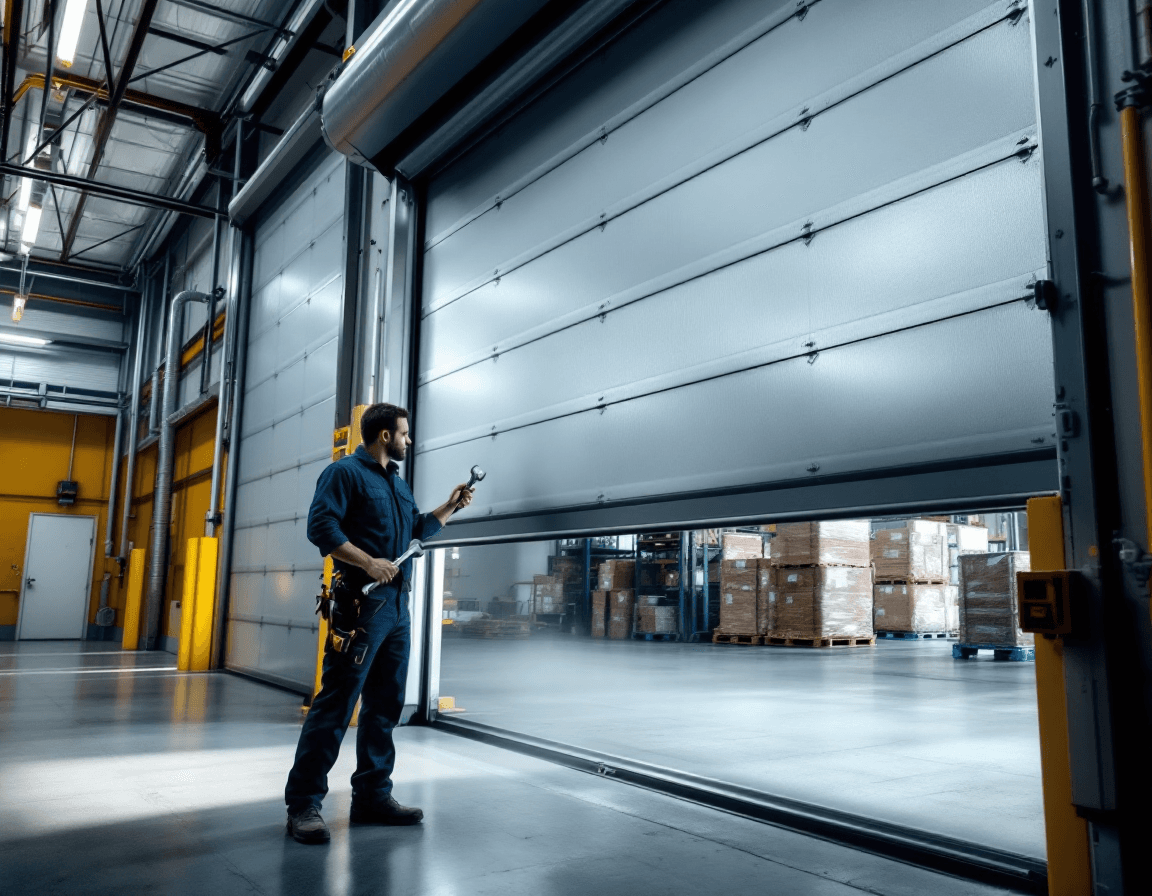
Commercial overhead door repair in Burien, WA is a different job from fixing a garage door at home. A warehouse, auto shop, or loading dock depends on its large doors to receive freight, move product, and keep staff moving, so a door that stops is a business problem before it is a mechanical one. Burien sits in a busy stretch of south King County, close to SeaTac Airport and the State Route 509 corridor, where freight, delivery vans, and contractor trucks move through the day. When a dock door or roll-up on a commercial building fails, the owner usually wants to know two things right away: how quickly a technician can get there, and what it will take to get the opening working safely again.
This page explains how we approach commercial door service for businesses in Burien and the surrounding neighborhoods, including Olde Burien, Three Tree Point, and Gregory Heights. We work on sectional overhead doors, rolling steel doors, commercial operators, and preventive maintenance programs, and we price each commercial job with a custom quote instead of a flat rate. The sections below walk through the most common problems we see, what causes them in the Pacific Northwest, and how we keep downtime as short as the repair allows. Our crews are licensed, bonded, and insured, and we serve businesses across the 98146, 98148, 98166, and 98168 ZIP codes.
Because commercial openings vary so much, no two service calls look exactly alike. A cold-storage dock in an industrial bay has different needs from a showroom with a single glass-front roll-up, and a restaurant's back-of-house door has different duty cycles from a fleet maintenance bay. We start by understanding how the door is used, how often it cycles, and what your operation can tolerate during a repair window. That context shapes the repair plan, the parts we bring, and the scheduling conversation we have with you.
Why a Stopped Dock Door Costs Burien Businesses More Than Repair Fees
When a loading-dock door refuses to open, the first cost is almost never the invoice from the technician. Trucks queue outside, staff are reassigned to manual handling, and orders that were scheduled for the morning slip into the afternoon. For a business near the airport corridor or along the main commercial routes, a single blocked dock can ripple into missed carrier windows and frustrated customers. Owners often try to limp along for a day or two before calling, which can turn a small adjustment into a larger failure.
The most useful thing a business can do in that first moment is to document what happened. Note whether the door made any sound, whether the operator hummed without moving the door, whether the door dropped suddenly or stopped partway, and whether anything changed right before the failure, such as a forklift contact or a power interruption. This information saves time on arrival and helps us decide whether the door can be safely run for a short period while we order parts. Please keep people clear of the opening and do not attempt to force a door that is binding, since that is how a repair becomes a replacement.
Downtime planning matters as much as diagnosis. We will tell you early whether the fix is a same-visit adjustment, a part that needs to be sourced, or a larger component such as a torsion system or drive that must be ordered. Clear expectations let you decide whether to stage deliveries differently, shift shipments to another door, or post a temporary notice for drivers. Our goal is to restore the opening in the shortest safe time, and to be honest with you when a timeline depends on parts that are still in transit.
Sectional Overhead Doors on Burien Loading Docks
Sectional doors are the workhorse of many Burien warehouses and light industrial buildings. They are made of horizontal panels that travel up a track and stack overhead, and they are usually run by a torsion spring system and a chain, belt, or jackshaft operator. On a loading dock, these doors take constant abuse from dock levelers, trailer bumpers, and the daily rhythm of pallet traffic, so wear tends to show up in predictable places. Rollers, hinges, track alignment, weather seals, and bottom brackets all work hard, and when one of them loosens, the others feel the strain.
Common symptoms include a door that rises unevenly, a panel that sits crooked in the track, a rattling sound at the top of travel, or a gap at the bottom that lets in rain and debris. In the Puget Sound lowlands, moisture also gets into hardware and wood or composite stiles, which can swell or stiffen and make the door bind in cool, damp months. We inspect the track radius, the vertical and horizontal runs, the seals, and the balance of the door before we decide what needs adjustment. Torsion springs are under very high tension, and any spring work is performed only by our trained technicians with the proper equipment and safety procedures.
Here are the sectional-door checks we usually perform during a commercial visit:
- Track alignment, including level, plumb, and the transition from vertical to horizontal runs
- Roller condition, hinge tightness, and any cracked or bent panel brackets
- Balance test with the door partially open, to confirm the springs are carrying the load
- Bottom weather seal, astragal, and perimeter seals for drafts and pest entry
- Operator limit settings, safety reversal sensors, and photo eyes on the dock side
- Cable condition and drum alignment on systems that use lift cables
Adjusting a sectional door without addressing the underlying cause often leads to repeat calls. If a track has shifted because a forklift nudged it, aligning the panels alone will not keep the door square for long. We correct the track, verify the balance, and then set the operator so the door reverses reliably if it meets an obstruction. That sequence protects both the equipment and the people working near the opening.
Rolling Steel Doors That Jam or Drift Off Track
Rolling steel doors are common on storefronts, service bays, and secured industrial openings in Burien. They are built from interlocking slats that coil into a hood above the opening, and they tend to be used in situations where space is tight or where security and fire ratings matter. Because the slats run inside guides, a small problem can become a jam quickly. Debris, a bent slat, a loose endlock, or a guide that has pulled away from the wall can all stop the curtain in its tracks.
Rolling doors in our service area often drift off track after repeated impacts or after someone tries to force the curtain manually. The first sign may be a slight scrape or a bulge at one side, followed by a curtain that rises unevenly and then binds. Continuing to run the door in that condition can bend additional slats, damage the coil, or strip the drive. We check the guides, the bottom bar, the endlocks, the coil alignment, and the condition of each slat before we attempt to bring the curtain back into the guides. Where a slat is badly bent, we will discuss sectional replacement so the door is not left under strain.
Because rolling doors are often used for security, we also pay attention to lock hardware, padlock hasps, and the connection between the door and any electric operator. Many businesses in the area close their bays at night and need the curtain to lock down reliably, so we verify the locking points and the bottom bar seal as part of the repair. If the door has a manual chain or crank, we confirm that it still engages properly, since an emergency release that does not work is a serious safety concern. Rolling doors that have been in service for many years may also show corrosion at the guides or hood, and we will note that for future planning.
Commercial Operators and Control Failures
The operator is the motor and control system that moves a commercial door, and when it fails, the door often seems to fail with it. Commercial operators differ from residential models in their duty rating, their torque, and their integration with access control, safety edges, and external push-button or key switches. A failure might come from a blown control board, a worn gear set, a tripped thermal overload, a loose limit switch, or a wiring fault in a conduit run that has taken moisture over the years. Careful diagnosis keeps us from replacing parts that were never the problem.
Start by checking what the operator does when you press the control. Does it hum, click, run without moving the door, or not respond at all? Note whether the problem happens in one direction only, whether the door stops at the same height each time, and whether a safety sensor light is on or blinking. If the building lost power during a storm, the operator may need a reset or an emergency release procedure, and we will walk you through any safe steps before we arrive. Please do not open control panels or work inside the operator housing unless you are qualified, since the electrical hazards are real.
Our technicians test the limit settings, the safety reversing edge, the photo eyes, and the control logic, then compare the results against the manufacturer's specifications for the specific model. When a motor or drive is worn out, we will quote the replacement and explain the expected service life, so you can plan the budget. When the failure is a sensor or wiring issue, we often resolve it in a single visit. Either way, we confirm that the door reverses correctly before we leave, because an operator that cannot detect an obstruction is a hazard to anyone on the dock.
When the Door Is Simply Too Slow for the Shift
Not every commercial door problem is a breakdown. Sometimes the door works, but it is too slow to support the way your business runs. A bay that opens at a crawl can turn a fast delivery schedule into a bottleneck, and a dock door that takes too long to cycle can add minutes to every truck. Over a busy week, those minutes add up. Owners often tolerate a slow door for months before they realize how much throughput is being lost, especially in operations that run multiple shifts or handle frequent small deliveries.
Speed problems usually come from a combination of factors rather than one component. An operator may be undersized for the door's weight, the track may have friction from debris or misalignment, the springs may be worn or unbalanced, or the controls may have soft-start and slow-speed settings that were left at the factory default. We measure cycle time, observe the door under load, and check the balance and track condition before recommending a change. In some cases, a few adjustments restore reasonable speed. In others, an operator upgrade or a different door speed package makes sense.
We are careful with speed upgrades because faster movement changes the stresses on the door and the safety margins for people nearby. Any change to operating speed must be paired with a check of the safety reversal system, the sensor placement, and the stop points. We will explain the trade-offs in plain language, including noise, wear, and the expected lifespan of any new components. Our aim is a door that meets your throughput needs while staying within the manufacturer's safe operating range.
Forklift Strikes and Damaged Sections: Assessing the Hit
Forklift impact is one of the most common causes of commercial door damage in warehouses and service yards. A pallet that swings too wide, a load that clips the bottom bar, or a driver backing up without a clear view can bend tracks, crack panels, and knock a door out of balance in seconds. In Burien's industrial and retail areas, where traffic and loading happen in tight spaces, these incidents are routine enough that many facilities have a plan for them. The challenge is knowing how much damage occurred, because the visible dent is often only part of the story.
After an impact, we look beyond the obvious damage. We check whether the track has shifted at the wall anchors, whether the header bracket has bent, whether the spring tension has changed, and whether any panels or slats have cracked at the hinges or endlocks. A door that looks fine from the outside can still be out of square and placing uneven loads on the operator. Continuing to run it can turn a single damaged panel into a failed roller or a broken spring. We recommend that the door be inspected before it is used at full cycle, especially if the impact involved the track or the springs.
Replacement decisions depend on the age of the door, the availability of matching sections, and the condition of the surrounding hardware. A single damaged panel on a newer sectional door may be replaced without changing the rest of the system. On an older door, matching panels may be harder to source, and a full evaluation of the track, springs, and operator may be the better investment. We provide written findings and photos as part of a commercial estimate so your insurance carrier, property manager, or accounting team has a clear record of what was damaged and what was repaired.
Here is what we document after a forklift strike, to support both the repair and any claim:
- Date, time, and a short description of the event, as reported by the operator or site staff
- Photos of the track, panels, bottom bar, and header before any repairs
- Measurements of track alignment and any shifted anchors
- Spring and balance condition, including any visible wear or cracking
- A list of damaged parts, with recommended repairs and estimated timelines
Marine Air, Winter Rain, and Corrosion Near the Sound
Burien's location close to Puget Sound brings a set of conditions that affect commercial doors in ways that are easy to underestimate. Salt-laden marine air, frequent rain, and damp winter weather speed up corrosion on steel tracks, brackets, hinges, and fasteners. Doors that sit near the water, or that face prevailing wind off the Sound, may show rust streaks and pitting sooner than doors inland. Even buildings a few miles from the shoreline experience cool, humid months where moisture lingers on metal surfaces and lubricants wash away.
Corrosion matters because it changes how a door moves. A rusted roller bearing becomes stiff, a corroded hinge loosens, and a rusty track can add friction that strains the operator. Winter condensation can also freeze in tracks during cold snaps, making the door bind or stop until the ice clears. We recommend regular cleaning, proper lubrication with products suited to the door type, and inspection of weather seals, since a failed seal lets water and debris reach the mechanical components. On rolling steel doors, moisture trapped in the hood or guides is a frequent cause of premature wear.
Planning for the Pacific Northwest climate is a practical advantage. A maintenance schedule that accounts for the wet season, with a check in late summer before the rainy months and another after the first hard freeze, can catch problems while they are small. We also look at drainage around the opening, since standing water at the threshold can rot wood framing and corrode the bottom brackets. These conditions are not unique to Burien, but the combination of coastal humidity and heavy winter rain means that routine attention pays off here.
How We Scope and Price a Commercial Repair
Commercial pricing is customized because no two commercial openings share the same mix of door type, operator, safety devices, and access requirements. A simple sectional-door adjustment at a single bay is a very different job from a multi-door dock repair that includes a new operator, a retrofitted safety edge, and spring replacement. We do not publish a flat rate for commercial work, because a flat rate would either overcharge simple jobs or underprice complex ones. Instead, we provide a custom quote based on what we find and what the repair requires.
The scoping process begins with a site visit or detailed phone assessment. We ask about the door make and model if you have it, the age of the system, the symptoms you are seeing, the hours the opening is used, and any deadlines that affect scheduling. On arrival, we inspect the door, test the operator, check the safety devices, and identify the parts needed. Where the repair is straightforward, we can often complete it on the same visit. Where parts must be ordered, we will explain the timeline and provide a written quote that separates labor, parts, and any optional upgrades.
Fast turnaround is a priority for commercial clients because downtime costs money. We focus on getting technicians on site as quickly as our schedule allows, carrying common parts where possible, and coordinating with suppliers when specialty components are needed. We will tell you honestly when a repair depends on an order that has not arrived, and we will suggest interim measures to keep the operation moving safely. Our quotes are written so that your property manager, owner, or accounting team can review them without needing technical language.
Preventive Maintenance Agreements That Fit a Burien Schedule
A preventive maintenance agreement is the most effective way to reduce emergency calls on commercial doors. Instead of waiting for a dock door to fail during a busy shipment, a scheduled program checks the critical components on a regular cycle and corrects small problems before they become shutdowns. For businesses in Burien, where seasonal rain, heavy use, and nearby traffic all take a toll, a structured plan can keep the fleet of doors on a predictable track. The right frequency depends on how many cycles your doors run each day and how exposed they are to weather and impact.
A typical agreement covers inspection, lubrication, adjustment, and documentation. We check the springs, cables or chains, rollers, hinges, tracks, seals, and operator settings, then record the condition of each door so trends are visible over time. Over several visits, the records can show which doors are wearing faster, which need closer attention, and when components are approaching the end of their service life. That information helps you budget for replacements instead of reacting to surprise failures. Agreements can be tailored to cover a single facility or multiple locations across the region.
We recommend an agreement that includes the following elements, adjusted to your operation:
- Scheduled inspections timed before the rainy season and after the first hard freeze
- Lubrication and adjustment of rollers, hinges, and tracks using products suited to each door type
- Safety testing of reversing edges, photo eyes, and operator stop settings
- Written condition reports with photos and recommended repairs, prioritized by urgency
- Priority scheduling for breakdowns covered by the agreement, so emergency calls move up the queue
Maintenance agreements also support safety compliance and internal policies. Many facilities need documented inspections for insurance, property management, or internal safety programs, and a regular schedule makes that paperwork straightforward. Because we handle the scheduling and the records, your team can focus on operations rather than tracking when each door was last checked.
Safety Lines We Hold on Heavy Commercial Doors
Commercial doors are heavy, under high spring tension, and often operated near forklifts, trucks, and foot traffic. Those conditions make safety a non-negotiable part of every job. We follow strict procedures for torsion spring work, cable systems, and any repair that requires releasing or loading the door's stored energy. Spring and cable work is performed only by licensed, trained technicians with the correct tools, and we will never ask a business owner or staff member to attempt it. If you have a broken spring, a slipped cable, or a door that has dropped, keep everyone clear of the opening and call a professional.
Lockout and tagout practices matter during repairs, especially on doors connected to electrical operators. Before work begins, we isolate power, verify that the operator cannot energize unexpectedly, and communicate with site staff about who is working on the door and where. We also test the safety reversal system and the sensor alignment before returning a door to service, because a door that passes a mechanical check but fails to detect a person or vehicle is still hazardous. If a door is not safe to operate, we will tell you clearly and recommend keeping it out of service until the repair is complete.
Business owners can help by reporting unusual behavior early, keeping the area around the door clear, and making sure staff know how to use emergency releases without attempting repairs. Training forklift operators to maintain safe clearance from the opening reduces impact damage, and posting a simple procedure for reporting a stuck door saves time. We are glad to walk through a site and suggest practical steps that fit your operation.
Commercial door trouble in Burien rarely waits for a convenient time, and the sooner a qualified crew sees the problem, the less it costs in lost hours and extra damage. Whether your loading-dock door has stopped, a rolling steel curtain is off track, an operator has failed, or you want a preventive maintenance plan to keep everything running, call Seattle Garage Door Fix at (888) 799-3819 to describe what you are seeing and request a custom commercial quote. Our licensed, bonded, and insured technicians serve Burien, Olde Burien, Three Tree Point, Gregory Heights, and surrounding neighborhoods across the 98146, 98148, 98166, and 98168 ZIP codes.