
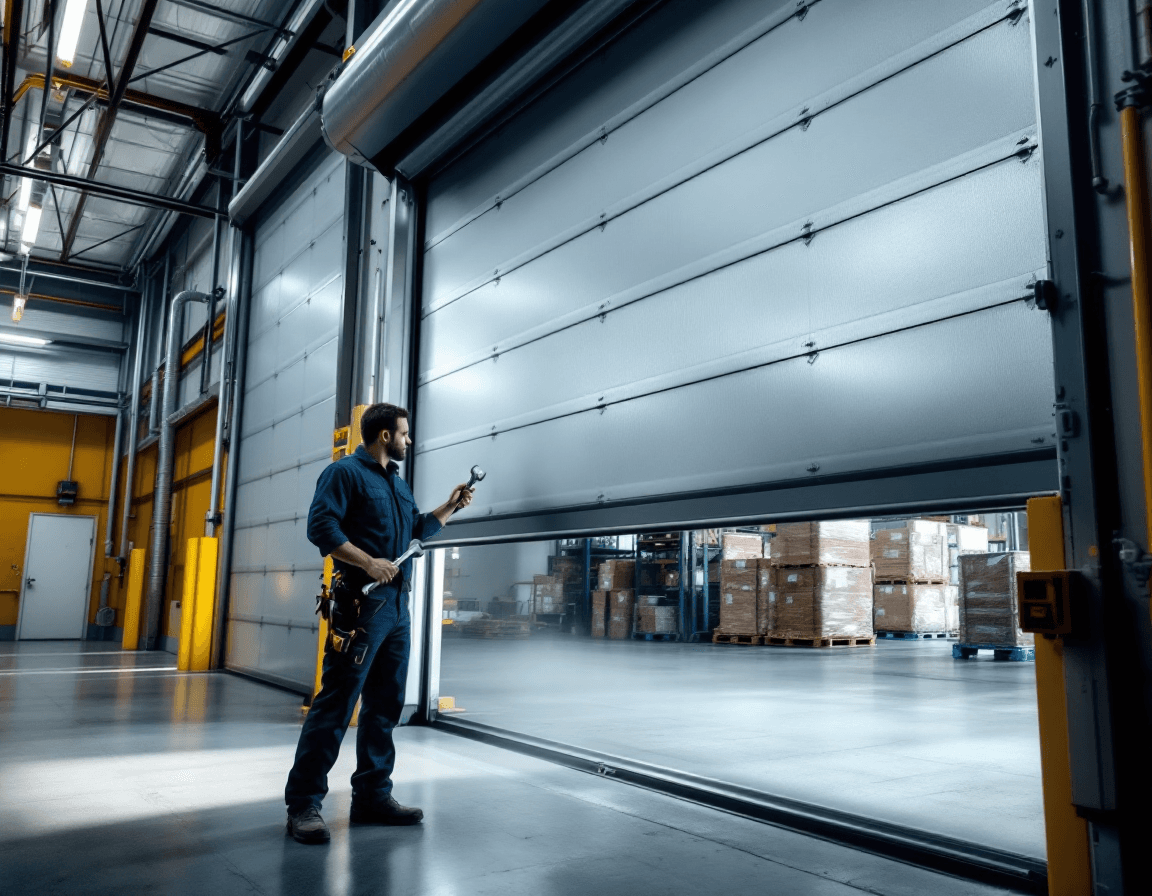
Commercial Overhead Door Repair in Des Moines, WA is one of the most time-sensitive jobs we handle, because a stalled loading door can stop trucks, pause production, and leave a crew standing around. Des Moines sits on the Puget Sound shoreline in south King County, where businesses along the Pacific Highway South corridor, the light industrial pockets near the airport, and the waterfront-adjacent blocks all depend on overhead doors that open and close dozens of times a day. When one of those doors fails, the cost shows up in missed deliveries and idle staff long before it shows up on an invoice.
Our commercial crew works on sectional overhead doors, rolling steel doors, dock-leveler-adjacent door hardware, and the operators that drive them. We see the full range of what local facilities run, from small shop bays and fulfillment spaces to larger warehouse openings with heavy traffic. Every commercial job starts with a site assessment, a clear explanation of what is failing and why, and a custom quote built around the door, the duty cycle, and how quickly you need it back in service. We are a licensed, bonded, and insured contractor, and we treat commercial work with the same safety discipline we apply to every spring and cable task.
If your dock is down right now, or if you want to get ahead of the next breakdown, this page explains what typically goes wrong with commercial doors in Des Moines, how we diagnose it, how we keep turnaround short, and how a preventive maintenance agreement can keep your openings predictable. Call (888) 799-3819 to talk to a dispatcher about your site.
Why Puget Sound Air Wears Down Commercial Door Hardware
The Des Moines climate is mild by national standards, but it is hard on steel and moving parts. Long wet stretches from fall through spring keep door hardware damp for weeks at a time, and that moisture gets into hinges, roller stems, bearing races, and the bottom seals of doors that rarely see direct sun. Facilities close to the water feel the effect more strongly, because salt-laden marine air settles on exposed steel and speeds up surface corrosion. Woodmont and the shoreline stretches of Redondo see this kind of exposure, and so do businesses near the Des Moines Marina where salt spray carries inland on onshore winds.
Those conditions do not usually cause a sudden failure. Instead, they produce slow changes that a trained eye can catch early: a roller that rotates with a faint grind, a track with a rust bloom at the lower bends, a bottom weatherstrip that has gone brittle and stiff. Left alone, those changes add friction and uneven loads, which then stress the operator and the springs. A door that worked fine last November may start binding in February simply because the lubricant washed out during the wettest weeks of the year.
Local temperature swings add another layer. A typical Puget Sound winter brings cool, damp mornings and warm afternoons on the rare sunny days, and that cycle makes metal contract and expand. Tracks that were square in summer can shift slightly, and fasteners that were snug can loosen. We account for this when we inspect a commercial opening, because a door that appears fine during a midday visit may behave differently at the start of a cold shift.
Reading the Warning Signs Before a Dock Goes Dark
Most commercial door emergencies are preceded by signs that the crew noticed but did not treat as urgent. The earlier you catch them, the cheaper and faster the repair tends to be, and the less likely a breakdown will land in the middle of a peak delivery window. Watch for changes in sound, speed, and alignment rather than waiting for a complete stop. A door that is slowing down or taking longer to open is usually telling you something specific.
Here are the signs our technicians most often hear about from facility managers and shift leads in the Des Moines area:
- The door opens noticeably slower than it did a month ago, or it stops partway and has to be reset.
- A grinding, popping, or chattering noise appears during travel, especially near the top or bottom of the track.
- The door rides crooked, with one side lagging or a panel visibly out of line with its neighbors.
- The operator hums, clicks, or cuts out under load, or it trips its thermal protection after several cycles.
- Photo-eye or safety-edge indicators flicker, or the door reverses for no obvious reason.
- Daylight shows around the perimeter seal or under the bottom panel after the door closes.
Any one of these is worth a call. A combination of two or three usually means the door is under stress that will not resolve on its own. Write down when the symptom started, what the door was doing at the time, and whether the problem appears in the morning, under heavy use, or during specific weather. That information speeds up diagnosis considerably when a technician arrives on site.
Sectional Overhead Doors on High-Traffic Floors
Sectional commercial doors are built from insulated or non-insulated panels joined by hinges and guided up a track system on rollers. In a warehouse or loading dock, those panels take a steady beating from pallet jacks, trailers backing in, and the constant cycle of open and close. The panels themselves are rarely the first thing to go, but the hinges, rollers, track brackets, and end-of-track alignment all wear over time. When one of those parts starts to fail, the door may still move, yet it will move unevenly and place extra load on its neighbors.
Our diagnostic process begins with a check of track alignment at the header, the vertical run, and the horizontal run, because even a small misalignment will push rollers against the track face and generate heat and noise. We then inspect each hinge and roller for play, cracks, or deformation, and we look at how the panels seat against one another when the door is closed. In many cases, replacing a worn roller set and resetting the track restores smooth operation without touching the panels. When a panel is bent or cracked beyond a usable shape, we discuss replacement sections, matching profile, and whether the existing hardware can accept a new panel without modification.
Sectional doors also depend on their counterbalance system to move smoothly. Torsion springs and their drums carry most of the door's weight, so any adjustment or replacement in that system is a licensed-professional task. We will explain what we find, what the spring load and cycle rating mean for your operation, and what we recommend, but we do not treat spring or cable work as a do-it-yourself item for a commercial facility. Heavy doors can cause severe injuries when a spring or cable fails under tension.
Rolling Steel Doors That Jam, Drift, or Ride Off Track
Rolling steel doors are common in Des Moines storefronts, service bays, and industrial spaces where a compact, high-security opening is needed and there is little room overhead for a sectional track. Instead of hinged panels, these doors use interlocking steel slats that wind onto a barrel above the opening. Because the curtain is continuous and the guides run closely along both sides, a small obstruction or uneven tension can cause the slats to jam or the curtain to slip out of its guide channel.
A rolling steel door that jams often has one of a few causes. Debris, grit, or a small piece of forklift-displaced material can lodge in the guide channel. A bent or twisted slat can catch on the guide and bind the curtain as it travels. Worn or damaged bottom bars can allow the curtain to pull sideways, and a barrel that has slipped on its shaft can change tension so that one side drags. We clear, straighten, or replace components as needed, and we check the lock and the bottom bar hardware for signs of stress that could make the problem return.
When a rolling steel door has come off its track, it is important not to force it back by hand or with tools that could cause the curtain to drop. The curtain's weight and the spring tension on the barrel can produce sudden movement, and a crew member who attempts an uncontrolled reset can be hurt. We secure the opening, assess the curtain and guides, and perform the reset under controlled conditions. If the springs or barrel show damage, that work also stays with our licensed technicians.
Commercial Operators That Stall, Overheat, or Quit Mid-Shift
The operator is the motor and control system that opens and closes a commercial door, and when it fails, the door becomes an immovable barrier. Commercial operators are typically rated for a specific duty cycle, which describes how often they can run within a set period before they need to cool down. A busy dock that runs the door far more often than the rated cycle will overheat the operator, and the thermal protection will shut it down to prevent damage. Some facilities learn about this the hard way during their busiest hour.
Our operator service begins with the control circuit. We check the wall station, the safety devices such as photo eyes and safety edges, the limit settings that tell the door where to stop, and the wiring connections, which can corrode in damp conditions near the water. Many operator complaints trace back to a sensor that is misaligned or obscured by dust, a limit setting that drifted, or a loose terminal that makes the controller believe a safety input has tripped. Those issues are usually quick to correct once they are found.
When the motor itself is at fault, the question becomes whether repair or replacement makes more sense. We look at the operator's age, the frequency of past failures, the availability of compatible parts, and how the replacement would affect your duty cycle and power requirements. For facilities with heavy throughput, a properly sized operator that matches the door weight and cycle count can be a more reliable choice than repeatedly patching an undersized unit. We will explain the trade-offs clearly and provide a written custom quote.
Forklift Strikes and Damaged Sections: Triage and Replacement
Forklift impact is one of the most common causes of damage to commercial doors, and it is also one of the most preventable. A pallet that catches the bottom panel, a load that swings into the frame, or a driver who misjudges the opening can crack panels, bend tracks, and knock hinges out of alignment in a single incident. Even a minor strike can leave a panel slightly out of plane, and that small deformation can cause the door to bind every time it cycles.
When damage happens, the first step is to make the opening safe. We recommend keeping the door closed or secured if it is not operating smoothly, and restricting traffic through the opening until a technician has assessed it. Once on site, we inspect the damaged section, the adjacent sections, the track, the hinges, and the bottom seal, because a single strike often affects more than the panel that was hit. We document what we find so your facility has a clear record for insurance or internal review if needed.
Replacement is often more practical than repair for severely deformed panels, but the match matters. Commercial door panels come in specific profiles, insulation types, and hardware configurations, and a replacement section must fit the existing track and hinge spacing. We check the manufacturer and profile where possible and confirm the panel dimensions before we order. For a fast turnaround, we discuss whether a temporary measure, such as a secured partial opening, can keep operations moving while the replacement part is sourced.
When the Door Works but Throughput Suffers
Not every commercial door complaint involves a breakdown. Sometimes the door opens and closes without error, yet trucks wait longer than they should, staff hesitate at the threshold, or the opening feels sluggish compared with how it performed a year ago. That gap between working and performing well is often a throughput problem, and it deserves its own attention because it can quietly erode productivity across an entire shift.
Throughput issues usually come from a few sources. The operator may be set to a slower travel speed than the facility needs, or its soft-start and soft-stop settings may have been adjusted for safety without considering the actual traffic pattern. Track friction, worn rollers, or an out-of-level header can add resistance that makes the door labor through its cycle. Photo eyes that are slightly out of alignment can cause unnecessary pauses or reversals, which look like hesitation to the people waiting on the other side.
We approach throughput as a measurable problem. We time the door's full open and close cycle, note any pauses or reversals, and compare the result against what the operator and door are rated to deliver. Then we adjust limits, speeds, and sensor alignment where appropriate and recommend hardware updates only if they will make a measurable difference. The goal is to keep your door moving at the pace your business requires without pushing the equipment beyond what it was designed to handle.
Spring and Cable Work Stays With Licensed Professionals
Torsion springs and lift cables are the heart of a commercial door's counterbalance, and they store a significant amount of energy. A spring under tension can release suddenly if it breaks, and a cable that snaps can whip with enough force to cause serious injury. For this reason, we treat every spring and cable repair as licensed-professional work, regardless of how experienced the facility's maintenance staff may be. Our technicians carry the right tools, follow established safety procedures, and know how to secure a door before work begins.
Facility managers sometimes ask whether they can replace a spring themselves to save time or money. Our answer is consistently no. Even small mistakes in winding, bracing, or cable seating can cause a spring to fail during the replacement itself, and commercial doors are heavier and more highly loaded than most residential units. A quick fix that goes wrong can close a dock for days and create a safety liability that costs far more than a properly scheduled repair.
If your door shows signs of spring or cable trouble, such as a door that will not stay open, one side that sags, a visibly gapped coil, or a cable that appears frayed, stop using the door and call us. We will secure the opening, confirm the cause, and provide a written quote that includes the parts, labor, and any related hardware checks. Doing it right the first time is the fastest way to get the door back in service and keep your crew safe.
Preventive Maintenance Agreements Built Around Your Hours
A preventive maintenance agreement is the most practical way to keep commercial doors predictable. Instead of reacting to breakdowns, a scheduled program lets us catch wear, adjust alignment, lubricate moving parts, and test safety devices before they cause a shutdown. For facilities in Des Moines, where moisture and salt air accelerate corrosion, a regular schedule can be especially valuable because it addresses problems during the drier months and before the wettest stretch of the year.
A good agreement is built around how your facility actually operates. We ask about your hours, peak delivery windows, number of doors, door types, and any seasonal surges, and then we schedule visits that minimize disruption. Maintenance visits can be arranged outside production hours where possible, and we document each visit so your team has a clear history of the doors, the parts replaced, and the items to watch. Here is what a typical preventive visit may include:
- Track inspection, alignment check, and fastener tightening at the header, vertical run, and horizontal run.
- Lubrication of hinges, rollers, bearings, and moving connections using products suited to outdoor and marine-adjacent conditions.
- Testing of photo eyes, safety edges, reversing functions, and emergency release mechanisms.
- Operator check covering limit settings, control wiring, thermal behavior under load, and duty cycle review.
- Inspection of bottom seals, weatherstripping, and panel condition, with notes on any forklift-related damage.
- Spring and cable visual inspection, with any repair work recommended and scheduled through our licensed crew.
Agreements can be tailored for a single loading dock or for multiple openings across a larger site. We will recommend a visit frequency based on cycle count, door age, and exposure, and we will adjust that frequency as the data from each visit shows what your doors need.
What Shapes a Custom Commercial Quote
Commercial door pricing depends on far more than a single line item, which is why we provide custom quotes rather than flat rates. The door type, size, weight, panel profile, operator model, and access conditions all affect the scope of work and the parts required. A rolling steel curtain on a narrow service bay is a different job from a multi-section sectional door on a wide dock, and a dock that can be taken offline during a quiet morning is different from one that must reopen before a delivery window closes.
Turnaround is shaped by parts availability and site access as much as by technician schedules. When we can identify the door model, the panel profile, and the operator specifications early, we can source components faster and reduce the time the opening stays closed. For urgent situations, we discuss temporary measures that keep traffic moving safely while the permanent repair is completed. We also explain which items must be addressed immediately, which can be scheduled for a planned window, and which are simply good to address during the next maintenance visit.
Every quote we provide is written and itemized so you can compare options and plan your budget. We will identify what is required for safe operation, what will improve performance, and what is optional. Our goal is to give Des Moines businesses a clear picture of the work, the timing, and the reasons behind each recommendation, so that the decision to repair, replace, or maintain your doors is based on facts rather than guesswork.
Your loading doors and rolling steel openings are critical to how your business moves, and they deserve a team that can respond quickly and work safely. Whether your dock is down right now or you want to set up a preventive maintenance agreement before the next wet season, call Seattle Garage Door Fix at (888) 799-3819 to schedule a commercial assessment in Des Moines, including the Woodmont, Redondo, and Des Moines Marina areas, and the 98198 ZIP code.