
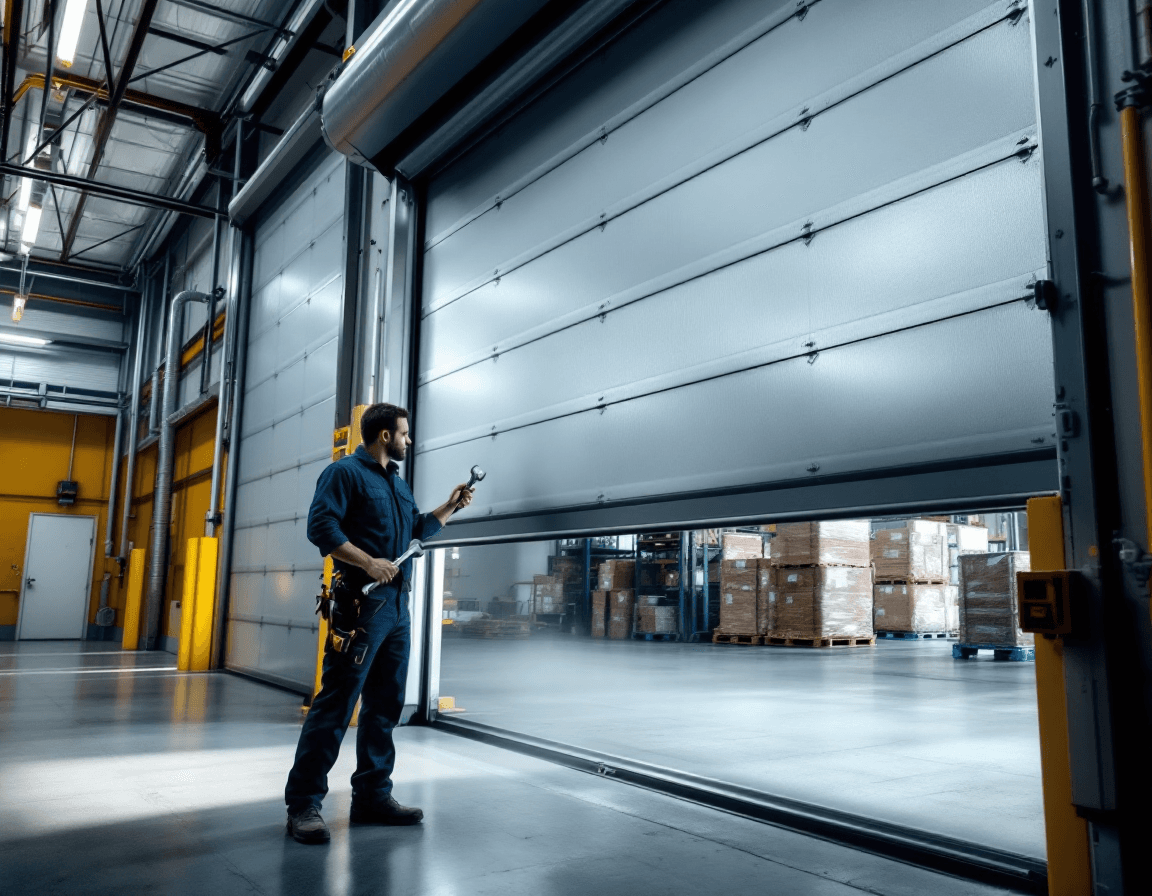
Commercial overhead door repair in Hunts Point, WA keeps a small town's businesses, marinas, and property managers moving, and it demands a different approach than a typical residential callout. Hunts Point is a quiet waterfront community on the east shore of Lake Washington, so most of its doors are residential, but the surrounding business corridors, boat storage yards, service garages, and light warehouse spaces across the lake's east side depend on sectional and rolling steel doors that open reliably every single day. When one of those doors stops, the cost shows up quickly in missed deliveries, idle staff, and frustrated customers.
Seattle Garage Door Fix provides licensed, bonded, and insured commercial door service for property owners and facility managers in Hunts Point and throughout the greater Seattle and Western Washington area, including the 98004 ZIP code. Our technicians work on sectional overhead doors, rolling steel doors, commercial operators, and preventive maintenance programs. We know that a loading-dock door is not just a piece of hardware; it is the entry point for your inventory, your customers, and your revenue. This page explains how we approach commercial door problems, what local conditions influence them, and how we price and schedule work so you can get back to business.
Every commercial job starts with a practical question: how quickly does this door need to work again, and what is the safest way to make that happen? Some failures can be stabilized the same day with a temporary fix, while others require parts that must be ordered and fitted. We will tell you which situation you are in before any work begins. The rest of this guide walks through the most common problems we see, the local factors that affect them, and the options available for keeping your doors dependable over the long term.
Why a Stalled Dock Door Costs More Than the Repair Invoice
When a loading-dock door refuses to open, the repair invoice is usually the smallest number on the list. A delivery truck may wait in the lot, a crew may stand idle, or an entire shipment may be rerouted to a different facility. For a business operating on tight receiving windows, even a half-day outage can ripple through scheduling, labor planning, and customer commitments. That is why we treat commercial door calls as time-sensitive work rather than routine service.
Before we arrive, we usually ask a few targeted questions over the phone. Is the door stuck open, stuck closed, or moving but slow? Is the operator making a sound, flashing a light, or not responding at all? Are there visible gaps, bent tracks, or damaged panels? Those answers help us bring the right parts and tools on the first visit, which is often the biggest factor in shortening downtime.
We also recognize that many commercial properties in this part of King County operate on shared access, with tenants, neighbors, and delivery partners depending on the same entry points. Our goal is to restore safe function quickly and then document what we found, so you can plan the permanent fix on your own schedule. A door that works today but has an unresolved cable or spring problem is still a risk, and we will be direct about that distinction.
Lake Air, Moisture, and What It Does to Commercial Steel
Hunts Point sits beside Lake Washington, and that waterfront setting shapes how commercial doors age. Moist air off the lake, combined with the long gray stretches typical of Western Washington winters, creates persistent humidity that settles on steel surfaces, hinges, and roller assemblies. Over time, that moisture encourages surface rust on exposed tracks, pitting on bottom brackets, and corrosion on fasteners that were never meant to sit in damp conditions for months at a time. Doors that are only a few years old can show these signs sooner than expected if they lack protective coatings.
Temperature swings add another layer of stress. Cool, wet mornings followed by warmer afternoons can cause metal to expand and contract, which gradually loosens bolts and changes how panels sit within their tracks. We often find sections that were installed square but have developed slight twists, causing the door to bind at one side of the track. Lubricant that works well in summer can turn sticky or wash away during the rainy season, leaving rollers and hinges to grind against dry metal.
Our technicians account for these conditions during every inspection. We check for surface corrosion, confirm that drainage at the bottom of the track is clear, examine weatherstripping for cracks that let moisture in, and look at the condition of fasteners where they meet the frame. When we recommend coatings, lubricants, or replacement hardware, we explain why those choices suit the local environment. The aim is to give your door a realistic chance of surviving the wet months without premature wear.
When a Sectional Door Goes Down at the Loading Dock
Sectional overhead doors are the workhorses of most commercial loading docks, and when one goes down, the cause is often traceable to a short list of components. Worn or broken rollers can let a section jump its track. Bent track sections create pinch points that stop the door mid-travel. A failed torsion spring or cable can leave the door heavy and unbalanced, making it impossible for the operator to lift it smoothly. Each of these problems has a distinct appearance, and identifying the right one is the first step toward a durable repair.
We begin with a visual walkthrough of the door from both the interior and exterior, checking track alignment, roller condition, hinge integrity, and the position of the bottom seal. We then operate the door manually and with the operator to observe how it behaves under load. Any sound of grinding, popping, or shuddering gives us clues about where to look next. If the door is off track, we determine whether the track can be realigned in place or whether damaged sections need replacement.
Common symptoms we see at Hunts Point–area docks include:
- Door stops partway up or down and will not reverse cleanly
- One side rises or lowers faster than the other, indicating track or cable imbalance
- Rollers squeal, bind, or pop out of the track during operation
- Visible gaps between sections or a bottom seal that no longer contacts the floor
- Operator runs but the door does not move, or moves only after repeated attempts
Spring and cable work carries serious risk because the tension stored in those components can cause severe injury if mishandled. Our technicians follow strict procedures for any repair involving springs, and we always recommend that spring replacement be performed by trained, licensed professionals. We will explain exactly what needs attention and why, so you can make an informed decision.
Rolling Steel Doors That Bind, Derail, or Stop Tracking
Rolling steel doors are common on warehouses, service bays, and storage buildings where space is limited and durability matters more than appearance. Instead of sections that hinge and roll along a horizontal track, these doors use interlocking steel slats that coil into a barrel above the opening. That design handles heavy use well, but it also means a small problem in the guides or curtain can quickly become a jam. When a rolling steel door binds or jumps off its guide rails, the whole assembly can be strained if someone keeps forcing it.
Our first priority with a jammed rolling door is to stop any further operation that could bend slats or damage the barrel. We inspect the guide channels on each side for debris, dents, and misalignment. Lake-area grit, leaf litter, and wind-blown material can settle into guides and interfere with smooth travel. We also check the bottom bar, locking hardware, and any slats that show visible deformation from impacts. In many cases, cleaning and realigning the guides restores normal operation without replacing the curtain.
When slats are bent or the curtain has lost its shape, a partial replacement is often more practical than a full new door. We will show you which slats are affected, what part numbers or profiles are needed, and how long the work typically takes. Because rolling steel doors can be heavy and under tension in certain configurations, we handle the disassembly and reassembly carefully and recommend against owner-performed repairs on the barrel or spring assemblies.
Commercial Operators: Diagnosing Motors, Limits, and Controls
A commercial operator is the motor and control system that lifts and lowers the door, and when it fails, the door may appear to be the problem even though the operator is at fault. Common issues include a worn drive chain or belt, a failed motor capacitor, a tripped safety reversing sensor, a misadjusted limit switch, or a control panel that has lost power or communication. Because commercial installations often include multiple control stations, keypads, and integrations with building systems, troubleshooting requires a methodical approach.
We begin by checking the power supply, breakers, and disconnects serving the operator, then verify that the control station is sending signals correctly. Photo-eye sensors and edge sensors are examined for alignment, dirt, and damaged wiring, since a dirty lens or a partially cut cable can make the operator act as though the door is obstructed. We also confirm limit settings so the door stops at the correct open and closed positions. If the operator is hesitating or stopping early, we check whether the mechanical load has changed due to track or spring issues.
Operator failures that are not caused by electrical faults can sometimes be traced to mechanical wear. Chains stretch, bearings dry out, and sprockets lose their teeth over time. We will tell you whether the operator can be repaired, whether a component upgrade is appropriate, or whether replacement makes more sense given the age of the unit and the parts availability. Our quotes always separate diagnostic time from parts and labor so you can see exactly what you are approving.
Forklift Impacts and Damaged Sections: Triage Before Replacement
Forklift traffic is one of the most frequent causes of commercial door damage, particularly on docks where pallets are staged close to the opening or where driver visibility is limited. A single collision can crack a section panel, bend a track, pull a hinge out of its mounting, or knock a roller out of alignment. The damage is not always immediately obvious, and a door that appears to function may still have compromised components that will fail under normal use.
After an impact, we recommend that the door be taken out of regular service until it has been inspected. We look at the affected section and its neighbors, the track curve and straight runs, the header and jamb connections, and the operator's mounting points. Sometimes a section can be replaced individually without disturbing the rest of the door, which keeps costs and downtime down. In other cases, the frame or track has shifted enough that a broader realignment is required before any new section will fit properly.
Prevention matters as much as repair. Bollards, impact guards, painted floor markings, and better lighting near the door opening can reduce the likelihood of future strikes. We can discuss those options during a site visit and recommend changes that suit your traffic pattern. Keeping a record of incidents also helps you see whether certain shifts, delivery routes, or equipment types are causing repeated damage.
Speed, Throughput, and When a Slow Door Is a Business Problem
Not every commercial door problem is a total failure. Sometimes a door still works but takes far longer to open or close than it should, creating a bottleneck at the dock. A door that used to cycle in a few seconds may now take twice that long, and multiplied across dozens of daily movements, the lost time adds up. Slow operation can also signal developing issues such as worn bearings, a weakening motor, misaligned tracks, or an operator setting that needs adjustment.
We measure cycle time during our inspection and compare it to what the operator and door design should deliver. If the door is slow because of mechanical drag, we identify the source and address it before the problem escalates into a full outage. If the operator is simply set for a conservative speed or soft-start profile that no longer suits your workflow, we can review the settings with you. Changes to speed should always be balanced against safety features, so we will explain any tradeoffs clearly.
For operations where throughput is critical, we sometimes recommend upgrading to a faster operator, adding a second control station at a different point in the building, or adjusting the door's counterbalance so the operator is not working as hard. Each option has costs and benefits, and our goal is to recommend the one that solves your bottleneck without creating new problems. We will always discuss how a change affects safety, maintenance frequency, and energy use.
Custom Commercial Quotes Built Around Your Facility
Commercial door pricing varies widely because no two facilities are identical. Door size, material, insulation, operator type, track configuration, access requirements, and site conditions all influence the scope of work. That is why we do not offer generic flat-rate pricing for commercial repairs. Instead, we provide custom quotes based on an on-site assessment, and we aim to deliver those quotes quickly so you can make decisions without delay.
Our quoting process typically includes a documented inspection of the door and operator, a list of recommended repairs ranked by urgency, parts and labor estimates, and a clear note about any items that should be monitored rather than fixed immediately. If we find something that could become a safety concern, we will say so plainly. If a repair is optional, we will identify it as optional. We believe you should understand what each dollar buys before you approve the work.
Fast turnaround is a priority for commercial clients, so we work to schedule inspections promptly and provide written quotes as soon as the assessment is complete. When parts must be ordered, we will tell you the expected lead time so you can plan around it. In some cases, a temporary stabilization can get the door operating safely while permanent parts are on their way, which can prevent extended closures.
Preventive Maintenance Agreements That Fit Your Operating Schedule
Preventive maintenance is one of the most effective ways to reduce emergency calls and extend the life of commercial doors. A well-structured program includes scheduled inspections, lubrication, adjustment of tracks and rollers, testing of safety sensors and reversing functions, checks on operator performance, and documentation of any wear trends. For facilities in the Hunts Point and greater Eastside area, we tailor these programs to account for seasonal moisture, heavy traffic periods, and the specific age and type of each door.
Maintenance agreements are most useful when they match how your business actually operates. A facility with predictable slow periods may prefer visits timed around those windows, while a busy distribution point may need checks scheduled outside peak receiving hours. We can also set priorities, such as focusing first on doors that handle the most daily cycles or doors that have a history of repeated problems. Each visit produces a written summary so you can track condition over time and budget for upcoming replacements.
Preventive work does not replace the need for prompt repairs when something goes wrong, but it does shift the balance. Instead of reacting to a door that stopped mid-shift, you gain visibility into wear before it becomes a failure. Many property managers find that maintenance records also help with insurance discussions, lease obligations, and capital planning. We can outline program options and pricing once we understand your door count, locations, and usage patterns.
Safety Boundaries: What We Handle and What Requires Licensed Specialists
Commercial doors store significant mechanical energy, and some components can cause serious injury if handled incorrectly. Torsion springs, extension springs, and cable drums are the most hazardous, because they carry high tension even when the door appears to be at rest. We believe every customer deserves a clear explanation of where our work stops and where specialized licensed installation or replacement must take over. Honesty about those boundaries protects your staff and your property.
Our technicians are licensed, bonded, and insured, and we follow established safety practices on every job. We will not attempt spring or cable replacement without proper equipment, training, and procedures, and we will always recommend that such work be done by trained professionals. Anyone on your property should keep clear of a door that is partially disassembled, off track, or under visible strain. Until the door is confirmed safe, it should be locked out and tagged.
We also recommend that facility staff avoid attempting repairs on their own, especially when a door is jammed, bent, or hanging unevenly. Forcing a door can turn a manageable repair into a dangerous and expensive one. If you are unsure whether a situation is safe, call us before touching the equipment. We would rather spend a few minutes on the phone than see someone hurt or a door damaged beyond economical repair.
Get Your Hunts Point Commercial Door Back in Service
When your loading-dock door, rolling steel door, or commercial operator stops working, every hour matters. Seattle Garage Door Fix serves Hunts Point and the surrounding Eastside and Western Washington communities with licensed, bonded, and insured commercial door repair, custom quotes delivered quickly, and preventive maintenance programs built around your schedule. Call (888) 799-3819 to describe your situation, and our team will help you decide the fastest safe path back to full operation.