
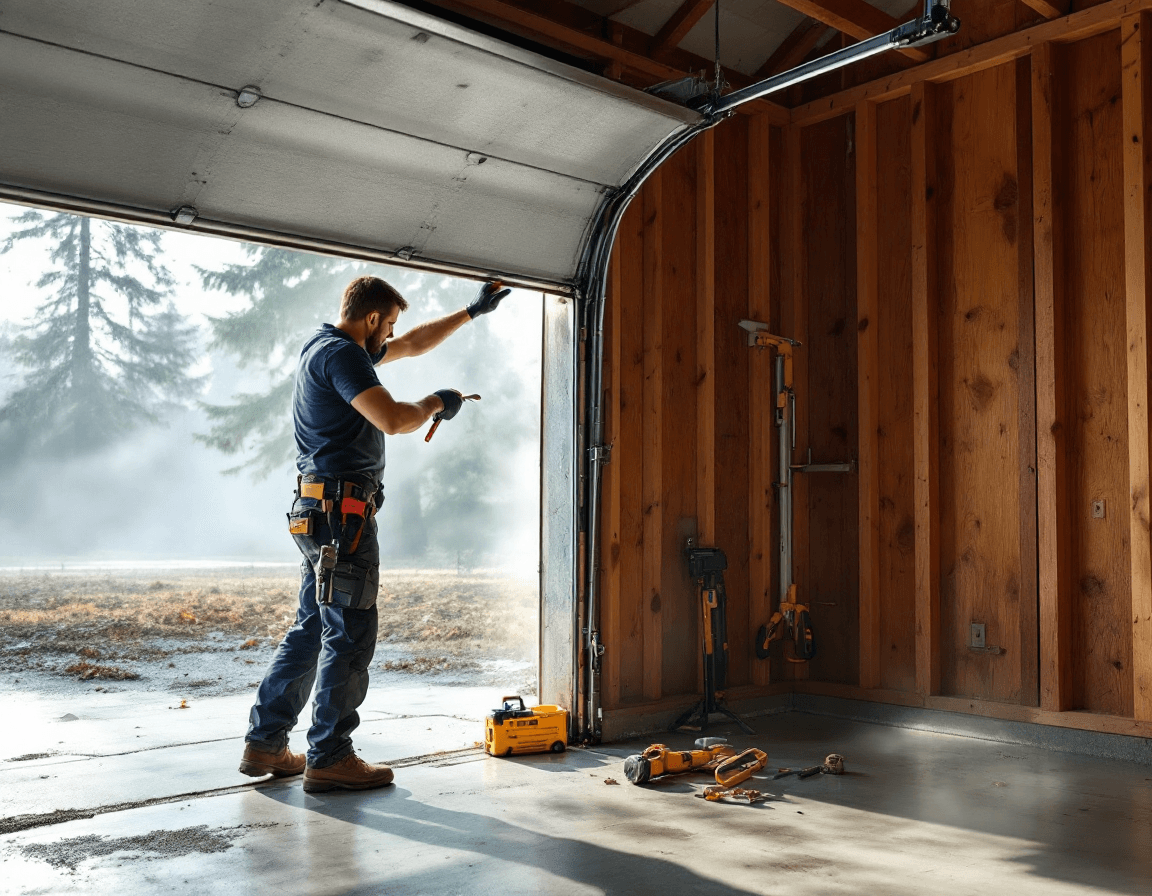
Off-track garage door repair in Hunts Point, WA is one of the more common calls we take from homeowners on the eastern shore of Lake Washington, and it is rarely a sign that a door is beyond saving. When a panel slips out of its track, the cause is usually a roller that has popped loose, a track section that has been nudged out of line, or a door that has shifted from years of wind and wet weather. Most of these repairs are straightforward realignment jobs that a licensed technician can complete in a single visit, typically for $125 to $400 depending on how far the door has moved and what components need attention. The sooner the door is put back on its track, the less strain it places on the opener, the springs, and the panels themselves.
Hunts Point sits on a stretch of shoreline where the air carries moisture most of the year, and the weather has a way of working on a garage door from every direction. Lake breezes push against large panels, winter rain soaks into wood and steel alike, and the freeze-and-thaw cycles that come through the region in late autumn and early spring keep tracks expanding and contracting. Those forces are the background for almost every off-track service call we handle on the peninsula. This guide explains what tends to go wrong, what our technicians look for, what it costs, and what you can safely do while you wait for help to arrive.
If your door is off its track, jammed in the opening, or sitting visibly crooked, you do not need to diagnose the full problem yourself. You do need to avoid making it worse. The sections below walk through the typical causes and repairs so you know what to expect when we arrive, and they explain why certain tasks belong only with a licensed professional. When you are ready to schedule, you can reach our team at (888) 799-3819.
Why Doors Leave the Rails on Lakeside Properties
Doors near the water tend to face conditions that inland garages rarely see. Wind coming across Lake Washington can build real pressure against a tall, lightweight panel, especially when the door is partly open during a storm. Humidity also plays a role, because it encourages wood trim and fasteners to loosen and because it accelerates corrosion on metal hardware that is not regularly cleaned. Over several seasons, these small changes add up to a door that no longer sits square in its opening.
Most derailments begin with a single weak point rather than one dramatic event. A roller that has worn flat on one side may start to skip, which pushes the door sideways a fraction of an inch each time it travels. A bracket may work loose from the wall or the header, letting the track flex under load. Once one component shifts, the others take on stress they were never designed to carry, and the door eventually steps out of its channel. Recognizing that chain reaction is the key to understanding why a door that came off once is likely to come off again if the root cause is not addressed.
Hunts Point homes also vary widely in age and construction. Some garages were built with framing that has settled over time, which can slightly tilt the header and the side jambs that the track is anchored to. Others have had sections of track replaced or extended during previous repairs, and mismatched parts can behave differently under load. A technician who knows how older Eastside structures settle will check the framing relationship as part of the realignment, not just the door itself.
Reading the Warning Signs Before a Door Derails
Doors rarely jump off the track without warning. In most cases, the door has been giving signals for days or weeks, and homeowners who catch those signals early often avoid a full derailment altogether. The most useful habit is to watch the door during a normal open and close cycle and to notice any change in sound, speed, or alignment. Small differences tend to be the first indicator that a roller or track section is starting to fail.
- A grinding or scraping noise near one side of the track, especially during the first few feet of travel
- A visible gap between the top edge of a panel and the weatherstripping on one side of the opening
- Rollers that look flattened, cracked, or shredded where they contact the track
- A door that tilts or drifts when it is partly open and left unattended
- Track bolts or brackets that appear loose, rusted through, or pulled away from the wall
- The opener strains or reverses on its own even though the door was moving smoothly the day before
If you notice any of these signs, it is worth scheduling an inspection before the problem progresses. A door that is still on the track but operating unevenly can often be corrected with a roller replacement and a bracket adjustment, which costs considerably less than recovering a door that has fully left the rails. Keep a note of when the symptoms first appeared, especially if they coincided with a windstorm, a hard freeze, or a heavy rain. That information helps the technician work out whether the damage is recent or the result of long-term wear.
What a Technician Actually Checks on a Derailed Door
When a licensed technician arrives at a derailed door, the first step is safety. We confirm the opener is disconnected, check that the door is not under unexpected tension, and make sure nobody is standing in the path of the panels. From there, we inspect the door, the rollers, the track, the brackets, and the spring system as a connected whole. A door that has come off its track may have stressed components elsewhere, and missing that connection leads to repeat calls.
Our crew measures the gap between the door edges and the jambs, checks whether the top section is level, and looks for signs of twisting in the panels. We examine each roller for wear, cracks, or a bent stem, and we check whether the track is plumb, level, and parallel to the other side. If a section of track has been struck or bent, we note the exact location so we can straighten or replace it. Spring and cable components are inspected visually, but any adjustment or replacement involving tension belongs to a licensed professional, because stored energy in those parts can cause serious injury.
Once the inspection is complete, the realignment itself usually involves gently guiding the door back into the track, replacing worn rollers, tightening or re-anchoring brackets, and straightening the track where it is safe to do so. We then cycle the door several times, watching for binding, uneven movement, or noise. A proper repair should leave the door tracking smoothly from closed to fully open, with no sudden jerks and no visible tilt. Our technicians will walk through the findings with you before leaving so you understand what was fixed and what, if anything, should be monitored.
Rollers That Pop Out and Why They Keep Doing It
Rollers are small parts with a large job. Each one rides inside the track and carries the weight of a door section as it travels between closed and open positions. When a roller pops out, it usually means the stem has worn, the track lip has bent slightly inward, or the roller was never fully seated after an earlier repair. Rollers that have popped out once are prone to doing it again if the underlying cause is not corrected.
Many homeowners in the area have older nylon or early steel rollers that have been in service for many years. Nylon rollers are quieter, but they can become brittle or flat after prolonged exposure to temperature swings and moisture. Steel rollers hold their shape longer, yet they may corrode or develop burrs that snag the track. Sealed ball-bearing rollers tend to run more smoothly and last longer, but they still need the track to be straight and the brackets to be secure. Choosing the right replacement depends on the door's weight, the track type, and how the door is used.
A roller that pops out repeatedly is often a symptom of something else. A track that has shifted outward, a hinge that has pulled loose, or a panel that has been bent by a vehicle can all push a roller out of its channel. Replacing the roller alone may restore function for a short time, but the door will continue to misbehave until the track and panel geometry are restored. This is why we treat roller replacement as one step in a larger realignment rather than as a standalone fix.
Bent Track Sections and How Straightening Works
Track sections are made from thin steel that is shaped to hold rollers in a precise path. Because the metal is relatively light, even a modest impact can dent the track or bend a section out of plane. Over time, a bent section can cause the door to rub, bind, or drift sideways as it travels. In some cases, the damage is visible from across the garage. In others, you only notice the problem when the door begins to lean or stops moving partway through its travel.
Straightening a track is a careful process. Technicians use hand tools and controlled pressure to bring the metal back into its intended shape, checking the result with a level and a straightedge after each adjustment. Bends that are severe, cracked, or located at a joint between sections often cannot be fully corrected, and the affected piece is replaced instead. Replacement keeps the entire track aligned and prevents the new section from pulling the old one out of position. Because track work interacts with the door's balance, we confirm that the spring system is still functioning properly after any track adjustment.
Track separation is another issue we see. Tracks are joined with bolts and brackets, and if those fasteners loosen, the sections can pull apart slightly. A gap at a joint will catch rollers and make the door jerk or stop. Re-tightening or replacing the hardware usually resolves the problem, but the technician also checks whether the wall or header anchors have shifted, since a loose anchor will allow the whole assembly to move again.
Vehicle Strikes: When a Bumper Changes the Geometry
A vehicle backing too quickly into a garage, or a bumper catching the bottom panel while a car is pulling out, can knock a door hard enough to dislodge it from the track. These impacts are common in driveways where space is tight, and they can happen even when the driver is being careful. The damage may range from a bent panel edge and a cracked roller to a fully derailed door with a twisted track. Because the forces involved are sudden, the connected components often take more damage than they first appear to.
After a vehicle strike, the most important step is to stop using the door until it has been inspected. Operating a door that has been struck can drive a roller further off the track, bend the panel further, or damage the opener. Take photos of the damage for your records, especially if you plan to file an insurance claim, and avoid pulling on the door or trying to force it back into place. Our technicians document the condition of each component before making repairs, which helps with insurance paperwork and ensures nothing is overlooked.
Some strikes cause damage that is not immediately obvious. A door may appear to be sitting correctly while the top roller brackets have been bent back, or while a torsion or extension spring has been placed under uneven load. We check these hidden connections during every post-impact visit. If a panel has been permanently bent or the frame is compromised, replacing that section may be more practical than attempting repairs, and we will explain the options and the expected cost range before proceeding.
Keeping the Door Out of Trouble Through Wet Seasons
Western Washington winters are long, damp, and occasionally windy, and a garage door will spend much of that season absorbing moisture and working against wind. Preventive maintenance during the dry months of summer and early fall can prevent many off-track problems before the rainy season arrives. The goal is to keep rollers moving freely, keep tracks clean and secure, and catch loosening hardware before it allows the door to drift.
A sensible seasonal routine includes wiping down the track to remove grit, moss, and dried debris, then applying a silicone-based lubricant to the rollers and hinges rather than heavy grease that attracts dirt. Homeowners should also check that the track bolts and wall brackets are snug, since vibration from daily use gradually loosens them. Look at the weatherstripping along the bottom and sides, because damaged seals let water pool in the track channel, where it can corrode the metal and freeze during cold snaps. Keep an eye on the door during heavy wind events, and close it when storms are forecast to reduce the chance of a gust pushing the panels off line.
- Clean the track channel of grit, moss, and leaf debris at least twice a year
- Lubricate rollers and hinge pivots with a silicone or lithium-based product, not petroleum grease
- Tighten track bolts and wall anchors, and check for hardware that has pulled out of the wood
- Replace cracked or flattened rollers before they fail during regular use
- Inspect weatherstripping and reseal gaps that allow water to reach the track
- Schedule a professional inspection before the wettest months if the door has been noisy or uneven
Maintenance has limits. Lubrication and tightening will not fix a bent track or a cracked panel, and they should never be used as a substitute for professional repair when the door has already come off. The goal of home care is to reduce wear, not to replace the inspection that a licensed technician can provide.
Pricing for Off-Track Work Near Hunts Point
Most off-track repairs we perform fall within a range of $125 to $400, although the final cost depends on what the technician finds once the door is inspected. A simple realignment where the door is still intact and only a roller or bracket needs adjustment usually sits near the lower end of that range. A repair involving multiple rollers, a bent track section, and a damaged bracket will typically land higher. Because every door is different, we give a clear explanation of the work and the cost before beginning, so there are no surprises at the end of the visit.
Several factors influence the price. The door's size and weight matter, since larger or heavier panels require more care during realignment. Access also plays a role, particularly if the door is high on a steep driveway or if the opener, wall anchors, or framing need additional work. Track damage that requires replacement rather than straightening will increase the cost, as will repairs that involve spring or cable components, which must be handled by a licensed professional under safe conditions. We are happy to discuss the likely scope over the phone before scheduling, though a final price is set after the inspection.
Homeowners sometimes ask whether it is worth repairing an older door rather than replacing it. The answer depends on the condition of the panels, the springs, and the opener. If the door is structurally sound and the damage is limited to the track and rollers, realignment is almost always the more economical choice. If the panels are cracked, the spring system is worn out, or the frame is badly distorted, a technician can help you compare the cost of repair against the cost of a new door, without pressure either way.
Staying Safe While a Door Is Off the Track
A door that has come off its track is unpredictable, and the safety steps you take in the first few minutes can prevent injury. Keep children, pets, and visitors well away from the opening. Do not stand under a door that is partly hanging, and do not try to lift or push it back into position yourself. The weight of a garage door is substantial, and a panel that shifts unexpectedly can crush fingers, hands, or worse.
If your opener is still connected, disconnect it before doing anything else. Most openers have a red release cord hanging near the carriage, and pulling it disengages the door from the motor. Once disconnected, the door must be moved by hand only as far as necessary to keep it stable, and even that should be done cautiously. Never attempt to adjust, loosen, or remove spring components, and do not climb onto a ladder to work on a high track while the door is hanging. These tasks carry real risk of stored energy release.
Once the door is secured, call a licensed professional. Our team arrives prepared to stabilize the door, inspect the components, and make repairs with the proper tools and training. In the meantime, keep the garage closed to the public, park vehicles clear of the door's path, and avoid using the opener until a technician has confirmed the door is safe to operate. A few minutes of caution now can prevent a much larger problem later.
Booking a Realignment Visit With Our Hunts Point Crew
If your garage door has come off its track, is binding, shows a gap along one side, or has been hit by a vehicle, our Hunts Point technicians are ready to inspect it and restore smooth, level travel. We bring the tools and parts needed for realignment, roller replacement, track straightening, and bracket repair, and we explain each step as we go. Our work is performed by licensed, bonded, and insured professionals who understand how Lakeside weather and older garage construction affect the way doors move. Spring and cable work is always handled by licensed technicians under safe procedures, and we will tell you clearly whether your repair falls into that category.
To schedule a visit or describe your symptoms, call (888) 799-3819. Our team can help you determine whether your door needs a quick realignment or a more involved repair, and we will provide a clear estimate before any work begins. The sooner a door is returned to its track, the less damage it is likely to cause, so do not wait for the next storm to find out how the door will hold up.