
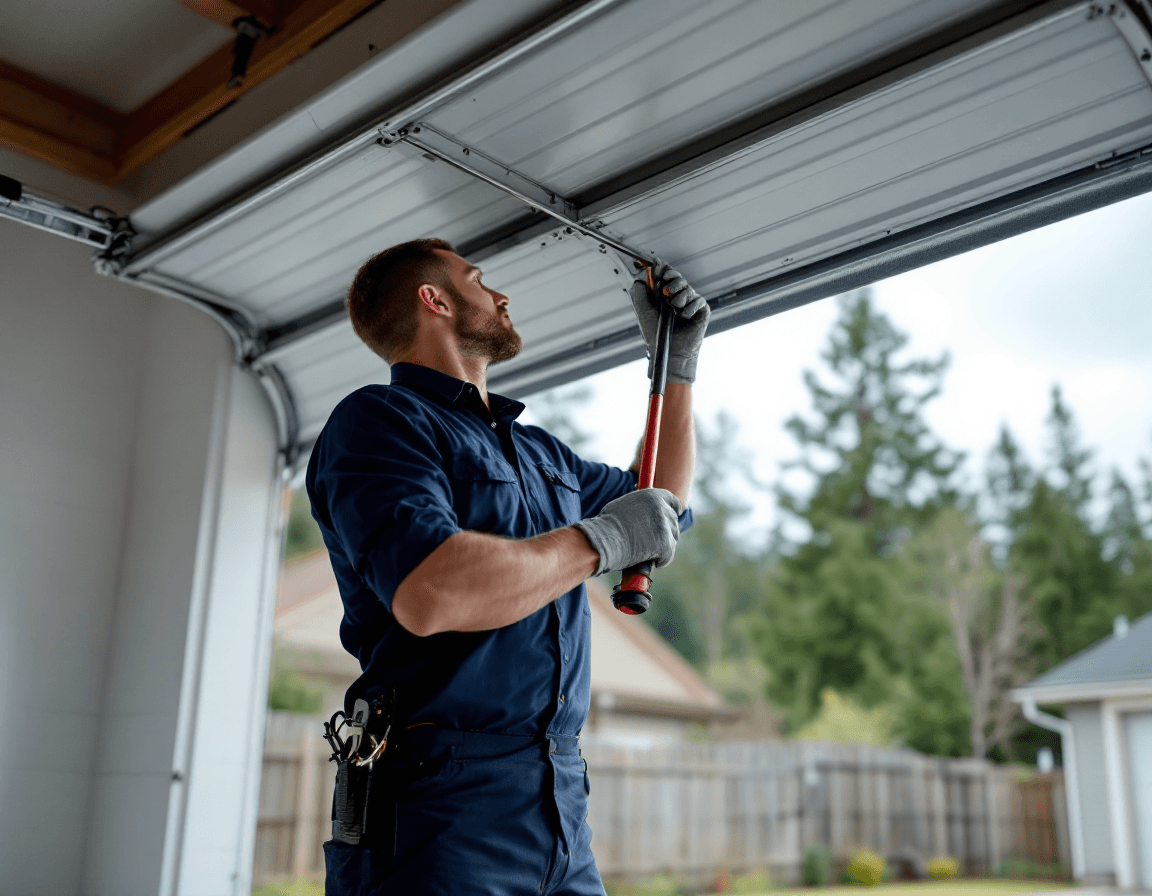
Garage door spring replacement in Hunts Point, WA is one of the most common repairs we handle for homeowners along the eastern shore of Lake Washington, and it is also one of the most dangerous jobs to attempt yourself. The springs carry most of the weight of a heavy garage door, so when one fails, the door can go from smooth and reliable to stuck, crooked, or hanging in a way that puts people and property at risk. Understanding what a broken spring looks like helps you act quickly and avoid making the problem worse.
Hunts Point is a small, residential community with large waterfront properties, mature trees, and driveways that often sit close to the lake's damp air. Many homes here have wide, heavy doors, sometimes custom-built or paired with older openers that were installed years before the current spring was added. Those factors mean the springs in this area can be working harder than the standard spring specification assumes. This page explains how to recognize a failing spring, what replacement involves, how pricing typically works, and why a licensed technician should handle every step of the job.
Our goal here is practical. We want you to know what you are looking at when something seems off with your garage door, what questions to ask any company that quotes the work, and how to keep your household safe while you wait for a professional. If you are reading this because your door just made a loud noise and will not close, the sections below will help you triage the situation before we arrive.
How Pacific Northwest Moisture and Lakeside Air Wear Down Springs
The climate around Lake Washington is mild by national standards, but it is persistently damp. Winter rain, fog that settles over the water, and high humidity in the warmer months all contribute to corrosion on steel. A torsion spring is a coil of hardened steel wire, and when moisture reaches its surface, tiny pits form and grow over time. Those pits become stress points, and the spring eventually fails at one of them. Homes closer to the water can see this process accelerate, especially when the garage is not heated or ventilated well.
Temperature swings also matter. Cold mornings make steel more brittle, and a spring that has been slowly weakening can give way suddenly on a chilly day when the door is lifted for the first time. Many of the spring breaks we hear about happen in late fall, winter, or the first warm stretch of spring, which is consistent with how metal responds to these conditions. A garage that holds in moisture from wet gear, bikes, kayaks, or landscaping tools will often see faster deterioration on the nearby hardware.
Because of this, we recommend that homeowners in Hunts Point treat spring inspection as a routine part of seasonal maintenance rather than something to do only after a failure. A quick look at the coils for rust, flaking, or gaps, combined with a check of the door's balance, can catch a weakening spring before it snaps. Technicians can also recommend coatings or environmental adjustments, though the spring itself will still have a finite service life.
Reading the Warning Signs Before a Spring Lets Go
Springs rarely fail without warning, even though the failure itself feels sudden. Often the door starts to behave differently for days or weeks before the break. You might notice that the door feels heavier when you lift it by hand, that it climbs unevenly, or that the opener seems to labor more than it used to. These changes are the early signs that one spring is losing its tension and the other is taking on more than its share of the load.
Some of the most common warning signs include:
- The door feels extremely heavy when lifted manually or the opener strains loudly
- A visible gap appears in the coils of a torsion spring, often near the center
- The door opens a few inches and then stops, or refuses to start at all
- The door closes too fast, drops unevenly, or sits crooked in the track
- A cable looks loose, frayed, or has slipped off the drum after a previous noise
When you notice one of these signs, avoid repeatedly pushing the opener button. Each attempt puts strain on the remaining spring, the opener motor, and the cables, which can turn a single broken spring into several damaged parts. Instead, disconnect the opener if you can do so safely and schedule an inspection. A technician can determine whether the door is simply out of balance or whether a spring has already failed.
What a Snapped Spring Sounds Like and What It Looks Like
A spring break is usually loud. Many homeowners describe it as a sharp bang, similar to a gunshot or a heavy metal object dropped on concrete, and it often comes from inside the garage. Because the release of stored energy happens in a fraction of a second, the sound can be startling even when you are expecting something to go wrong. If you hear this noise, take a moment to check the rest of the household and make sure no one was standing near the door.
After a break, look at the spring above the horizontal track, which is typically mounted on a metal shaft across the top of the opening. A broken torsion spring will often show a visible gap in the coils, and the two pieces may look separated or pulled apart. On extension springs, which run along the sides of the track, you may see a stretched or disconnected section, or a spring hanging loose from its bracket. Do not try to tug, wind, or reattach anything on your own.
Also check the cables that run from the bottom bracket up to the drums. When a spring breaks, the cables can slacken, slip off the drum, or become tangled. Some owners find the door sitting unevenly on one side or the bottom panel sagging. These are signs that the door needs professional attention and should not be operated until a licensed technician confirms it is safe.
Torsion Versus Extension Springs: Matching the Right Part to Your Door
Garage doors use two main spring systems, and knowing which one you have helps you understand the scope of the repair. Torsion springs mount on a steel shaft above the door opening and wind up to store energy as the door closes and release it as the door opens. They are generally quieter, more balanced, and better suited to heavier doors, which is why they are common in larger residential installations across the Seattle area. A torsion system is usually identified by a single long shaft spanning the width of the door with a spring or two centered on it.
Extension springs run parallel to the horizontal tracks on each side of the door, stretching and contracting as the door moves. They often appear in older homes or on lighter doors, and they sometimes come with safety cables threaded through the center of each spring. Those safety cables are designed to keep a broken spring from flying across the garage, but they do not prevent the spring from breaking in the first place. Replacing extension springs requires the same caution as torsion work, because the tension is still significant.
When we inspect a door, we confirm the spring type, the wire size, the inside diameter, the length, and the cycle rating before we order anything. Using a replacement that does not match the door's weight and dimensions can lead to imbalance, premature failure, or damage to the opener. A proper match is one of the most important steps in a reliable repair.
High-Cycle Springs and What the Extra Investment Buys
Standard springs are commonly rated for a certain number of open-and-close cycles, and many residential torsion springs fall into a range that works for typical household use. High-cycle springs are manufactured to a higher cycle rating, which generally means they are designed to last longer under frequent use. For a household that opens the garage several times a day, has teenage drivers, or runs a home business from the garage, that difference can translate into fewer service calls over time.
High-cycle options can also be a sensible choice for heavy doors, doors with insulation or glass panels, and doors in homes where the existing spring has broken more than once. The added cost reflects better material and tighter manufacturing tolerances rather than any change in how the door physically operates. We walk homeowners through the tradeoffs so they can decide what fits their daily routine and budget, without any pressure to upgrade beyond what the door needs.
It is worth noting that a high-cycle spring will not fix an imbalanced door or a worn opener on its own. If the underlying hardware is stressed, the new spring will still be asked to do more than it should. That is why we pair spring replacement with a full check of the rollers, hinges, cables, and opener force settings, so the new part is set up to succeed.
Why Precise Balancing Matters After Every Spring Replacement
A garage door is considered balanced when it stays at a stable height as you release it partway open, rather than sliding up or dropping down on its own. Balance is determined by spring tension, door weight, and the geometry of the cables and drums. When a spring is replaced, the door must be rebalanced to match the new tension, because even a correct-length spring can leave the door heavier on one side or too light overall. Precise balancing protects the opener, reduces wear on the rollers, and keeps the door from slamming shut.
To test balance yourself after a professional repair, you can close the door fully, disconnect the opener, and lift the door manually to about waist height. Let go slowly and watch what happens. A balanced door should stay in place. If it falls, rises, or tilts sideways, the adjustment needs to be refined by a technician who can safely change tension without risking injury.
Balancing is one reason we discourage homeowners from replacing a single spring without checking the rest of the system. When one spring breaks, the surviving spring may have been carrying a different share of the load, and replacing only the broken side can leave the door uneven. Our technicians set both springs to a matched tension and verify the result before leaving the job.
Cables, Drums, and the Hidden Damage a Spring Break Can Cause
The cables and drums are the quiet partners of the spring system, and they often take damage when a spring fails. The cable wraps around a drum that rotates with the spring, and when the spring releases suddenly, the cable can jump off its groove, fray against the drum edge, or stretch unevenly. Once a cable is kinked or partially unraveled, it becomes a weak point that can fail the next time the door is lifted. A cable that appears intact on the surface may still carry internal damage.
Drums can crack or slip on the shaft after a violent spring release, and drum set screws can loosen over time. Technicians check the drum alignment, the cable tension, and the condition of the cable ends during every spring job. Replacing the cables along with the spring is often more economical than discovering a second failure a few weeks later, and it allows the door to operate smoothly from the start.
Homeowners sometimes ask whether they can simply reattach a loose cable. We strongly advise against it. A cable under no tension can snap back violently when the spring is loaded again, and the drum may not be properly seated. This is one more reason the entire assembly should be inspected by someone trained to handle it.
What a Professional Spring Replacement Typically Involves
A thorough spring replacement follows a predictable sequence, although every door has its own details. The technician begins by securing the door in the closed position, usually with locking pliers or a clamp on the track, to prevent it from moving while the work proceeds. The opener is disconnected, and the old spring assembly is evaluated for wire size, length, and cycle rating. The technician then confirms the door's weight and dimensions before ordering or selecting the replacement part.
Once the new spring is ready, the technician uses winding bars with a controlled method to install it, never exceeding the safe number of turns for the specific spring. The cables are inspected and replaced if needed, the drums are checked, and the door is tested for smooth movement through its full travel. Balance is adjusted, the opener's force and travel limits are verified, and the safety reversal system is tested. The job concludes with a walkthrough so the homeowner understands what was replaced and what to watch for.
A typical checklist for a professional visit includes:
- Confirming the spring type, wire size, inside diameter, and length
- Securing the door and disconnecting the opener before any tension work
- Inspecting cables, drums, bearings, rollers, and hinges for wear
- Installing matched springs with the correct cycle rating for the household
- Rebalancing the door and testing movement through full travel
- Verifying opener force, auto-reverse, and safety sensor function
Pricing Spring Replacement in Hunts Point Without the Guesswork
Spring replacement pricing depends on the type of spring, the size and weight of the door, the cycle rating, and whether cables or drums also need attention. For most spring replacements in our service area, the typical range is $180 to $450. Lower figures often apply to straightforward extension spring swaps on standard doors, while higher figures may reflect heavier doors, high-cycle torsion springs, or additional hardware work discovered during the inspection.
We believe homeowners should understand what a quote includes before they agree to any work. A fair estimate should explain the spring type, the parts being replaced, whether cables are included, and whether balancing and safety testing are part of the price. If a company quotes an unusually low figure without an inspection, or pressures you to replace the entire system before confirming the cause, it is reasonable to ask more questions or request a second opinion. Our aim is a clear, written explanation before any work begins.
Because the final price depends on the door itself, we recommend contacting us at (888) 799-3819 for an accurate estimate. Describing the symptoms you are seeing, the door size if you know it, and the type of spring can help us give you a more useful answer over the phone before a technician visits.
Safety Rules Every Hunts Point Homeowner Should Follow
Spring work is one of the few household repairs where a mistake can cause serious injury. Torsion springs hold enough energy to cause severe harm if they are wound or released incorrectly, and even a small slip can send a winding bar into a face or hand. For this reason, we always recommend that spring and cable replacement be performed by a licensed, bonded, and insured professional. Our technicians are trained to handle the tension safely and to work within manufacturer specifications.
While you wait for service, a few simple precautions can reduce risk. Keep children and pets away from the garage door area, avoid standing directly beneath a door that is partly open or hanging, and do not attempt to lift a stuck door by hand. If the door is damaged, keep the opener disconnected so the motor does not continue pulling against a broken system. These steps buy time without asking you to touch the hardware.
Please avoid these common mistakes:
- Trying to wind, unwind, or remove a torsion spring with household tools
- Cutting or re-threading cables to make the door move
- Repeatedly running the opener after a loud bang or visible break
- Standing in the door's path while it is being operated or tested
- Replacing a spring with a part that has not been matched to the door's weight
Scheduling Your Spring Repair With Seattle Garage Door Fix
If your garage door in Hunts Point has made a loud bang, stopped partway up, or shows any of the warning signs described above, the safest next step is a professional inspection. Our team serves Hunts Point and dozens of nearby communities across Western Washington, and we can usually explain the likely cause over the phone before arriving. Keep the door closed, keep the opener disconnected if possible, and keep people clear of the area until a technician confirms the system is safe to operate.
Call Seattle Garage Door Fix at (888) 799-3819 to schedule spring replacement, high-cycle spring options, or a full balancing check. We will walk you through the options, give you a clear picture of what the repair involves, and help you get your garage working safely again.