
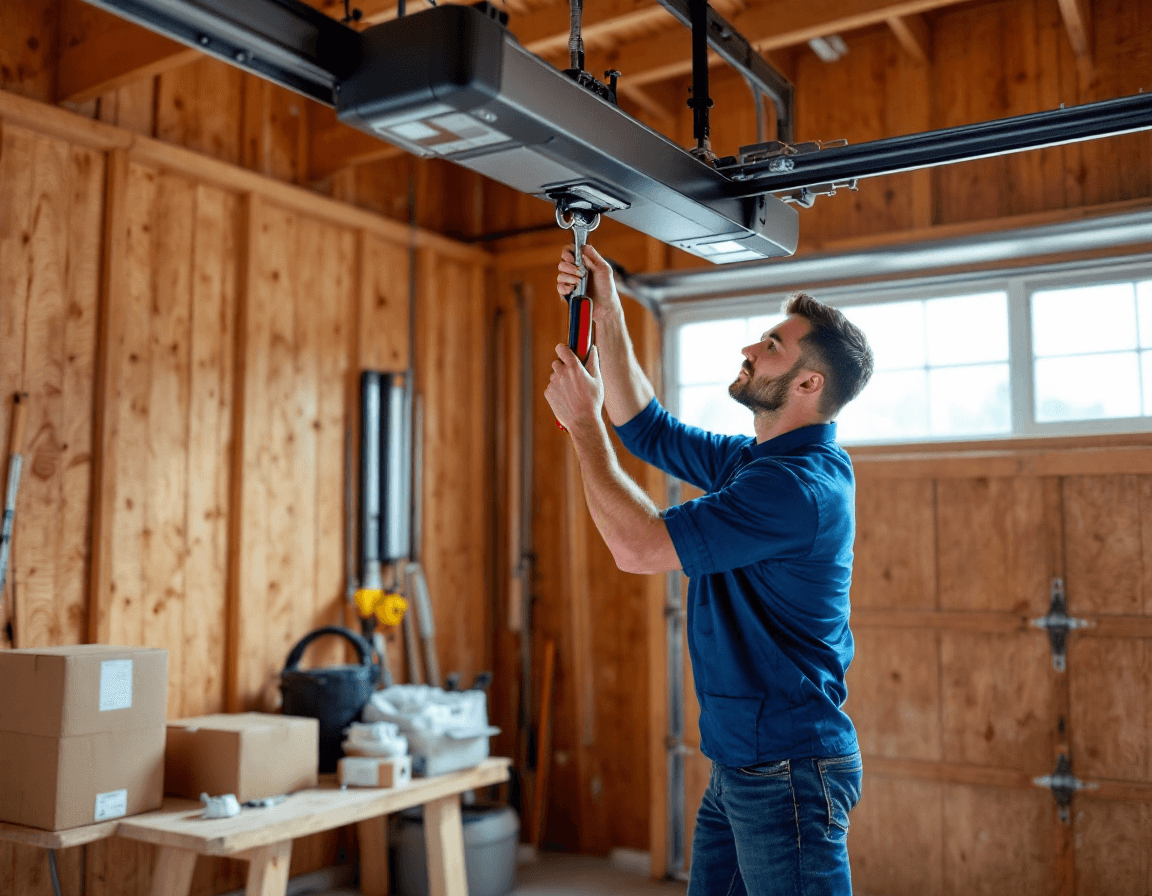
Garage door opener installation and replacement in Hunts Point, WA is one of the most practical upgrades a homeowner can make to a garage that has started to feel unreliable. Hunts Point sits on the eastern shore of Lake Washington, and the homes here were often built with generous garages, long sloped driveways, and a lot of daily traffic in and out of the bays. An opener that once handled that routine without complaint can begin to stall, grind, or fail to close at the worst possible moment. When that happens, the problem is usually the motor, the logic board, or the rail system rather than the door itself.
The good news is that a modern opener solves most of those issues in one visit. Today's units run quieter, respond faster, and use rolling-code security that makes it far harder for someone to capture a remote signal and reuse it. Many models also connect to Wi-Fi so you can check the door status from your phone, and battery backup options keep the door working when the power drops during a windstorm. At Seattle Garage Door Fix, we install belt-drive, chain-drive, and wall-mount smart openers, and we match each unit to the door weight, the garage layout, and the way your household actually uses the space.
Installed pricing typically falls between $275 and $650, depending on the opener model, the drive style, and any accessories such as battery backup or a smart control kit. The sections below explain how to recognize when replacement makes sense, how to choose between drive types, what security and smart features really offer, and what to expect from the installation itself. Our goal is to give you enough detail to make a confident decision, whether you are replacing a single unit or upgrading a garage that serves a larger household.
What a Hunts Point Garage Asks of Its Opener
Garages in Hunts Point tend to see more varied use than a typical single-car bay. Many homeowners park vehicles that are heavier or longer than average, store kayaks and paddleboards on the lake side, and rely on the garage as a staging area for outdoor gear and seasonal equipment. Each of those uses adds cycles to the opener and places repeated strain on the motor, the trolley, and the door connection. An opener that was adequate for a compact sedan can struggle when it is asked to lift a heavier door or handle frequent openings during busy weekends.
The Pacific Northwest climate adds its own demands. Lake-adjacent properties carry a higher level of ambient moisture, and the cool, damp months from late fall through early spring can cause metal components to corrode and lubricants to thicken or wash away. Wind is another factor. When storms move through King County, they can knock out power for hours at a time, which means the opener is expected to function both as a daily convenience and as a backup entry point for the household. Understanding these conditions helps determine which opener will hold up well over the next decade rather than just the next season.
Before choosing a replacement, a licensed technician will look at how the door is balanced, whether the tracks are aligned, and whether the existing wiring and mounting points can support a newer unit. Often the door itself is in good shape and only the opener needs attention. In other cases, a worn door that is binding or out of balance will shorten the life of even a new opener, so it is worth checking the whole system rather than assuming the motor is the only issue.
Signs an Opener Has Reached the End of Its Useful Life
Most homeowners notice a failing opener long before it stops entirely. The changes tend to be gradual: the door takes a little longer to start moving, the motor makes a new grinding sound, or the remote works only when you stand in one particular spot. Recognizing these early signs lets you plan a replacement on your schedule instead of waiting for a dead garage on a rainy weekday morning. Common warning signs include:
- The door opens or closes noticeably slower than it did a few years ago, or it pauses partway through its travel.
- The motor produces a loud rattle, a high-pitched whine, or a grinding noise that did not exist before.
- The remote or wall button requires several presses, works only at certain distances, or stops responding after a rainstorm.
- The opener reverses unexpectedly or the auto-reverse safety feature triggers without an obvious obstruction.
- Repairs have become frequent, and the cost of each service call is approaching the price of a new installed unit.
A useful rule of thumb is to compare the cost of repairs against the cost of replacement. If a technician has already replaced the logic board, the trolley, or the drive gear within the last couple of years, the opener is probably nearing the point where continued repair no longer makes financial sense. A new unit brings updated components, warranty coverage on the motor, and current safety standards, which can outweigh the small savings of keeping an aging motor running a little longer.
Belt Drive, Chain Drive, or Wall-Mount: Matching the Motor to the Build
Choosing the right drive style is one of the most important decisions in an opener replacement. A belt-drive opener uses a reinforced rubber belt to move the trolley along the rail. Because the belt runs more quietly than a metal chain, belt-drive units are a strong choice for homes where the garage shares a wall with a bedroom, a home office, or a finished space above. Belt-drive models also tend to be smoother in operation, which reduces vibration transferred into the ceiling framing.
A chain-drive opener relies on a steel chain and is generally the most economical option for heavier doors or detached garages where noise is less of a concern. Chain drives are robust and handle high-cycle use well, although they are louder during operation. For a detached structure or a workshop bay that is away from living spaces, a chain drive can be a practical choice that delivers reliable lifting power without adding unnecessary cost.
Wall-mount openers attach to the wall beside the door rather than to the ceiling. This design is valuable when the ceiling is low, when the garage has a finished attic or storage platform above the door, or when the door is an unusual size that does not leave room for a standard ceiling-mount track. A licensed technician will measure the header height, the clearance on each side, and the available space at the wall before recommending a wall-mount unit, since a poor fit can create problems that are difficult to correct later.
Rolling-Code Security and Why an Older Unit Is a Liability
Older openers often use fixed-code technology, meaning the remote sends the same signal every time it is pressed. A determined person with inexpensive equipment can record that signal and replay it to open the door. Rolling-code technology solves this problem by changing the code with every use, so a captured signal cannot be reused. For a home in Hunts Point, where property values and privacy are important, upgrading from fixed code to rolling code is one of the simplest security improvements available.
Rolling-code security also protects the convenience features you expect from a modern system. When a remote, keypad, or smartphone app is synchronized with the opener, each command is authenticated, which reduces the chance of interference or accidental activation. Many current models add motion sensors, light indicators that show whether the door is open or closed, and alerts that notify you when the door has been left open for an extended period. These features are most useful for households that travel often or frequently have family members coming and going at different times.
If your current opener is more than a decade old, it is worth asking a technician to confirm which code system it uses. Some units can be retrofitted with a new remote and receiver, while others are better replaced entirely. Replacing the opener is often the more complete solution, because it upgrades the motor, the safety sensors, and the control electronics together rather than leaving a weaker component in the system.
Smart Control Without the Guesswork: Wi-Fi, myQ, and Shared Access
Smart control has moved from a novelty to a practical feature. A Wi-Fi-enabled opener lets you open, close, and check the status of the door from a smartphone, which is especially useful when you are away from home or when a delivery needs access. Compatible systems such as myQ allow you to create shared access for family members, service providers, or housekeepers without handing over a physical remote. You can also review activity logs to see when the door was last operated, which many homeowners find reassuring.
Before buying a smart-enabled opener, check a few practical points. Confirm that the garage has reliable Wi-Fi coverage near the opener, because a weak signal can make the app appear to work while actual commands lag or fail. Consider whether you prefer a hub-based system, a direct Wi-Fi connection, or a combination of both, and make sure the platform works with the other smart devices already in your home. Finally, make sure the account is set up under your name and that you understand how to revoke access if a shared user no longer needs it.
When we install smart systems, we walk through the app setup with you, confirm that the sensors are aligned, and test the auto-reverse feature to ensure the door responds correctly. We also recommend turning on two-factor authentication where the platform supports it, since your garage door is a physical entry point to the home and should be protected like any other connected account.
Battery Backup for Hunts Point's Winter Power Interruptions
Winter storms in King County occasionally bring windstorms that down trees and power lines, and an outage can leave a garage door stuck in place for hours. Battery backup kits solve this problem by keeping the opener running for a limited number of cycles during a power loss. For a household that relies on the garage as the primary entry point, or for a family with someone who has limited mobility, a backup battery can be the difference between a minor inconvenience and a real challenge.
Battery backup capacity varies by model and battery size, so it is important to understand what the system is designed to do. Most units can open and close the door several times on a single charge, which is usually enough to get a vehicle out during an outage or bring it back in after a power restoration. The battery charges automatically when power returns, and many systems alert you when the battery is low so you can address it before the next storm. We recommend checking the battery status periodically, especially before the wettest months of the year.
Battery backup is also useful when you want to avoid being locked out during a planned utility shutoff or when the household is away and the power is interrupted. It does not replace a manual release cord, which every opener should retain. Make sure everyone who uses the garage knows where the release cord is located and how to use it safely, and remember that the release should be used only when the door is stationary and the vehicle is clear of the door's path.
What Installation Involves on a Typical Visit
A professional opener installation is more involved than simply mounting a new motor to the ceiling. The technician begins by checking the door's balance and the condition of the springs, cables, and rollers, since an opener cannot compensate for a door that is out of balance. Spring and cable work is a safety-sensitive task that carries serious risk of injury when performed without the right tools and training, so it should always be handled by a licensed professional. Homeowners should never attempt to adjust, wind, or replace torsion springs on their own.
Once the door is confirmed to be in good condition, the technician removes the old opener, inspects the header bracket and mounting hardware, and installs the new unit according to the manufacturer's specifications. The rail is aligned, the trolley is connected to the door arm, and the limit settings are programmed so the door stops at the correct open and closed positions. Safety sensors are mounted near the floor on each side of the door and tested to confirm that the door reverses when the beam is interrupted.
The final steps include programming the remote and any keypad, connecting the smart module if one is included, installing battery backup if it was selected, and testing the entire system through several full cycles. We also review the operating manual with you, explain how to use the manual release, and point out maintenance items such as lubricating the rail and checking the sensor alignment every few months. A well-installed opener should run smoothly from the first day, and the walkthrough helps you keep it that way.
Realistic Pricing Between $275 and $650
Installed pricing for garage door opener installation and replacement generally falls between $275 and $650. Where a particular job lands within that range depends on several factors, including the opener model you select, the drive style, whether a wall-mount bracket is needed, and whether you add battery backup or a smart control kit. A basic chain-drive unit for a detached garage will typically sit near the lower end, while a quiet belt-drive model with Wi-Fi control and battery backup will cost more.
It is worth asking for a written estimate that lists the opener model, the drive type, the included accessories, and any additional work such as replacing a damaged header bracket or upgrading old safety sensors. A transparent estimate makes it easier to compare options and understand what you are paying for. If the technician discovers an issue during the visit that changes the scope, such as a door that needs roller replacement before the new opener can be installed safely, you should receive a clear explanation and a chance to approve the added work before it begins.
Pricing should also be weighed against long-term value. A quieter belt-drive opener with rolling-code security and a reliable warranty may cost more upfront but can reduce noise in the home, lower the risk of unauthorized entry, and avoid the frequent repairs that come with an aging unit. Think about how often the garage is used, who relies on it, and whether power interruptions are a common concern in your area before deciding which features are essential and which are optional.
Repair Versus Replacement: A Practical Cost Check
Deciding whether to repair or replace an opener comes down to a few honest questions. How old is the unit? How many repairs has it needed in the last two years? Does it use fixed-code security? Is the motor still producing consistent lifting power, or is it straining? If the answers point to an aging unit with recurring problems, replacement is usually the better investment, especially when the new opener can add security, quieter operation, and smart features.
There are situations where a repair makes sense. A failed remote, a worn wall button, or a single sensor that needs realignment can often be fixed for a modest cost without replacing the entire opener. The key is to avoid throwing money at a unit that is fundamentally worn out. A technician who explains the diagnosis clearly, shows you the worn parts, and gives you options is doing the job well, and you should feel comfortable asking questions before approving any work.
It is also worth considering the door's condition during this decision. A new opener cannot compensate for a door that is out of balance, binding in the tracks, or dragging on the floor. If the door itself needs spring replacement, roller service, or track alignment, those repairs should be planned alongside the opener upgrade. Handling both together is often more efficient than returning for separate visits, and it ensures the new opener is working with a door that is safe and properly set up.
Keeping the New Opener Quiet and Reliable Through Wet Seasons
Once your new opener is installed, a few simple habits will help it run quietly and reliably through the damp months that define the Pacific Northwest. Lubricate the rail and the chain or belt path according to the manufacturer's recommendations, using the type of lubricant specified in the manual. Over-lubricating can attract dust and grime, so a light, even application is better than a heavy coat. Check the moving parts once or twice a year, and listen for any new sound that might signal loosening hardware.
Keep the safety sensors clean and aligned. Lake-side homes often accumulate fine moisture and dust on exposed surfaces, and a sensor lens covered in grime can cause the door to behave unpredictably. Wipe the sensors gently with a dry cloth, confirm that the indicator lights are steady, and test the auto-reverse feature periodically by placing a flat object in the door's path at a safe height. If the door fails to reverse, stop using it and call a licensed technician.
Finally, schedule a professional inspection every year or two. A technician can check the opener's limit settings, the condition of the trolley and mounting hardware, the battery backup if you have one, and the overall balance of the door. Early attention to small issues helps the opener last longer, keeps operation quiet, and preserves the security features you chose when you upgraded. Regular care is the simplest way to protect the investment you made in a better opener.
If your garage opener is loud, slow, unreliable, or running on outdated security, Seattle Garage Door Fix can help you choose and install the right unit for your Hunts Point home. Call (888) 799-3819 to schedule an inspection, ask about belt-drive, chain-drive, or wall-mount options, and get clear pricing before any work begins. Our licensed, bonded, and insured technicians will handle the installation safely and walk you through every feature so your garage works the way you need it to.