
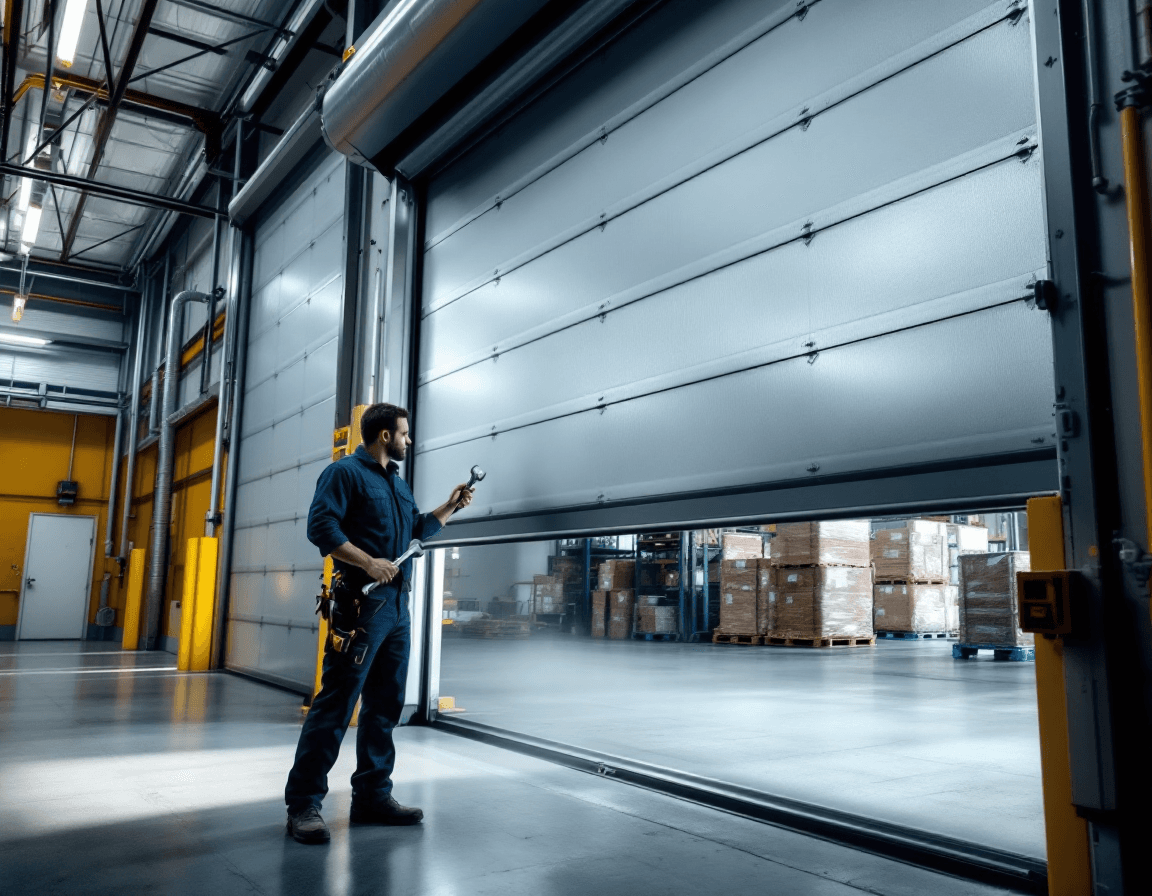
Commercial Overhead Door Repair in Mountlake Terrace, WA is the kind of service most business owners don't think about until a bay door stops halfway through its cycle with a delivery truck idling outside. Whether your building sits near the MLT Town Center or farther out along the commercial corridors that run toward Lake Ballinger, a loading door that won't close, open, or hold its position can stall an entire operation. The repair itself is often the smaller cost. Lost throughput, staged pallets sitting in the way, and drivers who can't be turned around on schedule add up faster than most managers expect.
Snohomish County weather makes commercial door work more demanding than it is in drier parts of the state. Winters bring long stretches of rain, cold mornings with condensation forming on steel panels, and damp marine air that drifts in from Puget Sound and settles into the valleys. Those conditions push galvanized hardware toward corrosion, cause wood trim and jamb components to swell, and slowly change how a door tracks over a season. Commercial doors also cycle far more often than residential ones, so a small problem that a homeowner might tolerate for months can turn into a shutdown in a single week.
This page walks through the door types we service in Mountlake Terrace, the failures we see most often in local warehouses, workshops, and dock buildings, and how we approach quotes and maintenance agreements. We are a licensed, bonded, and insured garage door company, and we bring the same care to a single rolling shutter as we do to a multi-door dock bank. Spring and cable tension on large sections carries serious risk, so that work always goes to a trained technician with the right equipment and procedures.
Sectional Doors on Mountlake Terrace Dock Buildings
Sectional overhead doors are the most common choice for loading docks, warehouses, and light industrial bays in the Mountlake Terrace area. They rise in horizontal panels that travel up a curved track and stack along the ceiling, which saves floor space and allows a large opening without a bulky curtain. That design depends on a precise system of rollers, hinges, track alignment, and balanced springs working together. When one part drifts out of tolerance, the whole door begins to complain.
On commercial sectional doors, the first signs of trouble are usually subtle. You may notice a grinding or popping sound at the top of travel, a panel that rides slightly out of line, or a door that rises unevenly from one side to the other. Worn rollers with flat spots can cause a rumble that gets louder through the morning as the door warms up. Left alone, uneven travel puts extra stress on hinges and the outermost track brackets, which is how a minor adjustment turns into a panel replacement.
Our technicians inspect the full door path during a service call, not just the component that failed. That means checking track plumbness, measuring gaps at the jambs, confirming the hinge pins are seated, and verifying that the door closes flush at the threshold. Where weather seal or bottom weatherstripping has worn away, we note it, because gaps at the bottom let in cold air, water, and pests. A thorough inspection gives you a clear list of what needs attention now and what can safely wait for the next scheduled visit.
Rolling Steel Doors and the Track Problems Behind Them
Rolling steel doors are a different animal. Instead of panels, they use a continuous curtain made of interlocking slats that wind around a barrel above the opening. Many of the rolling doors we see around Mountlake Terrace protect storefronts, storage bays, and light manufacturing spaces, and they are valued for their compact footprint and security. Because the curtain is guided on both sides by vertical tracks, any debris, bent slat, or misaligned guide can cause the door to jam partway through its travel.
The most common complaint with a rolling steel door is that it has come off track. This often happens after a sharp impact, a gust of wind through an open bay, or an accumulation of grit that builds up in the guides over months of use. Once a slat edge catches in the guide, the curtain can bind, bow, or stop entirely. Forcing the door manually or running the operator against a binding curtain can bend slats and damage the shaft, so the first step should always be a stop and an assessment.
Repairs on a rolling steel door might involve straightening or replacing individual slats, cleaning and realigning guides, replacing worn bottom bars, or servicing the barrel and bearings. We also check the spring or motor assembly that counterbalances the curtain, because a door that is out of balance will strain the operator and shorten its life. Rolling steel doors do not always need major parts. Often, a careful realignment and lubrication with the right product will restore smooth travel and buy the owner years of reliable use.
When a Dock Door Goes Down and Trucks Are Waiting
A dock door that goes down during business hours is an urgent situation, and we treat it that way. When a bay will not open at all, the first question is whether the problem is electrical, mechanical, or related to a safety device that has been triggered on purpose. Many commercial doors are designed to stop when a photo eye detects an obstruction, when a safety edge is pressed, or when a tension sensor senses a fault. Sometimes the door is working exactly as intended, and the cause is something simple, like a pallet in the sensor path or a failed beam alignment.
Other outages are more serious. A broken torsion spring, a cable that has come off the drum, or a damaged bottom section can leave a door unable to lift safely. In those cases the door should be secured in the closed position and kept out of service until a licensed technician can assess it. Do not attempt to lift a door by hand while the springs or cables are compromised, and do not allow staff to stand under a door that is partially open and not locked in place.
When you call us about a down dock door, we will ask a short set of questions to help the technician prepare. These include whether the door made a noise before it stopped, whether the control panel shows any fault codes, whether the door moved at all after the last cycle, and whether there was any recent impact. Being able to describe what you saw helps us arrive with the right parts and tools, which is often the difference between a same-day repair and a second trip.
Commercial Operators That Stall, Stutter, or Quit
The operator is the motor and control assembly that moves a commercial door, and it works hard. In a busy facility, an operator may cycle dozens or even hundreds of times in a day, and it is subject to heat, dust, and humidity inside the building and to the moisture that comes in with every cold, wet morning. Operators in the Mountlake Terrace area often show their age through slower travel, unusual heat at the housing, intermittent stops, or a door that reverses for no apparent reason.
Several issues tend to show up before a full operator failure. Worn limit settings can cause a door to stop short of closing or to overrun the open position. Contactors and relays can wear down, producing chatter or no response to the control station. Wiring connections at the junction box can corrode in damp conditions, which creates intermittent faults that are maddening to troubleshoot. Our technicians test each of these systems in sequence rather than replacing parts on guesswork, which keeps costs reasonable and gets the door back in service faster.
Operators also work alongside safety devices that protect people and equipment. These include monitored entrapment protection, safety edges that reverse the door on contact, and photo eyes that stop motion when a beam is broken. Any repair that touches these systems must restore them exactly to specification. We never recommend bypassing a safety device to keep a door moving, even temporarily, because that shortcut has caused serious injuries across the industry.
Forklift Strikes and Damaged Door Sections
Forklifts and pallet jacks are part of daily life at many Mountlake Terrace loading docks, and sooner or later a tine or mast will make contact with a door. A glancing blow may only scuff a panel, but a direct strike can crack a section, bend a track, knock a hinge out of its seat, or pull a roller from its bracket. Because sectional doors are made of individual panels, damage is often confined to one or two sections, and replacing them is usually more economical than replacing the whole door.
After any impact, check the door for several signs before you resume normal operation. Look for visible cracks or dents in the panels, misaligned track sections, rollers that sit at an odd angle, and any gap that has opened between panels. Watch the door through one full slow cycle if it is safe to do so, and listen for scraping or binding. If the door moves unevenly or the springs look different from one side to the other, stop using it and call a technician.
Our approach to impact damage starts with matching replacement panels to the existing door's make, model, and dimensions. Commercial sections come in different thicknesses and insulation ratings, and a mismatched panel can throw off the balance and weatherproofing of the entire door. We also recommend a fresh inspection of the springs and cables after a major impact, because the shock of a strike can affect load distribution even when the damage looks minor. Facilities that document impacts with photos and dates often find it easier to coordinate repairs and insurance claims, though we cannot advise you on coverage.
- Photograph the damage from several angles before anyone moves the door.
- Note the date, time, and approximate cause of the impact for your maintenance log.
- Keep the door closed and locked out of service until a technician has inspected it.
- Report any misalignment, grinding, or uneven rise, even if the damage seems cosmetic.
Why Your Door Feels Slow and What Throughput Means
Many facility managers describe the problem as a door that is simply too slow. A sectional door that used to rise in a few seconds now takes noticeably longer, or a rolling door drags through its travel as if it were fighting the air. For a warehouse or dock that depends on quick turnaround, those extra seconds on every cycle add up to real lost time across a shift. A door that moves at the wrong speed also tends to wear out components faster, because the operator works harder to compensate for friction.
Speed problems usually have a mechanical cause that can be measured. Old or underlubricated rollers create drag, bent track sections slow the curtain, and worn springs change the balance so the operator is forced to do more work. Operator settings can also be adjusted for speed and soft-start behavior, though those adjustments should only be made by a qualified technician who understands the safety implications. We look at the whole system to find the real bottleneck before recommending any upgrade.
In some cases, a slow door is a sign that the current setup no longer matches how the building is used. Higher traffic, heavier pallets, or a new schedule may justify a faster operator or a different door style. We are happy to walk through those options during a site visit. A thoughtful assessment can show whether a targeted repair will do the job or whether a larger upgrade will pay for itself in reduced downtime.
Protecting Doors Against Wet-Season Wear
The Pacific Northwest wet season is hard on steel and hardware, and Mountlake Terrace facilities feel it every winter. Rain driven by southwest winds can find its way under poorly sealed thresholds, and humid air condenses on cold metal overnight. Salt from winter road treatment and marine air can carry corrosive residue onto door bottoms and tracks, especially in buildings near the main roads. Over time, these conditions attack fasteners, weld points, and springs, and they can make lubricants wash away before they have done their job.
Good protection starts with the basics. Keep drains and weep holes near the door clear of debris so water does not pool at the bottom seal. Check bottom weatherstripping and side seals each season, and replace any section that has cracked, hardened, or pulled away. Use lubricants rated for outdoor and humid conditions on rollers, hinges, and tracks, and avoid heavy grease in dusty areas where it can trap grit. A clean, dry door is far less likely to develop the corrosion that eventually causes a failure.
Our technicians also look at how a door performs in wet conditions, not just in dry weather. A door that binds only on damp mornings may have a tracking issue that has been masked by summer conditions. Rusted hardware that looks harmless can hide structural weakness at mounting points. We recommend a pre-winter inspection for most commercial doors in the area, because catching these problems before the rainy months is far cheaper than responding to a failure in the middle of a freeze.
Preventive Maintenance Agreements Built Around Your Schedule
A preventive maintenance agreement gives a facility a predictable schedule of inspections and adjustments instead of waiting for something to break. For many commercial buildings in Mountlake Terrace, the value of that predictability is hard to overstate. A maintenance plan can be arranged around your operating hours, your busiest seasons, and your staffing, so that service visits happen when they cause the least disruption. It also creates a documented record of the door's condition over time, which is useful for managers, owners, and insurers alike.
A typical agreement covers a scheduled inspection, lubrication of moving parts, testing of safety devices, measurement of track alignment, and a check of the springs, cables, and operator settings. We provide a written summary after each visit that notes what was done, what was observed, and what we recommend. Items that need attention are prioritized so that you can plan budgets and schedule any larger repairs without emergency pressure. The frequency of visits depends on how heavily the door is used and what kind of environment it operates in.
Agreements can be tailored to a single bay, a full dock bank, or a mixed portfolio of sectional and rolling doors across several sites. We discuss the details during a walkthrough so that the plan fits how your facility really runs. Our goal is not to sell more work than necessary, but to keep doors reliable and safe while avoiding the costly surprises that come with deferred maintenance.
- Scheduled inspections timed to your slowest and busiest operating periods.
- Lubrication and adjustment of rollers, hinges, tracks, and guides.
- Testing of photo eyes, safety edges, and other protective devices.
- Written service summaries that track door condition over time.
- Priority notes on repairs so budgets and scheduling stay predictable.
How We Scope and Price Commercial Repairs
Commercial door pricing is not one-size-fits-all, and we do not pretend it is. Every quote depends on the door type, size, number of sections or curtain width, the condition of springs and cables, the operator model, and what parts will be needed. Access matters too. A door that is difficult to reach, requires after-hours work, or needs specialized equipment will be scoped differently from a standard bay on a ground-level dock. For that reason, we provide custom commercial quotes rather than flat rates.
Our process usually begins with a call describing the problem and the building. If the situation is urgent, we will prioritize getting a technician on site and discuss the likely scope as soon as we have assessed the door. For non-urgent work, we can often schedule a site visit that combines the repair with a broader inspection. Once the technician has documented the condition of the door, we prepare a written quote that separates labor, parts, and any recommended follow-up work, so you can make an informed decision.
Fast turnaround matters because downtime is expensive, and we work to keep quotes and approvals moving. Where parts must be ordered, we will tell you the expected lead time and whether a temporary measure can keep the building operating safely in the meantime. We believe a clear, honest estimate is more valuable than a low number that changes after the work begins. Our aim is to give you enough information to decide quickly and confidently.
Safety Rules for Spring and Cable Work
Torsion springs and extension springs store enormous energy, and cables under tension can cause severe injuries if they fail. Commercial doors often use larger, heavier springs than residential doors, which raises the stakes considerably. This is why spring replacement, cable repair, drum work, and any adjustment of tension must be performed by a licensed, trained technician with the proper tools and procedures. It is not a task for a building maintenance worker with a hardware store kit, and it is not something to attempt during a rush.
Facility staff can play a role in safety without touching the springs at all. Keep people and equipment clear of the door's path during operation, and do not allow anyone to stand beneath a partially raised door. Never attempt to disconnect the operator or release the door manually when springs or cables are suspected of being damaged, and do not use clamps or makeshift supports to hold a door in place. If a door is making unusual noises, sits unevenly, or has visibly shifted, lock it out and call a professional.
We follow established safety practices on every job, including securing the door before work begins, verifying the condition of components before handling tension, and testing the system thoroughly after reassembly. We also make sure you know what we have changed and why. If you are ever unsure whether a situation is safe, treat it as unsafe and contact us. A few minutes of caution can prevent a serious injury and a much longer shutdown.
Commercial doors keep Mountlake Terrace businesses moving, and they deserve a team that understands both the mechanical details and the local conditions that wear them down. If your dock door is down, your rolling steel door is off track, your operator is struggling, or you want a maintenance plan that keeps problems from stopping production, call Seattle Garage Door Fix at (888) 799-3819. Describe what you are seeing, and we will help you decide on the fastest safe path back to normal operation with a custom quote built around your facility.