
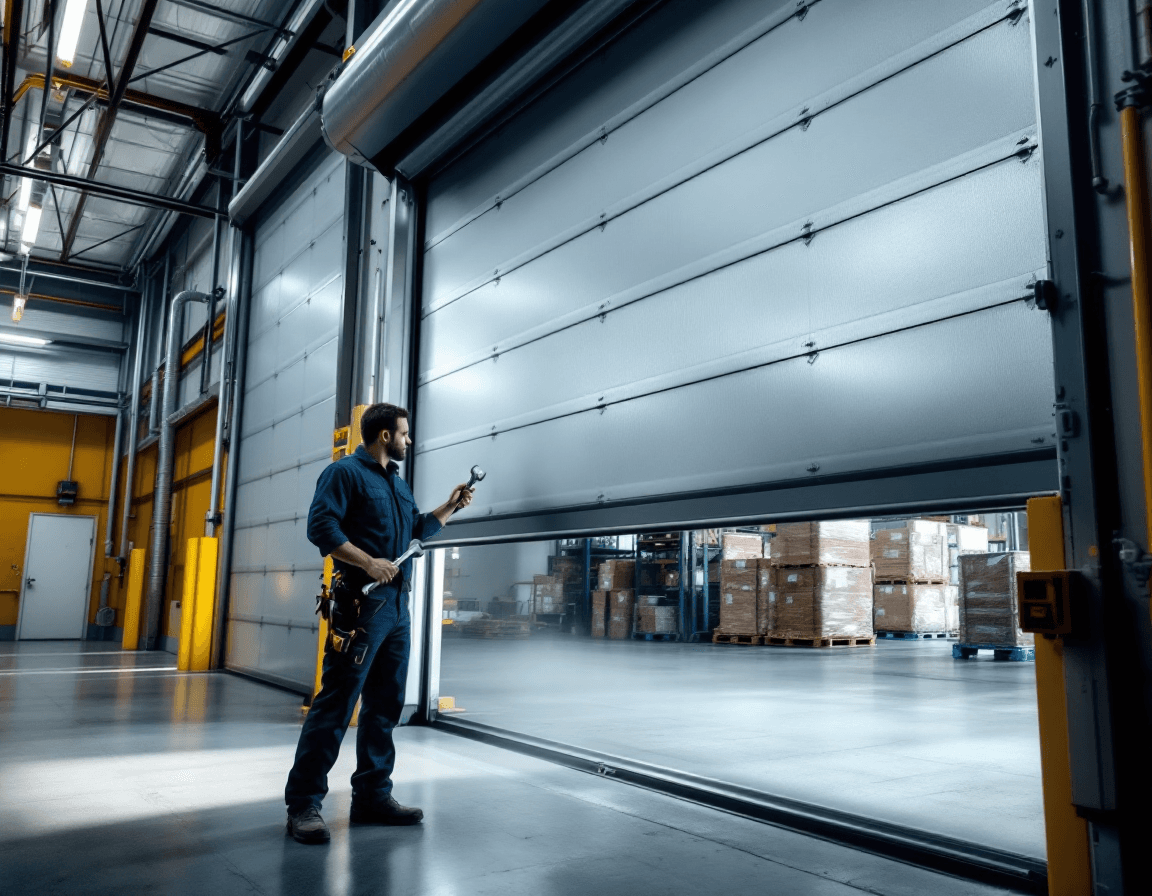
Commercial Overhead Door Repair in Edmonds, WA is a service that keeps warehouses, loading docks, and light-industrial bays running when a single door stops working. Edmonds businesses rely on overhead doors to receive freight, move product, and keep staff moving, so a door that sticks halfway up or refuses to close at the end of a shift quickly turns into lost hours and missed deliveries. Seattle Garage Door Fix handles sectional overhead doors, rolling steel doors, commercial operators, and preventive maintenance for businesses in Edmonds and the surrounding Snohomish County communities, including addresses in the 98020 and 98026 ZIP codes.
Commercial doors are larger, heavier, and used far more often than residential units, so they fail in different ways and need a different kind of response. A typical dock door may cycle dozens or hundreds of times on a busy day, and each cycle loads the springs, cables, rollers, and operator. When something breaks, the priority is not just getting the door working again but getting it working safely and quickly enough that the business can keep its schedule. This page explains the common problems we see in Edmonds, how we approach them, and how a preventive maintenance agreement can reduce the number of emergency calls you make in a given year.
Every site has its own history, and the most useful repairs start with understanding the door in front of us. Our technicians look at the door type, its age, how it has been used, and what the operator is asked to do each day. That information shapes a repair plan and a custom quote, which is why we do not publish a flat price for commercial work. What follows is a practical guide to the situations Edmonds facilities bring to us most often.
Why Edmonds Weather Is Hard on Commercial Door Hardware
Edmonds sits on the Puget Sound shoreline, and that location shapes how commercial doors age. Salt-laden marine air drifts inland, and the damp, drizzly months from fall through spring keep steel surfaces wet for long stretches. Galvanized and painted steel panels, hinges, track brackets, and bottom seals all feel this exposure, especially on buildings near the waterfront or on low-lying lots where moisture collects. Over time, corrosion can seize rollers, weaken fasteners, and roughen the surfaces that the door depends on to move freely.
The Pacific Northwest also produces a steady cycle of temperature swings that test every moving part. Cool, wet mornings can make lubricants thicken and grit stick to tracks, while occasional dry, cold snaps change how springs and cables behave under load. Doors that were adjusted in August may bind by November if the track has shifted slightly or if the bottom weatherstrip has swollen and dragged. Routine inspection is the most reliable way to catch these changes before they cause a stoppage.
Facilities near Downtown Edmonds and the Edmonds Waterfront often notice that their doors show wear sooner than similar equipment farther inland. Our technicians pay particular attention to the lower brackets, the lock bars, and the operator mounting points in those locations. Small corrosion issues are much cheaper to address during a planned visit than during a midweek breakdown.
Sectional Overhead Doors on Warehouse and Dock Openings
Sectional overhead doors are the most common commercial door type we service in Edmonds. Each section is hinged to the next and rides on rollers within vertical and horizontal tracks, which lets the door lift efficiently and stack compactly overhead. Failures in this type of door usually come from the rollers, the hinges, the track alignment, or the balance system rather than the panels themselves. Recognizing which component is responsible saves time and keeps the repair focused.
Common symptoms include a door that rises unevenly, one side that lags behind the other, popping or grinding noises at the track, and sections that separate from the track during operation. A door that is out of level usually has a balance or alignment problem, and continuing to run it can damage the operator and twist the panels. We check track plumb and level, verify roller seating, and inspect the springs and cable system before recommending any component replacement. Panels that are bent or cracked are often replaced individually, which is faster and less expensive than swapping an entire door.
Commercial sectional doors also carry insulation and weather seals that matter for energy use and for keeping conditioned air inside. Worn bottom seals, cracked weatherstripping, and gaps at the header can let rain and cold air into a space, which is particularly noticeable in Edmonds winters. Replacing these seals during a service call is often a sensible investment because it protects both inventory and utility costs.
Rolling Steel Doors That Jam, Drift, or Come Off Track
Rolling steel doors are a different animal. Instead of hinged panels, they are made of interlocking steel slats that wrap around a barrel above the opening. They are common on storefronts, shop entrances, and secured loading bays where space is tight and security matters. When a rolling steel door jams or pops out of its guides, the cause is often a damaged slat, a bent guide, a worn bottom bar, or a barrel that has shifted under spring load.
Edmonds buildings with rolling steel doors sometimes experience guide rails that fill with grit, leaf debris, or salt residue, which can cause the door to bind near the bottom of its travel. A door that drifts sideways may have a misaligned bracket or a slat that has been stressed by repeated impacts. Attempting to force a jammed rolling door can bend slats and turn a manageable adjustment into a costly rebuild. If the door is stuck, the safest first step is to stop operating it and call for service.
Because rolling steel doors carry significant spring tension in the barrel assembly, adjustment and spring work should only be performed by trained, licensed technicians with the correct tools. We inspect the guides, check the bottom bar and lock system, and confirm that the barrel and brackets are secure before recommending a fix. Where slats are damaged, we can often repair or replace specific sections instead of the full door.
When the Commercial Operator Fails Mid-Shift
A commercial operator is the motor and drive system that raises and lowers the door. Depending on the building, it may be a chain-drive unit, a belt-drive unit, or a jackshaft operator mounted above the opening. Commercial operators work hard, and they are rated for specific duty cycles, so a unit that is undersized or poorly maintained can overheat or fail partway through a busy shift. When the operator quits, a door that was working fine minutes earlier can suddenly become a closed barrier.
The most common operator complaints we hear from Edmonds businesses are doors that stop partway, doors that will not respond to the wall control or remote, and units that hum without moving the door. These symptoms can point to a failed limit setting, a blown control board, a worn drive component, a tripped safety circuit, or a power issue at the disconnect. Our technicians test each circuit methodically, starting with the simplest possibilities such as power supply and safety sensor alignment before moving to the drive train and control electronics.
Modern commercial operators include safety features such as photo eyes and edge sensors designed to reverse the door if something obstructs it. A photo eye that is knocked out of alignment or covered with dirt can make the door refuse to close, which often gets mistaken for a larger failure. We clean and align these sensors as part of every operator inspection. We also verify that any safety devices required for your building are working as designed, because a disabled safety feature is not an acceptable shortcut.
Throughput Problems: When the Door Works but Holds Up Operations
Not every commercial door call involves a dead door. Sometimes the door opens and closes but is too slow for the way the business uses it. A loading dock that handles a steady stream of trucks, forklifts, and pallet jacks needs a door that cycles at a pace matching the workflow. If drivers wait several seconds for a door to rise or staff are constantly stopping to wait for a door to finish closing, the delay adds up across every shift.
Throughput issues often trace back to the operator speed setting, the balance of the door, friction in the tracks, or an older drive system that no longer matches current demands. Adjusting the operator, correcting track alignment, lubricating rollers with the right product, and replacing worn hinges can noticeably improve cycle time without a full replacement. In some cases, a higher-speed operator or a different door type is the right answer, and we will explain the tradeoffs before recommending that step.
Speed upgrades must always respect safety requirements. Faster doors need correct sensors, appropriate reversing behavior, and proper controls, so every adjustment is verified before the door returns to service. We will not simply turn up the speed without confirming that the door still stops and reverses reliably. A custom quote gives you a clear picture of which improvements are practical for your site.
Forklift Impact Damage to Panels, Guides, and Frames
Forklifts and pallet trucks are part of daily life in many Edmonds warehouses, and a moment of inattention can put a dent in a door section, bend a track, or knock a guide out of position. Impact damage is one of the most frequent reasons businesses call us for emergency service. Even a modest hit can misalign a section enough to bind the door or cause it to run crooked.
After an impact, the first priority is safety. Do not operate a door that shows signs of major damage, such as a section hanging loose, a track pulled from its mounting, a cable that appears frayed, or a spring that looks displaced. Keep people clear of the opening and call for service. We inspect the affected section, the surrounding tracks, the hinges, and the balance system, then recommend the least invasive repair that restores safe operation. Often, a single panel can be replaced without disturbing the rest of the door.
Prevention matters here too. Bollards, guard rails at the bottom of tracks, clear floor markings, and lighting near the opening all reduce the chance of impact. Some facilities also benefit from relocating high-traffic doors or adding a secondary sensor loop that alerts operators when a door is misaligned. We can discuss these options as part of a site walkthrough.
Triage: What to Do in the First Thirty Minutes
When a commercial door fails, a calm, organized response keeps people safe and makes the repair faster. Before you call, take a few minutes to gather what your technician will need. The following steps are a sensible starting point for most Edmonds facilities:
- Stop using the door immediately if you notice grinding, snapping, sagging, or a section that has come loose from the track.
- Keep everyone clear of the opening and of the area under any spring or barrel assembly.
- Do not attempt to lift a stuck door by hand, pry it off its track, or adjust springs and cables yourself.
- Check whether the operator has power, whether a breaker has tripped, and whether any emergency disconnect has been switched off.
- Note what happened just before the failure, including any impact, unusual noise, or change in how the door was being used.
- Photograph any visible damage from a safe distance, and record the door size, type, and operator model if you can locate that information.
- Tell your team how the door should be accessed or bypassed safely until service arrives, such as using a secondary dock or a designated pedestrian entry.
These steps do not require any tools, and they reduce the chance of making an emergency worse. Clear information lets us prepare the right parts and send the right technician on the first visit.
How We Build a Custom Commercial Quote
Commercial door pricing depends on the door type, size, age, operator, local code requirements, access conditions, and how quickly the repair must be completed. For that reason, we provide custom commercial quotes rather than a single flat rate. Our goal is to give you a clear, itemized picture of what needs to be done, what is urgent, and what can wait for a planned visit. We also focus on turnaround time, because every hour a dock door is down has a real cost for an Edmonds business.
To prepare a useful quote, it helps to have a few details ready. The following information speeds up scoping and reduces surprises:
- The number of doors affected and their locations on the building.
- The door type, approximate width and height, and whether it is sectional or rolling steel.
- The operator brand or model, if visible on the motor housing or control box.
- How often the door cycles during a typical day and whether it serves forklift or truck traffic.
- Any recent repairs, noises, impacts, or intermittent problems you have noticed.
- Your preferred service window, including any after-hours constraints or shift schedules.
- Whether the building has a property manager or landlord who must approve repairs.
With these details, our technicians can often provide a preliminary scope quickly and schedule an on-site assessment. Final pricing is confirmed after inspection so you know exactly what you are approving.
Preventive Maintenance Agreements for Edmonds Businesses
A preventive maintenance agreement is a planned service arrangement that inspects and maintains your commercial doors on a regular schedule. Rather than waiting for a failure, the agreement focuses on catching small problems early, such as a worn roller, a loose bracket, a drifting limit setting, or a sensor that needs cleaning. For businesses that cannot afford unplanned downtime, this approach is usually more predictable and less disruptive than reacting to emergencies.
A typical maintenance visit for a commercial door includes inspecting and lubricating moving parts with appropriate products, checking track alignment and fasteners, testing safety reversal and sensors, examining cables, springs, and drums, and reviewing operator performance. Results are documented so you can see what was done and what may need attention in the future. The schedule and scope can be tailored to the number of doors, the traffic they carry, and the environmental exposure at your site. Doors near the waterfront or in areas with heavy salt exposure may benefit from more frequent inspection of hardware and coatings.
Maintenance agreements also make budgeting easier. Instead of absorbing an unexpected emergency repair, you can plan for regular service and address recommended upgrades on your own timeline. If you manage several buildings in Edmonds or nearby communities, a consolidated agreement can simplify scheduling and reporting.
Safety Rules for Springs, Cables, and Lockouts
Torsion springs and extension springs store large amounts of energy, and cables, drums, and lift components can cause serious injury if they fail under tension. For that reason, spring and cable work is never a do-it-yourself project and should always be handled by a licensed, trained professional. Even experienced maintenance staff should not attempt to wind springs, replace cables, or disassemble a barrel assembly without the correct equipment and training. A spring that appears to be in good condition can still release suddenly.
Lockout and tagout practices protect people during service. When a technician is working on a door, the operator should be disconnected from power and the door should be secured so it cannot move unexpectedly. Staff should keep hands and tools clear of pinch points, avoid standing beneath a door that is being raised or lowered, and never reach into tracks or rollers while the operator is energized. If your facility has its own lockout procedures, share them with the technician before work begins.
If you notice a broken spring, a frayed cable, a door that has dropped, or a panel hanging loose, keep the area clear and call for service. Do not attempt a temporary fix with straps, clamps, or improvised supports. Temporary supports can fail and create additional hazards. A licensed technician can make the door safe and recommend a permanent repair.
Call Seattle Garage Door Fix at (888) 799-3819 for Commercial Overhead Door Repair in Edmonds, WA, whether your loading-dock door is down, a rolling steel door is jammed, your operator has quit mid-shift, or you want to set up a preventive maintenance plan. Our team serves Downtown Edmonds, the Edmonds Waterfront, Perrinville, and surrounding Snohomish County communities in the 98020 and 98026 ZIP codes, and we will provide a custom commercial quote with a fast turnaround so your operations can get back on track.