
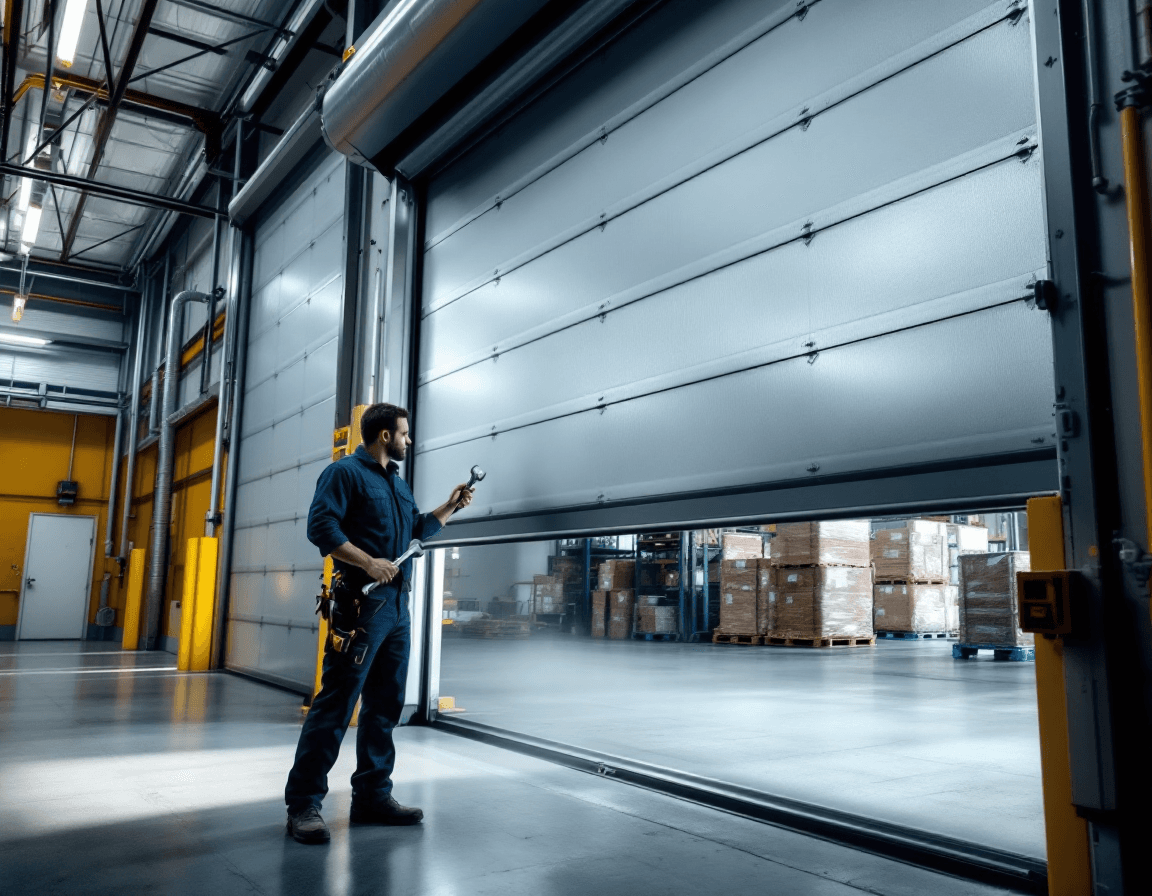
Commercial overhead door repair in Woodway, WA is a different job from residential garage work, and the difference shows up the moment a loading door stops cycling during a delivery window. Woodway is a small, tree-lined community on the bluffs above Puget Sound, with a residential character that stretches down toward the Edmonds corridor, and the businesses that depend on heavy doors often operate from nearby commercial parcels in the 98020 area. A stalled sectional door or a jammed rolling steel shutter can stop receiving, shipping, or service calls cold. Seattle Garage Door Fix handles these calls as operational problems first and mechanical problems second, because every hour a dock sits idle has a cost that goes well beyond the repair bill.
Our technicians work on sectional overhead doors, rolling steel doors, commercial operators, and the preventive maintenance programs that keep all of them running. We understand that a facility manager calling from a loading bay needs a clear plan, an honest estimate, and a crew that arrives with the right parts. Because commercial doors vary widely in size, spring configuration, track geometry, and operator type, we price every commercial job through a custom quote rather than a flat menu rate. That approach lets us match the repair to the actual equipment on site and move quickly once the scope is clear. If your door is down right now, call (888) 799-3819 and describe what you are seeing.
Every commercial door we service is handled by licensed, bonded, and insured professionals, and that matters most when springs, torsion shafts, and cables are involved. The sections below explain how Woodway's climate and setting affect commercial doors, what the most common failures look like, how we scope quotes, and how a preventive maintenance agreement can reduce the surprise breakdowns that cost businesses the most.
How the Woodland Setting and Wet Climate Wear on Commercial Doors
Woodway sits among mature evergreens and deciduous trees, and that canopy shapes what happens to a door long before anyone notices a problem. Needles, catkins, and fall leaves collect in tracks and at the base of rolling steel curtains, and when they mix with winter moisture they form a dense sludge that binds rollers and slows travel. Moss and lichen can creep onto exterior door faces and seals in shaded areas, especially on the north-facing sides of buildings that rarely see direct sun. Over time that organic buildup holds water against the bottom seal and the lower panels, which accelerates corrosion on steel hardware.
The Pacific Northwest's long wet season adds its own pressure. Winter humidity and frequent rain cycles cause steel components to expand and contract, and that movement can loosen bolts, shift track alignment, and stress hinge connections over months of operation. Coastal air carries a light salt load on the breezes off the Sound, which is hard on galvanized hardware and unprotected fasteners. A door that performed well in July can start grinding or hesitating by February, not because anything failed suddenly, but because the cumulative effect of the season finally crossed a threshold.
We recommend that facility managers in Woodway treat the fall and early winter as the right time for a door inspection. Clearing debris from tracks, checking the bottom weather seal, and confirming that drainage paths around the opening are clear will prevent a surprising number of mid-winter calls. A technician can also check the lubrication points and look for early signs of rust on track brackets, which are much cheaper to address before they seize.
Diagnosing a Loading Dock Door That Refuses to Move
When a warehouse or loading-dock door goes down, the first question is always whether the problem is electrical, mechanical, or a safety interlock doing its job. Many dock doors have sensors, edge bumpers, and photo-eyes that shut the door down intentionally when something is in the path. A door that stops halfway and reverses may be reacting to a pallet jack, a leaf in the sensor lens, or a misaligned eye rather than a broken component. Our technicians start by checking these inputs, because a clean photo-eye and a properly seated sensor bracket can restore operation in minutes.
If the controls look normal, the next step is to determine whether the door is moving at all. A door that hums without travel usually points to a drive chain, gear reducer, or clutch problem, while a door that moves unevenly often has track misalignment, a worn roller, or a binding hinge. Some sectional doors will stop when one side lifts faster than the other, which is a clear sign that the spring system or cable drum needs attention. In these situations we do not force the door to continue cycling, because doing so can damage the track, panels, or operator further.
Calling early helps. If a door is making a new noise, hesitating at the same height each cycle, or hanging slightly out of level, describe that when you call. Those details let us bring the right parts and tools on the first visit. If the door is fully down and the business needs access immediately, tell us that as well, because our priority will be to restore safe operation and get traffic moving while we plan a permanent fix.
Rolling Steel Doors That Jam, Bind, or Jump the Track
Rolling steel doors are common on Woodway-area commercial frontages, storage bays, and back-of-house entrances because they stack compactly and withstand heavy use. Their weakness is the track system. Each interlocking slat rides in guides that must stay parallel and free of debris, and a single bent guide or a slat that has lost its alignment can cause the whole curtain to bind. When a rolling door jumps the track, the cause is often a combination of impact, worn bearings, or a curtain that has been pulled at an angle for too long.
Jams usually show up as a grinding or squealing sound partway through the travel, a visible bow in the curtain, or a door that stops and refuses to continue. We look at the guides first, checking for dents, gaps, and debris packed at the base where the curtain enters the track. Next we check the barrel, brake assembly, and bottom bar, since an uneven load on the barrel will pull the curtain askew. Slats that are cracked, bent, or separated from their neighbors usually need replacement rather than straightening, because a distorted slat will keep creating friction even after the track is clear.
If a rolling door has come off the track, avoid pulling or prying it back into place by hand. Steel curtains are heavy and can shift suddenly, and the spring or brake tension involved can cause serious injury. Keep people clear of the opening, secure the area, and call a licensed technician. We will assess whether the curtain can be safely reseated with the proper tools or whether components need to come out for repair.
Commercial Operators That Overheat, Stall, or Quit Mid-Cycle
Commercial operators are built for higher duty cycles than residential openers, but they are still mechanical and electrical systems that respond to heat, voltage quality, and load. An operator that runs for several minutes, shuts off to protect its motor, and then restarts is often telling you it is working too hard. Common causes include an out-of-balance door, a binding track, a weak or failing capacitor, a control board with intermittent faults, or a worn limit setting that forces the motor to strain against the stop. Operating a door that is out of balance is one of the fastest ways to burn out an operator, so it makes sense to address mechanical causes before replacing the motor.
We diagnose operators by checking voltage at the disconnect and motor terminals, verifying that the control wiring is intact, and confirming the travel limits and force settings. A door that has been manually operated for a long time may also have unrealistic settings that cause the operator to fight the load. Some commercial units include fault codes or indicator lights, and recording those codes before the technician arrives will speed up troubleshooting. If the operator makes a burning smell, emits sparks, or trips the breaker repeatedly, shut the door down and call us rather than resetting the breaker over and over.
When an operator is failing, the choice between repair and replacement depends on age, parts availability, the condition of the drive components, and how well the door itself is balanced. We will explain the options clearly in a written quote so facility managers can compare the cost of a targeted repair against a full upgrade. In many cases, a short service visit that corrects the door balance and replaces a worn control part extends the operator's life considerably.
When the Door Is Technically Working but Too Slow for the Job
Not every complaint is a breakdown. Many businesses notice that a door opens and closes correctly but takes long enough that it becomes a bottleneck during peak periods. A dock door that needs twenty seconds to cycle might be tolerable for one truck a day and disruptive when a fleet arrives at once. Slow travel can result from undersized operators, worn gear reduction, excessive friction in the tracks, or a door that has been weighted incorrectly over the years. We treat throughput as a legitimate performance issue and evaluate it alongside safety and reliability.
Improving speed usually involves several steps working together. We check the balance and spring tension so the operator is not lifting more than it should, inspect rollers and bearings for drag, and confirm that the track is aligned and lubricated with products suited to outdoor steel. For some facilities, a faster operator, a different drive ratio, or a high-speed rolling door better suited to frequent cycles is the right long-term answer. We will tell you honestly whether a tune-up will meet your throughput goal or whether an upgrade is the more efficient path.
Before any speed-related upgrade, it helps to write down how many cycles the door sees on a typical day and at peak. That count, along with the door size and the type of traffic passing through, lets us recommend equipment that fits the actual workload. Doors that cycle hundreds of times a day need different components than doors used a few times a week, and matching the hardware to the duty cycle prevents premature wear.
Forklift Strikes and Damaged Sections: Repair Versus Replacement
Forklift impacts are among the most frequent sources of commercial door damage, and they rarely look as bad as they are. A bent panel edge can misalign the entire section, a cracked hinge can cause sections to separate under load, and a dented track can keep rollers from seating correctly. Sometimes the damage is visible only as a slight gap at the seam or a section that sits a fraction of an inch lower than its neighbors. Ignoring a strike because the door still opens is a mistake, since stressed hardware tends to fail suddenly and often on the next high-traffic day.
After an impact, we inspect every affected section, its hinges and rollers, the adjacent track, and the spring or cable system that supports the door. Sections are often replaceable individually, which keeps costs lower than replacing the full door, but only if the surrounding components are still sound. If the track is bent or the spring system has been overstressed, repairing one section alone will not restore reliable operation. Our quotes separate these items clearly so you can see what is needed now and what should be watched.
Documenting the damage with photos before repair is helpful for insurance claims and for internal safety reviews. Many facilities also benefit from a conversation about bollards, guard rails, or lane markings near the dock, since a small change in traffic flow can prevent repeat strikes. We are glad to discuss those site considerations during an inspection, though decisions about site layout remain with the property owner.
Spring and Cable Work Belongs in Licensed Hands
Torsion springs, extension springs, and lifting cables store large amounts of energy, and they are the parts of a commercial door most likely to cause serious injury when handled incorrectly. A torsion spring under tension can release with enough force to break bones, and a snapped cable can whip across a bay. For this reason, spring replacement, cable repair, drum adjustment, and any work that requires winding or unwinding tension should be performed only by trained, licensed professionals with the proper winding bars, safety equipment, and procedures. Do-it-yourself attempts on commercial springs are dangerous and often damage the door further.
Warning signs that a spring or cable needs immediate professional attention include a loud bang from the header area, a door that suddenly becomes very heavy or drops unevenly, a visible gap in a coiled spring, or cables that are fraying or off the drum. If you notice any of these, keep the door closed if it is safe to do so, restrict access to the area, and call us. Do not attempt to lift the door manually to test it, and do not stand beneath a door that is hanging unevenly.
We include spring and cable inspection in our preventive maintenance visits because these components wear gradually and their condition is not always visible from ground level. Cycle counts, age, and installation records all help determine when a spring should be replaced proactively rather than after failure. Planning that replacement during a scheduled window is far better for operations than an emergency call on a busy morning.
Here are the situations where we strongly recommend a licensed crew handle the work:
- A torsion spring is broken, gapped, or visibly loose on the shaft
- A cable is frayed, off the drum, or showing kinks or broken strands
- The door drops suddenly, sits unevenly, or resists manual movement after a spring event
- The header, bracket, or drum shows bending, cracking, or separation
- Any repair requires releasing or adjusting spring tension
Building a Custom Commercial Quote Without Guesswork
Because commercial doors vary so much, we do not publish a single price for a repair or replacement. Instead, we build a custom quote based on the door type, its size, the condition of each component, the operator, access requirements, and the urgency of the call. A small rolling door in a storage bay and a multi-section insulated dock door with an electric operator may both be called "a loading door," but they require very different parts, labor, and safety planning. Our goal is to give you a quote that reflects the work actually needed, not an estimate padded to cover unknowns.
To speed up the quote, it helps to have a few details ready when you call. Knowing the door manufacturer if the label is visible, the approximate width and height of the opening, the operator brand and model if you can read it, and how many times the door cycles per day will let us prepare accurately. Photos of the damage, the track, and the operator control panel are also useful, especially if the situation is urgent. We can often outline the likely scope before arriving, which reduces the number of visits needed.
Fast turnaround matters, but speed should never come at the expense of a correct repair. We aim to get your door back in service quickly while still giving you a clear explanation of what was done, what parts were used, and what should be monitored going forward. When a temporary fix is appropriate to keep operations moving, we will say so and recommend a permanent plan.
- Door type: sectional, rolling steel, or other configuration
- Approximate opening width and height
- Operator brand, model, and any visible fault indicators
- Daily or peak cycle count and the hours the door is most used
- Photos of damage, track condition, and control panel
- Access constraints such as after-hours windows, tenant rules, or required notice
Preventive Maintenance Agreements That Protect Operations
A preventive maintenance agreement is designed for businesses that cannot afford unplanned door downtime. Rather than waiting for a failure, the agreement schedules regular inspections that look for worn rollers, loose hardware, lubrication needs, track alignment, sensor performance, operator health, and spring and cable condition. Each visit produces a written summary so you know what was checked, what was adjusted, and what components are approaching end of life. Over time this record helps with budgeting and with decisions about when to replace equipment.
The right maintenance interval depends on how hard your doors work. A low-traffic storage door in a wooded setting might be reviewed less frequently than a busy dock door that cycles all day, and Woodway's wet season is a good reason to schedule at least one visit before winter. We will recommend an interval based on your cycle counts, door types, and the environment around each opening. Some agreements also include priority scheduling for service calls, which can be valuable when a door failure would halt deliveries or shipments.
Preventive work is most effective when the facility also keeps simple habits in place. Clearing debris from tracks and sensor lenses, reporting unusual noises promptly, avoiding overloading the operator, and keeping vehicles clear of the opening all reduce wear between visits. We are happy to walk your team through what to watch for and what to avoid, so that everyone who uses the doors understands their role in keeping them reliable.
Keeping Downtime Short When Every Hour Counts
When a commercial door fails, the businesses we serve in and around Woodway usually need three things at once: a safe way to secure or isolate the opening, a clear diagnosis, and a realistic timeline for getting back to normal. We prioritize calls based on safety risk, whether the door is blocking egress or a critical operation, and whether a temporary workaround is possible. A door that is stuck open in a secured bay may be less urgent than a dock door that is stuck closed during a delivery window, and we factor that operational reality into how we schedule.
During a call, the most helpful thing you can do is describe what you observed and what has changed. Did the door make a noise before it stopped? Did it operate normally yesterday? Is there visible damage, a recent impact, or a change in weather? Those details let our team plan the right parts and tools so we are not making multiple trips. If a temporary measure is safe, such as manually securing a rolling door in a closed position by a qualified person, we will advise on that and make sure you understand the limits.
Once the immediate problem is handled, we recommend a short review of what happened and whether a preventive visit would reduce future downtime. Many of the failures we see in Woodway's commercial corridor trace back to a handful of predictable causes: debris in tracks, neglected seals, worn rollers, and springs that were never inspected after years of heavy cycling. Addressing those items on a planned schedule is almost always cheaper and less disruptive than repeating emergency calls.
Commercial doors keep your facility moving, and they deserve the same careful attention you give to your other critical equipment. If your loading-dock door is down, a rolling steel door has jammed, an operator is failing, or you are ready to put a preventive maintenance plan in place, call Seattle Garage Door Fix at (888) 799-3819. Describe what you are seeing, and we will help you get a clear plan and a custom quote so your team can get back to work.