
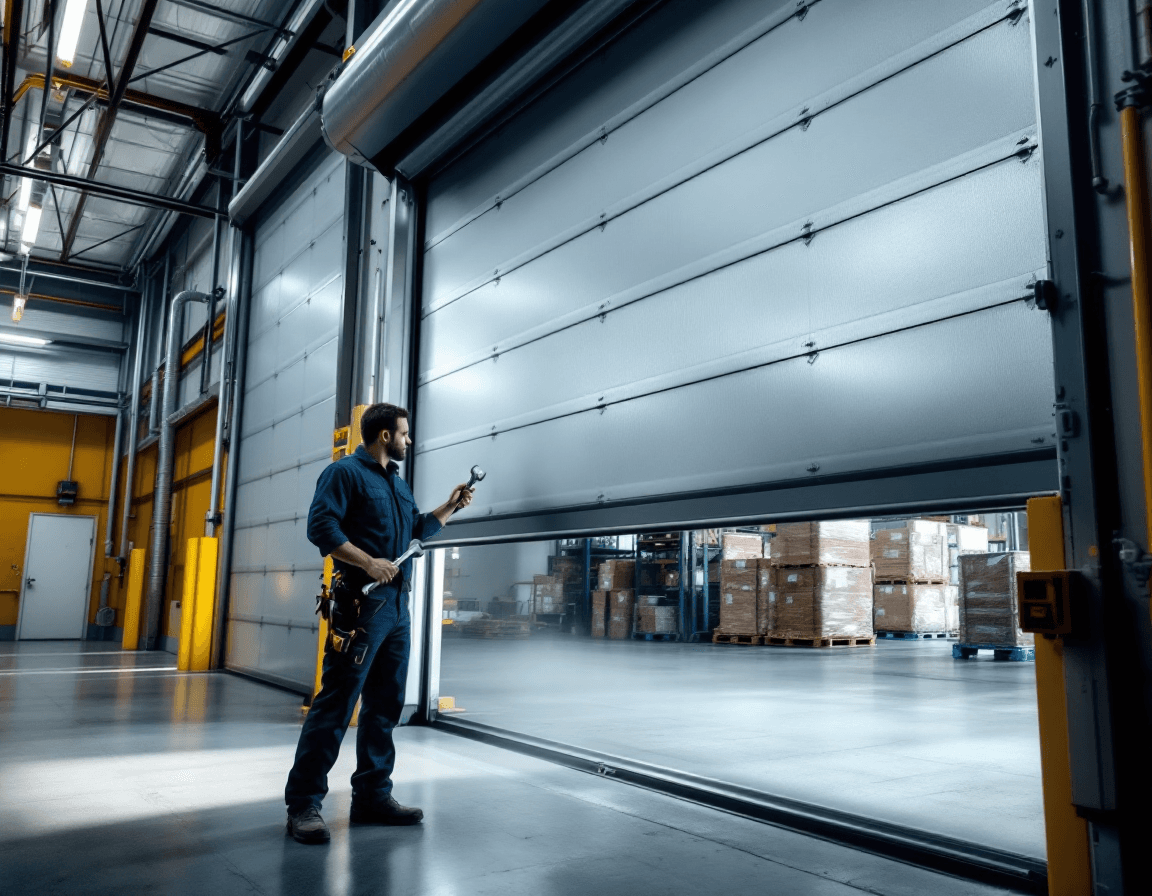
Commercial Overhead Door Repair in Shoreline, WA is a service that most business owners don't think about until a loading-dock door stops in the middle of a delivery window. Shoreline sits between Seattle and Lynnwood, and its mix of light industrial lots, retail strips, auto shops, and contractor yards depends on large doors that open and close dozens of times a day. When one of those doors fails, the cost is measured in idle trucks, rescheduled pickups, and staff standing around the bay waiting for it to move again. Seattle Garage Door Fix works with commercial property managers, facility teams, and owner-operators across Shoreline to get those doors back in service with minimal disruption.
This page explains how we approach commercial overhead and rolling steel door problems in Shoreline, what symptoms usually point to a specific failure, and how we price and schedule work so your operation keeps moving. We cover sectional doors, rolling steel shutters, commercial operators, and preventive maintenance agreements, along with the safety rules that apply to any spring or cable work. Whether your building is near the Aurora corridor, tucked into a business park off Bothell Way, or sitting close to the Interurban Trail, the principles are the same: diagnose accurately, quote clearly, and repair in a way that lasts through a Pacific Northwest winter.
If your dock door is down right now, or you suspect it will be soon, the sooner you call the better. The sections below walk through the most common commercial failures we see in this area so you can describe the problem accurately when you reach out.
Why Shoreline's Wet Winters Wear Down Commercial Steel
Western Washington's weather is gentle in temperature but relentless in moisture, and that combination is hard on steel doors. Shoreline gets long stretches of drizzle, fog off Puget Sound and the Sound-side hills, and damp mornings that can linger well past sunrise. Moisture settles into hinges, roller bearings, and the bottom seal, and it works its way into the tracks where grit from road traffic collects. Over several seasons, that moisture encourages surface rust on exposed galvanized edges, softens weather seals, and loosens fasteners that were never meant to sit in standing water.
Coastal salt air adds another layer of wear for businesses closer to the western edges of town and the bluffs near Richmond Beach. Salt carried on wind and deposited on exterior surfaces accelerates corrosion, particularly where paint has chipped from routine bumps. Even inland, the cycle of wet and dry conditions makes the metal expand and contract slightly through the year, which can shift track alignment and stress panel joints. A door that operated smoothly in August may start to drag by January simply because the environment has been doing quiet work on it.
For this reason, our commercial inspections focus on moisture-related wear as much as mechanical wear. We look at rust bloom on track flanges, the condition of bottom weather seals, the presence of standing water or debris in the track channel, and the state of any exposed fasteners. Catching these issues during a routine visit is far cheaper than replacing a warped section after it has jammed the door halfway up on a busy Monday morning.
Reading the Warning Signs Before a Dock Door Quits
Most commercial door failures announce themselves well before the door stops completely. Operators who notice these early signs and report them promptly often avoid the emergency call entirely. The trick is knowing which changes matter, because a door that makes noise every morning may simply need lubrication, while a door that suddenly sounds different may have a broken component under load.
Pay attention to changes in speed, sound, and smoothness. A door that takes noticeably longer to rise or lower, that stutters at the same spot each cycle, or that grinds or pops at the top of its travel usually has a developing problem with the drive, the track, or the spring system. Vibration that you can feel through the floor or the door frame is another signal that something is out of balance or that a roller has begun to fail.
- Slower cycle times than the door used to achieve, especially when lifting a full-height sectional panel.
- Grinding, clicking, or popping noises at the same point in the travel path on every cycle.
- Visible gaps between sections, uneven bottom seals, or a door that sits crooked when closed.
- Operator motor that runs hot, hums without moving the door, or trips its thermal protection.
- Rolling steel curtain that binds at one side or telescopes unevenly into the head box.
- Photo-eye or safety reversing sensors that intermittently fail, causing the door to stop or reverse without cause.
If you see any of these signs, schedule service before the door stops. Continuing to run a door that is struggling can turn a manageable roller or track repair into a damaged panel, a burned-out motor, or a bent shaft that takes far longer to fix.
Sectional Doors Versus Rolling Steel: Choosing the Right Repair Path
Commercial buildings in Shoreline use two main door types at loading points, and each one has its own repair logic. Sectional overhead doors are made of insulated or non-insulated panels joined by hinges and guided up a track system into a horizontal position near the ceiling. They are common on warehouses, distribution spaces, and service bays where clear overhead height matters and the door must open quickly. Rolling steel doors, by contrast, are made of interlocking slats or a solid curtain that coils around a barrel above the opening, making them ideal for storefronts, auto shops, and buildings where space is limited inside or outside the door.
Sectional door repairs typically center on panels, track alignment, rollers, hinges, and the counterbalance springs that do most of the lifting. A damaged panel may be replaceable as a single unit without removing the whole door, while a misaligned track often requires careful re-leveling and anchor bolt correction. Rolling steel repairs revolve around the curtain, the guides on each side, the barrel and brake assembly, and the operator that drives the shaft. A single bent slat can sometimes be replaced, but a curtain that has been pulled out of its guides may need to be re-laced, re-tensioned, and checked for hidden damage in the barrel.
Choosing between repair and replacement depends on several factors. We consider the age of the door, the availability of matching parts, how much of the door is affected, the condition of the operator, and how many hours the door must run each day. In many cases, a targeted repair restores full function at a fraction of the cost of a new door. In other cases, a door has reached the point where a replacement section or full replacement is more economical, and we will say so plainly with the numbers on paper.
Commercial Operators and Throughput: When the Motor Is the Bottleneck
For a busy loading dock, the speed of the door is a business issue, not just a convenience. If a dock door takes forty seconds to open when it should take fifteen, every truck that cycles through the bay loses time, and that delay adds up across a full shift. Commercial operators are designed to handle high cycle counts and heavier loads than residential units, but they also degrade over years of use, especially when lubrication lapses or electrical connections loosen in damp conditions.
Operator problems often show up as slow travel, intermittent stopping, overheating, or a complete failure to start. A failing limit switch can cause a door to stop short of its open position, while a worn drive chain or belt can slip under load. Control panels exposed to humidity can develop corroded contacts that produce erratic behavior, and wiring that has been pulled or pinched by a passing forklift may cause faults that look mysterious until someone traces the circuit. Our technicians check motor amperage, brake function, limit settings, and wiring integrity as part of every operator diagnosis.
Throughput improvements are often achievable without replacing the entire operator. Adjusting travel speed where the equipment allows, upgrading to a higher-duty drive where the existing door hardware can support it, or installing a faster control module can shave meaningful time off each cycle. We will explain what is possible for your specific door and what is not, because a door that is physically heavy or mechanically worn will not become fast simply because the motor is larger.
Forklift Strikes and Damaged Panels Along the Loading Dock
Forklift impacts are among the most frequent causes of commercial door damage we encounter. A pallet that catches the bottom panel, a load that swings during a turn, or a reversing forklift that misjudges the opening can bend a section, crack a panel seam, or knock a track out of alignment. Even a glancing blow can deform the edge of a steel panel enough to prevent it from sliding smoothly through the track, and some damage is hidden until the door is cycled and begins to bind.
Our approach to impact damage starts with a full inspection rather than a quick fix. We check the damaged panel and the adjacent sections, the hinges connecting them, the track near the point of impact, and the rollers that carry the load. We also look for signs that the counterbalance system has been affected, since a bent section can change the weight distribution and strain the springs or cables. Replacing only the visibly damaged panel is sometimes sufficient, but a door that has been struck hard may need track straightening or roller replacement to function safely.
Prevention matters here too. Bollards, painted safety striping, traffic mirrors, and clearly marked speed zones near the door can reduce impact frequency. Many Shoreline facilities also find that training drivers to approach the dock slowly and to confirm clearance before lowering a load prevents repeat damage. We are happy to discuss these measures during a site visit and can recommend placement options that fit your yard layout.
Off-Track Rolling Steel and Jammed Curtains
When a rolling steel door jumps off its guides or jams partway through its travel, the situation can feel urgent because the opening is either partly blocked or stuck in an unsafe position. Rolling steel curtains depend on the guides on each side to keep the slats aligned as they wind onto the barrel. A bent guide, a loose bracket, debris lodged in the channel, or uneven tension between the two sides can cause the curtain to ride up or telescope unevenly, which then leads to binding and a jam.
Correcting an off-track rolling door requires patience and attention to detail. We first secure the door against unintended movement and confirm that no one is in the opening. Then we inspect the curtain for kinks or damaged slats, check the guides for straightness and proper spacing, and examine the barrel and brake system for signs of uneven winding. In some cases the door can be carefully re-seated and tensioned in place, while in others a damaged slat or guide must be replaced before the curtain can run again.
Jammed doors also raise a safety concern. A curtain that is partly raised and partly stuck can fall unexpectedly if its brake or spring system is compromised. For that reason, we treat any jam as a potential hazard until it is resolved, and we ask that facility staff keep clear of the opening and avoid forcing the door by hand or with equipment. Our technicians bring the tools and parts needed to address most jams in a single visit whenever possible.
Custom Quotes and Keeping Your Shutter Moving Fast
Commercial door work is priced on a per-job basis because no two loading docks or storefronts are identical. A quote for a single dock seal in a small auto shop looks nothing like a quote for a multi-door distribution building that needs operator replacement and track correction. We provide custom commercial quotes that itemize the work, the parts, and the labor, so you can compare options and approve the scope that fits your budget and operating schedule.
Fast turnaround is a priority for businesses that cannot afford extended downtime. When you call, we will ask for the building address, the door type and approximate size, the symptoms you are seeing, and whether the door is fully inoperable or still usable at reduced speed. That information helps us determine whether a same-day response is realistic and which parts are likely to be needed. Where possible, we will identify common components on the truck before arriving, and for specialty items we will give you a clear estimated lead time so you can plan around it.
To speed up the quoting process, it helps to have certain details ready before you call:
- The approximate width and height of the opening, measured from the inside of the frame.
- The manufacturer name or serial plate on the door or operator, if you can locate it.
- A brief description of when the problem started and whether it has worsened over time.
- Your preferred service window, including any hours when the dock or bay must remain accessible.
- Whether the door has recently been struck, serviced by another company, or modified.
Having these details ready allows us to give you a more accurate estimate faster, often during the first call.
Preventive Maintenance Contracts Built Around Your Operating Hours
Reactive repairs are unavoidable sometimes, but a preventive maintenance agreement can significantly reduce the number of emergency calls a commercial property faces. A maintenance contract schedules regular inspections, lubrication, adjustment, and safety testing at intervals that match how heavily your doors are used. For a high-traffic distribution dock, that might mean more frequent visits than for a seldom-used side entrance at a small contractor yard. The goal is to catch wear before it becomes failure and to keep records that support warranty claims and insurance requirements.
A well-designed maintenance plan covers the components that matter most in this climate. That typically includes checking track alignment and fasteners, cleaning and lubricating rollers and hinges, inspecting weather seals and bottom bars, testing photo-eyes and safety edges, verifying operator limits and reversal function, and reviewing spring or cable condition under the supervision of a licensed technician. Documentation from each visit gives facility managers a clear history they can share with owners, insurers, or auditors.
We build maintenance agreements around your operation rather than offering a one-size package. Some clients prefer quarterly visits timed before the wettest months, while others want service scheduled around low-volume days or overnight hours. We will discuss the number of doors involved, their age and condition, your typical cycle counts, and any seasonal peaks in your business, then propose a plan that makes sense and can be adjusted as conditions change.
Safety Standards for Spring and Cable Work on Commercial Doors
Spring and cable systems are the most dangerous part of any overhead door. Torsion springs and extension springs store enormous amounts of energy, and a failed or improperly adjusted spring can release that energy with force capable of causing serious injury. Cables can snap under tension and whip across the opening, and drums can unwind unpredictably if handled without the proper tools and procedures. Because commercial doors are often larger and heavier than residential units, these risks are magnified.
For this reason, spring replacement, cable repair, and counterbalance adjustments should always be performed by a licensed, trained professional with the correct equipment and procedures. Attempting these repairs with improvised tools, standing in the path of a loaded spring, or relying on general advice from online videos is a common cause of preventable injuries. Facility staff should never attempt to wind springs, release tension, or remove cable components, even if the door appears to be a simple fix.
Our technicians follow established safety practices for commercial spring and cable work, including securing the door before any tension is released, using appropriate winding bars and locking devices, inspecting all hardware before reassembly, and testing the balance and safety reversal after the repair is complete. If your door needs spring or cable work, we will explain what is involved, what parts are required, and how the repair will be verified before the door returns to service. Your team's safety is a non-negotiable part of every commercial job we take on.
Serving Shoreline, Richmond Beach, Echo Lake, and North City
Shoreline is a city with distinct pockets, and each one presents slightly different needs for commercial doors. Businesses near the Aurora corridor often operate high-traffic service bays and retail loading areas with heavy daily cycling. Properties in the Richmond Beach area, closer to the bluffs and the Sound, deal more directly with salt air and damp coastal weather that accelerates corrosion. Commercial users around Echo Lake and the central business districts frequently juggle tight lot layouts where doors must open quickly without interfering with traffic or pedestrians. North City and the surrounding neighborhoods include a mix of small contractor yards, retail strips, and light industrial spaces that rely on reliable rolling steel and sectional doors for daily operations.
We provide commercial overhead and rolling steel door service throughout Shoreline and nearby areas across ZIP codes 98133, 98155, and 98177. If your property is in one of these areas or along the nearby commercial corridors, our team can usually respond within the same service region we already cover for facilities across King County. Wherever your building sits, our goal is the same: diagnose the problem accurately, provide a clear custom quote, and restore your door with as little disruption to your business as possible.
Whether your dock door is down right now or you are planning ahead with a preventive maintenance agreement, Seattle Garage Door Fix is ready to help. Call (888) 799-3819 to describe your door, your symptoms, and your timeline, and we will tell you what to expect and how quickly we can get a technician to your site.