
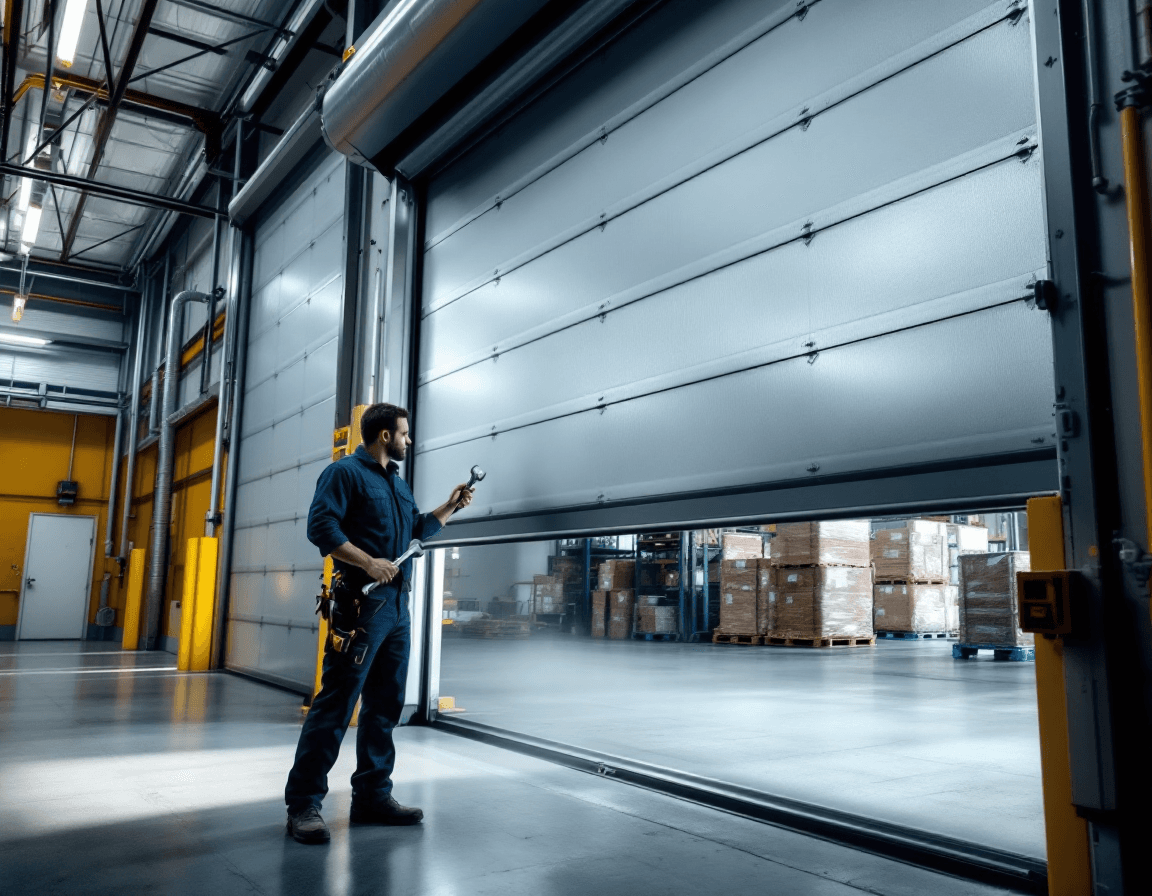
Commercial overhead door repair in Seattle, WA is a different job from fixing a residential garage door, and the difference shows up the moment a loading dock goes down. A warehouse or distribution bay that can't cycle its door is a bay that can't receive freight, load trucks, or move product, and every hour of that stoppage costs real money. Seattle Garage Door Fix provides licensed, bonded, and insured commercial service across King County, including the Seattle ZIP codes 98101, 98103, 98105, 98107, 98109, 98115, 98116, 98117, 98118, 98122, 98125, 98133, 98136, 98144, and 98199. We work on sectional overhead doors, rolling steel doors, commercial operators, and preventive maintenance programs for businesses ranging from single-bay shops to multi-dock facilities.
Our technicians understand that a commercial door sits at the center of daily operations, not at the edge of them. Whether the door belongs to a light-industrial building in SoDo, a food service kitchen off Dearborn, or a delivery bay tucked behind a Ballard storefront, the question is usually the same: how quickly can the opening be made safe and functional again? Custom commercial quotes are built around that question, and we aim for fast turnaround so your operation is disrupted for as little time as possible. This page explains how commercial doors fail in our climate, what symptoms to watch for, and how a maintenance plan can prevent many emergency calls before they happen.
Read on for a practical walk-through of the most common problems we see across Seattle, from rain-soaked tracks in Rainier Valley to salt and grit on the approach ramps near West Seattle. You will also find guidance on when a repair makes sense, when a section or operator should be replaced, and how to set up preventive service that fits your hours. If your door is down right now, call (888) 799-3819 and we will talk through what you are seeing before a technician arrives.
Why Seattle Dock Doors Wear Faster Than the Brochure Suggests
Seattle's climate is gentle on the thermometer but hard on steel and moving parts. Months of drizzle, persistent humidity, and long gray stretches from October through April keep metal surfaces damp for extended periods, and that moisture accelerates corrosion on tracks, hinges, brackets, and the bottom weatherseal. Coastal salt-laden air drifts inland in some areas near the Sound, and road grime from freight traffic on arterials like Airport Way and East Marginal Way settles on door hardware and works its way into bearings. A door that looked perfectly fine during a dry August can start grinding by November simply because the environment has been slowly eating at its lubrication and fasteners.
Heavy daily use compounds the problem. A loading dock door in a busy receiving bay may cycle dozens or even hundreds of times during a single shift, and each cycle stresses the springs, cables or chains, rollers, and drive components. Temperature swings between cold mornings and warm warehouse interiors can also cause panels and tracks to flex slightly, which loosens fasteners over time. None of this means a commercial door is poorly built, but it does mean that a schedule suited to a residential garage door will fall short for most business applications.
Because of these conditions, we tend to recommend a more frequent inspection rhythm for high-traffic doors, especially those exposed to outdoor weather in open yards. Keeping an eye on drainage, track alignment, and corrosion before a seasonal change is far less expensive than responding to a seized door during a delivery window. Ask your technician to note any early signs of wear during each visit so you can plan repairs on your schedule rather than the door's.
Reading the Warning Signs Before a Dock Door Quits
Most commercial door failures announce themselves well before the door stops completely. Operators often notice a change in sound first, such as a new squeal on the way up, a rhythmic clunk at the top of travel, or a grinding noise near the bottom bar. Movement can change too: the door may hesitate, stop partway and reverse, or lift unevenly so one side rides higher than the other. These behaviors usually point to track obstruction, roller wear, unbalanced tension, or an operator that is starting to labor under load. Catching them early often means a targeted repair instead of a full replacement.
Visual clues matter just as much. Look for daylight showing at the edges of the door when it is closed, gaps at the bottom seal, panels that look bowed or bent, and rust forming at track joints or along the bottom of the curtain. Frayed cables, loose brackets, and cracked rollers are signs that the door's load-bearing components are fatiguing, and a worn cable or spring should never be ignored because it can release suddenly under tension. If you see any of these, schedule an inspection rather than waiting for the door to fail completely.
Operator behavior is worth tracking, too. A motor that runs hot, trips the overload protection, or makes a buzzing noise without moving the door is telling you something about power supply, limit settings, or mechanical resistance. Many facilities keep a simple log noting when a door felt slower than usual, when it needed a second attempt to close, or when a sensor flickered. That information helps a technician diagnose the problem faster and often prevents an emergency visit.
- Unusual grinding, squealing, or banging during travel
- Door stops, reverses, or rides unevenly on one side
- Visible gaps at the bottom seal or along the jamb
- Rust or debris accumulating in the tracks
- Frayed cables, cracked rollers, or loose brackets
- Operator motor running hot or tripping its overload
Sectional Overhead Doors: Panels, Tracks, and Counterbalance Realities
Sectional overhead doors are the workhorse of most warehouses, service bays, and distribution centers. They are built from insulated or non-insulated panels joined by hinges and rolled up a track system on the ceiling, which means they depend on precise alignment, balanced tension, and clean rollers to operate smoothly. Common repairs include replacing a damaged panel, correcting a track that has shifted after an impact, swapping worn hinges, and adjusting the bottom weatherseal so it seals against an uneven slab. Many of these tasks are straightforward for an experienced technician, but they still require attention to the door's full system rather than one component at a time.
Counterbalance systems deserve special respect. Commercial doors typically use torsion springs mounted on a shaft above the opening, and these springs store enormous energy when wound. Replacing or adjusting them is dangerous work that must be performed by a licensed, trained professional with the right tools and equipment. Attempting a spring change yourself can result in serious injury, and it can also damage the door if the tension is set incorrectly. Our policy is clear: spring and cable work belongs in the hands of qualified technicians, every time.
When we evaluate a sectional door for repair versus replacement, we look at panel condition, track geometry, the age of the counterbalance system, and how much the door is being asked to do. A single damaged panel on an otherwise sound door is often an easy fix, while a door with widespread corrosion, multiple warped sections, and worn tracks may justify a full upgrade. We will explain the options clearly and provide a custom commercial quote so you can compare costs without guesswork.
Rolling Steel Doors in Tight Industrial and Retail Spaces
Rolling steel doors are built for openings where a sectional door would not fit or where security and fire-rating requirements call for a different design. Their slats coil into a compact barrel above the opening, which makes them common in older Seattle buildings, storefronts with limited headroom, and light-industrial spaces where ceiling clearance is tight. Because they run in vertical guides on each side instead of horizontal tracks, rolling steel doors can jam if a guide bends, debris collects in the channel, or a slat is pushed out of line by a bump from a pallet jack or truck.
Typical issues include a door that binds partway up, a slat that has popped out of its interlock, a bent bottom bar that catches on the guide, and a barrel or shaft that is no longer turning evenly. Repairing these problems often means straightening guides, replacing individual slats, re-aligning the curtain, and checking the spring or motor assembly that counterbalances the door's weight. Slats are not all interchangeable, so precise measurement matters when ordering parts for an older installation.
Rolling doors also see unique wear in Seattle's damp conditions. Water and grit that get into the guide channels can rust the interlocks and create friction that slowly drags down performance. We recommend regular cleaning and lubrication of guides, careful attention to drainage at the base of the opening, and prompt attention to any slat that shows surface rust or deformation. Because these doors often protect valuable inventory and sensitive operations, a small problem caught early is far better than a jammed curtain during a shift change.
Commercial Operators and When Slow Becomes Expensive
Commercial operators are the motors and controls that raise and lower large doors, and they must be matched to door weight, size, and cycle demand. A door that moves a little slower than it used to may seem tolerable, but in a busy receiving area even a few extra seconds per cycle adds up across a shift and can back up forklifts, trucks, and staff. When throughput drops, the operator is often the first suspect, though the cause may be a misadjusted limit, a worn drive chain or belt, a failing capacitor in the control board, or resistance caused by a track problem elsewhere in the system.
Operator failure can also be sudden. A control panel may stop responding after a power surge, a photo eye may misalign and keep the door from closing, or a motor may simply burn out after heavy use. We troubleshoot the whole circuit before recommending replacement, because many failures trace back to wiring, safety sensors, or the door's counterbalance rather than the motor itself. When a replacement is needed, we size the operator for the actual door and cycle requirements instead of guessing.
Speed and reliability are business decisions as much as technical ones. Some facilities need faster cycle times to keep trucks moving, while others prioritize quiet operation near residential edges or tighter safety controls. We discuss these priorities during the quote process, so the repair or upgrade reflects how your site actually runs. Our goal is an operator that performs consistently under your real workload, not just on a spec sheet.
Forklift Strikes and Damaged Sections: Triage and Replacement Strategy
Forklift impact is one of the most common causes of commercial door damage, and it often happens in seconds during a busy dock shift. A tine or pallet that clips the lower panels can crack sections, bend tracks, pull hinges out of their mounts, or throw the entire curtain out of alignment. The damage may look minor from the outside while the internal components are stressed or misaligned. For that reason, every impact should be inspected before the door is used heavily again, even if it appears to function normally afterward.
Our triage process starts with safety. If the door is hanging unevenly, if a cable or spring is visibly loose, or if a section is hanging by one hinge, the opening should be secured and kept closed until a technician can stabilize it. From there, we assess which panels or sections need replacement, whether the tracks and brackets are still true, and whether the counterbalance system was affected. Replacing a single section is often possible, but matching panel profiles, insulation, and hardware to an older door can take careful measurement.
Operators sometimes ask whether they should replace damaged sections piecemeal or upgrade the whole door. The answer depends on the age of the door, the availability of matching parts, the condition of the remaining sections, and the cost of repeated downtime. We provide clear options and a custom commercial quote, so you can make an informed decision rather than defaulting to the quickest patch. Many operations also decide to add protective bollards or guard rails after a strike, which can reduce future damage significantly.
Off-Track Doors and Jams: What a Technician Checks First
When a commercial door comes off its track, the instinct is often to force it back and try again. That approach can bend rollers, twist sections, and create a much larger problem. A safer first step is to stop operation, keep people clear of the opening, and call for service. A technician will check for obvious obstructions, verify that the tension on the counterbalance is correct, and inspect the track for dents, gaps, or loose fasteners before attempting to return the door to its channel.
Jams have a wide range of causes. Debris such as gravel, broken pallet boards, or packaging can get lodged in the track or guide channel, and water can freeze or stiffen rollers in colder weather. Worn rollers can jump the track under load, and a bent bottom bar can catch on a seal or guide. Electrical faults may also appear as jams, such as a limit switch that stops travel prematurely or a safety edge that triggers repeatedly. A methodical inspection separates these possibilities so the correct fix is applied.
We also watch for patterns. A door that comes off track on the same side every time often has a worn roller, a bent track section, or uneven lift from a counterbalance issue. Recording when and how the door jams helps us identify root causes quickly. When we find a problem that could affect safety, such as damaged cables or a compromised spring, we explain what needs to be replaced and why, and we perform that work with the appropriate licensed procedures.
Building a Preventive Maintenance Agreement That Fits Your Schedule
A preventive maintenance agreement is one of the most effective ways to keep commercial doors running and avoid emergency calls during peak periods. Instead of waiting for a failure, a scheduled program lets a technician inspect the door, operator, safety sensors, and hardware on a regular rhythm, adjusting and lubricating as needed. For many Seattle businesses, the value is less about the single visit and more about the predictability: you know when your doors will be checked, and you have a documented history of what was found and fixed.
Preventive service is especially useful for facilities with seasonal demand, such as food distributors who see heavier cycles before holidays or contractors whose trucks run hardest during spring and summer construction. A maintenance plan can be scheduled around your operating hours, so inspections happen during slow periods rather than in the middle of a delivery window. We can also prioritize doors that are most critical to your operation, and we can tailor the checklist to your equipment, whether that is a sectional dock door, a rolling steel service door, or a mix of both.
Agreements typically cover items such as track alignment, roller and hinge condition, lubrication, bottom seal condition, safety sensor testing, operator limits, and a review of any worn parts that should be scheduled for replacement. Here is a typical checklist for a preventive visit:
- Inspect tracks, guides, and brackets for alignment, looseness, and corrosion
- Lubricate hinges, rollers, bearings, and drive components as appropriate
- Test safety edges, photo eyes, and reversing function
- Check counterbalance components and flag any wear for licensed service
- Evaluate bottom seal and weatherstripping for water and pest intrusion
- Review operator performance, limit settings, and cycle speed
- Document findings and provide a summary of recommended repairs
How Custom Commercial Quotes and Fast Turnaround Work
Because commercial doors vary so widely in size, age, configuration, and use, we do not rely on flat-rate pricing for most projects. Each custom commercial quote begins with a site assessment or a detailed description of the problem, along with photos, door dimensions, operator model if known, and any history of recent repairs. From there, we outline the recommended work, parts required, labor, and any options for repair versus replacement. Our aim is a quote that is clear enough to approve quickly so that work can begin without unnecessary delay.
Fast turnaround is important when a dock door is down, and we prioritize calls that affect active operations. Where possible, we coordinate with your receiving schedule, your facility manager, or your truck dispatch team so technicians arrive with the right parts and tools. Temporary measures, such as securing an opening or reconfiguring traffic flow, may be discussed while permanent parts are sourced. Our goal is to get your door working safely and dependably with as little interruption as possible.
Every quote should answer a few practical questions: what is wrong, what is required to fix it safely, how long the work is expected to take, and what happens if additional damage is found. We will tell you when a repair is a stopgap and when it is a durable solution, and we will flag any component that requires licensed spring or cable service. That transparency helps facility managers plan budgets and avoid surprises during a busy season.
Neighborhood Coverage From Ballard to Rainier Valley
Seattle's commercial landscape is varied, and our technicians work across the city's distinct districts. In Ballard, marine-related businesses and older industrial buildings often contend with salt air and tight access. Capitol Hill and Queen Anne include mixed-use buildings where service bays and delivery doors must be maintained without disrupting neighbors or storefronts. Fremont and Green Lake host creative studios, food businesses, and small manufacturers with frequent deliveries, while Magnolia and West Seattle feature hillside access and sloped driveways that affect how doors are installed and maintained.
South and southeast Seattle present their own challenges. Rainier Valley and the industrial corridors near the Duwamish and SoDo areas handle heavy freight, steady truck traffic, and long operating hours, which means dock doors and rolling steel doors take constant use. Our service area also reaches the surrounding King County cities, and we coordinate scheduling and dispatch to keep response consistent across the region. Wherever your facility sits, we bring the same licensed, bonded, and insured standard to the work.
Local knowledge matters because the same problem can have different causes depending on the building. A door near the water may need more frequent corrosion checks, while a door in a hillside yard may see more debris and drainage issues. We factor these conditions into our inspections and recommendations, so the work we perform fits the real environment around your door.
Commercial overhead doors keep Seattle businesses moving, and they deserve attention before they fail. If your loading-dock door is down, your rolling steel door is jammed, your operator is struggling, or you are ready to set up a preventive maintenance agreement, Seattle Garage Door Fix is ready to help with a custom commercial quote and fast turnaround. Call (888) 799-3819 today to describe what your door is doing, and we will get the right technician moving toward your site.