
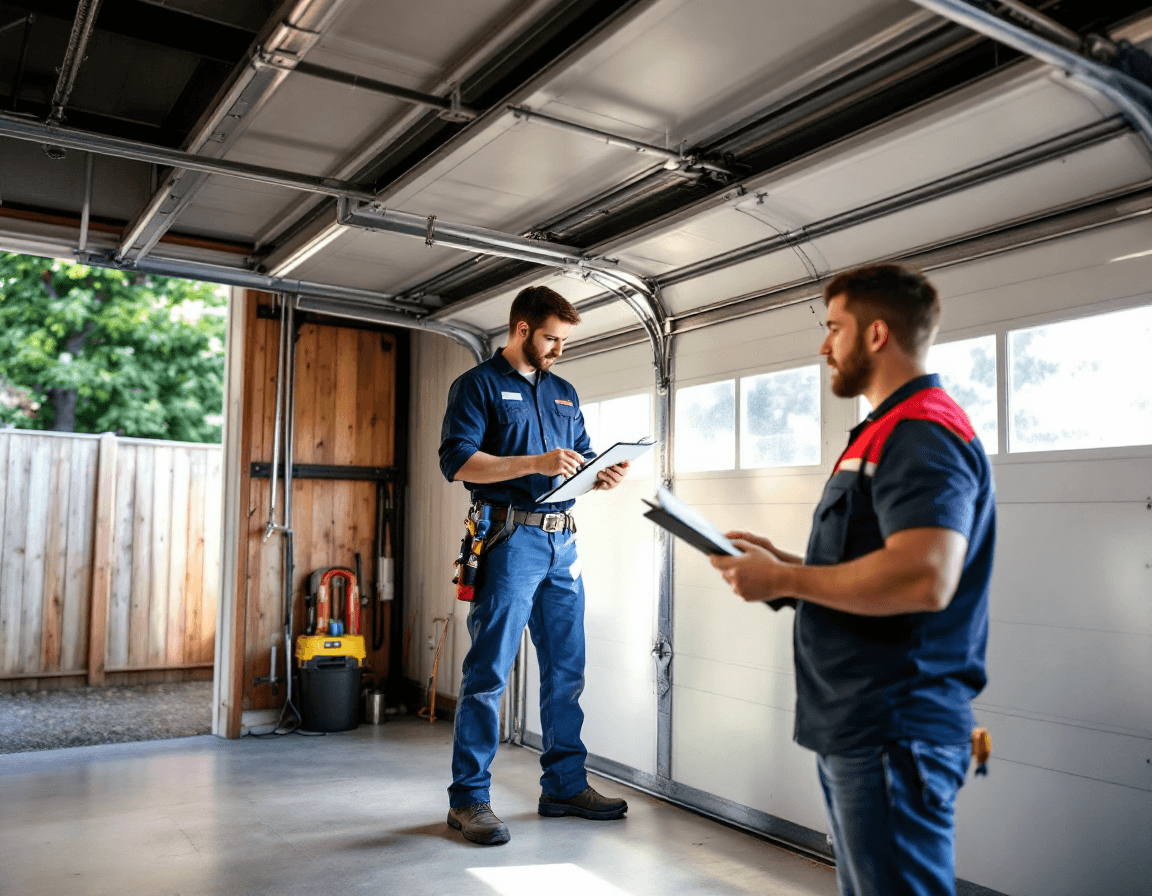
Garage Door Maintenance & Tune-Ups in Gig Harbor, WA is one of the most overlooked parts of keeping a home running smoothly, and it matters more on the peninsula than many homeowners expect. Technicians who work across the area see the same pattern again and again: a door that runs quietly one season starts groaning, jerking, or stalling halfway up by the next. Between long wet winters and the salt-tinged air that drifts in off the Sound, the steel, rollers, and hinges on your door are constantly working against the weather. A scheduled tune-up catches these small changes before they become a door stuck open at 6:30 on a school morning. This page explains what a professional multi-point tune-up covers, what it generally costs, and how to tell when your door is due for attention.
Gig Harbor homes vary widely, and that variety shapes how a door wears. Older houses in the Rosedale area often still have single-car or narrower doors with older openers that were never designed for today's heavier insulated panels. Newer construction near Gig Harbor North tends to come with wider, double-car doors, belt-drive openers, and sometimes smart-home accessories that add more electronics to the system. Along Harborview and the streets with waterfront exposure, moisture and blown debris find their way into door tracks and bottom seals more readily than they do on sheltered inland lots. A generic checklist cannot account for all of that, which is why a tune-up is useful: it lets a technician read the conditions on your specific door instead of guessing.
Whether you have lived in your home for two decades or closed on it last month, a maintenance visit gives you a reliable baseline. A full multi-point tune-up in our service area is priced between $89 and $149, with the final figure depending on the door and what the inspection turns up. We provide this service to homes across the 98332 and 98335 ZIP codes and the surrounding communities. If you want to talk through your door's age, size, and symptoms before booking, you can call (888) 799-3819 and a team member will help you decide what makes sense.
Why Puget Sound Weather Puts Extra Stress on Your Door
Western Washington's climate is mild by many national standards, but it is persistently damp, and that dampness is hard on garage doors. Moisture slowly penetrates galvanized hardware, and in the coastal air around Gig Harbor, a thin film of salt and mineral residue can accelerate corrosion on exposed metal. Steel components that once moved freely can begin to bind when rust forms on rollers, hinge pivots, or the track itself. Wood doors face their own challenge, because humidity causes panels and frames to swell and contract with the seasons. Over time, these changes shift how the door sits in its tracks.
Temperature swings add another layer. Cool, damp mornings followed by drier afternoons can make lubricant thicken and then thin, which means lubrication that worked in July may be less effective by December. The metal in springs and cables expands and contracts slightly as temperatures change, which subtly alters the tension your door depends on. Most homeowners never notice these shifts until the door starts behaving differently. A technician who knows the local rhythm of the seasons can anticipate where wear is likely to show up first.
Because the effects accumulate quietly, a yearly tune-up is a practical way to stay ahead of them. Doing the work before fall rains and winter damp set in is generally more effective than waiting for a problem to surface during a cold snap. The goal is not to fight the weather but to keep the components that respond to it in good working order. A door that is inspected and adjusted on a regular schedule tends to age more gracefully than one that is only addressed after something breaks.
What a Multi-Point Inspection Covers, Step by Step
A multi-point inspection is a structured walk-through of every system that keeps your door moving safely. It begins with the door panels themselves, where a technician looks for cracked or delaminated sections, loose end caps, bent sections, and any gaps between panels that could let in water or pests. From there, the inspection moves to the tracks, checking for dents, misalignment, and debris that can cause the door to catch or lurch. The technician also checks the vertical and horizontal tracks for level and for secure mounting to the wall and ceiling.
The inspection then covers the moving hardware in detail. Rollers are examined for cracks, flat spots, and wear on the bearings, while hinges are checked for looseness and fatigue. Bearing plates, center brackets, and the bottom bracket are inspected to confirm they are tight and not pulling away from the framing. Weather seals on the bottom and sides of the door are assessed for compression and tears, since a worn seal lets in water during the heavy rains common across Pierce County. Each of these points influences how smoothly and quietly the door travels.
Finally, the technician reviews the systems that carry the load. Torsion or extension springs are checked visually for wear, gaps, or rust, and the cables are inspected for fraying and proper seating on the drums. The opener itself is examined for mounting security, belt or chain tension, and the condition of the rail. Safety sensors, the photo-eyes near the floor, are tested for alignment and clean signal. Because spring and cable work carries real risk, those components are inspected rather than adjusted by homeowners, and any repair needing tension changes must be handled by a licensed professional.
- Panel condition, end caps, and gaps that allow water or pests in
- Track alignment, level, secure mounting, and debris buildup
- Roller wear, hinge looseness, bearing plates, and bottom bracket tightness
- Weather seal compression, tears, and proper contact along the threshold
- Spring and cable visual inspection (adjustments handled by licensed technicians only)
- Opener mounting, belt or chain tension, and rail condition
- Photo-eye alignment and safety reversal function
Lubrication That Actually Helps: Where Oil Belongs and Where It Doesn't
Lubrication is one of the most useful parts of a tune-up, and also one of the most commonly misunderstood. The right lubricant reduces friction at the points where metal meets metal, which cuts down on squeaking, grinding, and the extra strain that slows the opener. A quality garage door lubricant, typically a silicone-based or lithium-based product designed for this purpose, is applied to the rollers' bearings, hinge pivots, and the springs' coils where appropriate. Technicians are careful about where lubricant goes, because the wrong product or placement can attract dust and grit that makes noise worse.
Certain areas should not be lubricated in the way many homeowners assume. Tracks generally should not be greased, since lubricant on the track collects dirt and creates a gummy film that slows rollers. Nylon rollers often run better with a light touch rather than a heavy coat, and excess oil can run onto the door and stain the finish. Lubricant should also stay off the weather seals, which can swell or deteriorate when saturated with oil. A technician will often clean old buildup from the track before applying anything new, so the lubricant works where it is meant to.
Lubrication frequency depends on how the door is used and where it sits. A door that opens several times a day in a home near busy roads or in a damp, shaded lot may need attention more often than a door used only occasionally in a drier location. For most households in the area, though, a yearly service is a sensible rhythm, with extra attention if the door has become noticeably louder. Keeping a light maintenance log, even a note on your phone with the service date, helps you spot patterns over time.
Balance Testing and What a Heavy or Off-Center Door Is Telling You
Balance is the relationship between the door's weight and the tension in its springs. A properly balanced door should feel manageable when lifted by hand and should stay roughly where you leave it when partly open. When a door feels heavy, lurches upward, or drifts downward on its own, the balance is likely off. Many homeowners first notice this when the opener seems to labor more than usual, because it is compensating for weight that the springs are no longer carrying as intended.
A technician tests balance using controlled methods that do not require homeowners to handle the springs or disconnect the opener themselves. The door is raised and checked at several points along its travel to see whether it holds position or wants to move. Imbalance can come from worn springs that have lost tension, from a panel that has added weight through damage or moisture absorption, or from hardware that has shifted. In the damp months, a door that feels slightly off in fall may feel more pronounced after a wet winter, which is one reason a test before the rainy season is helpful.
If balance testing reveals a problem, the fix is not a do-it-yourself project. Spring tension must be adjusted or replaced by a licensed professional with the right tools and training, because stored spring energy can cause serious injury. The good news is that catching imbalance early often means a less involved repair than waiting until a spring fails. A heavy or off-center door is one of the clearest signals that a visit is due, and it deserves attention even if the door still closes.
Reading Your Opener: Straining Motors, Slow Travel, and Safety Reversal
The opener is the component homeowners interact with most, so changes in its behavior are easy to notice. A motor that hums louder than usual, takes longer to complete a cycle, or seems to strain at the top or bottom of its travel is often responding to friction or imbalance elsewhere in the system. In many cases, the opener is simply doing its job harder because the door is not moving as freely as it should. Addressing the door's mechanical condition often restores the opener's normal performance.
Safety reversal is an equally important function and one of the most critical things a tune-up verifies. Modern openers are required to reverse when they encounter resistance, and the photo-eyes near the floor must detect an obstruction and stop the door from closing on it. Technicians test both the force-sensing reversal and the sensor function, confirming that the door responds correctly. Because this safety feature protects children, pets, and vehicles, it should never be assumed to work just because the door appears to close normally. Testing is the only reliable way to be sure.
Belt-drive and chain-drive openers, both common in Gig Harbor homes, have slightly different maintenance needs. Belts should be checked for proper tension and wear, since a loose belt can slip and make the opener sound rough, while a chain needs adequate tension and lubrication to run quietly. The rail, the sturdy channel the opener's trolley travels along, should be inspected for alignment and for secure fastening to the ceiling bracket. Loose mounting can cause vibration that travels through the whole garage and makes the door seem noisier than it really is.
Noise That Keeps Getting Louder: Learning to Decode the Sounds
Garage doors make a range of sounds, and each one offers a clue about what is happening. A squeak that appears on the first morning opening after a cold night often points to dry or stiff rollers, while a rhythmic clicking may suggest a loose hinge or a roller that is not seating properly. A grinding noise can indicate that metal has worn against metal, and a sharp pop or bang at the top of the door sometimes signals a loose bracket or worn spring component. Learning these patterns helps you describe the problem clearly, which speeds up diagnosis.
Noise that grows louder over time is especially worth attention. Gradual changes often mean wear is spreading through several components at once, rather than a single part failing suddenly. In older doors, a layer of grit and corrosion can build up in the track and rollers, making every opening louder than the last. A tune-up typically resolves much of this by cleaning, inspecting, and tightening the hardware before the wear becomes more expensive to correct. Waiting until the noise is constant often means more extensive repair.
One simple practice is to listen to the door from inside the garage with the opener running, then again from outside when it closes. Note whether the noise happens at the start, middle, or end of travel, since that location often narrows the source. Pass this information along when you book service, because it helps the technician arrive prepared. It also gives you a benchmark to compare after the tune-up, so you can confirm whether the work made a real difference.
When More Than a Year Has Passed Without Service
Many homeowners lose track of when their door was last serviced, especially if the garage is used more for storage than for daily parking. A door that has gone more than a year without attention can accumulate a surprising amount of wear, even if nothing looks obviously wrong. Dust and fine debris work into the rollers, lubricant dries out or becomes sticky, and hardware gradually loosens from repeated vibration. In the damp months common across the peninsula, these small changes can compound faster than people expect.
A door that has been neglected for a long stretch often benefits from a thorough first visit. The technician will typically clean the tracks, remove old lubricant buildup, and reapply appropriate products where needed, then check every fastener for tightness. The inspection will look closely at the springs and cables, which are the components most likely to have quietly lost tension. If the door has been left unattended long enough for corrosion to take hold, the visit may reveal parts that should be replaced, and the technician can explain the options clearly.
Going more than a year between visits is not a disaster, but it does mean the door has been living on borrowed time. The sensible response is to schedule a tune-up now, then return to a regular yearly rhythm. Setting a reminder tied to a seasonal event, such as the start of fall or the first cold snap, helps keep the habit consistent. Consistency is what turns a maintenance visit from an occasional fix into a routine that prevents surprises.
Buying a Home in Gig Harbor? Get a Baseline Before Moving In
Purchasing a home brings a long list of inspections, and the garage door often gets only a passing glance. Yet a door you have never seen serviced is a mystery, and the cost of an unexpected failure during your first months in the house can be significant. A tune-up shortly after closing gives you a documented starting point, so you know the condition of the springs, cables, opener, and safety systems rather than assuming they are sound. It also helps you plan for any future replacement needs.
When buying in areas like Harborview or near Gig Harbor North, it is worth paying attention to how the door sits in its surroundings. Check whether the garage has any signs of water intrusion along the threshold, and whether the opener and sensors appear to be original or recently installed. Ask the seller if they know when the door was last serviced, and whether any repairs were made. These questions are not meant to be confrontational; they simply help you understand what you have inherited.
A post-purchase visit is also a chance to learn how your new door behaves in its normal use. Technicians can explain the features, show you the safe way to use the emergency release, and point out any issues worth monitoring. Having that knowledge early means you are not discovering the door's quirks during a rushed morning commute. For many new homeowners, this single visit becomes the foundation for a maintenance routine that keeps the home comfortable for years.
Tune-Up Pricing in Plain Terms and What Affects the Final Figure
Homeowners often want a clear sense of cost before scheduling, and a full multi-point tune-up in our service area ranges from $89 to $149. That range reflects the scope of a complete inspection, lubrication, balance testing, and opener safety testing, rather than a bundle of unrelated extras. The final figure depends on the door and what the inspection reveals, since a standard single-car door with an accessible opener will differ from a larger custom door with multiple sensors. Knowing the range in advance makes it easier to budget for routine care.
It helps to understand what the tune-up does and does not include. A tune-up is a preventive visit focused on inspection, adjustment, lubrication, and testing, and it is designed to catch problems early. If the inspection identifies a part that needs replacement, such as a worn roller set, a damaged panel, or a failing spring, the technician will explain the issue and the options before any additional work begins. You are never obligated to proceed beyond what you choose to approve.
Thinking of a tune-up as a low-cost way to avoid larger expenses is a practical approach. A door that is serviced regularly is less likely to fail suddenly, and sudden failures usually cost more because they require urgent scheduling and sometimes more extensive parts. Preventive attention is generally more economical than emergency repair. For homeowners who want a precise quote tailored to their door, calling (888) 799-3819 is the simplest way to get specific information.
Safety Boundaries: Springs, Cables, and the Work Best Left to Professionals
Garage door safety deserves plain speaking. The springs that counterbalance a heavy door store a large amount of energy, and cables and drums are under significant tension as well. When these components fail or are adjusted improperly, they can cause serious injury in an instant. This is why spring and cable work, including tension adjustments, replacement, and drum or cable repair, should always be performed by a licensed, bonded, and insured professional who has the tools and training to do it safely.
A tune-up includes visual inspection of springs and cables, but homeowners should not attempt to adjust, loosen, or remove them. Many people are tempted to tighten a loose cable or experiment with a spring to fix an imbalance, and these attempts are exactly where accidents happen. Even seemingly minor tasks can release stored energy unexpectedly. The safe approach is to observe any concerns, note when they occur, and call a licensed technician to handle the repair.
Homeowners do have important responsibilities that support safety. Keep the area beneath the door clear of obstacles, avoid standing in the path of a closing door, and keep children and pets away from the controls and the door's travel. Use the emergency release only as instructed, and remember that a door that is difficult to lift or behaves unusually should be inspected rather than forced. When in doubt, step back and call for help. A professional visit is always the safer choice over a risky home fix.
Scheduling Around Gig Harbor Life and the Seasons
Choosing the right time for a tune-up can make the visit more convenient and the results more lasting. Many homeowners prefer to schedule service in early fall, before the heavy rains and cold damp of winter arrive, because it gives the door time to settle into a healthy routine before the most demanding weather. Spring is another good window, especially after the damp season has passed and any winter wear is visible. Either way, aim for a regular interval so the door receives consistent attention rather than sporadic repair.
Gig Harbor's pace can shift with the seasons, from summer boating and outdoor activity to the quieter months when more people spend time at home. Booking a visit around your household routine helps you be present for the walk-through, which is valuable. Being there lets you ask questions, hear the door operate, and point out any noises or behaviors you have noticed. Technicians appreciate having a homeowner who can describe when and where problems happen.
To make the most of your visit, gather a few details before the appointment. Note the approximate age of the door and opener if you know them, any recent repairs, and any changes in noise, speed, or balance. Clear a path to the door so the technician can work efficiently, and make sure the remote controls and keypads are easy to reach. A little preparation turns a routine tune-up into a productive review of your home's most used moving part.
Gar