
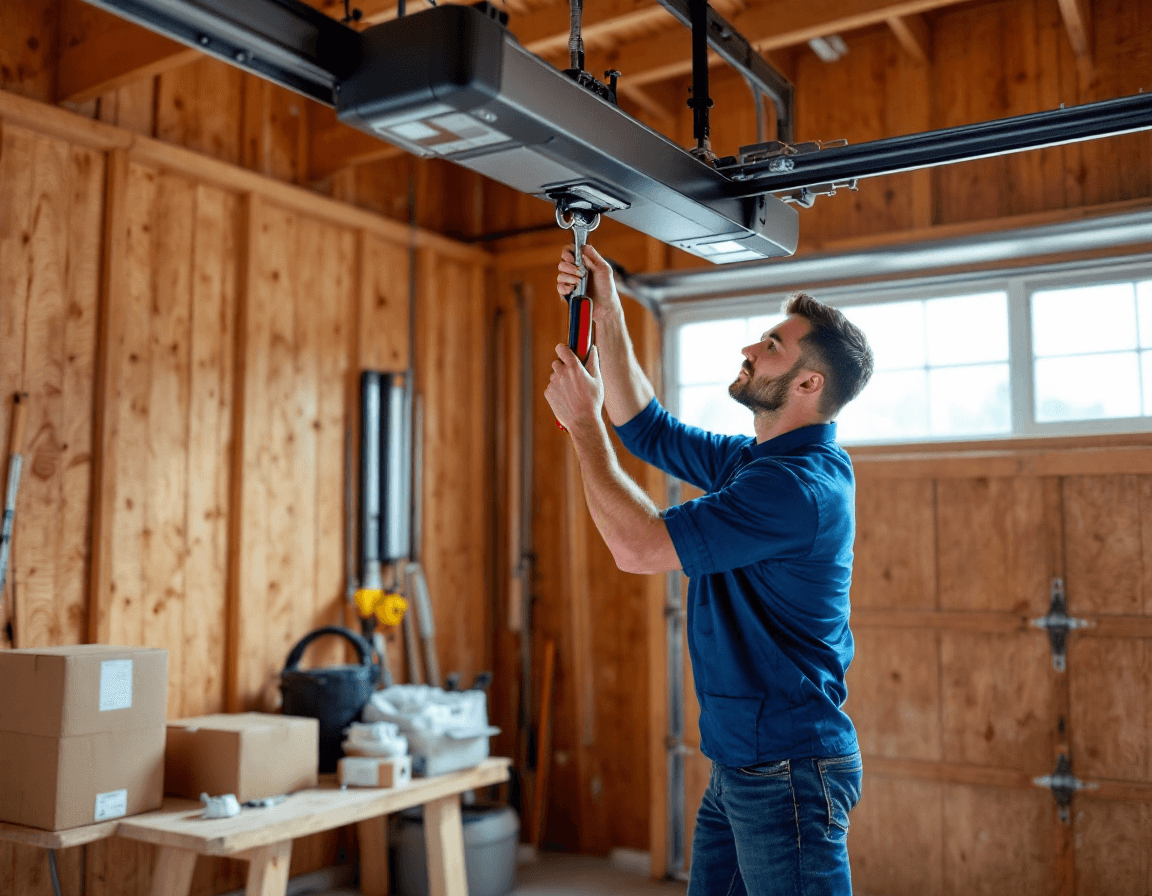
Garage door opener installation and replacement in Sammamish, WA is one of the most practical upgrades a homeowner can make, and it often delivers more daily benefit than people expect. The opener is the motor that lifts and lowers a door weighing several hundred pounds, so when it starts grinding, stalling, or ignoring the remote, the whole garage becomes harder to use. Our technicians serve homes across Sammamish, from the townhomes near Sammamish Commons to larger lots on the plateau, and we see the same pattern repeatedly: an opener that was installed twenty years ago simply cannot keep up with modern security, noise expectations, or the wet, humid conditions of a Pacific Northwest winter.
Replacing an opener is different from repairing one. A repair fixes a single failed part, such as a worn trolley, a bad logic board, or a sensor that has drifted out of alignment. A replacement makes sense when the unit is old enough that repairs keep stacking up, when the motor has lost its strength, or when the technology inside it no longer meets how your household actually uses the garage. Our goal on every visit is to tell you honestly which path makes sense, and to give you the option that fits your home and budget rather than the most expensive unit on the shelf.
Whether you have a detached garage off a quiet cul-de-sac in Klahanie or an attached two-car bay in a newer Pine Lake subdivision, the right opener depends on the door, the room layout, and the way your family comes and goes. Installed pricing for our opener work generally falls between $275 and $650, with the final figure driven mostly by the model you choose and the features it includes. The sections below walk through the warning signs, the drive types, the security and smart-home questions, backup power, and what to expect from a professional installation in Sammamish.
Reading the Warning Signs Your Opener Has Given Up
Most openers do not fail without warning. They usually send signals for months before a complete breakdown, and learning to read those signals can save you from being stranded in the driveway on a rainy morning. The most common sign is noise: a rattling, grinding, or clunking sound that gets louder over time often points to worn gears, a loose chain or belt, or failing bearings inside the drive rail. Slowness is another clue, especially if the door pauses halfway, struggles to start, or takes noticeably longer to close than it did a few years ago.
Reliability problems are harder to shrug off. If the door occasionally reverses for no apparent reason, if the remote works only when you stand in a particular spot, or if the light flickers and the opener resets itself, the control board or safety sensors may be failing. A door that refuses to close after the photo-eyes are cleaned and aligned is worth having inspected, because those sensors are a core safety feature and should never be bypassed to keep the door moving. We regularly find that homeowners have been living with these symptoms for a year or more before calling, and by then the cost of keeping the old unit running has often grown close to the price of a modern replacement.
Age itself is a useful signal. Many openers installed in the late 1990s and early 2000s still run, but they were built before rolling-code security became standard and before manufacturers offered reliable Wi-Fi integration. When a unit is old enough that parts are hard to source, that the manufacturer no longer supports, or that lacks the basic safety features you would expect today, the economics tip strongly toward replacement. Keep a quick mental checklist of noise, speed, reliability, security, and age, and if two or more of those are causing problems, it is time to start comparing options.
- Loud grinding, rattling, or clunking that worsens with each cycle
- The door stalls, pauses mid-travel, or reverses without an obvious obstruction
- Remote range has shrunk, or the opener responds only intermittently
- The unit is more than fifteen years old and lacks rolling-code security
- Repairs have already cost a meaningful share of a replacement opener
How Sammamish Weather and Power Patterns Shape Your Opener Choice
The Pacific Northwest climate is not kind to garage equipment, and Sammamish homes feel that in several ways. Our winters bring long stretches of damp air, frequent drizzle, and occasional hard freezes that can stiffen door seals and make the door and opener work harder. Moisture finds its way into electrical connections, and moss and mildew can build up in tracks on north-facing garages that rarely see direct sun. Those conditions do not automatically mean you need a specific model, but they do make it worth choosing an opener with a solid motor, quality weather-rated components, and a warranty that reflects the real environment it will live in.
Power reliability is another local consideration. Windstorms during fall and winter can knock out electricity across parts of the plateau, and an outage can leave you unable to open the garage at the exact moment you need to leave or return. Homeowners who work from home or who keep medications, freezers, or vehicles they rely on in the garage often find that backup power is the feature that changes their daily routine most. This is why we spend time on every installation discussing what happens when the grid goes down, rather than assuming the opener will always have power.
Humidity also affects the logic board and sensors over time, which is one reason we recommend inspecting the door balance and seals at the same visit. A well-sealed door with properly lubricated hardware puts less strain on the opener and extends the life of the new unit. When we walk a Sammamish garage, we look for signs of water intrusion along the bottom seal, rust starting on the track brackets, and any spot where the garage slab collects standing water. Catching those issues early keeps the new opener from working against conditions that would shorten its lifespan.
Belt, Chain, or Wall-Mount: Matching the Drive to Your Garage
The drive system is the part of the opener that moves the carriage along the rail, and choosing the right type is one of the most important decisions in the entire installation. Chain-drive openers are the traditional workhorse. They are typically the least expensive option, they handle heavy doors well, and they are straightforward to maintain. Their main drawback is noise, since the metal chain runs through the rail and produces a distinct clatter that carries into the house, particularly in attached garages with a bedroom or living room on the other side of the wall.
Belt-drive openers use a reinforced rubber or polymer belt instead of a metal chain, and they run noticeably quieter. For homeowners whose garage shares a wall with a family room, a home office, or a bedroom above the garage, the difference is immediately noticeable. Belt-drive units usually cost more upfront, and they still require the rail and mounting to be solid, but many Sammamish households consider the quieter operation worth the premium. Belts also tend to be gentler on the carriage and the door hardware during routine use.
Wall-mount openers attach to the wall beside the door rather than hanging from the ceiling, which frees up overhead space. This matters in garages with low ceilings, a ceiling-mounted storage system, a lift for vehicles, or a door that opens high on the wall. Wall-mount units are often paired with belt or screw drives, and they can be a strong fit for detached garages where the ceiling structure is limited. Our technicians check the wall framing, ceiling joists, and clearance before recommending a particular mounting style, because a poor match can lead to vibration and premature failure.
Keeping the Noise Down for Bedrooms Above and Beside the Garage
Noise complaints are among the most common reasons Sammamish homeowners call us about openers. Many of the newer subdivisions around Pine Lake and Klahanie were built with attached garages that share walls or ceilings with living spaces, and sound travels through framing more easily than people anticipate. A chain-drive opener that sounds acceptable in the driveway can feel intrusive at 6:30 in the morning when someone is trying to sleep in the room above the garage.
Several steps reduce that noise without sacrificing performance. Moving to a belt-drive model is the most direct fix. Properly tensioned hardware, a sturdy mounting bracket attached to framing rather than drywall, and vibration-isolating pads on the mounting points can cut transmitted sound substantially. A soft-start and soft-stop feature, available on many modern units, also reduces the jolt that travels through the door and into the structure at the beginning and end of each cycle. We pay attention to these details during every installation, because the same unit can sound very different depending on how it is mounted.
We also look at the door itself. A sagging or unbalanced door forces the opener to work harder and creates extra vibration and clatter, so balance and track alignment are part of a quality installation. Lubricating the rollers and hinges and replacing worn rollers with quieter nylon versions can make a real difference in how the entire system sounds. If noise was the main reason for your call, we will talk through these options so you understand exactly what to expect after the upgrade.
Rolling-Code Security and Why an Old Remote Is a Real Risk
Security is a serious reason to replace an older opener, and it is one that many homeowners overlook until after an incident. Openers manufactured before rolling-code technology use fixed codes, meaning the signal from the remote is the same every time. A device that captures that signal can replay it and open the door. Rolling-code systems change the transmitted code with every use, which makes simple replay attacks far less effective. For a home where the garage door is often the main entrance for family members, deliveries, or contractors, that difference is significant.
Modern openers also tend to include features that reduce risk in other ways. Many models offer a built-in keypad with a changeable PIN, which eliminates the need to leave a remote in the car where it can be stolen along with the vehicle. Some units provide activity alerts or log recent openings, so you can see when the door was operated and by which device. Others support an optional door sensor that reports whether the door is open or closed, which is useful if you want to confirm the garage is secured before leaving on a trip.
Replacing the opener is also a good time to audit every remote, keypad, and wall button in your household. Old remotes that belonged to former tenants, previous owners, or family members who no longer need access should be erased from the system. We walk homeowners through this process during installation, because a new opener is only as secure as the list of devices allowed to control it.
Wi-Fi Control with myQ and Smart Home Integration
Smart garage control has moved from novelty to everyday convenience, and many Sammamish households now want the ability to open, close, and check on the garage from a phone. Wi-Fi-enabled openers, including models compatible with the myQ app ecosystem, let you receive notifications when the door opens, close it remotely if you forget, and in some setups grant temporary access to a delivery driver or house sitter. For families whose schedules shift often between school runs, sports practices, and work commutes, that flexibility can be genuinely useful.
Connectivity is not automatic, though, and it deserves careful planning. The opener needs a reliable Wi-Fi signal in the garage, and in larger homes or those with thick walls, the signal may drop without a range extender or a mesh node nearby. Our technicians test signal strength during the visit and recommend placement that keeps the connection stable. We also remind homeowners that a smart opener is only as secure as the home network it joins, so a strong router password and up-to-date firmware matter just as much as the opener itself.
Integration with broader smart-home systems is possible with many modern units, though the exact options depend on the brand and model you choose. Some owners like voice assistant commands, while others prefer only app-based control. We recommend deciding what you actually want before you buy, because the most advanced model is not necessarily the best fit if you only plan to use the basic remote and an occasional phone alert. A clear list of priorities keeps the purchase focused and avoids paying for features that will sit unused.
Battery Backup Options for Outage-Prone Evenings
Battery backup is one of the most valuable upgrades for homes that experience occasional power interruptions, and it is often overlooked until the first long outage. A backup battery installed inside or alongside the opener allows the door to operate for several cycles when the electricity goes out, which can be the difference between getting the car out for a morning commute and being stuck in the house. Backup kits vary in capacity, so the number of cycles they provide depends on the model, the door weight, and the battery condition.
Battery backup is especially helpful in homes that rely on the garage for daily access, in households with medical equipment or someone who cannot easily manually open a heavy door, and in properties where the garage holds freezers or other items that matter during an outage. Keep in mind that a backup battery does not power the rest of the house, and its primary job is to move the door. We explain these limits clearly during installation so the expectations match reality.
Batteries do need periodic attention. Heat and cold both shorten battery life, and in a garage that sees temperature swings across our seasons, a battery may need replacing sooner than expected. We suggest checking the battery status indicator on the opener at least a few times a year and testing the door's operation during a planned outage check. Pairing the backup battery with a fresh, well-balanced door and a properly maintained track gives you the best chance of reliable operation when the power is out.
What a Professional Installation Visit in Sammamish Typically Covers
A good opener installation is more than mounting a motor and plugging it in, and homeowners should know what a thorough visit includes. Our technicians begin by inspecting the existing door, the tracks, the springs, the rollers, and the safety sensors, because those components affect how the new opener performs. We also check the ceiling structure, the wall framing, and the electrical outlet, since a properly grounded dedicated circuit and solid mounting points are essential for a safe installation.
Once the opener is installed, the technician sets the travel limits, adjusts the force settings, and tests the auto-reverse feature to confirm the door stops and reverses when it contacts an obstruction. The photo-eyes are aligned and tested, and the remotes, keypad, and any smart connection are programmed and verified. We also walk you through how to operate the system, how to use the emergency release, and what routine maintenance keeps it running smoothly. Leaving a Sammamish home with clear instructions and a working system is the standard we hold ourselves to.
Clearing away old hardware and explaining the new unit's warranty are part of the job as well. We will tell you what the manufacturer covers, what our workmanship covers, and what maintenance the warranty expects you to perform. That transparency helps you plan for the years ahead rather than discovering the fine print after something goes wrong.
- Full inspection of door balance, tracks, rollers, and safety sensors before mounting
- Structural check of ceiling joists or wall framing for secure bracket attachment
- Travel limit, force setting, and auto-reverse testing with the door in motion
- Remote, keypad, and smart-app programming, plus removal of outdated devices
- Backup battery setup and a walkthrough of emergency release and routine care
Understanding Our Pricing from $275 to $650 Installed
Opener pricing depends on several variables, and we believe homeowners should understand what those variables are. Our installed range of $275 to $650 reflects the spread between entry-level chain-drive units and feature-rich belt-drive or wall-mount models with smart connectivity and battery backup. The opener itself accounts for most of the difference, but the final number also reflects any additional parts required for your specific setup, such as a new safety sensor kit, mounting hardware for a particular ceiling type, or a backup battery.
Certain factors can push a project toward the higher end of the range. A heavier door, a garage with unusual mounting constraints, a need for a long rail to accommodate a tall door, or a request for a premium belt-drive unit with advanced features will all add cost. Conversely, a straightforward swap of a chain-drive unit for a comparable replacement in a standard garage often lands closer to the lower end. We provide a clear quote that lists the opener model, included accessories, and any optional upgrades before work begins, so you can compare choices with confidence.
Price should not be the only factor, but it does help to know that a more expensive opener is not automatically a better fit. A quiet belt-drive model may be exactly right for a bedroom above the garage, while a dependable chain-drive unit may serve a detached garage with no living space nearby just as well. We aim to match the opener to how you use the garage, not to sell the top of the line by default.
Neighborhoods, Landmarks, and Service Across ZIP Codes 98074 and 98075
Sammamish is a community of varied neighborhoods, and our technicians are familiar with the differences between them. Homes near Sammamish Commons often include attached garages in compact layouts, where noise control and space-saving wall-mount designs can be especially relevant. Around Pine Lake, many properties have driveways that slope or curve, and garages sometimes sit at angles that affect how the door tracks and where the opener can be mounted. In Klahanie, a mix of older and newer homes means we encounter everything from original builder-grade openers to recently installed units that simply need a smarter upgrade.
We provide service throughout ZIP codes 98074 and 98075, covering the broader Sammamish area and the surrounding neighborhoods that residents identify with the city. Whether your garage is attached to a townhome, set behind a single-family house on a hillside lot, or standing alone at the end of a long drive, we bring the same attention to fit, safety, and clear communication. Our service area extends across more than sixty cities in the greater Seattle and Western Washington region, so if your home sits near the Sammamish border, call us and we can confirm coverage for your address.
Local knowledge matters because the best solution in one neighborhood may not be the best in another. A homeowner near the commercial corridor may prioritize quiet operation and smart access for busy schedules, while a family on a larger lot may want backup battery power for storm-related outages. We take the time to understand your specific property and recommend a setup that fits it.
Why Spring Tension and Cable Work Belong to a Licensed Professional
Opener replacement is a manageable project for a trained technician, but it is important to be clear about what should never be attempted by a homeowner. Garage door springs store enormous mechanical energy, and the torsion or extension springs that counterbalance the door can cause serious injury if they are adjusted, removed, or replaced without the proper tools and training. Cables under tension present a similar hazard. These components are not part of a routine do-it-yourself opener swap, and any spring or cable work should be handled by a licensed, insured professional.
When we install a new opener, we check the springs, cables, and drums as part of the inspection, and if we find wear or imbalance, we explain the risk and the recommended repair in plain terms. We do not ask you to tension springs yourself, and we will not leave a door in a condition that compromises safety. If a spring has broken or a cable has frayed, we recommend stopping use of the door until a qualified technician has repaired it. A door with a broken spring can drop unexpectedly, and that danger is far greater than the inconvenience of waiting for service.
Keep that boundary in mind when you compare providers, and be cautious of anyone who suggests skipping safety checks to speed up an installation. A properly balanced door, correctly set travel limits, and functioning auto-reverse are what keep your household safe every time the door moves. Taking the time to do the job right protects your family, your vehicles, and the investment you are making in a new opener.
Replacing a garage door opener in Sammamish is a practical way to gain quieter operation, stronger rolling-code security, smart control from your phone, and reliable backup power when the lights go out. If your current unit is loud, slow, unreliable, or simply past its useful life, we would be glad to inspect the system, explain your options, and give you a clear installed price between $275 and $650 depending on the model you choose. Call Seattle Garage Door Fix today at (888) 799-3819 to schedule an opener installation or replacement visit in Sammamish.