
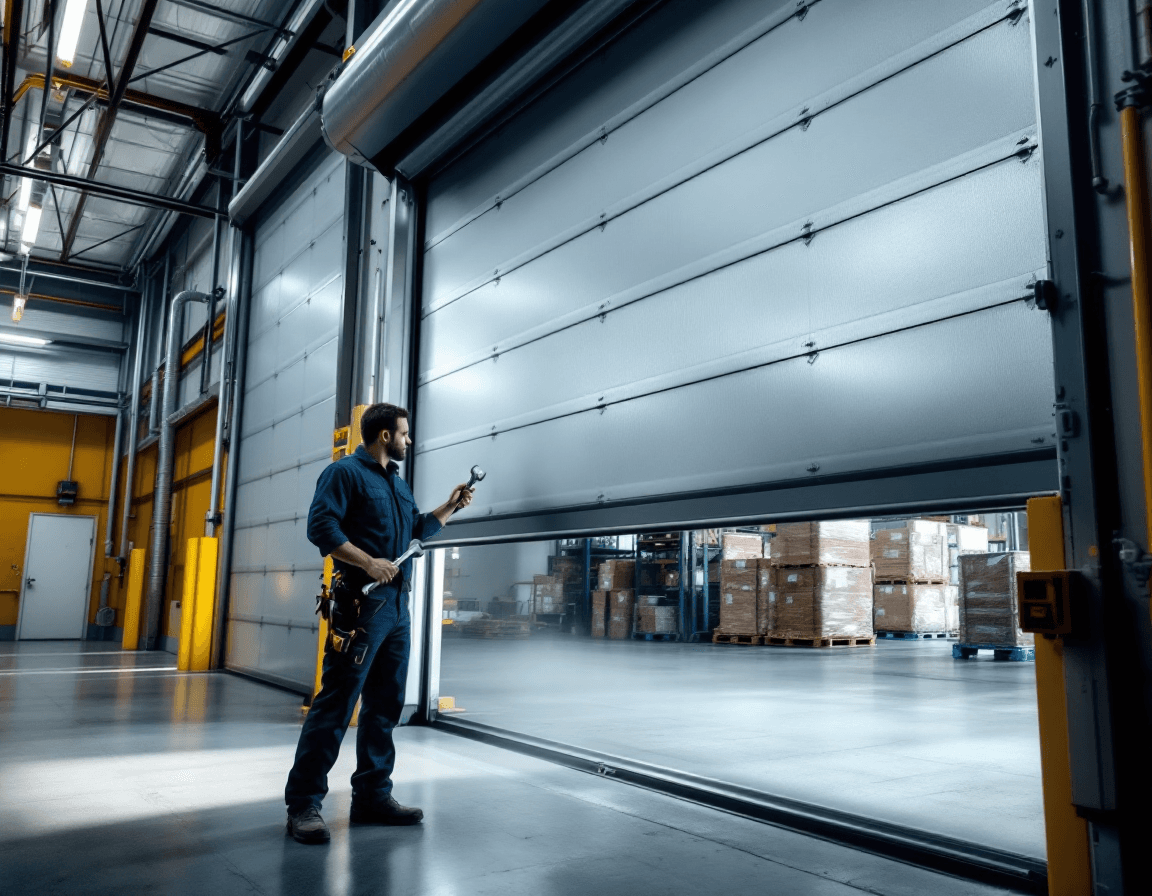
Commercial Overhead Door Repair in Everett, WA keeps a warehouse, distribution center, or auto shop running when a loading-dock door stops cycling or a rolling steel curtain jams at the worst possible moment. Everett's business corridors carry heavy daily traffic, from Port-related freight and aerospace suppliers near Paine Field to downtown storefronts that depend on rear service doors. When one of those doors fails, the cost is measured in lost shifts, delayed trucks, and crews standing around, not just in the price of a part. Seattle Garage Door Fix handles commercial sectional doors, rolling steel doors, operators, and preventive maintenance for businesses across Everett and the surrounding Snohomish County communities.
Commercial doors take a beating that residential units rarely see. A typical dock door might cycle dozens of times in a single shift, and each cycle puts load on the springs, tracks, rollers, and operator. Add Everett's damp winters, salt-laden air that drifts in from the water, and the constant grit tracked in by delivery vehicles, and it becomes clear why a door that looked fine during last quarter's inspection can start misbehaving quickly. This page explains what usually goes wrong, how our technicians approach it, and how we price and schedule work so your operation loses as little time as possible.
Our goal is practical: help facility managers, property owners, and operations leads understand their options before a failure becomes an emergency. Whether you are dealing with a single stubborn door or planning a maintenance program for a whole campus, the sections below walk through the details that matter most in this part of Washington.
Reading the Early Signals a Dock Door Gives Before It Quits
Most commercial door failures announce themselves days or weeks in advance, although the signs are easy to dismiss when production is busy. A door that grinds or chatters on its way up, a panel that seems to hesitate at the top of its travel, or a noticeable lean when the door is halfway open are all early warnings. Drivers and forklift operators often notice these first, because they are the people who use the door every hour. Encourage your team to report odd noises, uneven movement, or a door that needs a second push to close, even if the door still technically works.
On the Everett side of the county, moisture is the usual culprit behind slow decline. Rain and humidity in the cooler months find their way into hinge pins, roller bearings, and track joints, and rust builds quietly where lubrication has worn thin. Steel that sits near loading areas also collects road salt and brine splashed up by trucks during winter storms, which accelerates corrosion on tracks and bottom brackets. A technician who sees flaking paint, orange staining along seams, or stiff rollers can often correct the problem with cleaning, lubrication, and a few targeted replacements before anything breaks outright.
Keep a simple log of door behavior, including date, time of day, and what happened. A short record of "slow to open Tuesday mornings" or "bounced at the top after the afternoon wash-down" gives a technician far more to work with than a general complaint. Patterns often point directly to a cause, such as a sensor that picks up glare at a certain hour or a seal that has torn near a dock bumper. When you call for service, that log can shorten diagnosis time and reduce the number of visits needed.
Sectional Doors on Everett's Warehouse and Light Industrial Streets
Sectional overhead doors are the workhorses of most warehouses, distribution bays, and fleet facilities in the Everett area. Each door is built from insulated or uninsulated panels hinged together, running on tracks that curve from vertical to horizontal above the opening. Commercial versions use heavier gauge steel, larger rollers, and reinforced hinges compared with garage doors on homes. Because they are used constantly, even small misalignments can grow into serious wear within a single season.
Typical sectional door problems we see on industrial streets include bent or out-of-square track sections, worn roller stems that cause a door to wobble, and worn bottom weather seals that let rain and debris blow under the door. In areas where dock levelers and bumpers are close to the door, repeated impacts can also knock a track out of alignment. Our technicians check track plumbness, wind the door to confirm the spring balance, inspect panel joints, and verify that the bottom seal makes even contact across the full width. Fixing one problem without checking the others usually leads to a return visit, so we prefer a complete inspection before recommending parts.
Spring work deserves special attention. Torsion springs on commercial doors carry enormous stored energy, and a broken spring can injure anyone nearby. Replacement and tensioning must be performed by a licensed, trained professional using the correct winding bars and safety procedures. We never recommend that property staff attempt spring adjustments themselves, and we will always lock out the operator and secure the door before any spring-related work begins.
Rolling Steel Curtains That Jam or Drift Off Track
Rolling steel doors are common on storefronts, service bays, and older commercial buildings throughout downtown Everett, where space is tight and the door must coil compactly above the opening. Instead of panels, a rolling steel door uses interlocking slats that wind around a barrel as the door opens. Guides on each side keep the curtain tracking straight, and a barrel, brackets, and either a spring or motor drive the movement. When something goes wrong, the symptoms can look dramatic, such as a curtain that leaves its guides or a door that binds halfway through its travel.
Jams in rolling steel doors often trace back to debris in the guide channels, bent slats from a vehicle strike, or guide shoes that have worn unevenly. Downtown alleyways gather leaves, grit, and small litter that accumulates in channels over time, especially during the rainy season when wet debris packs down. Once a slat has been pushed out of its channel, the door may continue to run for a while, but the stress on adjacent slats and the barrel can cause further damage. Stopping operation early and having the door inspected is much cheaper than replacing a whole curtain later.
Rolling steel doors also show corrosion differently than sectional doors. Because the slats are often galvanized or painted steel, the first signs of trouble are usually scuffed coatings and rust tracks where water pools along the bottom bar or inside the guides. Our technicians clean and treat affected areas, check the barrel for uneven wind, and test the locking points. Where a slat or bottom bar has been compromised, we can often replace individual components rather than the entire curtain, which keeps repair costs more controlled for budget-conscious businesses.
Commercial Operators That Stop Mid-Shift
Operators are the motors and controls that raise and lower commercial doors, and they fail in ways that can be frustrating because the door itself may look perfectly healthy. A dead operator might come from a tripped thermal overload, a failed limit switch, a blown control board after a power surge, or a worn drive chain or belt. Heavy-duty chain drives and jackshaft systems are designed for daily use, but they still need correct tension and lubrication. An operator running on a weak electrical supply can also overheat, which causes intermittent stops that are hard to reproduce.
Start troubleshooting with the simplest checks. Confirm that the disconnect or circuit breaker has not tripped and that the control station is not stuck or shorted. Make sure the photo-eye sensors are clean, aligned, and not blocked by dock debris, since many operators stop when sensors detect an obstruction. If a door stops at the same point every time, the limit settings may have drifted. Technicians then look at motor condition, gear reducers, and wiring connections, particularly in facilities where moisture gets into junction boxes.
Operator replacement is a larger decision, and we present options clearly. In some cases a worn motor or control board can be replaced without changing the rest of the system. In others, the operator is old enough that replacing it with a modern unit, often with better safety features and easier diagnostics, is the more economical choice. Either way, we test the reversing sensors, entrapment protection, and emergency release before handing the door back to your team, because commercial operators must protect people and equipment in busy work areas.
- Check the disconnect and breaker before calling for service, and note whether the operator hums, clicks, or does nothing at all.
- Keep photo-eyes and safety edges clean, especially after rain, pressure washing, or forklift traffic near the opening.
- Record whether the failure happens at a specific temperature, time of day, or after the door has cycled many times in a row.
Throughput Problems When the Door Works but Holds Up Production
Not every complaint is an outright breakdown. Many facilities call us because a door is technically working but cannot keep pace with truck schedules, forklift traffic, or cold-storage turnaround. A sectional door that takes twenty seconds to open might not seem slow, but multiplied across a busy receiving shift, the delay adds up to lost minutes that ripple through the whole dock. Operators, drivers, and dispatchers notice these delays long before a door fails completely.
Throughput issues usually come from a handful of causes. Operator speed settings may have been reduced for safety during a previous incident and never restored. Tracks may have friction points that force the motor to work harder, which slows the door and shortens operator life. Worn rollers, misaligned hinges, or a sagging spring can add drag. In some cases, the door is simply undersized for current traffic, and a faster high-speed door or an additional opening is the better long-term answer. We review how the door is used, measure cycle times, and identify which fixes deliver the biggest gain for the least disruption.
Speed adjustments need to balance productivity with safety. Faster travel is only useful if photo-eyes, safety edges, and reversing logic remain reliable. We never recommend increasing speed in a way that compromises entrapment protection, and we verify all safety features after any adjustment. When a facility wants to explore high-speed or specialty doors, we walk through the tradeoffs in plain language so you can match the equipment to how your operation actually runs.
Forklift Strikes and Replacing Damaged Door Sections
Forklift impacts are one of the most common reasons commercial doors need emergency attention. A pallet jack or reach truck clipping the lower panels can crack a section, bend a track, or pop a panel out of its hinge line. In tight Everett loading areas, where trucks back into narrow bays and drivers work in wet or dim conditions, these strikes happen more often than anyone would like. The first priority after any impact is safety: secure the door, keep traffic clear, and do not run the operator until a technician confirms the springs, cables, and track are intact.
Damaged sections are often replaceable without replacing the whole door. Many commercial sectional doors are built from modular panels, so a single cracked section can be swapped if the manufacturer's part is still available and the door's dimensions match. Our technicians check panel gauge, insulation type, hinge hardware, and window or vision-panel options before ordering. Because a mismatched section can throw off the entire balance of the door, we verify fit before installation and recheck the track geometry afterward.
Some impacts reveal hidden damage. A strike that seems minor may have bent the track just enough to cause binding a few weeks later, or it may have loosened a bracket that carries the door's load. We recommend a full post-impact inspection even when the visible damage looks small. Prompt inspection also helps with documentation for insurance or lease obligations, since a clear written assessment of what was damaged and what was repaired makes those conversations much smoother for property managers.
Finding Parts for Older Commercial Doors Across Snohomish County
Many Everett commercial buildings have been operating for decades, and some of their doors predate current manufacturers' product lines. Parts for these older systems can be harder to source, and a technician may need to fabricate a bracket, match a roller diameter, or adapt a newer operator to an existing header. This is where experience matters. Measuring carefully, photographing the existing hardware, and checking the spring and cable specifications before ordering prevents a mistake that could delay the entire project.
When a part is discontinued, we discuss the realistic options. Sometimes a compatible replacement from another manufacturer fits with minor modifications. Other times, a section or full door replacement becomes the more cost-effective path, particularly if the existing door is failing in multiple places at once. We are direct about these tradeoffs. Our role is to give you a clear picture of the repair, the parts involved, the expected lifespan of the fix, and whether investing in a repair makes sense compared with a larger upgrade.
Keeping a spare parts list for critical doors is one of the smartest moves a facility can make. Rollers, hinge sets, bottom seals, safety edges, and sensor brackets are the components most often needed in an emergency. Storing a small inventory on site, or having us record the exact part numbers for each door, shortens downtime considerably when something fails on a busy Monday morning.
How Custom Commercial Quotes and Fast Turnaround Are Handled
Commercial door work is priced individually because no two facilities are the same. Door size, spring type, operator model, access restrictions, after-hours requirements, and the number of doors involved all affect the scope. We do not use a single flat rate for every commercial job. Instead, we provide a custom quote after an on-site assessment, outlining the work needed, the parts we recommend, and the timeline for completion. Where a situation is urgent, such as a dock door that is closed and blocking receiving, we prioritize a rapid assessment so you know what to expect quickly.
Fast turnaround depends on preparation as much as on the technician's speed. When you call, it helps to have the door's approximate size, the operator brand if you know it, the nature of the problem, and any photos or videos showing the failure. Clear access to the door, a designated contact on site, and information about loading schedules allow us to plan the visit around your operation. We work to minimize downtime by bringing common parts on the first visit whenever possible and by coordinating with your team about when the door can be taken out of service.
We also explain what happens if the work exceeds the initial estimate. Hidden damage is sometimes discovered only after panels are removed or a track is opened, and we will contact you before proceeding with significant additional work. You will always know what has changed, why it changed, and what the revised cost would be. That kind of transparency is especially important for property managers and operations leads who must answer to budgets and tenants.
Preventive Maintenance Agreements Built Around Your Operating Hours
Preventive maintenance is the most reliable way to avoid emergency calls. A maintenance agreement schedules regular inspections, lubrication, adjustment, and component checks so that small issues are corrected before they turn into breakdowns. For Everett facilities that run through the rainy season, scheduling maintenance in the early fall before the wettest months can be particularly valuable, because it lets us address corrosion, seal wear, and track alignment before winter moisture accelerates them. Maintenance visits can also be timed around your shifts, weekends, or slower periods to avoid interrupting production.
A well-designed agreement typically covers the items that matter most for your specific doors. For sectional doors, that often includes track inspection, roller and hinge checks, spring tension review, bottom seal condition, and balance testing. For rolling steel doors, it may include guide cleaning, barrel and bracket inspection, and curtain alignment. Operators receive limit verification, safety sensor testing, and a review of wiring and control connections. Each visit should end with a written summary of what was done, what was observed, and what is recommended for the next period.
Maintenance agreements also help with budgeting. Instead of absorbing unexpected emergency costs, facility managers can plan for scheduled service and set aside funds for predicted replacements such as rollers or seals. Over time, the service history becomes a valuable record of door condition, which can inform decisions about when to repair, when to upgrade, and when a door has reached the end of its practical life. We tailor the frequency and scope of each agreement to how heavily each door is used.
- Ask for a written checklist of what each visit includes, so you know whether safety sensors, springs, and operators are covered.
- Schedule a pre-winter inspection in late summer or early fall to address corrosion and seal wear before the wet season.
- Keep a shared logbook at each door so technicians and staff can record unusual sounds, slow cycles, or impacts between visits.
Safety Rules for Springs, Cables, and Lockout Procedures
Safety must come first in every commercial door repair. Torsion springs, extension springs, and lift cables store significant energy, and mishandling them can cause serious injury. These components should only be inspected, adjusted, or replaced by licensed, trained professionals who understand the correct winding procedures and tooling. If your team notices a broken spring, a frayed cable, or a door that drops unevenly, the right response is to stop using the door, keep people clear of the opening, and call a qualified technician. Never attempt to wind springs or repair cables on your own.
Lockout and tagout procedures protect your staff during service. Before a technician begins work, the operator should be disconnected at the breaker or disconnect, the door should be secured against movement, and the area should be marked so no one attempts to operate the door during the repair. Facilities with multiple doors benefit from labeling each disconnect and posting clear instructions for shutdowns. We follow these procedures on every job and will confirm with your team before restoring power and returning the door to service.
Routine safety checks should be part of your daily operations. Ask staff to look for obvious hazards such as bent tracks, loose bolts, debris in the opening, or sensors that appear damaged. Test the photo-eyes and safety edges periodically by confirming the door reverses when an object crosses the beam. If anything seems wrong, take the door out of service and call for help. A cautious approach costs far less than an injury, and it protects both your employees and your building.
Start a Conversation About Your Commercial Doors
If a loading-dock door, rolling steel curtain, or commercial operator is giving you trouble, or if you want a maintenance plan that keeps your Everett facility moving through every season, Seattle Garage Door Fix is ready to help. Call (888) 799-3819 to describe what your doors are doing, request a custom quote, and learn how we can minimize downtime for your operation. We are licensed, bonded, and insured, and we will give you clear, honest recommendations before any work begins.