
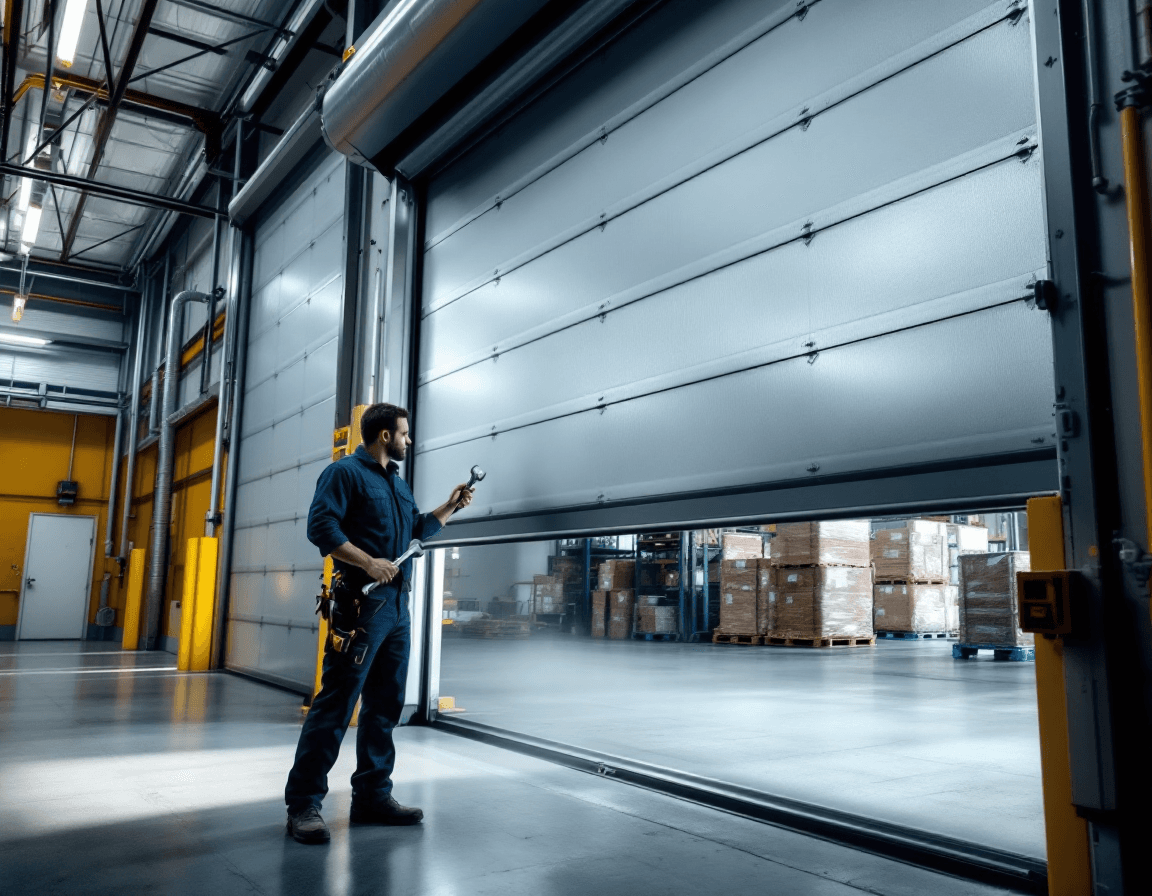
Commercial Overhead Door Repair in Monroe, WA keeps warehouses, contractor yards, and loading docks moving, and when a dock door stops, the whole operation stops with it. Seattle Garage Door Fix sends trained technicians to businesses across Monroe and the surrounding Snohomish County valley, handling everything from a single stuck sectional door to a full rolling-steel and operator overhaul. We know that a door down for a shift costs you more than the repair itself, so we plan our visits around your receiving schedule and bring the parts we expect to need. Call (888) 799-3819 to describe what is happening at your site.
Monroe sits where the Skykomish and Snohomish river valleys meet, and the weather here is more demanding on steel and mechanical hardware than many business owners expect. Wet winters, long stretches of damp air, and wind-driven rain push moisture into bottom brackets, track joints, and motor housings, while summer humidity keeps those same components from drying out between storms. Those conditions are why a commercial door that looked fine in October can start grinding by January. This page explains the most common problems we see at Monroe businesses, how we approach each one, and how a preventive maintenance agreement can keep small issues from becoming emergencies.
How Valley Weather Shapes Commercial Door Wear in Monroe
The Snowy-to-soggy cycle that moves through the Monroe area is hard on galvanized track, exposed torsion shafts, and the hinges that connect sectional panels. Moisture gets trapped where track meets the wall, and in facilities near open loading yards it mixes with road grit and fine debris that sticks to rollers. Over several seasons, that combination produces surface rust, seized bearings, and track that slowly shifts out of plumb as fasteners loosen. A door can still look sound from the outside while its internal alignment drifts away from where the operator expects it to be.
Cold mornings add another layer of stress. Lubricants thicken when temperatures drop, which means the operator works harder to start the door, and the load on the motor and gearbox climbs sharply on the first cycle of the day. We often see businesses report that a door is slow only on frosty mornings, and that pattern is a useful clue. It usually points to a lubrication issue, a weak spring tension that's compensating poorly, or an operator that's near the end of its service life.
Because so many Monroe commercial properties sit along busy corridors and near agricultural and event traffic, doors also take a steady beating from vehicles, dust, and the occasional forklift tine. Weather and impacts combine over time, so we encourage facility managers to think about door health as a yearly condition, not a one-time purchase.
Sectional Doors Going Down at Loading Docks
A sectional overhead door that will not close, closes unevenly, or stops halfway up is the most common call we take from Monroe warehouses and dock facilities. The cause is rarely a single failure. Often a worn cable, a misaligned roller, and a tired spring are all contributing at once, and the door simply reaches the limit of what its weakest component can tolerate. Our technicians inspect the full assembly before recommending any repair, because replacing one part on a door with several worn parts usually leads to another visit within weeks.
Sectional door complaints tend to fall into a few recognizable groups. Knowing which group your door belongs to helps you describe the problem clearly when you call, and it gives us a head start on what to bring to your site.
- Door stops mid-travel or reverses for no obvious reason, which often points to sensor misalignment, a damaged safety edge, or a binding track.
- Panels pop out of the track or sit crooked, which can indicate worn rollers, a bent track section, or hinge hardware that has loosened.
- Door sounds like it is scraping or grinding on the way up, typically a sign of dry or contaminated rollers and bearings.
- Door opens unevenly, with one side lagging, which frequently traces back to unequal spring tension or a cable that has begun to slip.
- Visible gaps at the bottom seal or sides, letting weather, pests, and conditioned air escape from the building.
Repairs on torsion springs and lift cables carry serious stored energy, and they should only be performed by a licensed, trained professional with the correct tools. Attempting to adjust springs without proper equipment is one of the most dangerous things anyone can do around a garage or dock door. We perform all spring and cable work ourselves, and we would rather schedule a careful visit than encourage a quick fix that puts people at risk.
Rolling Steel Doors That Jam, Bind, or Jump the Track
Rolling steel doors are common at Monroe contractor shops, storage yards, and retail spaces that need a compact, durable closure. Because the door rolls into a coil above the opening, it depends on a set of guides, a tensioned barrel, and a smoothly running curtain. When any one of those elements falls out of step, the door can jam, bind partway through its cycle, or slip off its guide tracks entirely. Impact damage is a frequent cause, especially on doors that sit near busy truck bays.
A jammed or off-track rolling door should be treated carefully. Forcing the curtain back into the guides with a bar or a vehicle can bend slats, damage the barrel, and create a situation where the door drops unexpectedly. We recommend keeping people clear of the opening, disconnecting power to the operator, and calling for service before anyone tries to manually free the curtain. Once our technician arrives, the usual steps include checking guide alignment, inspecting the curtain for bent or cracked slats, and verifying that the barrel and brake assembly are operating correctly.
Rolling steel doors also benefit from periodic cleaning of their guide channels. Grit, pallet dust, and road debris accumulate in those channels faster than most people expect, particularly near unpaved yard areas. A simple cleaning and lubrication schedule, adjusted to your site's conditions, can prevent many binding problems before they start.
Commercial Operator Failures and Erratic Door Travel
When a commercial operator fails, the symptoms can be deceptive. A door may not respond to the wall switch, may run only in one direction, or may hum without moving at all. Some operators stop mid-cycle and restart when the control panel is power-cycled, which often indicates a failing limit switch, a worn gearbox, or a control board that has started to overheat. Because commercial operators handle heavier doors and more frequent cycles than residential units, they also wear out sooner, and a slow or erratic door is often the first sign that the unit is nearing the end of its useful life.
Our diagnostic process starts with the basics: checking incoming power, verifying that safety devices such as photo eyes and edge sensors are clean and aligned, and confirming that the door's balance is within normal range. Only after those checks do we move to motor, gearbox, and control-board testing. Many operator complaints turn out to be caused by a sensor blocked by a dock bumper or a loose wire, and those are fast fixes that do not require replacing the entire unit. When replacement is the better choice, we explain why in plain terms and provide a written quote with options.
Operators also carry safety responsibilities. Any work involving the power supply, control wiring, or emergency release should follow lockout and tagout practices so that the door cannot be energized while a technician is working on it. Business owners should make sure staff know where the disconnect is and understand that a door must never be operated while someone is inside the opening or working on the door.
Forklift Impact Damage and Replacing Sections Without Losing Days
Forklifts and pallet jacks are an everyday part of Monroe industrial life, and sectional door panels take hits more often than most facility managers would like. A single strike can crack a panel's insulation core, bend the end caps, or knock a hinge out of alignment. Sometimes the damage is visible right away. Other times it shows up weeks later as a panel that sits slightly off track or a seal that no longer meets the frame, and that delayed symptom can be easy to miss during a busy week.
When a panel needs replacement, the goal is to restore the door to full function as quickly as possible. We check whether the damaged section can be swapped without disturbing the rest of the door, whether the replacement panel matches the existing profile, insulation, and window configuration, and whether the surrounding track and hinges need adjustment. Matching the panel is important; a mismatched section can create gaps that undermine temperature control and weather sealing. We also recommend inspecting the opposite side of the door and the track near the impact, since force that damages one panel often stresses neighboring components.
Preventing impact damage is partly a matter of layout. Bollards, dock bumpers, painted guard rails, and clear traffic markings reduce the chance that a forklift or truck will drift into the door frame. Talk with your operators about where the highest-risk approach angles are, because the fix is often as simple as moving a bumper or adjusting a floor marking.
Getting Throughput Back When Your Door Feels Too Slow
A door that technically works but takes too long to open or close can quietly drain productivity. If a dock door takes twenty seconds to rise when it used to take eight, drivers wait, staging slows down, and the crew starts propping the door open to avoid repeated cycles. That workaround creates its own problems, including energy loss, pest entry, and security exposure. Slow travel is one of the most common reasons businesses reach out for a checkup even when the door has not failed outright.
Speed problems usually come from a combination of factors: an operator running on a weakened motor or capacitor, lubrication that has dried out or collected grit, a door whose balance has shifted, or a track that has developed friction points. We measure how the door behaves under load, listen for changes in motor sound, and compare current performance to what the equipment should deliver. In many cases, restoring balance, cleaning and lubricating the track, and replacing a worn component brings travel speed back into line without a full replacement.
For facilities that need faster cycles, there are options such as upgraded operators, high-speed doors, or revised control settings. Those choices depend on your traffic pattern, safety requirements, and building layout, and we discuss them openly so you can match the solution to the way your site actually runs.
How We Keep Downtime Short on Commercial Service Calls
Commercial customers often ask how quickly we can respond, and the honest answer depends on the situation. A fully down loading door at an active facility gets priority scheduling, and our first goal is to get the door safely operational for the next shift. If a permanent repair needs parts that are not on hand, we will explain the lead time, offer a safe temporary arrangement where appropriate, and schedule the return visit with clear expectations. We would rather tell you the real timeline than promise something we cannot control.
Before arriving, we ask a few practical questions. What is the door type and approximate size? Is the door still moving, or is it stuck in one position? Are there any signs of damage, leaking hydraulics, or burning smells from the operator? Is anyone currently working in the opening? Those answers help us decide what tools and parts to bring and whether a second technician is needed. Keeping the door area clear and making the controller accessible speeds up the visit for everyone involved.
Our crews carry common replacement components and work to document each visit, so you have a record of what was inspected, what was repaired, and what should be monitored. That documentation is useful for maintenance planning, insurance conversations, and internal budgeting, and it helps your team spot patterns over time.
What Shapes a Custom Commercial Quote in Monroe
Every commercial door job is different, which is why we provide custom quotes rather than flat rates. A single sectional panel swap at a small contractor shop is a very different project from replacing a rolling steel curtain and operator across a multi-bay facility. Pricing depends on the door's size and type, the age and condition of the surrounding hardware, access constraints at your site, whether work must happen outside normal hours, and how much of the system needs attention. We walk through the findings with you before any work begins, so the scope and cost are clear.
Quotes usually break into separate line items for diagnosis, parts, labor, and any follow-up items we recommend. That structure lets you decide which repairs to approve now and which to schedule later. If we spot a component that is worn but still functional, we note it and explain the likely timeline for replacement rather than inflating the immediate invoice. Our goal is to keep your door running safely while giving you the information you need to plan the budget.
If you manage several locations or a large campus, we can also review your doors across the portfolio and prioritize work by urgency and operational impact. That kind of review helps facilities teams replace the highest-risk equipment first and avoid unplanned failures during peak seasons.
Preventive Maintenance Agreements for Monroe Businesses
Preventive maintenance is the most effective way to protect a commercial door from the slow wear that Monroe's climate encourages. A maintenance agreement typically covers scheduled inspections, lubrication, balance checks, sensor testing, fastener tightening, and cleaning of tracks and guides. Each visit gives our technician a chance to catch a loosened bracket or a cracked roller before it turns into an after-hours emergency. Over time, that routine care tends to extend component life and reduce the number of urgent calls.
Agreements can be tailored to your facility. A busy distribution center with doors cycling dozens of times per shift needs a different schedule than a seasonal storage building that opens a few times a week. We discuss how often your doors are used, which doors are most critical, what your recent service history looks like, and whether you have a preferred maintenance window. Based on that conversation, we propose a schedule and a written scope so you know exactly what is included.
A good preventive plan usually includes these elements, which we adjust based on your door types and site conditions:
- Seasonal inspection before the wet fall and winter months, focusing on seals, drainage, track condition, and operator performance.
- Lubrication and cleaning of rollers, hinges, bearings, and guide channels, using products suited to the equipment and the local climate.
- Safety system testing for photo eyes, edge sensors, and reversing functions, with documentation of results.
- Balance and spring inspection performed by licensed technicians, with any adjustments made under safe procedures.
- A written summary after each visit, flagging wear items and recommending timelines for future repairs.
Safety Standards We Hold to on Every Commercial Door
Commercial doors store enough energy to cause serious injury, and no repair is worth a shortcut. Torsion springs, lift cables, and counterbalance systems can release tension violently if they are handled incorrectly, so spring and cable work belongs in the hands of licensed, trained professionals who use proper winding bars, safety cables, and correct procedures. We strongly recommend that facility staff never attempt spring adjustments, cable replacement, or manual disassembly of door hardware, even if they have done similar work on a residential door. The equipment and the consequences are different at commercial scale.
Electrical work on operators and controllers also requires care. Lockout and tagout procedures should be followed whenever a technician works on energized equipment, and facility staff should know where the disconnect is located and how to shut the system down safely. Any door that is damaged, unbalanced, or behaving unpredictably should be taken out of service until it has been inspected. Propping a door open or bypassing a safety sensor to keep traffic moving is a hazard that often leads to injuries, and we will happily help you find a safer temporary solution.
We bring the same safety discipline to every job, whether it is a single panel replacement or a full system overhaul. Our technicians are licensed, bonded, and insured, and we are glad to discuss our procedures with your safety coordinator before work begins. Clear communication about hazards and access helps protect your staff and ours.
Ready to get your Monroe door back in service or set up a preventive plan that keeps trouble away? Call Seattle Garage Door Fix at (888) 799-3819 to describe your doors, your schedule, and what your team is seeing, and we will put together a custom commercial quote with a realistic timeline.