
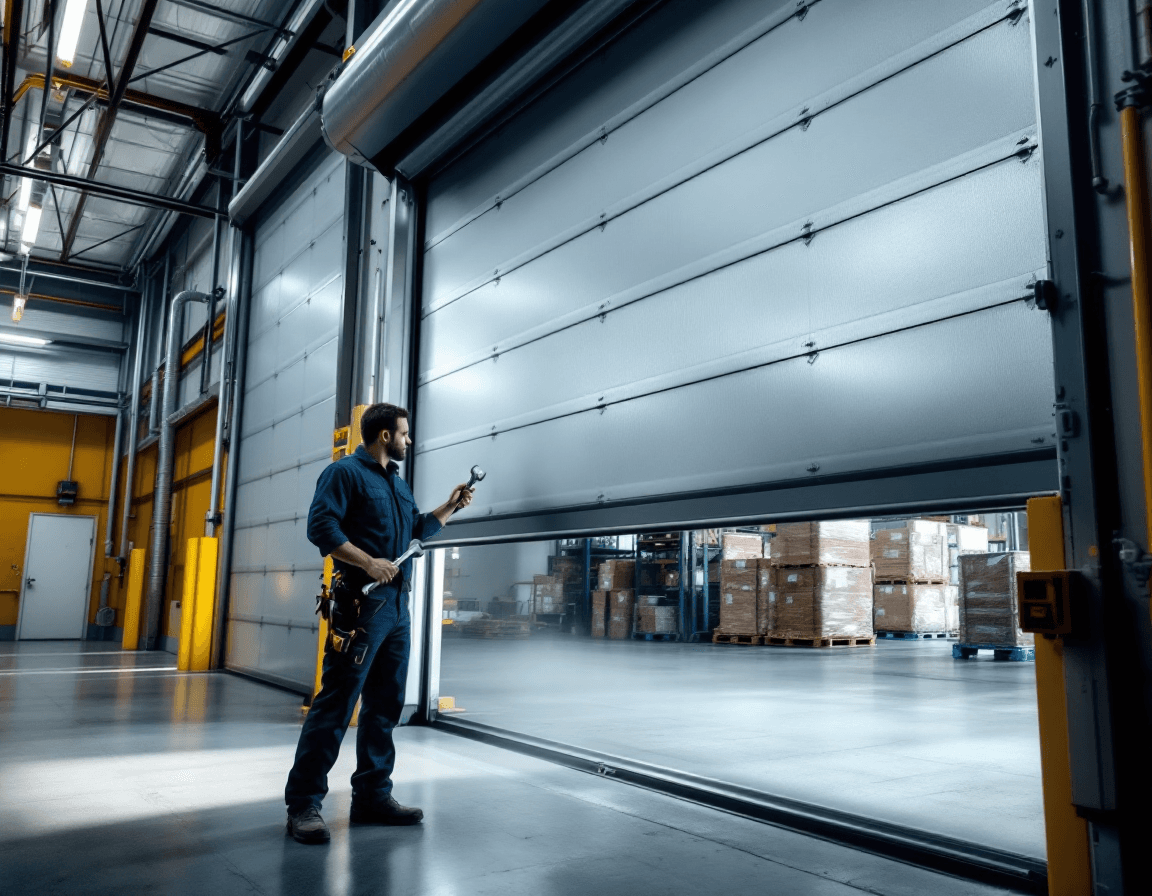
Commercial overhead door repair in Pacific, WA is a different job from fixing a residential garage door. A warehouse or loading-dock door carries heavier sections, runs more cycles in a day, and sits at the center of a business that loses money every minute it stays closed. When a sectional door stalls, a rolling steel door binds, or an operator quits, the question is rarely just "what's broken?" It is also "how fast can we get trucks and staff moving again?" This page explains how our commercial crews approach those calls in Pacific and the surrounding part of King County.
Pacific sits in the south end of the Puget Sound region, where the White River valley and its mix of light industrial, distribution, and service businesses keep doors working through long days. Many of the buildings we see have been in service for years, and their doors have absorbed decades of rain, temperature swings, and daily forklift traffic. Our technicians arrive with the parts and tooling needed for most common commercial repairs, which keeps a single visit from turning into two or three. We work with facility managers, owners, and property managers who need clear communication, a realistic timeline, and a repair that holds up under real loads.
We handle sectional overhead doors, rolling steel doors, commercial operators, and preventive maintenance programs. Every job begins with a conversation about your access needs, your hours, and what the door does for your operation. From there we give you a custom commercial quote rather than a generic flat rate, because a dock door on a cold-storage building and a rolling curtain at a machine shop present very different problems. To reach our dispatch line for a door that is down right now, call (888) 799-3819.
How the Pacific Northwest Climate Wears on Commercial Doors
Western Washington weather is hard on steel and hardware, even when the temperatures never reach extremes. Months of drizzle, persistent humidity, and damp mornings encourage surface rust on exposed steel, especially at bottom brackets, roller stems, and the edges where paint has chipped. Galvanized components last longer, but they still develop white corrosion when water sits in tracks or pools inside hollow bottom bars. Over several seasons, that moisture quietly works into hinges and bearings until a door that once ran smoothly begins to grind.
Temperature shifts add another layer of stress. A door that closes in cool, damp air in November may seem fine, but the same door can bind when a warm afternoon expands the steel and the building settles unevenly. Sectional doors rely on tracks that must stay parallel and plumb through these changes, and even a small misalignment can cause one side to lag behind the other. Rolling steel doors face similar issues at their guides and hood, where dust, grit, and moisture collect in the channels.
For facilities in this area, the practical response is steady inspection rather than waiting for a failure. We check for corrosion at pivot points, confirm the track is clean and square, look for loose fasteners that vibrations have worked free, and test the balance and travel of the door at each service visit. Catching a worn roller or a corroded bearing in March is far cheaper than an emergency call in the middle of a January shipping rush.
When a Loading Dock Door Goes Down Mid-Shift
A loading-dock door that stops working during operating hours creates a chain reaction. Trailers queue outside, drivers wait, dock staff lose productivity, and outbound orders slip behind schedule. Our first step on an urgent call is triage: determine whether the door is stuck open, stuck closed, or simply not responding, and whether it is safe to operate at all. A door that has lost its balance or shows visible damage must be secured before anyone works around it.
We start with the simplest explanations, because they are often the fastest fixes. Power to the operator may have tripped a breaker, a safety edge may be reporting an obstruction, a photo-eye may be misaligned, or a control station may have a failed button. Once those are ruled out, we inspect the mechanical side, including track alignment, roller condition, and whether a section has come out of its track. Each of these checks takes only a few minutes, and they let us give you an honest estimate of how long the door will take to return to service.
If the door cannot be safely restored the same day, we discuss temporary measures with you. That might mean securing the opening, redirecting traffic to a second dock, or scheduling a crew for the next available window with the right parts already on the truck. We would rather give you a clear plan than promise a fix we cannot deliver, and that honesty tends to matter most when a truck is waiting at the gate.
Rolling Steel Doors That Jam, Bind, or Jump the Track
Rolling steel doors look simple, but they carry a lot of load in a compact space. The curtain slats interlock and coil around a barrel, guided by side tracks that must remain clear and true. When a slat bends from an impact, when debris lodges in the guide, or when one side of the curtain falls out of alignment, the door can bind or jump out of its channel. Continuing to run a jammed rolling door risks further bending and can damage the barrel, brackets, or operator.
Our technicians typically begin by relieving tension and assessing whether the curtain can be safely lowered or raised by hand under controlled conditions. We look for bent slats, separated locking bars, damaged end locks, and worn bottom bars. Guide channels get inspected for dents, sediment, and corrosion, and we check that the hood and barrel are seated correctly. Restoring a rolling steel door often means straightening or replacing specific slats rather than the entire curtain, which keeps costs under control when the rest of the door is in good shape.
Rolling doors that jump the track usually reveal an underlying problem. It may be a worn bearing, a shifted bracket, a broken spring assembly, or an operator that is pulling the curtain unevenly. Simply pushing the curtain back into the channel buys a few cycles at best. We diagnose the root cause so the repair holds.
Commercial Operators That Stall, Surge, or Quit
The operator is the motor and control system that moves a commercial door, and in busy facilities it may cycle hundreds of times a day. When an operator stalls partway through travel, surges unpredictably, or fails to start, the cause could be electrical, mechanical, or a combination of both. Overheating from frequent cycles, failing limit settings, worn gear reducers, and damaged wiring from forklift strikes or vibration are all common culprits.
We test the operator under load, check the voltage supply, and confirm that limit settings match the door's actual travel. Safety devices deserve careful attention, because commercial operators must respond correctly to obstructions and reversing edges. Our crews verify that entrapment protection functions as designed and follow the manufacturer's specifications, since a safety device that does not respond properly is a liability for everyone who uses the building. When we replace components, we use parts matched to the door's size, weight, and duty cycle.
Operator problems sometimes masquerade as door problems. A door that seems to resist movement may actually be receiving too little power, while a jerky operation may be caused by a worn chain or a misadjusted sprocket. Careful testing separates these possibilities, which keeps you from paying for a door repair when the real fix is an operator adjustment or a control board replacement.
Doors That Are Too Slow for Your Throughput
Many commercial facilities have doors that technically work but cost time every day. A dock door that takes forty seconds to open, a high-speed roll-up that crawls, or a sectional door that stops halfway for a second cycle can add up quickly when trucks or forklifts pass through hundreds of times in a shift. Slow operation is often the result of worn components, mismatched operator settings, or an older motor that has lost capacity.
Speed is a balance, not a number to maximize. A door that opens too fast can create safety hazards, increase wear, and make it harder to control impacts from wind or vehicles. Our technicians adjust travel speed, soft-start and soft-stop settings where the equipment supports them, and limit positions to match how your operation actually uses the door. We also check for friction points, unlubricated bearings, and track obstructions that drag the door and force the motor to work harder than it should.
When a door is consistently too slow for your workflow, we talk through options with you. Sometimes the answer is a tune-up that restores factory performance. In other cases, a higher-speed operator or a different door type makes more sense. We will tell you which path fits your budget and throughput goals, and we will show you the numbers behind the recommendation in your quote.
Repairing Damage from Forklift Strikes and Impacts
Forklifts and pallet jacks are part of daily life in Pacific's warehouses, and an occasional impact is almost inevitable. A bent section on a sectional door, a cracked panel, a dented rolling curtain slat, or a damaged track bracket can compromise both security and operation. The first question after any strike is whether the door is still safe to run, and in many cases a visibly damaged door should be locked out until it has been inspected.
Sectional doors often allow replacement of individual panels, which avoids the expense of replacing the entire door. We match new sections to the existing door's profile, insulation, and hardware where possible, because mixing mismatched panels can create gaps and uneven travel. Hinges, rollers, and brackets near the impact point deserve inspection too, since a hard hit can knock them out of alignment even when the damage looks cosmetic. Rolling steel doors may need a slat or two replaced along with barrel and guide checks.
Preventing the next strike is a conversation worth having. Bollards, guard rails at the dock edge, floor markings, and driver training reduce the chance of repeat damage. We are happy to note placement concerns during an inspection, though decisions about traffic layout belong to your facility team.
Spring and Cable Work Belongs to Licensed Professionals
Commercial doors are counterbalanced by torsion springs or extension springs, and those springs store an enormous amount of energy. A commercial torsion spring can hold tension capable of causing serious injury if it is released improperly, and cables under load can snap with force. For this reason, spring replacement, cable repair, and drum adjustments should only be performed by trained, licensed technicians who have the proper winding bars, safety equipment, and procedures.
Our crews treat spring and cable work as a specialized task. We verify the door's weight, spring rating, and cycle expectations before selecting replacement parts, and we secure the door against unexpected movement during the work. Facility staff should never attempt to adjust or replace springs themselves, even if they have handled residential doors. If you notice a broken spring, a frayed cable, a door that slams down, or a sagging curtain, keep people clear of the opening and call a professional.
Safety also means lockout procedures. When a door is out of service, it should be physically blocked or de-energized so it cannot be triggered by a switch or remote during repairs. We coordinate with your team on lockout steps, labeling, and communication so that everyone on site knows the status of the door.
A Preventive Maintenance Plan Built Around Your Operation
Preventive maintenance is the most reliable way to avoid expensive surprises. A well-designed plan does not simply mean a yearly visit; it reflects how many cycles your doors run, what the environment is like, and what downtime costs you. We structure preventive maintenance contracts around the specific needs of each facility, which keeps spending predictable and focuses attention where it matters most.
A typical commercial maintenance visit may include some of the following items:
- Inspection and lubrication of hinges, rollers, bearings, and guide channels
- Track alignment checks and correction of loose or missing fasteners
- Operator testing, limit verification, and review of safety device function
- Visual inspection of springs, cables, drums, and mounting hardware for wear
- Corrosion assessment and touch-up recommendations for exposed steel
- Written service notes so your facility team can track trends over time
Plans can be set up for a single building or for multiple sites, and scheduling can align with your slow periods to limit disruption. We also recommend keeping a simple log of door incidents, unusual noises, and cycle issues, because those observations help us target repairs before a small symptom becomes a shutdown.
Custom Quotes Built for Commercial Jobs
Commercial door pricing depends on more than a single number. The door type, size, weight, operator model, access requirements, parts availability, and urgency all shape the final scope. That is why we provide custom commercial quotes rather than standard flat rates. Our goal is to give you an accurate picture of what the repair involves, what it will cost, and how quickly we can complete it.
To help us prepare a fast and accurate estimate, it helps to have a few details ready when you call:
- The door type (sectional, rolling steel, or other) and approximate opening size
- The make or model of the operator, if you know it, along with any model plate information
- A description of the symptoms and when they began
- Whether the door is currently secured, operating, or stuck in a position
- Your operating hours and any times when access is critical
- Whether you have an existing maintenance contract or service history
Turnaround matters as much as price for most commercial customers. We prioritize calls where a door is blocking operations, and we schedule follow-up work with minimal disruption. Once we understand your timing, we can tell you whether a same-day visit, a scheduled window, or a phased repair fits best.
Serving Pacific and the Corridors Around It
Our commercial crews work throughout Pacific and the nearby King County communities, including properties near Pacific City Park and along the main commercial corridors that connect the valley to the rest of the region. Our service area covers 60+ cities across the greater Seattle and Western Washington region, and Pacific's ZIP code, 98047, is one of the areas we support regularly. Whether your building sits in a dense industrial block or a standalone lot, we plan routes to reach you efficiently.
Familiarity with local conditions helps us work faster. We know how the valley's moisture and seasonal temperature swings affect steel doors, how traffic patterns around busy distribution routes influence dock scheduling, and how many facilities here rely on early-morning and late-evening shipments. That knowledge shapes everything from the parts we stock to the maintenance intervals we recommend.
Whatever your situation, the first step is simply describing what is happening. We will listen, ask the right questions, and explain your options in plain language. Call (888) 799-3819 to talk with our team about your commercial door, schedule an inspection, or set up a preventive maintenance plan that keeps your doors moving.