
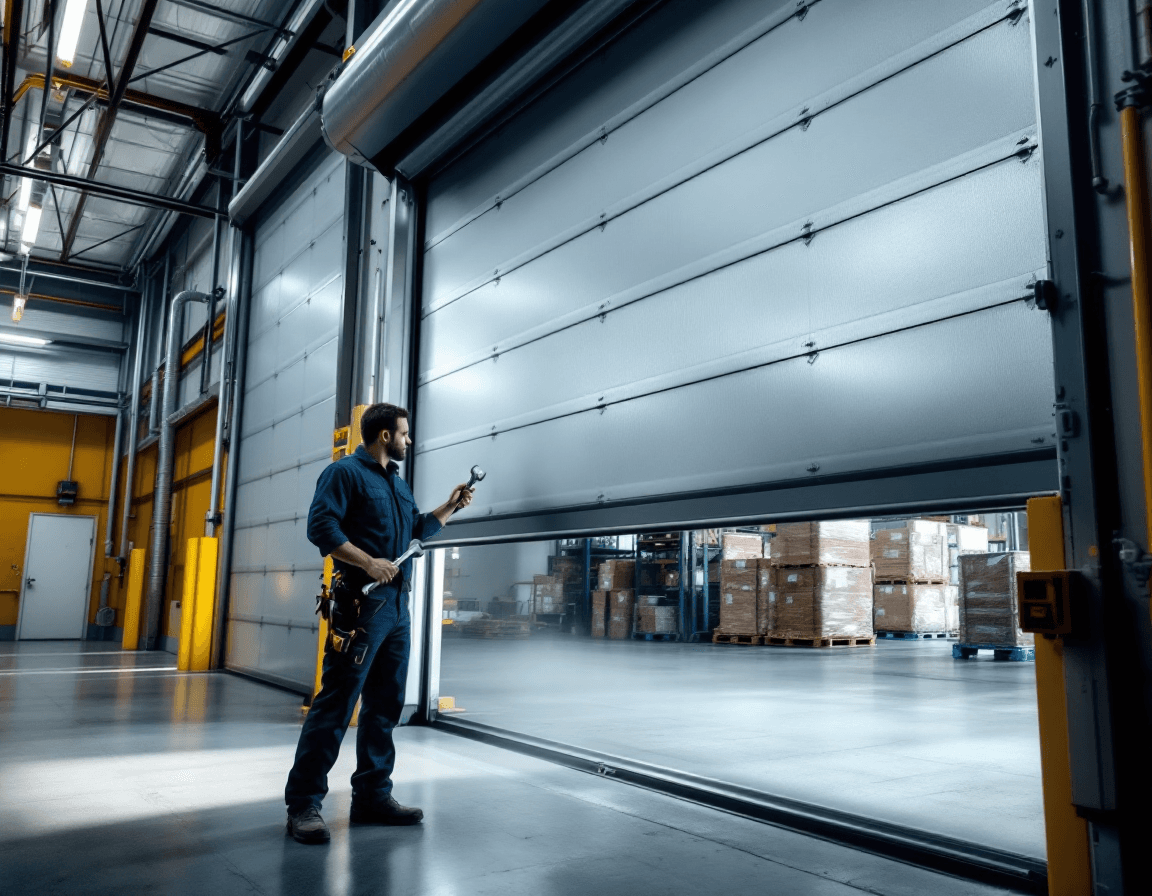
Commercial overhead door repair in Auburn, WA is a different job from fixing a garage door at a single-family home. A warehouse or loading-dock door carries constant cycles, heavier panels, and a schedule that depends on trucks arriving on time. When one door stops, the cost goes beyond the part and the labor. Staging areas back up, drivers wait in the yard, and crews stand around while product sits on the dock. Our technicians understand that a commercial door has to be back in service as quickly as safely possible, and that is the standard we bring to every call in the Auburn area.
Auburn sits in the Green River Valley, where a large share of the region's warehousing, distribution, and light manufacturing happens. Businesses here run near major freight routes, and many operate extended shifts, weekend receiving, or early-morning deliveries. Our crews work with property managers, facility leads, and owner-operators who need a clear diagnosis, a realistic plan, and a quote they can take to their own approval process. This page explains the most common commercial door problems we see around Auburn, what causes them, what we check first, and how we keep repairs focused on getting your operation moving again.
Because every facility is laid out differently, no two commercial door jobs are identical. A cold-storage dock in the valley has different needs than a light-assembly bay near downtown, and a rolling steel door at a storefront presents different challenges than a multi-section dock door with an edge-mounted operator. The sections below walk through the typical scenarios, but the final scope always comes from an on-site inspection. We would rather spend a few extra minutes understanding your door than guess and send you back for a second visit.
Why Auburn Loading Doors Wear Faster Than the Brochure Suggests
Western Washington winters bring long stretches of rain, damp mornings, and temperatures that hover near the freezing point for days at a time. Moisture is the quiet enemy of commercial doors. Water gets into track joints, collects at the bottom seal, and works its way into hinge pins and roller bearings, where it accelerates rust and seizes moving parts. Steel that looks fine in October can show surface corrosion by February if the door sits in a low spot where runoff pools.
The valley also has a lot of dust, road grime, and tire debris kicked up by trucks. Those fine particles settle into tracks and guide channels, mix with lubricant, and form an abrasive paste that grinds away at rollers and bushings. Doors that cycle dozens of times per shift accumulate that wear quickly. A door that worked smoothly during a summer inspection can begin to drag by the end of the wet season simply because the track was never cleaned after months of buildup.
Heavy use compounds all of this. A dock door that opens and closes forty or fifty times a day experiences far more stress on its springs, cables, and drive components than a residential door that might cycle a few times daily. Over time, small misalignments turn into binding, and binding turns into strain on the operator. Recognizing that a commercial door is a high-cycle machine is the first step toward preventing the emergency calls that disrupt the whole week.
Warning Signs That a Loading Bay Door Needs Attention Now
Most commercial door failures announce themselves well before the door stops completely. Staff who open and close the same door every day often notice changes in sound, speed, or behavior before anyone writes a ticket. Catching those early signs usually means a shorter, less expensive repair and far less disruption to the dock schedule.
Watch for these conditions on any sectional or rolling commercial door:
- Grinding, popping, or squealing during travel, especially at the start or end of the cycle
- Visible gaps between sections, or a door that no longer seals against the floor or the jambs
- The door climbing off a track, rubbing a guide, or leaning to one side as it moves
- Slower opening or closing than it used to be, even when the operator sounds normal
- Stops, reversals, or hesitation at certain points in the travel, sometimes in the same spot each time
- Water intrusion, daylight at the bottom seal, or frost and ice buildup on the lower panels during cold snaps
Any one of these signs deserves a look. Several together usually point to a maintenance gap that has been building for a while. If your team has started working around a door rather than reporting it, that is a strong signal that the door has already moved past the stage where a quick adjustment would have solved it.
Sectional Overhead Doors: Panels, Tracks, and Hidden Wear
Sectional doors are the most common style on commercial docks and warehouse bays. They are made of insulated or non-insulated steel panels joined by hinges and rolled up on vertical and horizontal tracks inside the building. Their main advantage is that they move out of the opening efficiently, which matters when a bay needs to stay open for long periods. Their main weakness is that every joint, roller, and track segment has to stay aligned for the whole system to work correctly.
When we inspect a sectional door, we start with the track geometry. Vertical runs should be plumb, horizontal sections should be level and parallel, and the radius where the track curves should be free of dents or flattened spots. A bent track segment, often caused by a forklift tip or a truck trailer that tapped the door frame, can make the entire door bind. We also check the rollers, since worn or cracked nylon wheels and dry steel rollers are among the most frequent causes of noise and jerky motion.
Hidden wear shows up in the hinges and end caps, and in the bottom bracket where the lowest panel meets the bottom seal. We look for cracked hinge plates, loose bolts, and panels that have started to bow. In many commercial doors, the torsion spring system above the opening carries most of the lifting load. Those springs are under very high tension and must be serviced only by a licensed, trained technician with the proper equipment. Anyone who tries to adjust or replace them without that training risks serious injury. We handle all spring work as a controlled, specialized task and explain the options clearly before we proceed.
Rolling Steel Doors That Bind, Jam, or Jump Their Guides
Rolling steel doors are common on storefronts, service bays, and smaller warehouse entrances. They roll up into a compact coil above the opening, so they save interior space and are often chosen for secure, high-traffic entries. Because they rely on interlocking steel slats running in side guides, a problem in one small area can stop the entire door. A jammed rolling door is frustrating, and forcing it can warp the curtain and make the damage worse.
Our first step with a rolling steel door is to determine whether the problem lies in the curtain, the guides, the barrel, or the operator. A slat that has been bent by impact can catch in the guide and create a hard stop. A guide that has shifted or loosened can let the curtain walk sideways until it jumps out of its channel. Debris, road salt residue, and grit collecting in the bottom of the guides can add enough friction to overload a motor that was properly sized for a clean door.
If a rolling steel door has come off its guide, do not attempt to pull the curtain back into place by hand while the door is still under tension. Once the situation has been made safe, we can reseat the curtain, straighten or replace damaged slats, and check the barrel alignment so that the door will track evenly. Many doors that look badly damaged can be restored with targeted slat replacement and guide correction, which is often far less costly than a full door replacement.
Commercial Operators and Controls: When the Motor Stops Mid-Shift
A commercial operator is the motor, gearbox, and control system that drives the door. Depending on the building, the operator may be a jackshaft unit mounted on a shaft above the door, an operator mounted on the side wall, or a direct-drive system designed for heavy-duty or high-speed use. Operators are built to handle frequent cycling, but they depend on properly set limits, sound wiring, and clean, well-balanced doors. When the operator fails, the cause is often elsewhere in the system and only shows up at the motor.
A reliable diagnostic approach starts with the controls. We check the push-button stations, pull cords, wireless transmitters if equipped, and any safety devices that prevent operation when a condition is not met. A safety edge that is tripped, a photo-eye that is misaligned, or a loop detector that is picking up interference can all make a door appear dead when the operator itself is fine. We then confirm the power supply, the contactor or relay condition, and the limit settings that tell the operator where the door should stop.
If the operator really has failed, the repair may involve a control board, a brake, a gearbox, a chain or belt drive, or a motor. Some operators can be repaired on site, while others need a replacement unit ordered and installed in a single visit. Because commercial downtime is expensive, we will discuss the realistic options for your building, including whether a temporary solution keeps the dock functional while the permanent part is being sourced.
Here is a short checklist our technicians often walk through when an operator stops responding:
- Confirm that the disconnect, breaker, and power feed are energized and that no phase or voltage problems exist
- Test each control station and any safety device separately to isolate the fault
- Inspect limit settings and any encoder or sensor feedback for drift or damage
- Check the drive chain, belt, or gearbox for wear, slack, or lubrication problems
- Verify that the door moves freely by hand only after the operator has been locked out and the door is secured
Forklift Impact: Assessing Damage Without Guessing
Forklift impact is one of the most common reasons a commercial door needs repair in an industrial area. A forklift tine, a pallet, or a loaded lift can strike a lower panel, a track, or a guide in a moment of misjudgment. Sometimes the damage is obvious, with a dented panel or a twisted track. Other times the visible damage is minor, but the force has traveled through hinges and rollers and knocked the door out of alignment in ways that will show up later.
When we assess impact damage, we look at the full path of the force. We check whether the impacted section is still square, whether adjacent panels have shifted, and whether the hinges connecting them have been stressed. We inspect the track above and to the sides of the impact zone, because a bent track can create a hidden binding point that wears rollers quickly. On rolling doors, we look for bent slats, distorted guides, and any change in the curtain's tension that could cause it to bind on the next cycle.
Not every damaged section needs full replacement. A single panel can often be swapped out, which is usually faster and less costly than replacing the entire door. Replacement sections need to match the existing profile, thickness, insulation type, and hardware so that the door seals correctly and tracks as designed. We recommend keeping a record of impacts and near-misses, since patterns of damage often point to traffic routing, lighting, or staging issues that can be fixed in the building rather than repeated at the door.
Throughput Problems: When the Door Works but Holds the Dock Back
Some commercial door complaints are not about outright failure. The door opens and closes, but it does so slowly enough to slow the entire receiving process. A dock crew that waits fifteen or twenty extra seconds per cycle across a full shift loses real time, and that time adds up quickly during peak deliveries. These throughput problems often come from a combination of operator settings, mechanical resistance, and the door's overall condition.
We begin by measuring the cycle. How long does the door take to open fully, close fully, and reverse? Is the speed consistent, or does the door slow down in one zone of its travel? A door that drags in the upper third of its range may have a binding track or a roller problem, while a door that moves quickly but stalls at the end may need limit or speed adjustments. Operator speed can often be tuned, but only within the limits the manufacturer and safety standards allow. We will never recommend a setting that compromises safety just to save a few seconds.
In many cases the fix is a combination of mechanical service and programming. Cleaning and lubricating tracks, replacing worn rollers, correcting alignment, and verifying the operator's performance can restore a door to its intended speed. If the door and operator are simply undersized for the facility's current cycle count, we can talk through upgrade options so the door keeps pace with your operation for years rather than becoming a daily bottleneck.
Safety Systems and Expectations for Commercial Doors
Commercial doors carry more safety responsibility than most residential doors. A large panel moving under power can cause serious injury if a person or piece of equipment is caught in its path. For that reason, commercial doors are expected to include safety devices such as photo-eyes, safety edges, and controlled reversing behavior. These systems protect workers, visitors, and vehicles, and their proper function is a core part of any repair we perform.
During service, we test each safety device to confirm that it stops or reverses the door as intended. We check that photo-eyes are aligned and clean, that their wiring is intact, and that they are not being triggered by reflections, dust, or nearby lighting. Safety edges should respond when pressed, and the door should reverse as designed. If a safety device has been bypassed, disconnected, or damaged, we will explain why it matters and recommend restoring it before the door returns to regular use.
Facilities also need to think about local building and safety expectations for their particular occupancy and door type. Requirements can vary depending on the building's use, the door's size, and whether the door is part of an egress path. We are not a substitute for an engineer or code official, but we can point out visible safety issues, document what we found, and help your facility team plan corrections. Keeping safety functions tested and recorded is one of the simplest ways to protect your people and your liability position.
Quoting and Dispatch Built Around Downtime
Every commercial job we quote is priced individually. Doors differ in size, age, manufacturer, operator type, and the complexity of access. A straightforward track adjustment in an accessible building is a very different job from a multi-section panel replacement at a height that requires lift equipment and coordination with the property. Because of that variation, we do not publish flat rates for commercial overhead door repair. Instead, we provide custom quotes after a clear picture of the problem.
Our goal on every commercial call is to shorten the path from report to repair. When you contact us, we will ask about the door type, the nature of the symptom, when the door last worked properly, whether any forklift impact or recent weather event occurred, and what your operation needs in terms of timing. Many commercial repairs can be scheduled to fit around receiving windows, overnight shifts, or weekend closures. If a temporary fix will keep product moving while a part is ordered, we will explain that option plainly so you can make the decision that fits your business.
We also know that commercial quotes often need to pass through purchasing, a property owner, or a management review. We write our estimates so they explain the scope, the parts involved, the labor, and any items that depend on what we find once we open things up. If a second issue is discovered during the repair, we will stop, explain it, and provide a clear addition to the quote before proceeding. Transparency keeps the project moving and avoids surprises when the invoice arrives.
Preventive Maintenance Agreements Built Around Your Shift
Reactive repairs solve the problem in front of you, but preventive maintenance keeps the problem from happening in the first place. A written maintenance agreement gives your facility a schedule of inspections, lubrication, adjustments, and safety testing that matches how your doors are actually used. For a busy Auburn distribution site, that might mean more frequent visits during the wet months, when track buildup and corrosion are most likely, and a lighter schedule during drier periods.
A typical preventive maintenance program may include track cleaning and inspection, roller and hinge checks, bottom seal and weatherstripping review, operator testing, limit verification, and safety device testing. For rolling steel doors, it can include guide cleaning, curtain checks, and barrel inspection. Each visit should end with a clear record of what was checked, what was adjusted, and what needs attention before the next scheduled service. That record is valuable for facility managers, insurance reviews, and budgeting.
We design these agreements around your operating schedule rather than forcing a one-size-fits-all calendar. If your receiving team is busiest on certain days, we can plan visits around low-traffic windows. If your facility has multiple doors, we can group them into a single visit to reduce disruption. Preventive maintenance is ultimately about predictability: fewer surprises, fewer emergency calls, and a dock that opens when your trucks arrive.
Serving Auburn Downtown, Lakeland Hills, Lea Hill, and Nearby Neighborhoods
Auburn is a city of distinct areas, and commercial properties in each one have their own patterns. Businesses near Auburn Downtown often deal with older building stock, tighter access for equipment, and doors that have been in place for decades. Facilities in the Lakeland Hills area may include newer commercial developments with a mix of retail, service, and light industrial uses, where door traffic and delivery schedules can vary throughout the day. Properties around Lea Hill sometimes combine commercial frontage with access roads and grades that affect how trucks approach loading areas.
Our technicians serve Auburn and surrounding communities across the ZIP codes 98001, 98002, and 98092, and we regularly work with property managers, tenants, and owner-operators throughout the valley. Whether your door is on a dock in an established industrial building or in a newer commercial complex, we bring the same focus on safe, efficient repair. We take time to understand how your building is laid out and how your team uses the door, because that context shapes the best repair plan.
If you are not sure whether your situation calls for an urgent response or a scheduled visit, call us and describe what you are seeing. We can help you sort through the options, explain what we would check first, and give you a realistic path forward. For commercial overhead door repair in Auburn, WA, a clear diagnosis and a well-planned repair are the fastest route back to normal operations.
Your loading dock is too important to leave to guesswork. If a sectional door is binding, a rolling steel door has jumped its guides, an operator has quit mid-shift, a forklift has damaged a section, or your facility needs a preventive maintenance plan that fits your schedule, call Seattle Garage Door Fix at (888) 799-3819 to request a custom commercial quote. Our team is licensed, bonded, and insured, and we will work with you to keep your downtime as short as safely possible.