
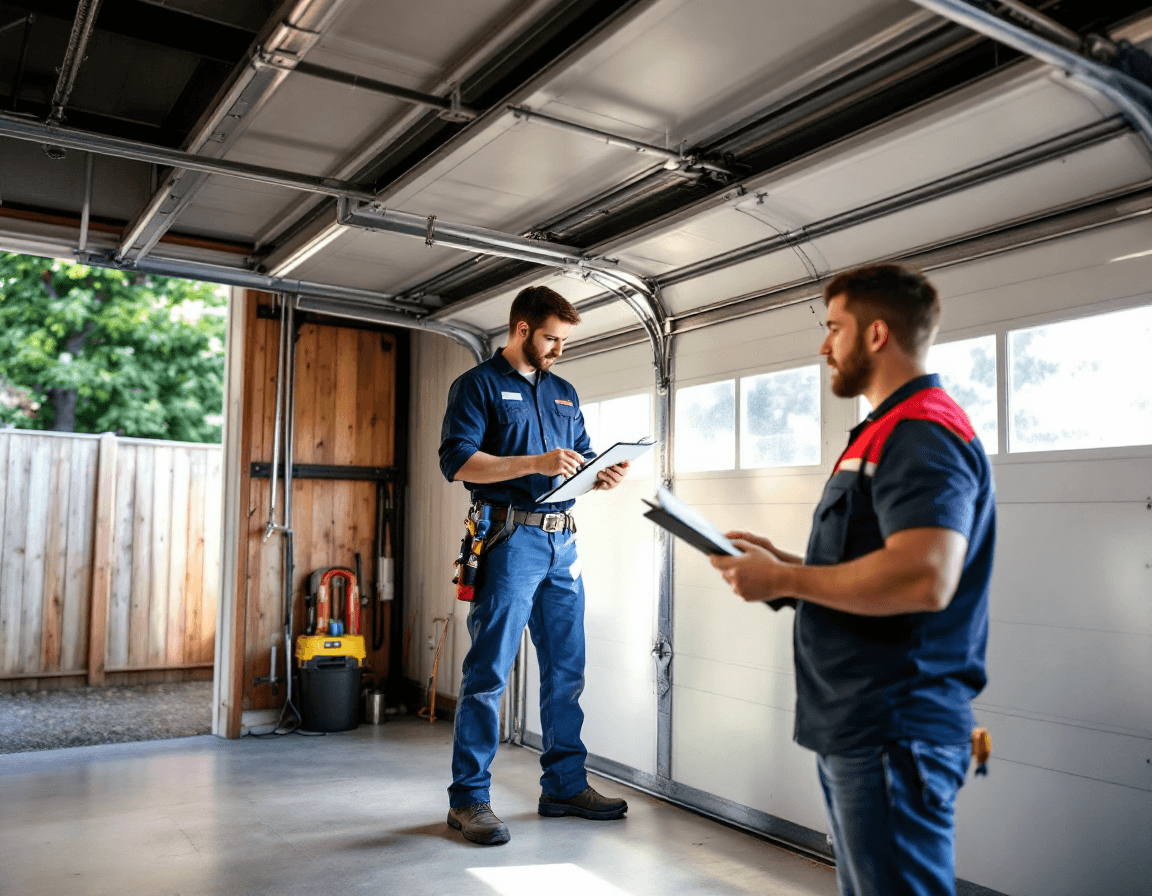
Garage Door Maintenance & Tune-Ups in Edmonds, WA is one of the most practical things a homeowner can schedule, and it costs far less than the emergency call that usually follows a neglected door. Edmonds sits on the Puget Sound shoreline with the Olympic foothills to the west and the Cascade foothills to the east, and that combination brings damp winters, salty air near the water, and long stretches of gray weather that keep a door's hardware wet longer than most people realize. A garage door is a heavy, moving machine that lives outdoors in all of that, even when it is attached to a house. A tune-up is a scheduled inspection and adjustment that catches small problems while they are still small.
Our technicians serve homes across Edmonds and the surrounding Snohomish County communities, including the 98020 and 98026 ZIP codes, from the older blocks near Downtown Edmonds to the quieter streets around Perrinville. We see the same patterns repeat from house to house: a door that has grown louder over several seasons, an opener that sounds like it is working harder than it should, or a door that seems to resist being lifted by hand. Most of these issues do not appear overnight. They develop gradually, and a multi-point tune-up is designed to find them before a spring snaps or a cable frays.
Whether you have lived in your home for twenty years or you closed on it last month, this page explains what a professional tune-up includes, why local conditions matter, which warning signs deserve attention, and what the $89–$149 service price actually covers. If you have questions about your specific door, you can call us at (888) 799-3819 at any time.
What a Multi-Point Tune-Up Actually Covers
A multi-point tune-up is a structured walkthrough of every component that keeps your door moving safely. It is not a quick glance from the driveway or a squirt of lubricant on the rollers. A technician checks the door panels, the tracks, the rollers, the hinges, the end brackets, the cables, the springs, the drum, the bottom seal, the weatherstripping, and the opener, then documents what is worn and what is still in good condition. Each item is evaluated for alignment, tension, and wear, and any adjustments that can be made safely on site are completed during the visit.
Because the door is a system, the inspection looks at how the parts work together rather than at each part in isolation. A worn roller can cause a track to bind, which puts extra strain on the opener, which then wears its own components faster. Catching that chain early is the real value of a tune-up. Our technicians look for these connections as they go, and they will explain what they found in plain language before any recommendations are made.
Here is a general outline of what a standard visit includes:
- Visual and hands-on inspection of door panels, hinges, and end caps for cracks, loose fasteners, or sagging sections
- Track alignment checks, including vertical and horizontal measurements and cleaning of debris from the channels
- Roller inspection for flat spots, cracks, or worn bearings, with replacement recommended where needed
- Lubrication of hinges, rollers, bearings, and moving connection points using a product suited to garage door hardware
- Balance testing and a review of spring and cable condition, with the work referred to licensed specialists when it goes beyond routine checks
- Opener safety testing, including auto-reverse and photo-eye function, plus a check of the force settings and limit adjustments
- A written summary of findings so you know what was done and what, if anything, should be planned for later
Why Salt Air and Wet Winters Wear Down Edmonds Garage Doors
Edmonds has a climate that is mild by most American standards but hard on mechanical hardware. Winters are wet and often gray, and the Puget Sound air carries a fine mist of salt that settles on surfaces and lingers. Steel springs, zinc-plated hinges, and exposed bearings can all begin to show corrosion in this environment, especially on doors that sit close to the street, face the prevailing winds, or receive little direct sun. The moisture does not need to pour down to cause harm; a steady dampness over many months is enough to start rust at the points where metal meets metal.
Our technicians often notice that the lower brackets, the bottom roller stems, and the springs show the earliest signs of surface oxidation. Rust itself does not always cause immediate failure, but it increases friction, raises the stress on moving parts, and can make a fully closed door feel stiffer on the lift. Dampness also works its way into wood doors, causing swelling, warping, or softened bottom rails. Steel doors can trap moisture in their insulation layers, while aluminum tracks may pick up grime and mineral deposits that interfere with rollers.
Summer in Edmonds is generally drier and milder, but it can bring its own problems. Long daylight hours and warm afternoons cause the lubricant on rollers and hinges to thin and migrate, and then the same dust and grit that settled during the wet season can stick to parts that were recently coated. A tune-up timed for early spring, before the heaviest rain, and another in late summer or early fall gives the door a chance to recover from each season. Many homeowners who schedule once a year do well by choosing a consistent month and sticking with it.
Reading the Warning Signs Your Door Is Telling You
Garage doors communicate through sound, movement, and feel long before they stop working. The most common early signal is a change in noise. A door that once rolled quietly may begin to squeak, grind, rattle, or pop, and the sounds often grow in intensity over several weeks. A squeal usually points to dry or contaminated hinges and rollers, a grinding noise can suggest worn bearings, and a loud bang at the top of the travel may indicate a misaligned track or a loose bracket. Homeowners sometimes assume that noise is simply part of an older door, but a change in sound is almost always worth investigating.
Movement is the second signal. A door that stops at an odd point, jerks as it passes certain sections of track, or lands unevenly when closed needs attention. Pay attention to whether the door climbs smoothly or hesitates, and whether one side lags behind the other. These behaviors can point to alignment issues, uneven cable tension, or a roller that has begun to flatten or crack. Also watch for panels that appear to bow or gap when the door is halfway open, since that can indicate a hinge or a section that is under strain.
Feel is the third signal, and it is the one many people notice first without realizing it. If you can lift the door by its handle and it feels heavy, or if it seems to rise suddenly when you release the opener, the door may be out of balance. A properly balanced door should stay roughly in place when raised manually to about waist height and released, and it should not drop or shoot upward. Here are signs that deserve a professional look:
- The door feels noticeably heavier on one side or requires more effort to lift by hand
- The opener motor runs longer than usual, hums loudly, or seems to strain at the start of travel
- A section of track looks bent, has visible gaps, or has pulled away from the wall or ceiling
- Rollers appear cracked, chipped, or have worn into flat spots
- Light or sensor alignment seems off, or the door reverses without an obvious obstacle
Balance Testing: The Test Most Homeowners Never Hear About
Balance is one of the most important and least discussed aspects of garage door performance. A counterbalance system, usually built around torsion springs or extension springs, is designed to carry most of the door's weight so the opener does not have to lift it alone. When the balance is right, the opener needs to do relatively little work, and the door moves smoothly in both directions. When the balance drifts, the opener must compensate, and that extra strain shows up as slower travel, louder operation, and premature wear on the motor and gear assembly.
During a tune-up, our technicians perform a balance check by disconnecting the opener (following safe procedures) and manually lifting the door to a partial height to see whether it holds its position. They also observe how the door behaves on the way down and how evenly it moves across the full range. A door that fails the test does not always need immediate spring replacement. Sometimes the problem is a worn cable, a damaged drum, a loose bracket, or a track that has shifted slightly. Our job is to determine the cause, explain it clearly, and tell you what the fix involves.
It is important to understand where a homeowner's responsibility ends. Torsion springs and cables are under very high tension, and working on them without the proper tools and training can cause serious injury. Adjusting spring tension, replacing cables, or repairing drums is specialized work that should be performed only by licensed professionals. A tune-up includes the diagnostic measurements and visual inspection that help determine whether spring or cable work is needed, but the actual spring or cable work should always be handled by a licensed technician. If anyone suggests that you adjust a spring yourself to save money, that is a clear reason to call a professional instead.
Opener Safety Reversal and Photo-Eye Checks
Modern garage door openers are built with safety systems that are meant to protect people, pets, and property. The two most important are the auto-reverse mechanism, which should stop and reverse the door if it contacts an obstacle while closing, and the photo-eye sensors, which are small devices mounted near the bottom of the tracks that detect objects in the door's path. When these systems work correctly, the door should reverse within a fraction of a second after striking an object. When they do not, the consequences can be serious, especially for young children who may be near the door.
A tune-up includes testing these systems. Our technicians place a safe test object in the closing path, typically a block of wood or similar item, and confirm that the door reverses promptly. They also check the photo-eye alignment, clean the lenses if needed, inspect the wiring for damage, and confirm that the sensors respond when the beam is interrupted. The force settings and limit adjustments on the opener are reviewed as well, because a door that is set too tightly can fail to reverse properly, while one set too loosely may not close fully.
Edmonds homes often have sensors that sit close to the floor, and that can make them vulnerable to dust, spider webs, and moisture. A sensor that is dirty or slightly misaligned may work intermittently, which is one of the more frustrating problems homeowners report. Our technicians can tell you whether a sensor is failing or simply needs cleaning and realignment. If you have noticed the door reversing for no clear reason, or if it refuses to close unless the button is held down, schedule a safety check promptly rather than waiting for the next scheduled visit.
Lubrication Done Right (and What Not to Put on Your Door)
Lubrication is the part of maintenance most homeowners think they understand, yet it is also where the most common mistakes happen. Garage door hardware needs a lubricant that stays in place, resists moisture, and does not attract a heavy layer of dust. In the Pacific Northwest, that matters even more, because wet conditions can wash away thin coatings quickly. Our technicians typically use a silicone-based or lithium-based garage door lubricant on hinges, rollers, bearings, and metal-to-metal contact points, applying it sparingly so that excess does not drip onto the floor or collect grime.
Some products are a poor choice for this work. Heavy grease can become sticky in cold weather and pick up grit that wears down rollers and tracks. Household oils such as cooking oil or motor oil can break down quickly, stain concrete, and attract dirt. WD-40 is often used as a cleaner and penetrating agent, but it is not a long-lasting lubricant for garage door parts, and it should not be relied on as the only treatment. We recommend lubricating only the components that need it and wiping away old residue before applying fresh product, so the new layer bonds properly.
Lubrication also has a timing component. A door that has not been lubricated in more than a year often develops squeaks and resistance that a fresh coat will not fully fix, because the buildup of old lubricant and dirt has to be cleaned out first. During a tune-up, our technicians clean the track channels, wipe down rollers and hinges, and then lubricate the right points. Track lubrication is handled differently from roller and hinge lubrication, and applying the wrong product inside the track can cause rollers to slide instead of turn. Doing the job correctly is one of the simplest ways to extend the life of your door.
Fitting Maintenance Into Edmonds Homes: Older Builds, Sloped Driveways, and Tight Garages
Edmonds has a mix of housing styles. Many neighborhoods near Downtown Edmonds feature homes built decades ago, with detached garages or attached garages that were not designed around today's larger doors and heavier opener systems. In these homes, the header height, the track radius, and the clearance above the door can be unusual, and older track systems may have been modified over the years. A tune-up on these doors often involves more careful measurement, because a small alignment issue can have a bigger effect when the track geometry is already a bit off.
Sloped driveways and lots that rise toward the bluffs or fall toward the water also influence how a door behaves. A garage that sits lower than the street can collect runoff and debris at the threshold, which affects the bottom seal and can cause the door to bind at the floor. Our technicians check the bottom weatherstripping, the threshold condition, and whether water is pooling in a way that encourages rust on the bottom bracket. Clearing and adjusting these areas can make the difference between a door that closes cleanly and one that leaves a gap that lets in cold air and moisture.
Tight garages present their own challenges. When the space behind the door is limited, the opener rail and the track may be crowded, and that can make routine service harder to perform safely. In some cases, a tune-up reveals that the opener mounting bracket has loosened, or that the rail is flexing under load, and those issues can cause noise and alignment drift. We take care to work around these constraints and explain what we find, so you can make informed decisions about whether an upgrade or repair makes sense for your space.
Buying a Home in Edmonds? Start With a Baseline Inspection
Purchasing a home is a busy time, and the garage door is often the last thing on a buyer's mind. Yet the door can tell you a great deal about how the property has been cared for. Many buyers in Edmonds, particularly those moving into older homes near the Edmonds Waterfront and nearby residential blocks, find that the previous owner never scheduled routine service. A baseline tune-up soon after closing gives you a clear picture of the door's condition and establishes a maintenance history that you can build on.
A baseline visit is especially useful because it answers several questions at once. Is the door balanced and tracking correctly? Are the safety reversal and photo-eye systems working as they should? Are there signs of rust, cracked rollers, or worn cables that might become urgent in the next season? Knowing these answers early lets you budget for repairs, negotiate if the issues were not disclosed, or plan a more thorough replacement if the door is nearing the end of its useful life. It also gives you a reference point, so that future changes in noise or performance are easier to spot.
If you are already in the home and have not had the door looked at, do not wait for a problem to appear. Many homeowners assume that a door that still opens and closes is in good shape, but the most important safety and balance functions are hidden from casual observation. A tune-up is a simple way to confirm that your garage is functioning as intended, and it gives you a professional's read on the components you cannot see from the driveway.
What the $89–$149 Tune-Up Price Includes and Doesn't
Our multi-point garage door tune-up is priced between $89 and $149, depending on the size and configuration of your door, the type of opener, and the overall condition of the system. The service includes the full inspection, lubrication, balance testing, and opener safety testing described above, along with adjustments that can be made safely during the visit. You receive a clear explanation of what was checked, what was adjusted, and what, if anything, should be scheduled for later. The price is a flat-rate service estimate, and our technicians will confirm the final quote before beginning any work that goes beyond the standard tune-up.
It helps to understand what the tune-up does not include. Replacing torsion springs, cables, drums, or the door itself is a separate repair that requires its own quote and scope of work. Opener replacement, track replacement, and panel repair are also outside the standard tune-up. If your inspection reveals that one of these items needs attention, our technician will explain the options, the reasons behind each recommendation, and the approximate cost range before any repair is performed. You are never obligated to proceed, and you can take time to consider the findings.
Here is a practical way to think about the service:
- Included in the tune-up: inspection, cleaning, lubrication, balance testing, opener safety testing, and adjustments within routine scope
- Quoted separately: spring replacement, cable replacement, drum repair, roller or panel replacement beyond minor fixes, track rebuilds, and opener replacement
- Always handled by licensed professionals: any spring or cable work, regardless of how small it appears
Keeping Maintenance on a Practical Schedule for Western Washington
A maintenance schedule works best when it fits the local climate and the way your household uses the garage. For most Edmonds homes, a yearly tune-up is a reasonable baseline, with timing chosen to avoid the wettest part of the season if possible. Late winter or early spring is a common choice, because the door has been through the wet months and any corrosion or wear can be addressed before the longer, busier days of summer. Homes where the garage door is used many times a day, or where the door faces the weather directly, may benefit from a second visit in late summer or fall.
Between professional visits, there are a few simple habits that help. Keep the door's tracks free of leaves, moss, and debris that blow in during windstorms. Wipe the bottom seal and check it for cracks or flattened sections after heavy rain. Watch the door as it operates, and pay attention to any change in sound or movement. Avoid hanging heavy items from the door or its hardware, and do not attempt to manually force a stuck door open or closed, since that can damage the opener and the balance system.
Finally, keep a simple record of your service visits. Note the date, the findings, and any repairs or recommendations. This record helps your technician track changes over time and makes it easier to plan for larger replacements. If you notice new noise, a shift in balance, or a safety system that is not responding as it should, call us before the problem grows. For scheduling, questions about your specific door, or to set up a tune-up anywhere in Edmonds or the surrounding Snohomish County communities, call (888) 799-3819 and a member of our team will help you find a convenient time.