
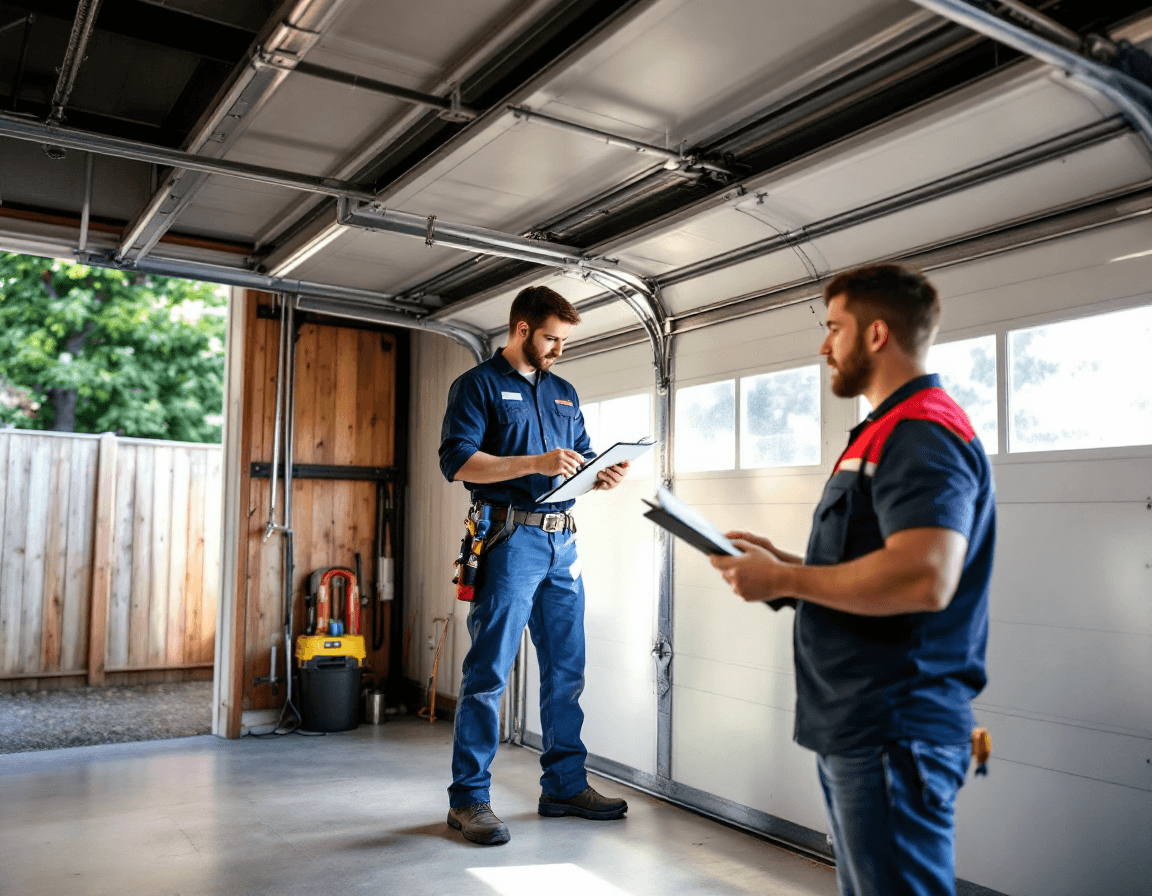
Garage Door Maintenance & Tune-Ups in Lynnwood, WA is one of the most practical ways to protect a home that sees long, wet winters and cool, damp springs. Homes across Lynnwood, from the older neighborhoods near the Alderwood area to newer subdivisions closer to the City Center, share a common challenge: the garage door is one of the largest and heaviest moving parts on the house, and it works hard every day without much attention. A door that goes a year or more without a look can quietly drift out of balance, lose lubrication, and put extra strain on the opener until something finally stops working on a cold morning when you are already running late.
A well-planned tune-up catches those small changes before they become a service call. Our multi-point tune-up, priced between $89 and $149 depending on the door and the condition of its components, is designed to check the safety systems, reduce friction across the moving hardware, test whether the door is properly balanced, and confirm that the opener is doing its job without overworking. Think of it as a physical checkup for a machine that carries serious weight every time it opens. The goal is simple: a door that moves smoothly, closes reliably, reverses safely when it should, and gives you warning signs early rather than surprising you at the worst possible time.
If you are a homeowner in ZIP codes 98036, 98037, or 98087, or you have recently moved into the Lynnwood area and are wondering what condition the door was left in, this page explains what we look for, why it matters in this part of Snohomish County, and how to tell whether your door is due for attention. We have written it to be practical rather than theoretical, so you can make a clear decision about your own garage door. Read on for the details, and call (888) 799-3819 whenever you want a qualified technician to take a look.
Why Lynnwood's Damp Winters Show Up in Your Garage Door
The Pacific Northwest climate is gentle compared with many parts of the country, but it is hard on steel, wood, and mechanical hardware in a different way. Lynnwood sits in the Puget Sound lowlands, where long stretches of drizzle, low cloud cover, and high humidity keep surfaces damp for weeks at a time. Moisture slowly works into hinges, roller bearings, and the bottom seal, and once metal begins to surface-rust or a wooden door begins to swell at the edges, the friction changes enough to affect how the door travels along its tracks. Many local homeowners notice the difference first in late autumn, when a door that rolled quietly all summer starts to chatter or hesitate.
Temperature swings matter as well. A typical Snohomish County winter may bring cool nights followed by milder afternoons, and a garage can cycle through those changes faster than the rest of the house because it is less insulated and often opens to outside air many times a day. Metal expands and contracts a little with each cycle, and over time that movement can loosen fasteners, shift roller alignment, and make tracks slightly out of plumb. None of these changes is dramatic on its own, but together they explain why a door that was perfectly adjusted at installation may feel different a few years later without any single failure to point to.
Because the region stays damp for so long, we pay particular attention to the parts of the door that trap moisture. Bottom brackets, the lower edges of panels, and the tracks near the floor are common spots for corrosion and debris, and they are often overlooked during routine use. A tune-up gives us a chance to inspect these areas closely, clean away grit that has been carried in on wet shoes and tires, and note any early signs of rust before it spreads. That kind of attention costs far less than replacing a corroded roller assembly after it has seized in the track.
What a Multi-Point Safety Inspection Covers on Your Door
A multi-point safety inspection is the foundation of every tune-up we perform, and it is more thorough than a quick glance at the door from the driveway. Our technician starts by examining the door panels, hinges, and end caps to confirm that each section is securely attached and that no hardware has backed out or cracked under load. We then move to the tracks, checking that they are straight, properly fastened to the wall and ceiling, and free of dents that could cause a roller to jump or bind. Every component that touches the door's path of travel gets a visual and physical check.
Next, we turn to the springs, cables, and drums. Because torsion and extension springs store a large amount of energy, we inspect them for visible wear, gaps between coils, and any signs of stress without attempting to adjust or loosen them. Cables are checked for fraying, kinks, and proper seating on the drum. We also look for loose set screws, cracked bearing plates, and any indication that a component has been rubbing against another. If we find a condition that requires tension work or cable replacement, we will explain it clearly and recommend a licensed repair, because those tasks are dangerous without specialized tools and training.
The inspection also covers the weatherstripping and the bottom seal, which in our climate play a bigger role than many people expect. A worn bottom seal lets water and cold air into the garage, and it can allow pests to enter as well. We check that the seal makes firm, even contact with the floor across the full width of the door. Finally, we confirm that the door's safety features are present and visibly intact, including the photo-eye sensors near the floor, since those components should be clean, aligned, and unobstructed.
Lubrication That Goes Beyond a Quick Spray
Lubrication is one of the most misunderstood parts of garage door care. Many homeowners grab a can of penetrating spray, soak the hinges, and assume the job is done, but that approach often attracts dust and grit that turn into a grinding paste over time. A proper lubrication service uses a lubricant suited to garage door hardware, applied to the components that actually need it, and wiped clean where excess would collect dirt. Our technicians focus on rollers, hinge pivot points, bearing surfaces, and the torsion or extension spring coils, while being careful not to overspray the tracks in ways that would hold debris.
Lubrication in Lynnwood also needs to account for moisture. Because damp conditions can wash lubricant out of exposed areas or cause it to mix with dirt, we pay attention to how well each application is holding. In some cases, a lubricant that works well in a dry climate needs to be replaced more often in western Washington. We also avoid putting grease on the photo-eye sensors and the safety reversing edge, since residue on those components can interfere with proper operation. The goal is smooth, quiet movement without creating a sticky buildup that makes the door work harder.
It is worth noting that lubrication alone does not fix a door that is out of balance or misaligned. When lubrication is applied to a door with a bent track or a worn roller, it may feel better for a few weeks but will not solve the underlying problem. That is why the tune-up combines lubrication with the inspection and balance testing so that we understand the full picture. Lubrication is most effective when it is part of a broader maintenance plan rather than a stand-alone patch.
- Rollers and hinge pivots should be lubricated and wiped clean, not drenched.
- Torsion spring coils and bearing surfaces need a light coat of appropriate lubricant to reduce friction and wear.
- Tracks are cleaned of grit and checked for debris, but are generally not greased, because dirt sticks to grease.
- Photo-eye sensors and the safety reversing edge should be kept free of lubricant and residue.
Balance Testing for a Door That Feels Heavy or Lopsided
A garage door should feel nearly weightless when you lift it by hand, at least when the opener is disconnected and the door is in good condition. Balance testing is the check that tells us whether the springs are supporting the door's weight evenly. If a door feels heavy on one side, rises unevenly, or tends to slam down when released, it may be out of balance, and that imbalance places extra load on the opener, the cables, and the springs. Over time, an unbalanced door can wear out components much faster than normal.
During a tune-up, we test balance by disconnecting the opener and lifting the door partway to see whether it stays in position. A properly balanced door will hold steady at a mid-height point and will not drift up or down on its own. We also watch for uneven movement, where one side rises faster or binds more than the other. These observations help us determine whether the cause is a tracking issue, a roller problem, a loose hardware fitting, or a spring that has lost tension. Depending on what we find, the fix may be a simple adjustment or a recommendation for professional spring service.
Here is an important safety point: spring tension adjustments are not a do-it-yourself task. Springs under tension can cause serious injury if released incorrectly, and the procedures involve specialized winding bars and tools. Our approach is to diagnose balance issues accurately and to refer any necessary spring or cable replacement to a licensed technician who can perform the work safely. Homeowners should never attempt to wind, unwind, or remove a torsion spring themselves.
Opener Strain, Slow Travel, and Safety Reversal Testing
The garage door opener is the motor that does the lifting, and when it starts to strain, the symptoms are often easy to hear and feel. A straining opener may hum loudly, pause partway through its travel, or take noticeably longer to open or close than it did a year or two ago. Sometimes the motor will shut off briefly before finishing its cycle, which is a sign that it is working harder than it should. In many cases the root cause is not the opener itself but a door that has become heavier to move because of friction, imbalance, or worn hardware.
Our opener testing includes checking the travel limits, which tell the motor where to stop at the fully open and fully closed positions. Incorrect limits can cause the door to stop short, strike the floor too hard, or fail to close fully. We also check the force settings, which determine how much effort the opener applies before it reverses. These settings matter for safety and for longevity. If the force is set too high, the opener may push harder than necessary, and if it is set too low, the door may reverse unexpectedly.
Safety reversal testing is one of the most important parts of the tune-up. Modern openers are required to reverse when they detect an obstruction, and that reversal should happen reliably. We test the reversal by placing a safe test object in the door's path and confirming that the door stops and reverses as designed. We also confirm that the photo-eye sensors align correctly and that the door reverses when a beam is interrupted during closing. If an opener fails these checks, we explain the problem and recommend repairs before the door is returned to regular use. A door that does not reverse properly is a hazard, especially in homes with children or pets.
When Noise Creeps In Gradually
Noise is one of the most common complaints we hear from homeowners in Lynnwood, and it is also one of the most useful early warnings. A garage door that becomes gradually louder over several months is usually telling you something about friction, wear, or alignment. Squeaks can point to dry hinges or rollers, while grinding or scraping often indicates that rollers are worn, tracks are bent, or debris has collected in the channel. A sharp rattle or clunk may suggest loose brackets or fasteners that have worked their way out of position after repeated cycles.
Noise tends to change with the weather, which is another clue. In the Lynnwood area, a door that squeaks more in damp, cold mornings may be experiencing lubricant that has thickened or washed out, while a door that rattles more during windy weather may have loose panel connections or a track that has shifted slightly. Because these patterns are subtle, it helps to keep a simple mental note of when and how the noise happens. Describing those details to a technician can make the diagnosis faster and more accurate.
Ignoring noise does not make it go away. Usually it signals a condition that is becoming more expensive to fix over time. A roller that is starting to flatten may be replaced for a modest price now, but if it fails completely, it can damage the track or cause the door to jam partway open. The tune-up is a good opportunity to address the source of the noise, tighten hardware where appropriate, and replace worn parts before they create a larger problem.
When a Year Has Slipped By Without Service
Many homeowners do not realize how long it has been since their door was last serviced. Garage doors often work so reliably day after day that maintenance slips off the calendar entirely. If your door has gone more than a year without a tune-up, it is a good idea to schedule a multi-point inspection, especially if the door is used several times a day or if the household includes drivers who rely on the garage in all kinds of weather. A year is a reasonable point to check, but in a damp climate with heavy daily use, the sooner you look, the better.
After a long gap, the most common findings include dried or dirty lubrication, early corrosion on hinges and brackets, slight misalignment of rollers, and a bottom seal that has begun to flatten or crack. These issues are rarely serious on their own, but they add up. Dirt and old lubricant form a gummy layer that increases friction, forcing the opener to work harder and wearing components faster than they would otherwise. Catching these conditions early often means a simpler and less expensive service.
Overdue service also gives us a chance to establish a baseline. Once we know the current condition of the door, we can recommend a realistic schedule based on how it is used and how it has aged. Some doors need attention every six to twelve months, while others can go longer between visits. The tune-up gives you a clear record of what was done and what to watch for, which is especially helpful if you are planning to sell the home or simply want to keep the door in good working order.
Preparing for a Pre-Purchase Garage Door Check
If you have just bought a home in Lynnwood, the garage door is one of the systems that is easiest to overlook during the excitement of moving in. Many buyers focus on the roof, the furnace, and the water heater, while the garage door sits quietly in the background until it misbehaves. A pre-purchase or early-ownership tune-up is a smart step because it tells you exactly what condition the door is in, and it gives you a starting point for future maintenance. You do not have to know the previous owner's habits to make a good decision about your own door.
A useful way to approach this is to run through a short checklist before the tune-up. Note whether the door opens and closes smoothly, whether the opener reverses when you place an object in its path, whether you hear unusual noises, and whether the door looks level when it is partly open. If the previous owner left manuals, warranty information, or an opener remote programming sheet, keep those with the house paperwork. These small details help a technician understand the system and can save time during the inspection.
Buying a home is also a good time to think about the rest of the garage. Check whether the bottom seal is intact, whether the track is firmly mounted, and whether any weatherstripping along the sides and top has pulled away. In a region with frequent rain, a gap at the bottom of the door can cause water to pool near the threshold and eventually reach stored items or the floor slab. A tune-up can identify those issues and recommend practical fixes so the garage stays dry, secure, and comfortable through the seasons.
Setting a Maintenance Rhythm That Prevents Surprise Breakdowns
The best way to avoid a surprise garage door breakdown is to establish a maintenance rhythm that fits how your household uses the door. For most homes, a professional multi-point tune-up once a year is a solid baseline, with a few simple habits in between. Households with high daily use, teenagers who come and go at odd hours, or frequent trips with cargo may benefit from more frequent checks. Those who rarely open the door may find that an annual visit is enough to keep everything moving well.
Between professional visits, homeowners can do some useful monitoring. Once a month, watch the door as it opens and closes, listening for new noises and noticing any hesitation or uneven movement. Check that the bottom seal still meets the floor evenly and that the photo-eye sensors are clean and unobstructed. Wipe away dust from the tracks with a dry cloth, and avoid spraying lubricant into the track channel. These small habits do not replace a tune-up, but they help you notice changes early.
It is also wise to keep a simple record of service dates, repairs, and any unusual behavior. A short note in a home maintenance binder or a phone document can show a technician what has changed since the last visit. Over time, that record becomes a useful history of your door's performance, which can be valuable when deciding whether a repair or replacement makes sense. If you are ever unsure whether a sound or movement is normal, call us for a second opinion rather than waiting for the problem to grow.
What a Tune-Up Does Not Cover and When to Call for Repair
A maintenance tune-up is designed to keep a working door working well, but it is not a substitute for every type of repair. If a spring is broken, a cable has frayed or come off the drum, a panel is cracked or separated, or the opener motor has failed, the door needs a repair rather than routine maintenance. During the inspection, our technician will tell you clearly if we see a condition that goes beyond tune-up work, and we will explain your options in plain language. You will never be pressured into work you do not need, and you will always know what is being recommended and why.
Certain warning signs should prompt a call right away. A door that drops suddenly, a visibly broken spring, a cable hanging loose, a door that will not stay open when lifted by hand, or an opener that does not reverse when it contacts an object all require prompt attention. Do not attempt to fix these problems yourself, and keep people and pets clear of the door's path until a licensed professional can inspect it. A garage door is heavy enough to cause serious injury, so caution is always the right choice.
If your door has reached the point where repairs are frequent or very expensive, it may be time to discuss replacement. Our technicians can compare the cost of ongoing repairs with the benefits of a newer door or opener, taking into account the age of the system, its condition, and how you plan to use the home. A tune-up often provides the information needed to make that decision with confidence. Whether you need routine care or a full assessment, the first step is simply to have the door checked by people who understand how it should perform.
Ready to keep your Lynnwood garage door running smoothly through every damp season? Call Seattle Garage Door Fix at (888) 799-3819 to schedule a multi-point tune-up. Our licensed, bonded, and insured technicians serve Lynnwood and surrounding communities, including ZIP codes 98036, 98037, and 98087, and we will walk you through exactly what we find before any work begins.