
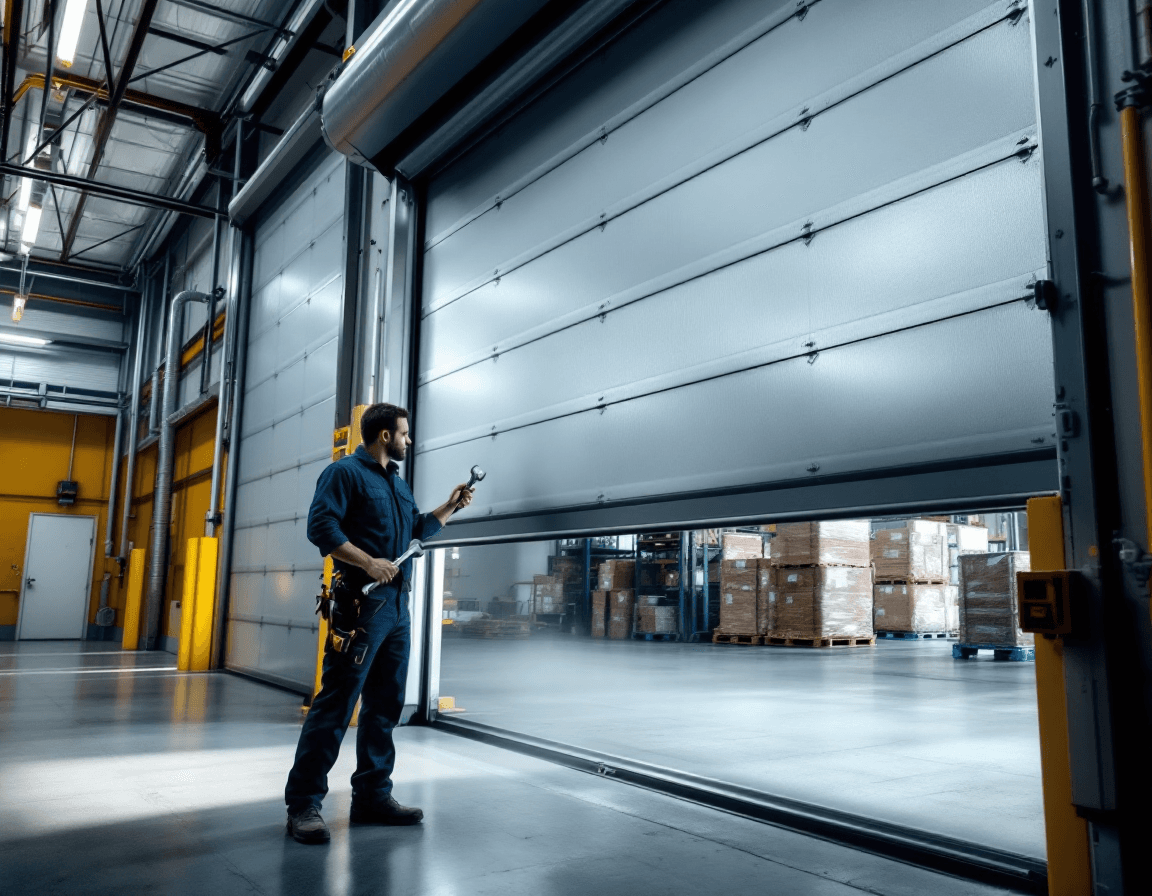
Commercial overhead door repair in Tacoma, WA is different from residential service because a stuck door can stop a loading dock, a production line, or an entire receiving schedule. Tacoma's warehouses, light manufacturing shops, and distribution yards sit in a climate that is mild by national standards but hard on steel. Constant moisture, salt-laden air drifting in from the Tideflats, and long stretches of gray weather all work against the galvanized steel, tracks, and electrical components that keep commercial doors moving. Our technicians understand these local conditions and plan repairs around how your business actually operates.
When a sectional door, rolling steel door, or dock leveler door fails, the first priority is getting your operation moving again. We respond to calls across Downtown Tacoma, the North End, Proctor, the Stadium District, Hilltop, and the surrounding industrial and commercial corridors. Our approach combines a quick diagnosis with a clear, itemized quote so you can decide quickly whether a temporary fix, a component replacement, or a full door assembly makes the most sense. Every job is handled by licensed, bonded, and insured technicians who treat high-tension hardware with the caution it requires.
This page explains the most common commercial door problems we see in Tacoma, how to recognize early warning signs, what affects repair timelines, and how preventive maintenance contracts can reduce the chance of an unplanned shutdown. It also covers the safety practices that protect your staff and our crews during every service call. If your facility is currently without a working door, call (888) 799-3819 and we will walk you through the next steps.
Why Tacoma's Damp Air and Tideflats Breezes Shorten Door Life
Tacoma's marine climate brings long wet seasons, frequent drizzle, and humidity that rarely drops far below comfortable levels for much of the year. Moisture gets into door tracks, hinges, roller bearings, and the joints between panels, and over time it encourages surface rust and gradual binding. Facilities located near the Port of Tacoma and the Tideflats face an added challenge, because salt-tinged air carries corrosive particles that settle on exposed steel and accelerate deterioration. A door that looks fine from the outside can have rust building inside the track channel where nobody sees it.
Freeze events are uncommon in Tacoma, but when they happen, condensation and cold snaps can cause roller shafts and weatherseals to stiffen and crack. Repeated cycles of wet and dry conditions also cause wood-core doors and some composite panels to swell and warp, which changes the fit against the jamb. Steel doors handle moisture better, but their finish and any scratches in the paint become entry points for corrosion. Routine cleaning of tracks and lubrication of hinges and rollers helps counter all of these effects.
We recommend that facility managers inspect commercial doors at least a few times a year and after particularly rainy stretches or windy storm systems. Look for flaking paint, orange or brown residue on tracks, and bottom seals that have hardened or split. Early attention to these details is far less expensive than replacing a warped panel or a seized roller assembly after it has already failed.
Dock Door Triage for Downtown and North End Warehouses
Loading dock doors tend to be the busiest doors in any facility, cycling many times per shift and taking abuse from trucks, pallet jacks, and the occasional misjudged backing maneuver. In the older brick and timber buildings found in Downtown Tacoma and parts of the North End, door openings may not be perfectly square, which can cause uneven loads on the springs, rollers, and operator. When one of these doors stops working, a quick triage often reveals whether the problem is electrical, mechanical, or structural.
Before calling for service, your team can safely note what is happening. Doing so helps our technicians arrive prepared and shortens the time to a working door. Keep in mind that staff should never attempt to adjust springs, disconnect the operator under load, or climb onto the door mechanism. Our crews use the following information to prioritize calls and bring the right parts.
- The door does not respond to the wall control, keypad, or remote, but the indicator lights on the control panel are on.
- The door begins to open or close and then stops partway, or reverses without a clear obstruction.
- A loud bang, grinding, or popping sound occurred during operation, which may indicate a broken spring or cable.
- One side of the door sits lower than the other, or the panels look visibly out of alignment.
- The door moves noticeably slower than normal, which can signal a worn motor, failing capacitor, or binding track.
Once you have noted these details, keep the door area clear, switch to the manual release only if your facility has already been trained for it and it is safe to do so, and call us. Our dispatch team can often estimate arrival time and let you know if a temporary workaround is possible while parts are sourced. Clear communication at the start of a service call usually saves hours of downtime.
Rolling Steel Doors Off Track in Proctor and Stadium District Storefronts
Rolling steel doors are common in retail frontage, auto service bays, and small industrial units across Proctor and the Stadium District. These doors coil into a barrel above the opening, and their interlocking slats run in side guides that must stay perfectly aligned for smooth travel. When a slat bends from an impact or a guide shifts, the door can jam, come partly off track, or make a grinding sound that signals a problem before it becomes serious. Ignoring these early signs often turns a modest adjustment into a bigger repair.
Rolling doors take a lot of cycles in high-traffic locations, and their hardware can loosen over time. Bolts holding the guide brackets can work out of position, and the curtain can drift sideways if the barrel tension is uneven. Our technicians check guide alignment, slat integrity, bottom bar condition, and the barrel brake or locking mechanism during every rolling door service visit. We also verify that the door locks securely at closing, which matters for both security and insurance purposes.
Some rolling steel doors are fitted with a manual chain hoist or an automatic operator, and each has its own safe-operation requirements. A jammed door should never be forced with a vehicle or a pry bar, because that can bend slats beyond repair or injure someone when tension releases suddenly. If your door has come off track, secure the area and contact us so a technician can assess whether the curtain can be reseated safely. In many cases, the repair involves realigning guides and replacing only the damaged slats instead of the entire curtain.
Commercial Operators, Limit Switches, and Why Slow Doors Cost Throughput
A commercial operator is the motor and control system that opens and closes a large door on schedule, and it is one of the most important components for businesses that depend on steady throughput. When an operator begins to fail, the signs often appear gradually: the door takes longer to open, the motor hums without fully lifting the curtain, or the door stops at the wrong height. Slow doors may seem like a minor inconvenience, but a door that adds even thirty seconds to every cycle can add up to significant lost time across a busy shift.
Limit switches are a frequent source of trouble. These settings tell the operator where the door should stop when fully open or fully closed, and they can drift as cables stretch or as the door settles on its tracks. Photo-eye sensors, safety edges, and reversing contacts also need regular checks, because a misaligned or dirty sensor can cause nuisance reversals that frustrate operators and make the door appear to malfunction. Our technicians test each safety device as part of a complete operator inspection, since these features protect people and equipment.
Operator replacement is sometimes the most cost-effective path, especially on older units that draw more power, produce more noise, or lack modern safety monitoring. We evaluate each operator based on the door weight, duty cycle, and the specific throughput needs of your business. When possible, we match the replacement to your existing door and control wiring to limit disruption to your operations.
Forklift Strikes and Damaged Sections: Repair or Replace?
Few things damage a commercial door faster than a forklift or pallet jack making contact at the wrong angle. A single strike can crack a sectional panel, bend a track, dislodge a hinge, or push a rolling door slat out of alignment. In Pierce County's busy distribution and manufacturing corridors, impact damage is one of the most common reasons facilities call us for urgent service. The question is often whether the damaged part can be repaired or whether the entire section should be replaced.
Sectional doors are designed with individual panels that can often be replaced without removing the whole door, which makes impact repairs more affordable when the surrounding structure remains sound. Damage to the track, the spring system, or the door frame is more complex and may require a full inspection before any work begins. Rolling steel doors can sometimes have a damaged slat replaced, but heavy bending across multiple slats usually points to a full curtain replacement. We examine every impact site carefully, because hidden damage to the springs or cables can be just as dangerous as visible dents.
After an impact, do not operate the door until a technician has inspected it. Even if it still appears to work, a bent track or a shifted spring can release tension unexpectedly. Document the damage with photos for your records and for any insurance or fleet claims, then call us for an assessment. We provide itemized estimates that separate panel replacement, track correction, and any spring or cable work, so you can make informed decisions.
Hilltop Loading Bays and the Components That Wear First
Hilltop's mix of older commercial buildings, converted storefronts, and smaller light-industrial spaces means that many loading bays were installed decades ago and have been upgraded piece by piece. This history can create a mix of hardware types that must work together, and it can make troubleshooting more involved. A door that was adequate when first installed may now be carrying heavier loads or running more cycles than its original specifications anticipated.
In our experience, the parts that tend to wear first on commercial sectional doors include rollers, hinges, bottom weatherseals, and the bearings in the torsion shaft. Rollers can flatten or crack after years of use, and worn bearings produce grinding or squealing that gets louder over time. Bottom seals break down from sun exposure and abrasion, which lets in drafts, water, and pests. Replacing these components before they fail completely often extends the life of the entire door and keeps energy costs more predictable.
Hilltop facilities also benefit from careful attention to balance and alignment. If a door was installed on a sloped approach or in a building with settling foundations, the track may need periodic adjustment to keep the curtain running true. Our technicians check track plumbness, header height, and side-to-side level on every commercial inspection, because small misalignments grow into larger problems if left alone.
Preventive Maintenance Contracts Designed Around Your Operating Hours
A preventive maintenance contract is one of the most practical ways to reduce unplanned downtime. Instead of waiting for a door to fail during a peak shipping window, a scheduled program allows our technicians to inspect, lubricate, adjust, and test each door on a predictable timeline. Scheduling service during slower periods, such as early morning or weekends when your facility allows it, minimizes disruption and gives your team confidence that critical doors will perform when needed.
A typical maintenance visit covers the core elements that keep commercial doors safe and reliable. The checklist below reflects the kinds of items we review during scheduled service, though the exact scope is always tailored to your door types, operator models, and usage patterns.
- Inspect springs, cables, drums, and end bearings for wear, corrosion, or damage, and address any hazards immediately.
- Lubricate hinges, rollers, bearings, and locking hardware with appropriate products for your door type.
- Clean and inspect tracks, removing grit and rust residue that can cause binding or uneven travel.
- Test the operator, limit settings, photo-eye sensors, safety edges, and reversing functions.
- Check bottom seals, side seals, and weatherstripping for cracks, gaps, or drafts.
- Verify fasteners, brackets, and mounting bolts, tightening or replacing any that have loosened.
- Document findings and provide a summary of recommended repairs so your budget and schedule can be planned in advance.
Maintenance contracts also create a useful service history for your facility. When a door eventually needs major work, that record helps our technicians understand its condition over time and helps you justify capital decisions to management. Many clients find that the program pays for itself by preventing the emergency calls that carry premium scheduling and rush parts costs.
Safety Practices for Staff and Crews Around Heavy Commercial Springs
Commercial doors use high-tension torsion springs and heavy cable systems that store enormous amounts of energy. A spring or cable that fails during adjustment or removal can cause serious injury, which is why these components should only be handled by trained, licensed professionals with the proper tools. Our technicians follow strict lockout and tagout procedures, verify that springs are fully relaxed before disassembly, and use winding bars and safety equipment appropriate to each door size and weight.
Facility staff play an important role in safety as well. Never stand under a door that is moving or under a door that appears partially open and unsupported. Keep pedestrian paths clear of cables, and make sure forklift operators understand that doors should not be used as a physical stop or pushed while closing. If a door makes a sudden loud noise, shifts unexpectedly, or appears to be hanging off its track, evacuate the immediate area and call for service rather than attempting to investigate on your own.
Our crews also respect the operational needs of your business. We coordinate with supervisors to isolate work zones, cordon off dock areas when necessary, and schedule loud or disruptive tasks at times that minimize interference with shipping and production. When a door must remain out of service for a period, we communicate clearly about expected timelines and any safety measures that should be in place in the meantime.
Custom Commercial Quotes and Fast Turnaround to Limit Downtime
Every commercial door is different, and a one-size estimate rarely reflects the real scope of work. Our custom quotes begin with an on-site evaluation that considers door type, size, age, operator model, opening conditions, and the specific business impact of downtime. We then provide a written proposal that separates immediate safety repairs, recommended upgrades, and optional improvements, allowing you to approve what your operation needs right away.
Fast turnaround is a priority for us because each hour of a closed dock or stalled rolling door can affect deliveries, staffing, and customer commitments. When a facility is down, we work to diagnose the problem quickly and to identify parts that can be sourced without unnecessary delay. In some situations, a temporary repair restores safe operation while a permanent solution is ordered. We will always explain what is temporary and what is final so your team knows exactly where things stand.
For facilities that need ongoing support, we can build a service plan that matches your operating calendar and priority levels. Clients with critical doors often benefit from a clear escalation path, so urgent problems move quickly to the right technician. To discuss your facility's needs or request a site visit, call (888) 799-3819.
Service Coverage Across Tacoma and Pierce County
Our commercial overhead door team serves Tacoma and the surrounding Pierce County communities, with coverage for the ZIP codes listed below. Whether your facility sits in a dense downtown block, a busy industrial district near the water, or a quieter business park on the edges of the city, we plan routes to reach you efficiently and to keep response times as short as possible.
- Tacoma ZIP codes: 98402, 98404, 98405, 98406, 98407, 98408, 98409, 98418, 98421, 98422
- Surrounding Pierce County ZIP codes: 98444, 98445, 98465, 98466, 98467
Within Tacoma, we regularly work in Downtown Tacoma, the North End, Proctor, the Stadium District, and Hilltop, along with the warehouse and industrial zones that serve the region's shipping and manufacturing needs. Each area has its own mix of building ages, door types, and operating schedules, and we tailor our approach accordingly. If your business is located outside these listed ZIP codes, call us anyway, because we may still be able to help or recommend the right resource.
Commercial door problems rarely wait for a convenient time, so the sooner you reach out, the sooner we can get your facility moving again. Whether you need emergency repair for a stuck loading dock door, a rolling steel door realigned after an impact, a commercial operator diagnosed for slow performance, or a preventive maintenance contract that keeps your doors ready for peak season, our licensed team is ready to help. Call (888) 799-3819 today to schedule your evaluation and receive a clear, custom quote for your Tacoma facility.